Brushless vs Brushed RC Motors
You just got into RC cars, boats, or planes. Now you’re looking at motors and feeling confused. Two types keep popping up everywhere: brushless and brushed motors.
What’s the difference? Which one should you get? And why does everyone seem to argue about them online?
Don’t worry. This guide breaks down everything in simple terms. By the end, you’ll know exactly which motor fits your needs.
What Is an RC Motor Anyway?
Before we jump into the differences, let’s talk basics.
An RC motor is the heart of your remote control vehicle. It takes electrical energy from your battery and turns it into motion. The motor spins, and that spinning power moves your car’s wheels, boat’s propeller, or plane’s propeller.
Simple enough, right?
The thing is, not all motors work the same way inside. That’s where brushed and brushless motors come in. They both do the same job, but they use different methods to get there.
Brushed Motors: The Old School Classic
Brushed motors have been around forever. They’re the traditional type that’s been powering RC vehicles since the hobby began.
How Brushed Motors Work
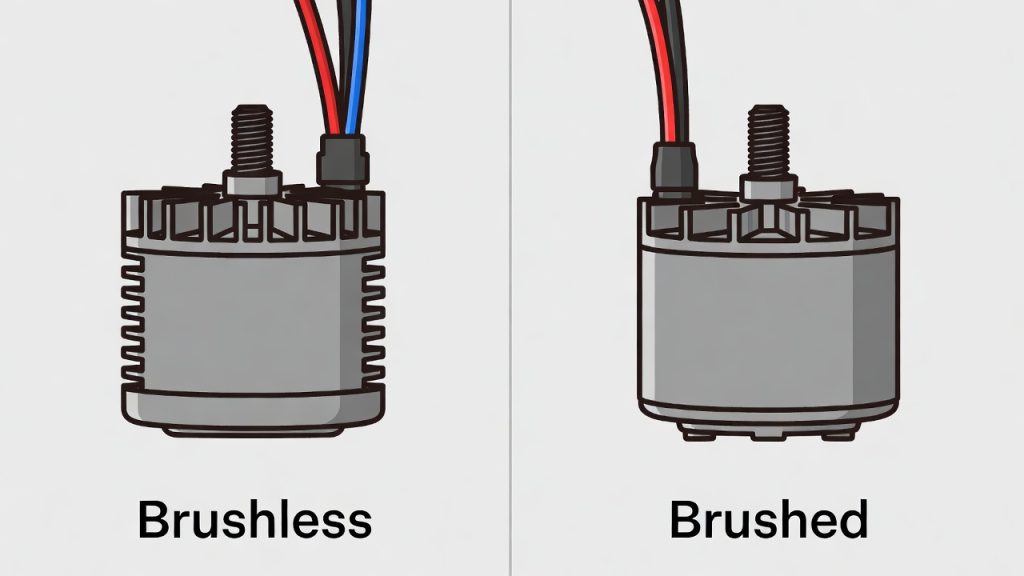
Inside a brushed motor, you’ll find these main parts:
- A rotor (the part that spins)
- Carbon brushes (little blocks that touch the rotor)
- A commutator (a split ring on the rotor)
- Magnets (usually permanent magnets on the outside)
Here’s what happens when you send power to a brushed motor:
Electricity flows through the carbon brushes. These brushes touch the commutator on the spinning rotor. The commutator sends the electricity to wire coils wrapped around the rotor. This creates a magnetic field that pushes against the permanent magnets. The rotor spins.
As the rotor turns, the brushes keep sliding along the commutator. This keeps changing which coils get power. The result? Continuous spinning motion.
The key thing to remember: the brushes physically touch the commutator. There’s actual friction happening inside the motor every time it runs.
The Good Stuff About Brushed Motors
Brushed motors have some real advantages:
They’re cheap. You can find brushed motors for very low prices. This makes them perfect for beginners who don’t want to spend a lot of money right away.
They’re simple. Hook up the wires to your battery, and you’re good to go. No complicated setup. No special controllers needed in most cases.
They’re easy to control. Want to go faster? Send more power. Want to reverse? Just switch the polarity. Basic speed controllers work just fine.
They’re everywhere. Walk into any hobby shop, and you’ll find brushed motors. Parts are easy to get. Replacements are cheap.
They’re beginner-friendly. If you’re new to the hobby, brushed motors let you learn without stressing about expensive equipment.
The Not-So-Good Stuff About Brushed Motors
But brushed motors have downsides too:
They wear out fast. Remember those carbon brushes? They’re constantly rubbing against the commutator. This friction wears them down. After enough use, the brushes get too short and stop making good contact. Then you need to replace them.
They lose efficiency. All that friction creates heat and wastes energy. Your battery drains faster. You get less runtime per charge.
They need maintenance. You should check and clean brushed motors regularly. Brush dust builds up inside. The commutator gets dirty. If you ignore maintenance, performance drops.
They’re slower. Compared to similar-sized brushless motors, brushed motors usually can’t spin as fast. This means lower top speeds for your vehicle.
They can overheat. The friction inside generates lots of heat. Push a brushed motor too hard, and it might get damaged from overheating.
They’re less powerful. For the same size and weight, a brushed motor won’t pack as much punch as a brushless one.
Brushless Motors: The Modern Marvel
Brushless motors are the new kids on the block. Well, not that new anymore, but they’re definitely the modern choice.
How Brushless Motors Work
Brushless motors flip the design around:
- The rotor has permanent magnets
- The stator (the part that doesn’t move) has wire coils
- No brushes at all
- No commutator either
Here’s the magic:
An electronic speed controller (ESC) sends precisely timed pulses of electricity to the wire coils in the stator. These pulses create magnetic fields that push and pull on the magnets in the rotor. The rotor spins smoothly.
The ESC constantly switches which coils get power. This keeps the rotor spinning in the right direction at the right speed. It all happens electronically, with no physical contact between moving parts.
That’s why they’re called “brushless” – there are literally no brushes rubbing on anything.
The Good Stuff About Brushless Motors
Brushless motors have become super popular for good reasons:
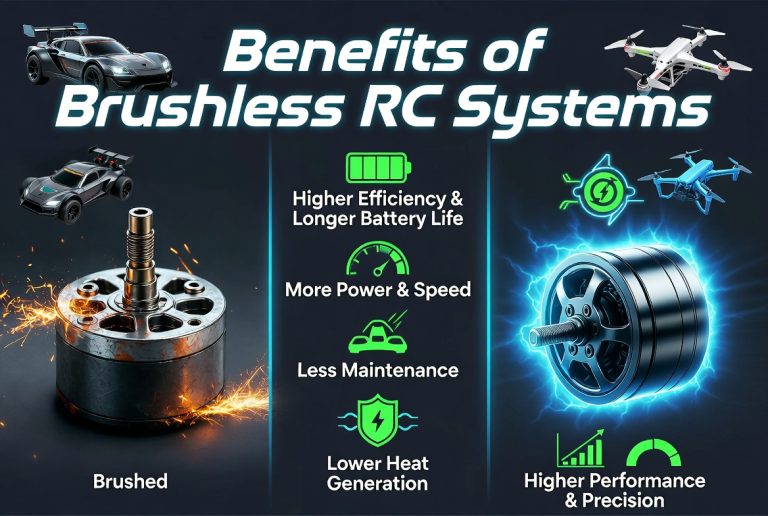
They’re incredibly efficient. No friction from brushes means less energy wasted as heat. Your battery lasts much longer. You get more runtime and more fun per charge.
They’re powerful. Brushless motors deliver way more power for their size. A small brushless motor can outperform a much larger brushed motor.
They’re fast. These motors can spin at crazy high speeds. If you want maximum velocity, brushless is the way to go.
They last forever. Well, not literally forever, but close. With no brushes to wear out, brushless motors can run for years without needing replacement parts.
They need zero maintenance. Just run them. That’s it. No cleaning, no brush changes, no fussing around. They just work.
They run cooler. Less friction means less heat. You can push brushless motors harder without worrying about overheating.
They’re quieter. Without brushes scraping on the commutator, brushless motors make less noise. Your neighbors will appreciate this.
They perform better in all conditions. Brushless motors handle water, dirt, and dust better than brushed motors. They’re more reliable in rough environments.
The Not-So-Good Stuff About Brushless Motors
Nothing’s perfect, though:
They cost more. Brushless motors and the required ESCs are significantly more expensive. You might pay three to five times more than brushed setups.
They need special controllers. You can’t just hook a brushless motor directly to your battery. You need a brushless ESC, which adds to the cost and complexity.
They’re more complex. The technology is more advanced. If something goes wrong, troubleshooting can be trickier.
They can be overkill. If you’re just casually running an RC car in your backyard, you might not need all that power and speed.
They’re sensitive to damage. Hit something hard and bend the motor shaft slightly? A brushless motor might not work right. Brushed motors are more forgiving of rough treatment.
Speed and Performance Face-Off
Let’s get specific about performance differences.
A typical brushed motor might spin at 20,000 to 30,000 RPM (revolutions per minute). That’s pretty fast.
But a comparable brushless motor? It can hit 40,000 to 50,000 RPM or even higher. Some racing motors exceed 100,000 RPM.
This speed difference translates directly to how fast your vehicle moves.
Acceleration is another factor. Brushless motors respond instantly to throttle inputs. There’s no lag. You press the trigger, and the motor reacts immediately.
Brushed motors have a tiny bit of delay because the brushes need to make contact and the motor needs to overcome initial friction.
For racing or high-performance driving, this instant response matters. For casual fun, you probably won’t notice much difference.
Battery Life and Runtime
Here’s where brushless motors really shine.
Let’s say you have two identical RC cars with the same battery. One has a brushed motor, the other has brushless.
The brushless car will run noticeably longer on the same charge. Sometimes 50% longer. Sometimes even double the runtime.
Why such a big difference?
Efficiency. The brushless motor wastes very little energy as heat. Almost all the battery power goes into actual motion.
The brushed motor wastes a chunk of energy as heat from friction. Less energy for motion means your battery drains faster.
If you hate constantly recharging batteries, brushless is your friend.
Durability and Lifespan
Brushed motors wear out. It’s just a fact of life.
The carbon brushes slowly grind away. After 50 to 100 hours of use, you’ll probably need new brushes. Some people get more life, some get less. It depends on how hard you run the motor.
The commutator also wears down over time. Eventually, it gets grooved and pitted. When that happens, you usually just replace the whole motor.
Brushless motors, on the other hand, can run for hundreds or even thousands of hours. The bearings might wear out eventually, but you can replace those. The motor itself just keeps going.
Think of it this way: a brushed motor is like a pencil. It works great, but it gets shorter and shorter until you need a new one. A brushless motor is like a mechanical pencil. Keep feeding it (power), and it keeps working.
Maintenance Requirements
Brushed motors need regular care.
Every few runs, you should:
- Open up the motor
- Clean out brush dust
- Check the brushes for wear
- Clean the commutator
- Make sure everything looks good
It’s not hard, but it takes time. Skip maintenance, and performance suffers. The motor might even fail completely.
Brushless motors? Just run them. Seriously. That’s all the maintenance they need.
You might blow out dust and dirt occasionally if you run in muddy conditions. But there are no wearing parts to replace or clean.
This simplicity is a huge plus for people who just want to play without fussing over maintenance.
Cost Comparison
Let’s talk money.
A decent brushed motor might cost $15 to $30. The basic speed controller could be another $20 to $40. Total cost: $35 to $70 for a complete setup.
A comparable brushless motor runs $50 to $100 or more. The required brushless ESC adds another $40 to $150. Total cost: $90 to $250 for a complete setup.
That’s a big price difference.
But here’s the thing: over time, the cost gap shrinks.
You’ll replace that brushed motor at least once. Maybe twice. You might replace brushes a few times before that. Those costs add up.
The brushless system just keeps running. You buy it once and you’re done for years.
If you’re serious about the hobby and plan to stick with it, brushless makes financial sense in the long run.
If you’re testing the waters or on a tight budget, brushed is fine to start with.
Which One Should You Get?
This is the big question, right?
There’s no single answer that fits everyone. It depends on your situation.
Get a Brushed Motor If:
- You’re brand new to RC vehicles and want to learn the basics
- Your budget is tight
- You’re buying an RC vehicle for a young kid
- You only plan to run the vehicle occasionally
- You enjoy tinkering and maintenance
- You want the absolute cheapest entry point
- Top speed and performance aren’t your main priorities
- You’re fixing up an older RC vehicle that came with brushed motors
Get a Brushless Motor If:
- You want the best performance possible
- Long battery runtime is important to you
- You hate maintenance and want reliability
- You plan to run your vehicle frequently
- You want to race or do high-speed runs
- You can afford the higher upfront cost
- You’re ready to upgrade from a beginner setup
- You want your investment to last for years
The Hybrid Approach
Here’s a smart strategy many people use:
Start with a brushed setup to learn the hobby. Figure out if you enjoy it. Learn basic driving skills. Get comfortable with RC vehicles in general.
Then, when you’re ready, upgrade to brushless. You’ll appreciate the performance difference way more after experiencing brushed motors first.
Many ready-to-run RC vehicles come with brushed motors. That’s totally fine. Run them until they wear out, then upgrade to brushless. You’ll get to experience both worlds.
Common Questions People Ask
Can I just swap a brushless motor into my brushed RC car?
Usually, yes. But you’ll need a brushless ESC too. And you might need to check if the mounting holes line up. Some modification might be required.
Do brushless motors really need no maintenance?
Pretty much. The only thing that might need replacing eventually is the bearings. But that’s after a very long time.
Are brushless motors waterproof?
The motors themselves handle water well. But the ESC needs to be waterproof too. Check the specifications before running in wet conditions.
Can brushed motors be as fast as brushless?
Not really. You can get them fairly quick, but brushless motors will always have the edge in top speed and acceleration.
Do I need special batteries for brushless motors?
Not necessarily. LiPo batteries work great with brushless setups because they can deliver high current. But you can use NiMH batteries too, depending on your setup.
Will a brushless motor fit in the same space as a brushed motor?
Often, yes. Motor sizes are somewhat standardized. But always check the dimensions before buying.
Making the Switch from Brushed to Brushless
If you decide to upgrade from brushed to brushless, here’s what you need:
- A brushless motor (check the size and mounting pattern)
- A brushless ESC rated for your motor
- Possibly a new motor mount (if sizes don’t match)
- New wiring or connectors (brushless setups often use different plugs)
The installation isn’t too complicated. You remove the old brushed motor and ESC, install the new brushless motor, connect the ESC, and program the ESC to work with your transmitter.
Most people can do this upgrade in an hour or two, even as beginners.
The first time you hit the throttle with your new brushless system, you’ll probably grin. The difference is that noticeable.
Real-World Performance Examples
Let’s look at some practical scenarios to see how these motors perform.
Backyard Bashing
You’re running your RC truck around the yard, hitting jumps, and crashing into things. A brushed motor works great here. The impacts and rough treatment won’t hurt it too much. If it does break, replacement is cheap.
But a brushless motor makes the experience more exciting. Faster acceleration means bigger jumps. Better runtime means longer sessions before recharging.
Racing
On the track, brushless motors dominate. The extra speed and instant throttle response make a real difference in lap times. Competitive racers almost always choose brushless.
Brushed motors can race too, but you’ll be at a disadvantage against brushless competition.
Scale Crawling
Rock crawlers need low-speed control and torque. Brushed motors actually work quite well for this. They’re smooth at low speeds and easy to control.
Brushless motors also excel at crawling. They provide excellent low-speed torque and precision control. Many high-end crawlers come with brushless systems.
Boats and Planes
For RC boats, brushless motors are almost standard now. The water-resistant design and high power make them ideal.
RC planes benefit hugely from brushless motors. The light weight and high efficiency mean longer flight times and better performance.
The Technology Behind the Spin
Let’s dig a tiny bit deeper into what makes these motors tick.
In a brushed motor, the electrical switching happens mechanically. The brushes and commutator physically switch which coils get power. It’s elegant in its simplicity but creates friction.
In a brushless motor, the switching happens electronically through the ESC. Tiny sensors detect the rotor position. The ESC’s computer chip fires the right coils at exactly the right moment. This precision is why brushless motors are so efficient.
This electronic control also allows for programmable features. Many brushless ESCs let you adjust things like:
- Throttle curve and response
- Brake strength
- Low voltage cutoff
- Timing advance
- Motor rotation direction
Try doing that with a basic brushed setup. You can’t.
Noise Levels Matter
If you run your RC vehicles in neighborhoods or parks, noise might matter.
Brushed motors create a distinctive whining buzz. The brushes scraping on the commutator add extra noise. Some people love that classic RC sound. Others find it annoying.
Brushless motors run much quieter. You’ll hear the gear mesh and maybe some wind noise at high speeds, but the motor itself is nearly silent.
This quieter operation has benefits beyond just being polite to neighbors. It’s also more pleasant for you as the driver. Long sessions with a loud brushed motor can get tiresome.
Temperature and Heat Management
Heat is the enemy of electronic components.
Brushed motors generate lots of heat from friction. Run them hard, and they get hot enough to burn your fingers. This heat stresses the motor and can cause permanent damage if you’re not careful.
Many people add cooling fans to brushed motors for high-performance applications. The fans help, but they add weight and complexity.
Brushless motors run much cooler. They still generate some heat from the wire coils, but far less than brushed motors. You rarely need additional cooling for normal use.
This cooler operation means you can push brushless motors harder for longer without worrying about damage.
Future-Proofing Your RC Vehicle
Here’s something to think about: the RC industry is moving toward brushless technology.
More and more ready-to-run vehicles come with brushless systems standard. Manufacturers are developing better, cheaper brushless motors every day. The technology keeps improving.
Brushed motor development has basically stopped. They’re a mature technology. What you buy today is pretty much what you’ll get in the future.
If you invest in brushless now, you’re set up for current and future upgrades. Parts availability will stay strong. New innovations will be compatible with your system.
Brushed motors will stick around for budget options and entry-level vehicles. But the cutting edge belongs to brushless.
The Bottom Line
Both brushed and brushless motors have their place in the RC hobby.
Brushed motors are the affordable, simple option. They’re perfect for learning and casual use. Sure, they need maintenance and don’t last as long. But they work fine for many people.
Brushless motors are the high-performance choice. They’re more expensive upfront but offer better speed, efficiency, and longevity. If you’re serious about the hobby, they’re worth the investment.
The good news? You don’t have to make a permanent decision. Start with what fits your budget and needs right now. You can always upgrade later.
The RC hobby is all about having fun and enjoying your vehicles. Brushed or brushless, you’ll have a great time as long as you’re out there running your car, boat, or plane.
So pick the motor that makes sense for you, get out there, and start having fun. That’s what really matters.
Happy driving, flying, or sailing!
Peterson is an RC hobby enthusiast and product reviewer with a passion for remote-controlled cars, trucks, boats, drones, and accessories. He enjoys testing the latest RC products, comparing features, and sharing practical buying guides to help beginners and experienced hobbyists make informed decisions. Through RCThing.com, Peterson provides honest reviews, maintenance tips, and expert advice to help readers get the most from their RC adventures.