Belt Drive vs Shaft Drive RC Car
So you want to get into RC cars. Or maybe you already have one and you’re thinking about upgrading. Either way, you’ve probably run into two big terms: belt drive and shaft drive. And you’re probably wondering what the difference is — and which one wins.
Good news. This guide breaks it all down in plain English. No confusing jargon. No walls of text. Just the real stuff you need to know.
Let’s get into it.
What Is a Drive System Anyway?
Before we compare the two, let’s quickly cover what a drive system actually does.
In an RC car, the drive system is the setup that sends power from the motor to the wheels. The motor spins. That spinning energy has to travel somewhere. The drive system is how it gets from point A (the motor) to point B (the wheels).
There are a few different ways to do this. The two most popular in hobby-grade RC cars are the belt drive system and the shaft drive system.
Each one does the same job. But they do it in very different ways.
Belt Drive RC Cars: How They Work
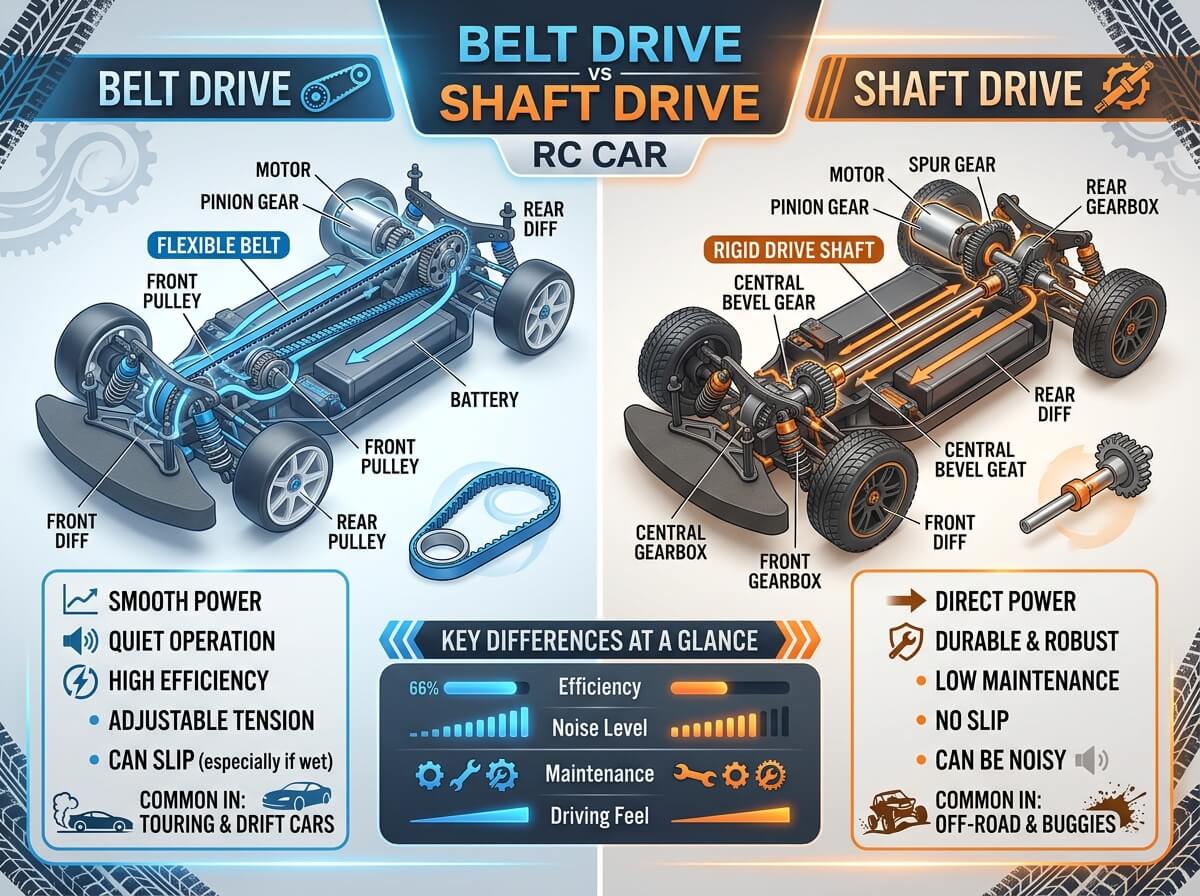
A belt drive system uses a thin, flexible belt — kind of like a rubber band but stronger — to transfer power to the wheels.
The belt runs around a series of pulleys. The motor turns one pulley. That pulley moves the belt. The belt moves another pulley. That pulley spins the wheels. Simple as that.
You’ll find belt drive setups in a lot of popular touring cars, on-road RC vehicles, and some buggies.
The Good Stuff About Belt Drive
1. Smooth and quiet power delivery
Belt drives are super smooth. The belt absorbs a tiny bit of vibration as it spins. This makes the car feel buttery to drive. It’s also quieter than a shaft system. If you’re driving indoors or in a neighborhood, that matters.
2. Better handling on flat surfaces
Because power delivery is so smooth, belt drive cars tend to handle really well on carpet, asphalt, and smooth dirt tracks. Drivers who race on prepared surfaces love belt drives for this reason.
3. Low center of gravity
Belt drive systems can be laid out flat inside the car. This keeps heavy parts low. A lower center of gravity means the car stays more stable in corners. It’s one reason touring car racers prefer belt drives.
4. Great for high-speed racing
If you’re into track racing or speed runs on a flat surface, belt drives shine. The smooth power transfer helps the car stay in control at high speeds.
The Not-So-Good Stuff About Belt Drive
1. Belts wear out
This is the big one. Belts stretch over time. They can snap. They can slip. If you push your car hard, you’ll go through belts. Replacing them isn’t super expensive, but it does happen more often than with shaft drives.
2. Belts hate dirt and debris
A little rock or sand stuck in the belt can cause problems fast. If you’re running on loose terrain or in muddy conditions, a belt drive can clog up. This can slow you down or break the belt entirely.
3. Not great off-road
Belt drive RC cars are not built for rough terrain. If you start climbing rocks or plowing through deep gravel, you’re asking for trouble. The belt gets stressed, and the system doesn’t handle impacts well.
4. More maintenance needed
You’ll need to check belt tension regularly. Too tight and it wears out fast. Too loose and it skips or slips. It’s not hard to adjust, but you do have to stay on top of it.
Shaft Drive RC Cars: How They Work
A shaft drive system uses solid metal drive shafts instead of a belt. The motor connects to a series of gears and shafts. Power flows through the shafts directly to the wheels.
Think of it like the driveshaft in a real full-size truck. Hard, rigid, direct. That’s a shaft drive.
You’ll find shaft drives in most off-road RC trucks, monster trucks, crawlers, buggies, and short course trucks.
The Good Stuff About Shaft Drive
1. Super durable
Metal shafts are tough. They don’t snap the way belts do. They handle rocks, jumps, crashes, and rough terrain without complaining. If you’re hard on your car, shaft drive is way more forgiving.
2. Loves dirt, mud, and rough stuff
Shaft drives don’t care about debris. Nothing gets tangled. Nothing clogs. You can run through mud, sand, gravel, and rough grass all day long. The power just keeps flowing.
3. Lower maintenance
Once a shaft drive is set up, it mostly just works. You don’t have to check tension. You don’t have to replace belts. Just keep things lubricated and clean, and the system will run for a long time.
4. Better for bashing
Bashing means driving your RC car hard — jumps, crashes, running over stuff, general chaos. Shaft drives are the go-to for bashers. They can take a beating without breaking down as quickly.
5. No belt to replace
This sounds simple, but it’s a real benefit. Belts can snap mid-run and leave you stranded. A shaft drive keeps going even after hard impacts.
The Not-So-Good Stuff About Shaft Drive
1. More drivetrain noise
Gears and shafts make more noise than belts. It’s not a huge deal, but shaft drive cars are louder. In some cases, you might feel a bit more vibration through the chassis.
2. Slightly less smooth on smooth surfaces
On carpet or asphalt, shaft drives can feel a tiny bit less refined than belt drives. For most casual drivers, the difference is barely noticeable. But competitive track racers feel it.
3. Heavier in some designs
Metal shafts and gears add weight. In some RC cars, this raises the center of gravity a little. For off-road use, this usually doesn’t matter. But for flat-surface racing, it can affect handling.
4. More complex to work on at times
Taking apart a shaft drive system can involve more steps than a belt drive. You might need to remove several components to get to one gear. That said, you don’t need to do this very often.
Belt Drive vs Shaft Drive: Side-by-Side Look
Here’s a quick comparison so you can see everything at once:
| Feature | Belt Drive | Shaft Drive |
|---|---|---|
| Power delivery | Smooth and soft | Direct and strong |
| Durability | Belts wear and snap | Very tough |
| Off-road ability | Poor | Excellent |
| On-road performance | Excellent | Good |
| Maintenance | More frequent | Less frequent |
| Noise | Quieter | Louder |
| Best for | Racing, flat surfaces | Bashing, off-road |
| Cost of upkeep | Belt replacements | Less parts needed |
Which Type of Driver Are You?
Now here’s the real question. The best drive system depends on how you drive and where you drive.
You Might Love Belt Drive If…
- You race on carpet or asphalt tracks
- You care about clean, smooth handling
- You drive in a competitive setting
- You want a quiet RC car
- You don’t mind a little more maintenance
Belt drive RC cars are ideal for track racers and people who drive on clean, controlled surfaces. If precision and speed matter more to you than toughness, go belt drive.
You Might Love Shaft Drive If…
- You drive off-road in dirt, gravel, or grass
- You bash your car through jumps and rough terrain
- You want something durable and low-maintenance
- You’re a beginner who doesn’t want to deal with snapped belts
- You want a car that can take a beating
Shaft drive RC cars are ideal for off-road drivers, bashers, and beginners. They’re tougher, simpler to own, and can handle rough treatment without falling apart.
What About 4WD vs 2WD? Does It Change Things?
A little bit, yes.
In 4WD RC cars, power has to travel to all four wheels. This makes the drive system layout more complex. Belt drives in 4WD touring cars use multiple belts running through the length of the car. Shaft drives in 4WD trucks use a central driveshaft with smaller shafts going to each axle.
Both systems work well in 4WD setups. The belt drive still wins for smoothness on paved surfaces. The shaft drive still wins for rugged off-road performance.
In 2WD RC cars, the system is simpler. Power only goes to two wheels. Both belt and shaft drives can be used, but shaft drives dominate in 2WD off-road trucks and buggies.
Common RC Cars That Use Belt Drive
Here are some RC car categories where you’ll typically find belt drives:
- Touring cars — These are flat, low-riding cars built for carpet or asphalt racing. Belt drive is the standard here.
- Pan cars — Super low, flat racing cars. Almost always belt driven.
- Some electric on-road buggies — Designed for smooth dirt tracks.
Popular brands known for belt drive tourers include Tamiya, Yokomo, Xray, and Serpent. These companies build high-performance racing machines that use belts for that smooth, precise feel.
Common RC Cars That Use Shaft Drive
Shaft drives dominate in the off-road world:
- Monster trucks — Big, beefy, built for jumps and rough terrain. Almost always shaft driven.
- Short course trucks — Replica-style racing trucks that run on rough dirt tracks.
- Rock crawlers — Need maximum torque and durability. Shaft drives are perfect here.
- Off-road buggies — Most 1:8 scale buggies use shaft drive.
- RC stadium trucks — Built for dirt and grass bashing.
Brands like Traxxas, Arrma, Losi, and Team Associated all make popular shaft drive RC vehicles.
Can Belt Drive Cars Go Off-Road at All?
Technically, yes. But it’s not a great idea.
Some RC buggies use belt drives on mild dirt tracks. With the right setup and clean terrain, a belt drive can survive off-road conditions. But the moment you hit mud, deep gravel, or rocky terrain, the belt is at serious risk.
Debris gets caught in the belt. Sudden hard impacts stress the pulleys. The belt stretches faster. You’ll be replacing parts a lot more often.
If you want to go off-road, just get a shaft drive. It’s built for that world.
Does Price Differ Between the Two?
Not necessarily.
Both belt drive and shaft drive RC cars come in a huge range of prices. You can find cheap versions of both. You can find expensive racing versions of both.
However, ongoing costs can differ.
With belt drive, you’ll buy replacement belts over time. Belts are not expensive — usually a few dollars to around ten dollars each — but if you break several in a season, the cost adds up.
With shaft drive, you rarely replace drive shafts. They last a long time. You might replace a gear or a diff cup after a big crash, but overall, the running costs can be lower.
For beginners on a budget, shaft drive might save a little money over time just because of fewer replacement parts.
Maintenance Tips for Belt Drive Cars
If you go with belt drive, here’s how to keep it running well:
- Check belt tension often. A loose belt slips. A too-tight belt wears out fast. Find the sweet spot.
- Inspect for debris. After every run, check the belt for rocks, sand, or anything stuck in it.
- Replace belts before they snap. If a belt looks worn, frayed, or cracked, swap it before it breaks mid-run.
- Keep pulleys clean. Dirty pulleys cause uneven belt wear.
- Use the right belt. Always use the exact replacement belt your car needs. Wrong size belts cause problems.
Maintenance Tips for Shaft Drive Cars
Shaft drive cars are easier to maintain, but they’re not zero maintenance:
- Lubricate the driveshafts. A little grease goes a long way. Dry shafts wear faster.
- Check diff oils. The differentials in your RC car use oil to control how power splits between wheels. Change it based on your driving style and the manufacturer’s guide.
- Inspect after big crashes. A hard hit can bend a driveshaft or break a universal joint. Check after big impacts.
- Keep the gears clean. Dirt in the gearbox causes wear. Clean it out regularly if you run in dirty conditions.
- Tighten screws regularly. Vibration from rough terrain loosens screws over time. Do a quick check after every few runs.
What Do RC Racers Say?
Talk to any competitive RC racer and they’ll almost always pick belt drive for track racing. The extra maintenance is worth it for the performance gain on smooth surfaces.
Talk to any RC basher and they’ll laugh at belt drive. “Belts snap when I land that jump,” they’ll tell you. Shaft drive is the only choice for hard, rough driving.
Both groups are right. It just depends on what you’re doing.
For beginners, most experienced RC hobbyists recommend starting with a shaft drive. It’s tougher. It forgives mistakes. It lets you have fun without worrying about snapping a belt on your third day.
Once you understand the hobby better and know what kind of driving you love, then you can get more specific with a belt drive racer if that’s your direction.
The Bottom Line
Both belt drive and shaft drive RC cars are great. Neither one is “better” in every situation.
Belt drive wins for:
- Smooth surfaces
- Competitive racing
- On-road performance
- Quiet operation
Shaft drive wins for:
- Off-road terrain
- Bashing and casual fun
- Durability
- Low maintenance
The key is matching the drive system to how you actually drive. Get the wrong one and you’ll be fighting your car instead of enjoying it. Get the right one and you’ll have a blast every single run.
So think about where you’ll drive. Think about how hard you’ll push it. Then pick the drive system that fits your style.
Happy driving.
Frequently Asked Questions
Is belt drive or shaft drive better for beginners?
For most beginners, shaft drive is the easier starting point. It’s more durable, needs less maintenance, and can handle rough driving without breaking down as quickly.
Can I convert a belt drive car to shaft drive?
In most cases, no. The two systems use completely different chassis designs. It’s not a simple swap. It’s usually better to buy the right car from the start.
Which is faster, belt drive or shaft drive?
On smooth tracks, belt drive cars can feel slightly faster because of the smoother power delivery and lower weight in some designs. In off-road conditions, shaft drive cars perform better. Raw speed depends more on the motor and gearing than the drive type.
Do professional RC racers use belt drive or shaft drive?
On-road pro racers almost always use belt drive touring cars. Off-road pro racers and competition truck drivers typically use shaft drive setups. Each class of racing uses what works best for its surface.
How often do RC car belts need replacing?
It depends on how hard you drive and how well you maintain the belt. A belt can last many months with light use on clean surfaces. With heavy use or dusty conditions, you might replace it every few weeks or even sooner.
Found this helpful? Share it with a fellow RC enthusiast who’s trying to figure out the same thing.