Quadcopter vs Hexacopter
You’ve decided you want to get into drones. That’s awesome. But now you’re staring at all these options, and you don’t know where to start. Should you go with a quadcopter? Or should you jump straight to a hexacopter?
Don’t worry. This guide will help you figure out which one is right for you.
The Basics: What Are Quadcopters and Hexacopters?
Let’s start with the simple stuff. Both quadcopters and hexacopters are types of drones that fly using rotors.
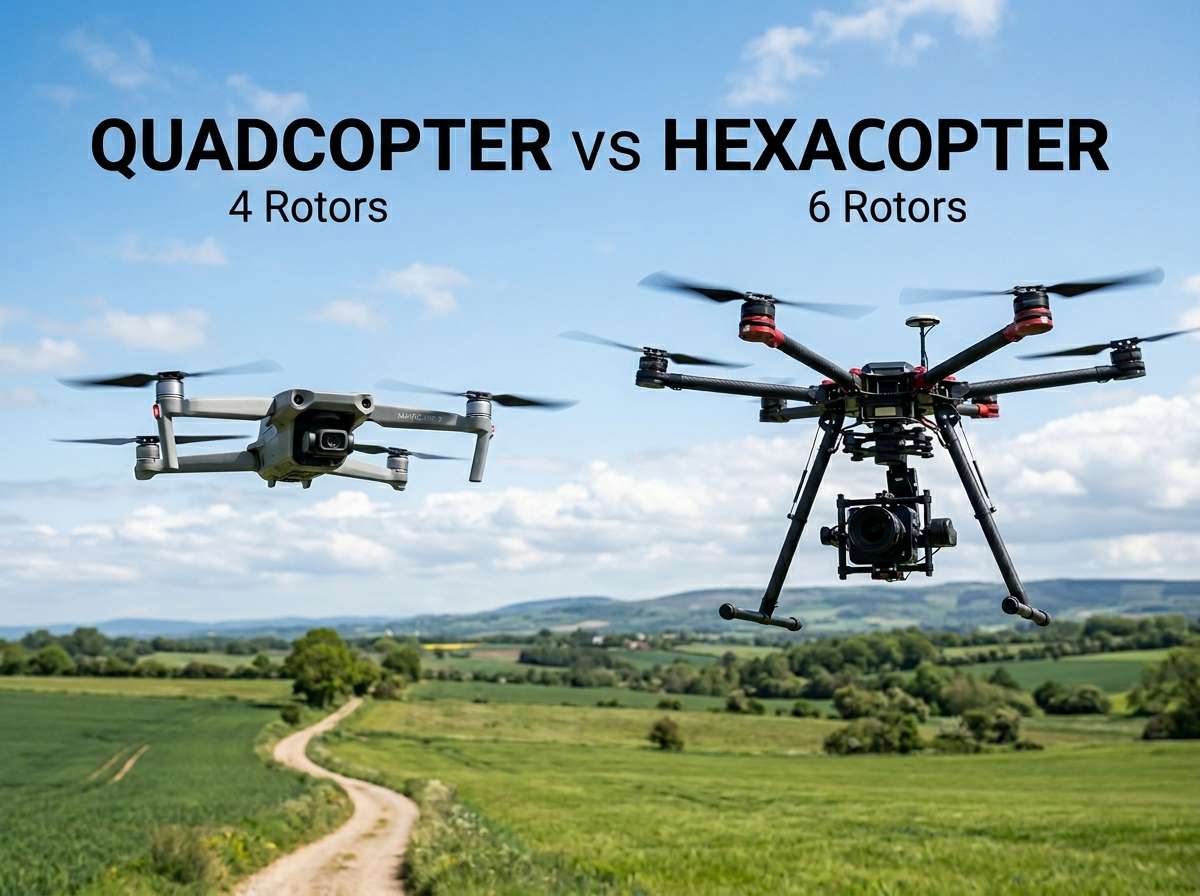
A quadcopter has four rotors. That’s where the name comes from. “Quad” means four. These four rotors spin around and lift the drone into the air. Then you steer it where you want to go.
A hexacopter has six rotors. “Hex” means six. So instead of four propellers pushing air down, you get six. That means more lifting power overall.
Think of it like this. A quadcopter is like having four strong people lifting a box. A hexacopter is like having six people doing the same job. With six people, the work gets easier on each individual person.
Both types of drones have a main body that holds all the electronics. Inside, you’ll find a battery, a camera, and a computer that makes the drone fly. The rotors spin really fast to create the lift that gets the drone off the ground.
How Many Rotors Matter
The number of rotors isn’t just a fun fact. It changes how the drone works and what it can do.
With four rotors, a quadcopter divides its lifting work equally among all four. Each rotor has to work hard. This is why quadcopters tend to drain their batteries faster than you might expect.
With six rotors, each rotor doesn’t have to work as hard. The six rotors spread the work out. This means the battery lasts longer. It also means each rotor faces less stress during flight.
This difference sounds small, but it really matters in real life. When you’re flying a drone, you want it to stay in the air long enough to finish your job. A longer flight time means fewer battery swaps and fewer trips to charge your equipment.
Weight and Lifting Power
Let’s talk about how much stuff your drone can carry.
A standard quadcopter weighs pretty light. Most consumer quadcopters weigh between one and three pounds. Some are even lighter. Because they’re light, they don’t need to work as hard to lift off the ground.
A hexacopter weighs more. Most professional hexacopters weigh between five and fifteen pounds. That’s a lot heavier. But here’s the thing. That extra weight comes with extra lifting power.
Hexacopters can carry heavier cameras and equipment. If you want to use a professional video camera or a powerful sensor, a hexacopter is your better choice. The extra rotors mean you have extra lifting power to haul that gear.
Quadcopters have limits on what they can carry. A typical quadcopter can lift one to three pounds of extra weight. That’s fine if you want to use a small action camera or a simple photo camera. But if you want to use heavy gear, you’ll hit that limit fast.
The hexacopter doesn’t hit that limit as quickly. You can load it up with more equipment before it starts to strain.
Flight Time and Battery Life
Flight time is huge when you’re shopping for a drone. Nobody wants a drone that flies for ten minutes and needs an hour to recharge.
Here’s what you’ll find in real life:
A quadcopter usually flies for 20 to 30 minutes on a full battery. Some high-end models might stretch that to 45 minutes. But that’s the ceiling for most quadcopters. The lighter weight helps, but only so much. Four rotors spinning fast eat through batteries.
A hexacopter typically flies for 10 to 20 minutes. That sounds worse, right? But remember, a hexacopter can carry much heavier payloads. If you’re using a heavy camera, the hexacopter can still fly longer than a quadcopter would in the same situation.
Think about your actual needs. If you just want to film videos around your neighborhood, a quadcopter’s 20-minute flight time is plenty. But if you’re doing professional work on a large farm or construction site, you’ll wish for longer. The hexacopter isn’t necessarily longer on paper, but it handles heavier loads better, so in practice, it might give you more usable flight time for your job.
Stability in the Wind
Wind is the enemy of all drones. But some drones handle it better than others.
A quadcopter is not great in wind. The four rotors work hard to keep the drone stable. When the wind pushes on the drone, all four rotors have to adjust at the same time. The drone bounces around more. Your videos might look shaky. Your photos might be blurry.
A hexacopter is much better in wind. The six rotors give it more stability. If one rotor gets pushed by a gust of wind, the other five can help balance it out. The drone stays level and steady. Your videos come out smooth. Your photos stay crisp.
This matters a lot if you live in a windy place. Or if you want to fly near trees or buildings where wind gets weird and jumpy. A hexacopter will give you much better results.
Speed and Agility
If you want a drone that zips around fast, a quadcopter is your friend.
Quadcopters are nimble. They turn quick. They speed up fast. They can dart between obstacles. If you want to film action footage or race, a quadcopter is way more fun. The lighter weight means it responds instantly to your controls.
A hexacopter is slower. It’s heavier. It has more rotors to control. It doesn’t zip around like a quadcopter. It’s more of a steady, reliable worker. It moves with purpose, not speed.
If you’re flying for fun and want to do tricks, get a quadcopter. If you’re flying for work and want reliable, steady performance, a hexacopter makes more sense.
Durability and Reliability
Both types of drones can break if you crash them. But they break in different ways.
A quadcopter has only four rotors. If one breaks, you lose 25% of your lifting power. The drone might still fly, but it will be lopsided and hard to control. In most cases, you need to repair or replace that rotor before flying again.
A hexacopter has six rotors. If one breaks, you lose 16% of your lifting power. The drone can still fly. It will be less stable and use more battery power, but it can limp home. You have more safety margin with six rotors.
This is a big deal for professionals. Losing a rotor on a quadcopter means your mission ends right now. Losing a rotor on a hexacopter means you can probably finish your job and fly home. Then you fix the rotor later.
Over time, a hexacopter is more reliable. The work spreads out across more rotors, so each rotor lasts longer. Quadcopter rotors wear out faster because they work harder.
Cost: The Money Talk
Let’s be real. Price matters.
A good quality quadcopter costs between $500 and $2,000. Some cheap ones are cheaper. Some fancy professional ones are more. But that’s the ballpark.
A hexacopter costs more. Most hexacopters run between $1,500 and $5,000. Some professional models cost way more. The extra rotors add cost. The stronger frame costs more. The better electronics cost more.
That’s a real difference. If you don’t have much money to spend, a quadcopter is the smart choice. You’ll get a solid drone for less cash.
But here’s the thing. If you use the hexacopter for work, it might pay for itself. Professional filmmakers and surveyors charge good money for their services. A hexacopter lets you deliver better work. Better work means better pay. Over time, that hexacopter might actually save you money compared to using a cheaper quadcopter.
Maintenance and Parts
Both drones need maintenance. But hexacopters need more.
A quadcopter has four rotors, four arms, and basic electronics. When something breaks, you replace that part. The parts are cheap and easy to find. You can get propellers for $10 a set. A new arm costs $20. You can fix most problems yourself with basic tools.
A hexacopter has six rotors, six arms, and more complex electronics. When something breaks, the part costs more. You might pay $50 for a set of propellers. A new arm costs $40. The electronics are fancier and might need professional repair.
Over time, a quadcopter is cheaper to maintain. The parts are simpler. The repairs are easier. If you’re on a tight budget, that matters.
Camera Quality and Recording
Both quadcopters and hexacopters can carry cameras. But hexacopters carry better cameras.
A quadcopter usually carries a small camera. It might be 12 megapixels or 20 megapixels. It can film in 1080p or maybe 4K. The video is good for social media. It’s not good enough for professional TV or movie work.
A hexacopter can carry a serious camera. It might carry a 50-megapixel camera. It can film in 6K or even 8K. The video quality is broadcast ready. It’s good enough for TV shows, movies, and professional documentaries.
If you’re just making videos for fun or your small business, a quadcopter’s camera is fine. If you’re doing professional video work, you need the camera quality that a hexacopter provides.
Ease of Use
A quadcopter is easier to fly. It’s more forgiving. If you make a small mistake, the drone usually recovers. The lighter weight means your input has a gentler effect on the flight.
A hexacopter is harder to fly. It’s heavier and has more rotors to manage. Beginner pilots sometimes struggle with hexacopters. The controls feel different. The response is different.
If this is your first drone, start with a quadcopter. Learn the basics. Get good at flying. Then, if you want to, move up to a hexacopter. You’ll appreciate the upgrade more after you understand how drones work.
Professional vs. Hobbyist Drones
Here’s a quick breakdown:
Quadcopters are best for:
- Beginners learning to fly
- Casual filmmaking and photos
- Fun and entertainment
- Tight budgets
- Fast, agile movements
- Travel and portability
Hexacopters are best for:
- Professional work
- Heavy camera equipment
- Windy environments
- Long mission times with heavy loads
- Stability and reliability
- Broadcasting quality footage
Most hobbyists and casual users buy quadcopters. Most professionals buy hexacopters.
What About Octocopters?
You might have heard about octocopters. That’s eight rotors. Eight rotors give you even more lifting power and stability. But they’re even heavier, more complex, and more expensive. They’re mainly for serious professionals doing heavy lifting or cinema work. For this comparison, we’re sticking with quads and hexes.
Real-World Situations
Let’s look at some real examples:
Scenario 1: You Want to Film Your Backyard
You want videos of your house and yard. You have a small budget. Get a quadcopter. It’s affordable. It’s easy to learn. It flies long enough to film everything you want. You’ll have fun with it.
Scenario 2: You Work in Construction
You need aerial photos of building sites. You want to inspect roofs and progress. The sites are sometimes windy. You might need to carry professional camera gear. Get a hexacopter. It will handle the wind. It can carry heavy cameras. It’s stable for clear photos and videos.
Scenario 3: You Do Photography for Events
You shoot weddings and events. You want nice aerial shots. You have some budget to spend. A quadcopter works great. It’s fast enough to get creative shots. It’s light enough to carry to every event. It takes good photos.
Scenario 4: You Map Large Farms
You do land surveys or crop monitoring. You cover big areas. You need professional data. You need reliable equipment. Get a hexacopter. It flies longer with heavy survey equipment. It’s more reliable if something goes wrong. The stability means better data collection.
Making Your Decision
Here’s how to decide between a quadcopter and a hexacopter:
Pick a quadcopter if:
- You’re new to drones
- You have a small budget
- You want to fly for fun
- You need portability and light weight
- You want fast, agile movement
- You want a long flight time for light payloads
- You plan to maintain it yourself
Pick a hexacopter if:
- You’re doing professional work
- You have heavy equipment to carry
- You live in a windy area
- You need maximum stability
- You need reliability for important missions
- You’re willing to spend more money
- You need broadcast-quality video
The Bottom Line
A quadcopter is a great starter drone. It’s affordable, fun, and good enough for most people. If you’re just getting into drones, this is probably your answer.
A hexacopter is a professional tool. It does serious work. It costs more, but it delivers better results for demanding jobs. If you need a drone for work, a hexacopter might be your best investment.
Many people own both. They use a quadcopter for fun and practice. They use a hexacopter for serious work. Over time, you might end up doing the same thing.
Common Questions
Can I use a quadcopter for professional work?
Yes, but with limits. You can do professional work with a quadcopter if the job doesn’t need heavy equipment or extreme stability. Many small videography businesses use quadcopters successfully.
Is a hexacopter harder to transport?
Yes. Hexacopters are bigger and heavier. They don’t pack as small as quadcopters. If you travel a lot, that matters.
How long does it take to learn to fly each one?
Most people learn basic quadcopter flying in a few hours. Hexacopters take longer because of the extra complexity. Give yourself more practice time before flying a hexacopter on a real mission.
Can I repair a drone myself?
Quadcopters are easier to repair yourself. Hexacopters are harder. Both are possible if you have patience and basic mechanical skills. Watch tutorials online before trying anything.
What if I can’t decide between them?
Start with a quadcopter. Fly it for a few months. See what you like and don’t like. Then decide if a hexacopter makes sense for your needs. It’s better to start small and grow than to invest big right away.
Final Thoughts
The choice between a quadcopter and hexacopter depends on your goals and budget. A quadcopter is the right call for beginners and casual flyers. A hexacopter is the tool for professionals and serious missions.
Neither is wrong. They’re just different tools for different jobs. A carpenter needs both a hammer and a drill. Drone pilots might eventually need both a quadcopter and a hexacopter.
Start where you are. Use what you have. Do what works best for your situation. Then, as you learn and grow, you can add more tools to your toolkit.
Happy flying. Your next adventure is waiting in the air.
Quick Comparison Table
| Feature | Quadcopter | Hexacopter |
|---|---|---|
| Rotors | 4 | 6 |
| Weight | 1-3 lbs | 5-15 lbs |
| Flight Time | 20-45 min | 10-20 min |
| Payload Capacity | 1-3 lbs | 5-10 lbs |
| Wind Resistance | Moderate | Excellent |
| Speed | Fast | Slower |
| Stability | Good | Excellent |
| Price | $500-$2,000 | $1,500-$5,000 |
| Learning Curve | Easy | Moderate |
| Repair Ease | Easy | Harder |
| Rotor Failure Recovery | Low | High |
Ready to take to the skies? Whether you choose a quadcopter for fun or a hexacopter for professional work, you’re in for an exciting journey. Both machines open up new perspectives and possibilities. Start with research, move to practice, and then soar into your drone flying adventure.
Peterson is an RC hobby enthusiast and product reviewer with a passion for remote-controlled cars, trucks, boats, drones, and accessories. He enjoys testing the latest RC products, comparing features, and sharing practical buying guides to help beginners and experienced hobbyists make informed decisions. Through RCThing.com, Peterson provides honest reviews, maintenance tips, and expert advice to help readers get the most from their RC adventures.