GPS Drone vs Non GPS Drone
If you’re new to drones, you’ve probably heard people talk about GPS drones and non-GPS drones. But what’s the real difference? And which one is right for you? Let me break this down in a way that makes sense.
What Is a GPS Drone Anyway?
A GPS drone is a flying robot that uses satellite signals to know exactly where it is in the sky. Think of it like your smartphone. When you use Google Maps, your phone talks to satellites in space to figure out your location. GPS drones work the same way.
These drones have a small GPS receiver built inside. This receiver picks up signals from satellites orbiting Earth. Once the drone knows where it is, it can hold its position steady in the air. It won’t drift or move unless you tell it to.
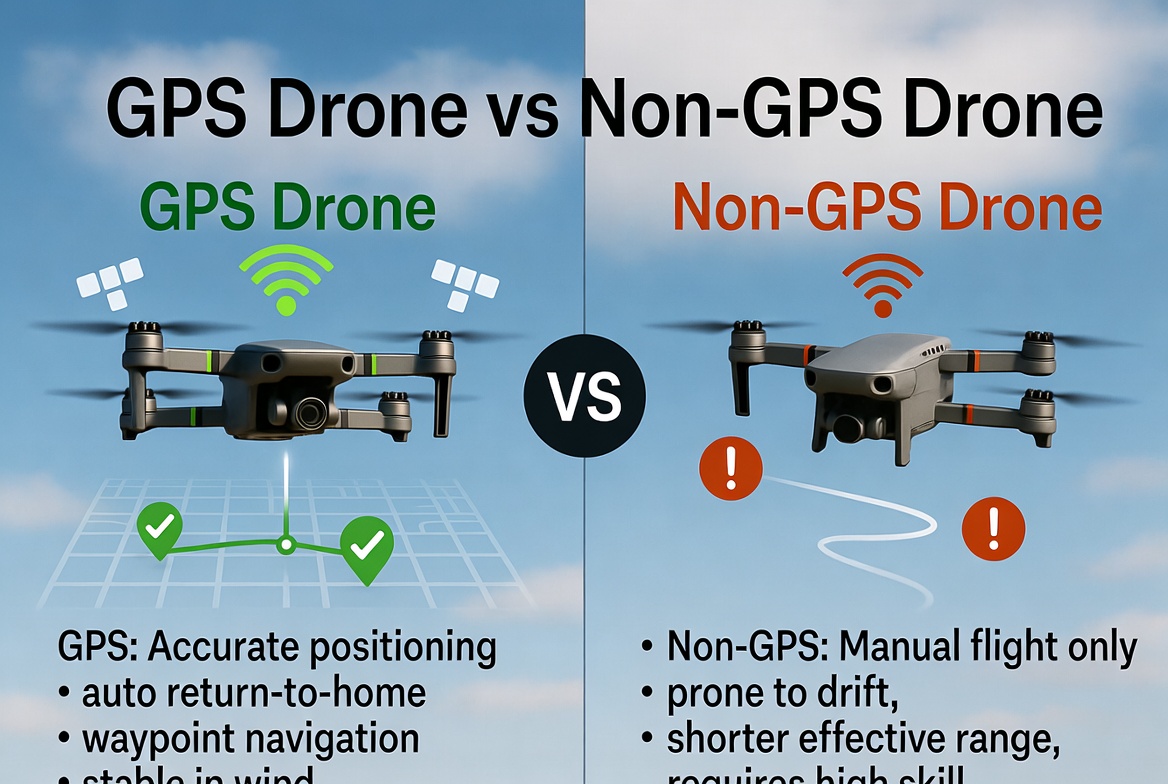
The GPS system helps the drone do some pretty cool things. The drone can fly in a straight line. It can return to its takeoff spot all by itself. It can even avoid flying away from you using something called geofencing.
GPS technology in drones is not new anymore. It’s been around for a while. Most modern consumer drones have it. Brands like DJI use GPS as a standard feature on their popular models.
What About Non-GPS Drones?
A non-GPS drone doesn’t have satellite navigation. So how does it stay in one place? It uses different technology.
Non-GPS drones rely on other systems to hold their position. Many use cameras and sensors that look at the ground below. These systems are called vision-based positioning or optical flow systems. The drone’s camera takes pictures of the ground really fast. It then compares one picture to the next. By spotting changes, the drone figures out which way it’s drifting. Then it adjusts itself to stay put.
Some non-GPS drones use infrared sensors or ultrasonic sensors instead. These sensors send out signals and wait for them to bounce back. By measuring the bounce time, the drone learns how far away things are. This helps it maintain its height and position.
Non-GPS drones are often smaller and lighter. They’re usually cheaper too. But they have limits. They work best indoors or in open spaces. If there’s no clear ground to see, they struggle.
How GPS Drones Hover in Place
Here’s something cool about GPS drones. Once you let go of the controller, the drone just sits there in the air. It won’t drift backward or sideways. It won’t creep toward buildings or trees.
This happens because the GPS tells the drone where it is every second. If the wind pushes the drone a little bit, the GPS system notices the change. The drone then fires up its motors to move back to the right spot. All of this happens so fast that you don’t see it.
This stable hovering is huge for photography and videography. If you want to take nice smooth videos, you need your drone to stay still. GPS makes that possible.
The drone’s computer also uses accelerometers and gyroscopes. These are tiny sensors that detect movement and rotation. The computer uses info from all these sensors together. GPS gives the big picture of where the drone is. The other sensors help make fine adjustments. This combo makes the drone super stable.
How Non-GPS Drones Stay In Place
Non-GPS drones can stay in place too. But the method is different.
When a non-GPS drone uses vision-based positioning, it needs to see the ground clearly. The camera pointing downward takes continuous pictures. The drone’s brain analyzes these pictures rapidly. It spots small movements in the image. When it sees movement, it knows the drone is drifting. It then moves the motors to fix this drift.
This system works well indoors. A clear floor or carpet gives the drone lots of visual information. In an outdoor open field with lots of grass, it also works fine.
But problems happen in certain conditions. If you’re flying over water, the camera sees ripples and reflections. These look like movement to the system. The drone gets confused and doesn’t hold position well. Flying over snow causes issues too. Everything looks the same, so the camera can’t track movement properly.
Ultrasonic and infrared systems have their own limits. They measure distance okay but don’t give the complete position information that GPS does. These systems work better for altitude control than for staying in the same spot.
Flying Indoors: Non-GPS Wins
Want to fly your drone inside your house? Inside a gym? Inside a warehouse? Then a non-GPS drone is your friend.
GPS signals don’t work indoors. Walls and buildings block the satellite signals. So GPS drones are basically useless inside buildings. Their GPS receivers just can’t pick up a signal.
This is where non-GPS drones shine. They don’t need satellites. They can use their cameras or sensors to hold position. So if you plan to fly indoors, buy a non-GPS drone. A GPS-equipped drone will be frustrating and dangerous to fly inside.
Many small racing drones don’t have GPS. They’re meant for fast flying and tricks anyway. These drones are designed to be agile and responsive. GPS systems add weight and cost. Racing drone pilots don’t need them.
Flying Outdoors: GPS Drones Rule
Now flip the situation. You want to fly outside in an open field. You want to take scenic videos or aerial photos. You want your drone to stay steady in the wind.
GPS drones are better here. The GPS gives you that rock-solid stability. Even if a stiff breeze hits, your drone stays in the same spot. You get smooth video footage without jitter. Your photos come out sharp.
GPS drones also let you fly farther from home. You can feel confident your drone will come back to you. Many GPS drones have a return-to-home feature. If the battery gets low or you lose the control signal, the drone flies back automatically. It lands right where it took off. This is a safety net you don’t get with non-GPS models.
A non-GPS drone in the outdoors? It can work. But wind is a problem. Without GPS corrections, wind can push the drone around. Your video won’t look as smooth. And if you fly far away, getting the drone back becomes harder. You have to manually steer it back.
The Importance Of Stability In Drone Flying
Let’s talk about why stability matters so much.
Imagine you’re filming a video of a beautiful landscape. The sun is setting. The light is perfect. But your drone is bouncing around in the wind. Your video looks shaky and amateurish. That’s not what you wanted.
Stable flight gives you professional-looking results. The video is smooth. The photos are sharp. You look like you know what you’re doing, even if you’re a beginner.
Stability also affects safety. A stable drone is easier to control. You have more confidence. You won’t accidentally fly into an obstacle because the drone drifts toward it. You know exactly what your drone will do.
Wind is the enemy of unstable drones. A 10-mile-per-hour breeze is nothing for a GPS drone. It holds its position no problem. The same breeze pushes a non-GPS drone around. You have to constantly steer to keep it where you want it.
Cost Comparison: Price Differences Between GPS And Non-GPS
Budget matters. Let’s be real about prices.
Non-GPS drones are usually cheaper. Small beginner non-GPS drones can cost as little as 30 to 100 dollars. They’re toys basically. But they’re fun toys.
Entry-level GPS drones start around 300 to 400 dollars. These are real machines. They’re built well. They have good cameras. They fly great.
Professional GPS drones cost 800 dollars to several thousand dollars. You’re paying for better cameras, longer flight times, and advanced features.
The price difference comes from the GPS hardware and the software that runs it. GPS receivers, the antenna, the processing power needed—these add cost. But you’re getting real value. You’re getting stability, safety features, and reliability.
Think of it this way. You can save money buying a non-GPS drone. But if you’ll be flying outdoors regularly, a GPS drone is worth the extra investment. You’ll take better photos. Your videos will look better. You’ll have more fun.
Flying Range: How Far Can You Go?
GPS drones let you fly farther safely.
With a non-GPS drone, you need to keep the drone in sight. You need to see it with your eyes. The moment you lose sight, you lose control. You might crash into a tree you can’t see. You might fly out of range and lose the signal entirely.
With a GPS drone, you get more range. The drone remembers where home is. Even if you fly it out of sight, if something goes wrong, it comes home. This is the return-to-home feature again. It’s a real lifesaver.
Some GPS drones have impressive range. They can fly a half-mile away and still respond to your controller. That opens up new possibilities for photography and exploration.
Non-GPS drones typically have shorter range. Once you’re 200 to 300 feet away, things get risky. Go farther and you’re just hoping the signal stays strong.
Weather Resistance: Which Drones Handle Wind Better?
Wind and drones don’t always get along. But GPS drones handle wind much better.
A GPS drone in windy conditions will fight to stay in place. It actively adjusts its motors to resist the wind. The result is stable footage and reliable hovering. You can fly on a moderately windy day without issues.
A non-GPS drone in wind is a different story. The wind pushes it. The vision system tries to compensate, but it can’t fight the wind like GPS can. You’ll see the drone drifting. Your videos look wobbly.
This is a big deal if you live in a windy area. Or if you want to fly outside during different seasons. GPS drones give you more flexibility and better results.
Camera And Image Quality
Both GPS and non-GPS drones can have good cameras. The presence or absence of GPS doesn’t determine camera quality.
However, the stability that GPS provides helps you get better photos and videos. A stable drone means stable video. A stable video means professional-looking results. So while both types can have similar cameras, a GPS drone with a good camera will give you better final results.
Many high-end cameras are paired with GPS drones. That’s because professionals want the stability. Professionals want reliability. GPS drones offer both.
A non-GPS drone can still have a good camera. A cheap non-GPS drone probably has a cheap camera. But you can find non-GPS drones with decent cameras at mid-range prices.
Battery Life Differences
Here’s something people don’t always think about. GPS drones often have shorter flight times than non-GPS drones of the same weight.
Why? Because GPS is always running. It’s constantly communicating with satellites. That uses power. Non-GPS drones don’t have this power drain. They can fly longer on the same battery.
A typical GPS drone might fly for 20 to 30 minutes on a full battery. A non-GPS drone of similar size might fly for 15 to 20 minutes. Wait, that’s the opposite of what I just said.
Actually, let me correct that. The battery life depends more on the drone’s size, weight, and motor efficiency than on whether it has GPS. Big GPS drones fly longer than small non-GPS drones. It’s the weight and power of the motor that matters most.
What’s true is that GPS systems use a small amount of extra power. So all else being equal, a non-GPS version would fly slightly longer. But the difference is small. Not a game-changer.
Learning Curve: Is One Easier To Fly?
GPS drones are easier for beginners to fly. Let’s be honest.
A beginner flying a non-GPS drone needs to balance the drone manually. The slightest controller input sends the drone in a new direction. The drone doesn’t hold position on its own. New pilots struggle with this.
A GPS drone? The drone holds position when you’re not touching the sticks. This is called hover mode. You can learn to control it more easily. The drone does half the work for you.
GPS drones also have beginner modes. These limit how fast the drone can fly. They reduce sensitivity. This makes learning safer and less stressful.
Professional racing drone pilots actually prefer non-GPS drones. They want the drone to respond instantly to their input. They want agility. GPS systems add delay. But that’s for advanced pilots doing tricks and races.
For someone just starting out, a GPS drone is friendlier.
Real-World Scenarios: When To Use Each Type
Let’s look at actual situations you might face.
Scenario 1: Recording your friend’s birthday party in the backyard.
You need smooth video. Your friend’s house is around. You want the drone to stay stable. Buy a GPS drone. It hovers like a pro. Your video looks amazing.
Scenario 2: Flying your drone inside your garage.
GPS won’t work. The structure blocks the signal. You need a non-GPS drone. Use it for fun flying in the open space. Keep it small so it doesn’t break anything.
Scenario 3: Taking photos of a big event in a field.
Lots of open space. Lots of wind potentially. Lots of people watching. A GPS drone is the right call. You need stability and safety features. You need the return-to-home feature in case something goes wrong.
Scenario 4: Racing drones with your buddies.
Speed matters. Agility matters. You want responsive controls. Non-GPS racing drones are standard. Go with the racing drone.
Scenario 5: Inspecting your roof or a building exterior.
You need stable hovering. You need altitude control. You need to get close to the building without crashing. A GPS drone is better. The stable hovering lets you inspect carefully.
Common Mistakes People Make
People often assume all drones are the same. They’re not.
Some people buy a non-GPS drone thinking they can fly it indoors. They discover it doesn’t work. The vision system fails. The drone crashes.
Other people buy a GPS drone and try to fly it inside. The GPS doesn’t work. They get frustrated.
Another common mistake: buying a cheap non-GPS drone and expecting it to hold position like an expensive GPS drone. Cheap non-GPS drones have poor sensors. They drift and wobble. People blame the non-GPS system when really it’s just a cheap drone.
The opposite happens too. Someone gets a high-end GPS drone but doesn’t read the manual. They don’t learn to use the features. They think the drone is overpowered for their needs. In reality, they’re just not using it right.
Making Your Decision
So which type should you buy?
Ask yourself these questions:
Will I fly mostly outdoors?
If yes, get a GPS drone. You’ll get better videos, longer range, and safety features.
Will I fly mostly indoors?
If yes, get a non-GPS drone. GPS won’t work indoors. A non-GPS drone designed for indoor flying is your only real option.
Am I a complete beginner?
If yes, a GPS drone makes learning easier. The drone does some of the work for you.
Do I want to race or do tricks?
If yes, look at racing non-GPS drones. You need instant response for these activities.
Do I have a big budget?
If yes, a high-end GPS drone opens lots of possibilities.
Do I want something cheap just to learn?
If yes, start with a small non-GPS drone. If you hate it, you didn’t spend much. If you love it, upgrade to a GPS drone later.
Do I care about professional video quality?
If yes, you want a GPS drone. Stability is crucial for great video.
Do I live in a windy area?
If yes, a GPS drone handles wind better than a non-GPS drone.
The Future Of Drone Technology
Drone technology keeps improving. New features come out regularly.
Modern GPS drones are getting lighter and quieter. Battery life is getting better. Cameras are getting sharper. Sensors are getting smarter.
Non-GPS drones are also improving. Vision systems are becoming more reliable. Obstacle avoidance is getting better. These drones are becoming more capable.
One trend we’re seeing is hybrid systems. Some newer drones use GPS when available and switch to vision-based positioning indoors. They get the best of both worlds.
The gap between GPS and non-GPS is shrinking. But the basic differences remain. GPS still offers better outdoor stability and range. Non-GPS still works better indoors.
Safety Considerations
Let’s talk about keeping your drone safe and keeping people safe from your drone.
GPS drones have better safety features overall. Return-to-home is a safety net. Geofencing prevents you from flying into restricted areas. Obstacle avoidance helps prevent crashes.
Non-GPS drones rely more on manual control. You’re responsible for avoiding obstacles. You’re responsible for not flying into dangerous places.
Both types should be flown responsibly. Both can hurt people or property if misused. Both should be insured if you’re using them commercially.
In most places, you need a license to fly a drone commercially. Rules exist to protect people on the ground. Follow the rules.
Maintenance And Durability
GPS drones and non-GPS drones need similar maintenance. You should:
- Check propellers for damage before each flight
- Keep the camera lens clean
- Store the battery properly
- Check for loose parts
GPS drones have slightly more components because of the GPS system. But this doesn’t mean they break more often. Modern GPS drones are built tough.
Non-GPS drones are simpler. Fewer parts mean fewer things that can break. But this isn’t a huge advantage. Both types can last for years with proper care.
Accessories And Add-Ons
Both GPS and non-GPS drones have accessories available.
Extra batteries are essential for both types. You’ll want at least two batteries so you can fly longer.
Propeller guards protect your props and protect people from the spinning blades.
ND filters help you take better photos and videos in bright sunlight.
Cases keep your drone safe during transport.
Landing pads are nice for protecting your drone when it lands in dirt or sand.
These accessories work with either type of drone. The brand matters more than the GPS question.
Resale Value
Will you eventually want to sell your drone?
GPS drones tend to hold their value better. They’re in higher demand. More people want them.
Non-GPS drones have lower resale value. But they also cost less new. So the resale situation is more balanced than you might think.
If you think you might sell the drone later, remember this. But don’t let resale value be your main decision factor.
Environmental And Ethical Use
Flying a drone responsibly matters.
Respect people’s privacy. Don’t film people without permission.
Respect wildlife. Don’t chase birds or disturb animals.
Respect property rights. Don’t fly over someone’s land without permission.
Respect the environment. Don’t fly in protected areas or nature reserves without permission.
Flying responsibly means following local laws and regulations. It means being a good neighbor. These things matter whether you fly a GPS drone or a non-GPS drone.
Final Thoughts: Making Peace With Your Choice
There’s no perfect drone. Every drone is a trade-off.
A GPS drone costs more but gives you stability and range. A non-GPS drone costs less but requires more skill.
An indoor drone needs to be non-GPS, but an outdoor drone can be either type.
Your decision depends on your needs, your budget, and where you’ll be flying.
The good news? Both types of drones are fun. Both can capture amazing footage. Both can provide hours of enjoyment.
Start with what makes sense for your situation. Learn your drone well. Have fun with it. As you get better, you can always get a different drone later.
The drone community is friendly and helpful. Lots of people are flying both GPS and non-GPS drones. Lots of people are happy with both choices.
Conclusion
GPS drones and non-GPS drones serve different purposes. GPS drones excel in outdoor flying where you need stability, range, and safety features. Non-GPS drones work great indoors and for specialized activities like racing.
For most beginners starting out with outdoor flying, a GPS drone is the better choice. For indoor flying, you have no choice—go non-GPS.
Think about where you’ll fly most often. Think about what you want to film. Think about your budget. Then make your decision.
Either way, you’re going to love flying a drone. Get out there, follow the rules, and enjoy the sky. Your drone awaits.
Ready to take the plunge into drone flying? Do your research on specific models. Read reviews from actual users. Watch videos of both types in action. Then pick the drone that fits your needs.
Happy flying!
Peterson is an RC hobby enthusiast and product reviewer with a passion for remote-controlled cars, trucks, boats, drones, and accessories. He enjoys testing the latest RC products, comparing features, and sharing practical buying guides to help beginners and experienced hobbyists make informed decisions. Through RCThing.com, Peterson provides honest reviews, maintenance tips, and expert advice to help readers get the most from their RC adventures.