How RC Gear Ratio Affects Speed?
If you just got your first RC car, truck, or buggy — welcome to one of the most fun hobbies on the planet. You are probably already thinking about one thing: going faster.
But before you start swapping motors or buying new batteries, there is one thing you need to get a handle on. It is called the gear ratio. It sounds like a math class concept. It is not. Once you get it, you will never look at your RC setup the same way again.
Let us break it all down in plain language. No fluff. No confusing jargon.
What Is a Gear Ratio, Exactly?
A gear ratio tells you how many times the motor spins for every one full rotation of the wheels.
That is it. That is the whole idea.
Let me give you a quick example. Say your gear ratio is 10:1. That means your motor spins 10 times for every one spin of the rear axle. Simple, right?
You get this number by dividing the number of teeth on the spur gear by the number of teeth on the pinion gear.
- Spur gear = the big gear connected to the drivetrain
- Pinion gear = the small gear connected to the motor shaft
So if your spur gear has 80 teeth and your pinion gear has 20 teeth, your gear ratio is 80 ÷ 20 = 4:1.
That means the motor spins four times for every full turn of the wheels.
Why Does Gear Ratio Matter for Speed?
Here is where it gets really interesting.
The gear ratio directly controls how your RC vehicle behaves on the track or trail. Change the ratio, and you change the personality of your whole rig.
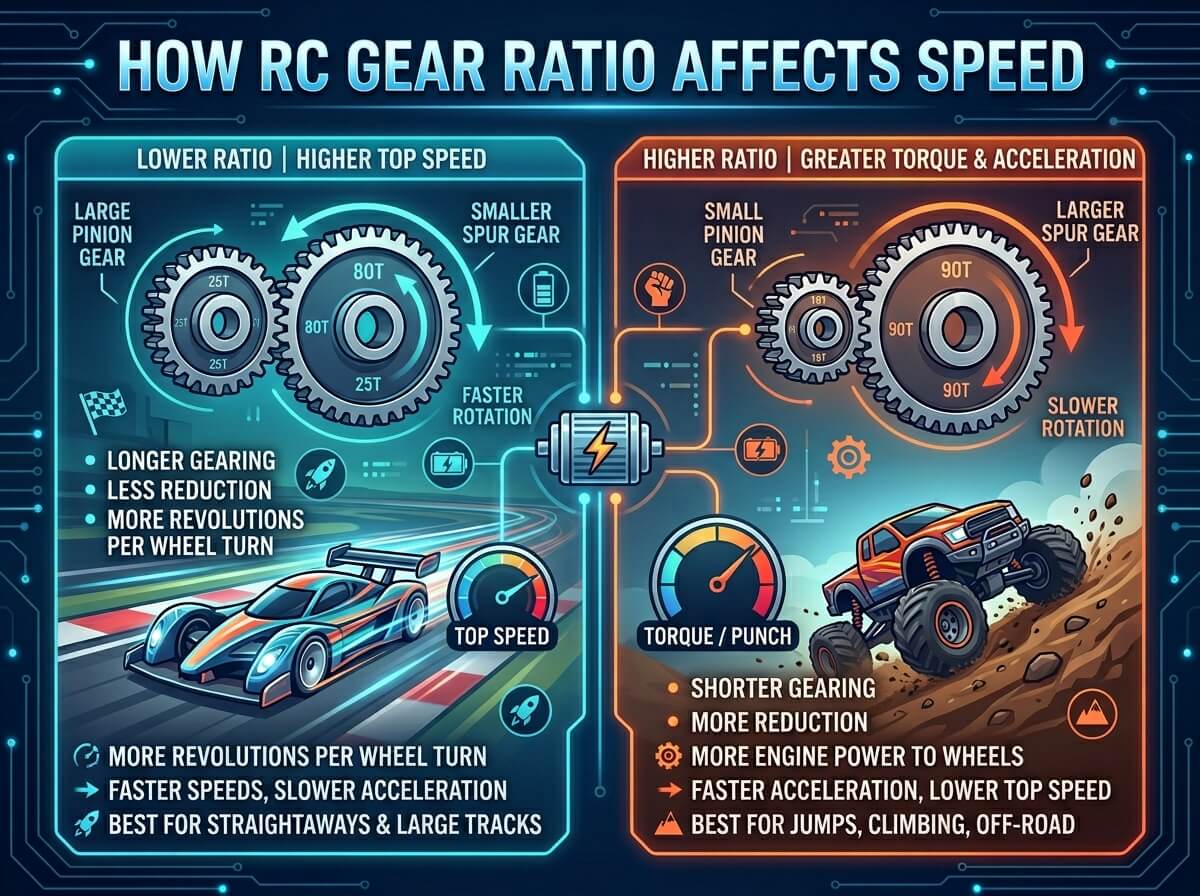
High gear ratio (like 10:1 or 12:1) = More torque, less top speed. Your RC pulls hard off the line but will not go blazing fast in a straight stretch.
Low gear ratio (like 3:1 or 4:1) = Less torque, more top speed. Your RC screams down a straight but might struggle to punch out of a tight corner.
Think of it like a bicycle. When you are in the lowest gear, you can climb a steep hill with ease. But you pedal like crazy and still go slow. When you shift to the highest gear, one pedal rotation moves you a huge distance. You go fast but you need momentum to get started.
Same idea applies to your RC car.
The Two Numbers That Control Everything: Spur and Pinion
You will hear these two words a lot in RC tuning conversations. Let us dig into each one.
The Pinion Gear
The pinion gear sits right on your motor shaft. It is tiny. It spins crazy fast.
When you add teeth to your pinion gear (go bigger), you lower your overall gear ratio. That means more top speed. But it also means more heat in the motor and ESC because they work harder.
When you remove teeth from your pinion (go smaller), you raise your gear ratio. You get more torque and better acceleration. The motor runs cooler because it is not being pushed as hard.
The Spur Gear
The spur gear is the big one. It takes the spinning energy from the pinion and transfers it to the drivetrain.
When you use a bigger spur gear (more teeth), your gear ratio goes up. That means more torque, slower top speed.
When you use a smaller spur gear (fewer teeth), your gear ratio comes down. You get more speed potential.
Most RC drivers adjust the pinion more often than the spur because pinion gears are cheap, easy to swap, and come in many sizes.
Final Drive Ratio vs. Internal Gear Ratio
Here is something a lot of beginners mix up.
Your RC car has two types of gear ratios working together.
Internal gear ratio refers to what is happening inside the transmission or gearbox. Most RC vehicles have a fixed internal ratio that you cannot easily change.
Final drive ratio is the number that actually matters for tuning. It combines the pinion and spur relationship. This is what you adjust when you are chasing more speed or torque.
The formula looks like this:
Final Drive Ratio = (Spur Gear Teeth ÷ Pinion Gear Teeth) × Internal Gear Ratio
So even a small change to your pinion has a bigger effect than you might think once you multiply it through the whole drivetrain.
How Speed Actually Works in an RC Car
Speed in an RC car comes from a combination of things.
- Motor KV rating — this is how fast the motor spins per volt of battery
- Battery voltage — more volts, more spin speed
- Gear ratio — how that spinning speed gets converted to wheel movement
- Tire diameter — bigger tires cover more ground per revolution
All four of these work together. The gear ratio is the one you can adjust the most easily without buying new parts.
Here is a simple way to estimate your top speed:
Top Speed = (Motor RPM ÷ Final Drive Ratio) × Tire Circumference
If your motor spins at 30,000 RPM, your final drive ratio is 6:1, and your tires are roughly 5 inches around — you get a rough top speed calculation from there.
Lower your final drive ratio? Speed goes up. Raise it? Speed comes down, but torque and control go up.
Tuning for the Track vs. Tuning for Bashing
Your ideal gear ratio totally depends on what you are doing with your RC car.
Bashing in the Backyard
When you bash, you want torque. You want to launch off ramps, power through grass, and smash into things without killing your motor.
A higher gear ratio (say 8:1 to 12:1) is your friend here. The motor does not overheat as fast. You get strong acceleration everywhere. You can handle rough terrain without bogging down.
Racing on a Track
On a track, top speed and throttle response both matter. But the surface is smooth and consistent, so you can afford to push things harder.
A lower gear ratio helps you hit higher top speeds on long straights. But you need to be careful. Too low a ratio and your motor fries fast.
Most track racers spend a lot of time tweaking their pinion gear by just one or two teeth at a time to find that sweet spot.
Rock Crawling
This is a totally different beast. Rock crawlers need massive torque at very low speeds. They need to creep over obstacles with total control.
A very high gear ratio (sometimes 20:1 or more) is normal for crawlers. Speed does not matter. Pulling power is everything.
How Gear Ratio Affects Motor Temperature
This is one of the most important things to understand.
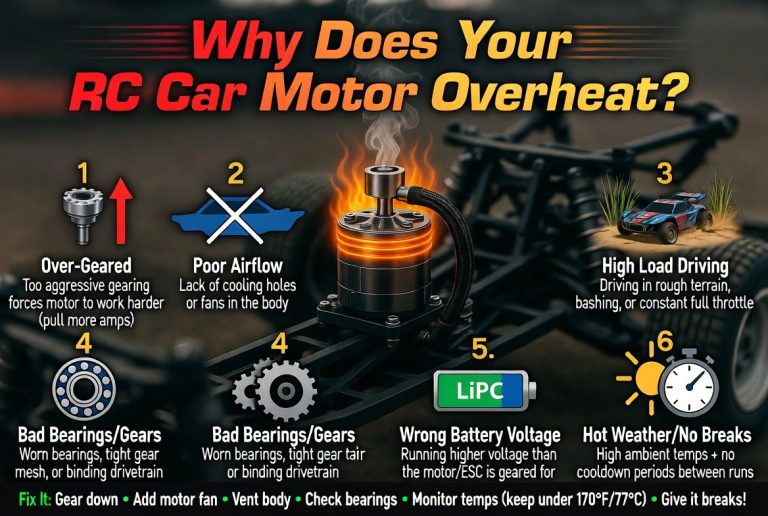
Run too low a gear ratio and your motor overheats. When the motor has to spin too fast relative to the load, it generates tons of heat. Heat kills motors and ESCs.
A good rule of thumb: touch your motor after a few minutes of running. If it is too hot to hold your finger on for three seconds, your gearing is too aggressive (ratio too low).
Back off by adding a tooth to your spur gear or removing a tooth from your pinion.
Lots of RC racers use small infrared thermometers to check temps. You want your motor under around 170°F (77°C) for brushless setups. Your ESC should stay under 160°F (71°C).
Going with a slightly higher ratio is almost always safer for your electronics. You lose a tiny bit of speed but gain a lot of durability.
Brushed vs. Brushless: Does Gear Ratio Work the Same Way?
Yes and no.
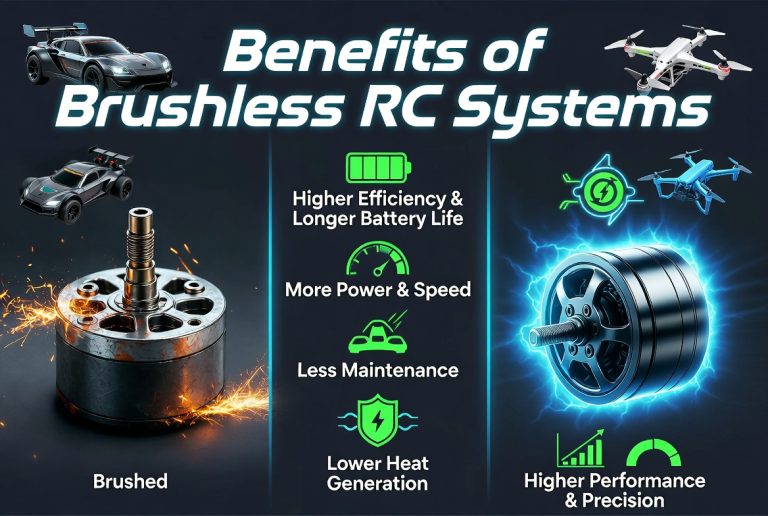
With brushed motors, the gear ratio concept is identical. But brushed motors are less efficient and run hotter in general. So you often need to be more conservative with your ratio.
With brushless motors, the higher efficiency means you can sometimes afford to run slightly lower ratios without destroying the motor. But the same basic principles apply.
Also, brushless systems usually have a specific recommended gear ratio range from the manufacturer. Always check that range before you start swapping gears.
Ignoring the recommended range is one of the fastest ways to cook an expensive brushless motor.
Common Gear Ratio Mistakes Beginners Make
Let us go over a few things that trip people up.
Mistake #1: Only Thinking About Speed
It is tempting to just lower your gear ratio as much as possible and go as fast as you can. But without enough cooling, you will burn through expensive parts really fast.
Balance speed with heat management. Always.
Mistake #2: Ignoring Mesh Quality
When you swap gears, the mesh between the pinion and spur needs to be right. Too tight and the gears grind. Too loose and they strip.
A good mesh has just a tiny bit of play — about the thickness of a piece of paper. Get that right before you run.
Mistake #3: Not Accounting for Tire Size
If you put bigger tires on your RC car, the effective gear ratio changes. Bigger tires cover more ground per revolution, which lowers the effective ratio. You might need to adjust your pinion to compensate.
Mistake #4: Running One Setup Everywhere
The ideal gear ratio for a hot day on a carpet track is not the same as for a cold day on outdoor dirt. Temperature affects motor efficiency. Surface affects load. Adjust accordingly.
How to Find Your Starting Gear Ratio
Most RC manufacturers publish a recommended gear ratio range for each vehicle. That is your starting point.
From there, you adjust based on:
- The surface you run on
- The outside temperature
- Your battery voltage
- Your driving style
A simple way to dial it in:
- Start at the middle of the manufacturer’s recommended range
- Run for five minutes
- Check motor and ESC temps
- If too hot, go one tooth bigger on the pinion — wait, wrong direction. Go one tooth smaller on the pinion to raise the ratio and reduce heat.
- If temps are fine and you want more speed, try one tooth larger on the pinion.
- Repeat until you find the sweet spot.
Take notes. Write down what pinion you used, the temp, the surface, and how the car felt. Over time you will build a chart of your ideal settings for every condition.
Gear Ratio and Battery Life
Here is something people do not always think about.
Running a lower gear ratio does not just affect speed and heat. It also drains your battery faster.
When the motor has to work harder (lower ratio, higher speed demand), it draws more current from the battery. More current = faster discharge = less run time.
If you are running a 2S LiPo and you want longer bashing sessions, a slightly higher gear ratio can stretch your battery life significantly. You give up some top-end speed, but you get more time on the track or trail.
For racing, you usually do not care — races are short. But for casual bashing or crawling, battery efficiency matters a lot.
LiPo Voltage and Gear Ratio Work Together
When you upgrade from a 2S LiPo (7.4V) to a 3S LiPo (11.1V), your motor spins faster.
That means you need to adjust your gear ratio too.
Going from 2S to 3S without changing your gearing is like swapping a bicycle into a gear that is way too high. You get speed — but you also get massive heat buildup.
Most experienced RC drivers raise the gear ratio (lower pinion or larger spur) when they move to higher voltage. This keeps motor temps in check while still getting the benefit of more power from the extra voltage.
It is a balancing act. And the gear ratio is your primary tool for striking that balance.
Quick Reference: What to Do for Different Goals
Here is a fast cheat sheet:
| Goal | What to Do |
|---|---|
| More top speed | Larger pinion (more teeth) or smaller spur |
| More acceleration / torque | Smaller pinion (fewer teeth) or larger spur |
| Cooler motor temps | Raise your gear ratio (smaller pinion) |
| Longer battery life | Raise your gear ratio slightly |
| Better rock crawling | Use the highest practical gear ratio |
| Faster track times | Lower ratio carefully while watching temps |
Keep this handy when you are doing your next gear swap.
The Gear Ratio Sweet Spot
Here is the truth: there is no universal perfect gear ratio.
It changes based on your motor, your battery, your tires, the track, and the weather. The best RC drivers learn to tune on the fly. They carry a few different pinion gears in their pit bag and swap as needed.
But every RC driver has to start somewhere. And now you have all the tools to start smart.
Start in the middle of your recommended range. Check temps. Adjust one tooth at a time. Keep notes. Over time, you will develop a feel for exactly what your setup needs.
That feeling — that dialed-in, perfectly tuned RC car ripping through a corner — is one of the best things about this hobby.
Wrapping It All Up
The gear ratio is one of the most powerful tuning tools in your RC kit. It controls how motor power turns into real-world speed, torque, and control.
A high gear ratio gives you more pulling power and cooler temps. A low gear ratio gives you more top-end speed but demands more from your motor and battery.
The pinion and spur gears are your adjustment points. Small changes make big differences. Always check motor heat after any ratio change.
Tune for your surface. Tune for your battery. Tune for your goals.
Do that, and you will always be running the fastest, most reliable RC setup possible — no matter if you are bashing in the backyard, racing on a carpet track, or crawling up a rock face.
Go slow on the tuning. Go fast on the track. That is the RC way.
Happy wrenching — and even happier driving.