How to Land Your RC Airplane Safely?
If you’re new to the world of remote control flying, landing your RC airplane might feel like the scariest part. Don’t worry. Millions of RC pilots land their planes every single day without any trouble. The key is knowing what to do before you even take off.
A smooth landing comes down to practice, planning, and understanding the basic steps. You’ll learn everything you need to know in this guide. By the end, you’ll feel confident bringing your RC plane down safely.
Why RC Airplane Landings Matter More Than You Think
Landing is different from flying. Flying straight and level feels easy once you get the hang of it. Landing? That’s where your skills really get tested.
Most beginners lose their planes during landings, not during flight. A bad landing can wreck your plane, hurt people on the ground, or cause property damage. This is why safe landing techniques are so important.
The good news is that landing gets easier every time you do it. Your muscle memory builds up. Your brain learns to predict what the plane will do. Soon, smooth landings become automatic.
Safe landings also save your plane. Fewer crashes mean fewer repairs. You spend less money fixing things and more time flying.
The Basic Anatomy of a Safe RC Airplane Landing
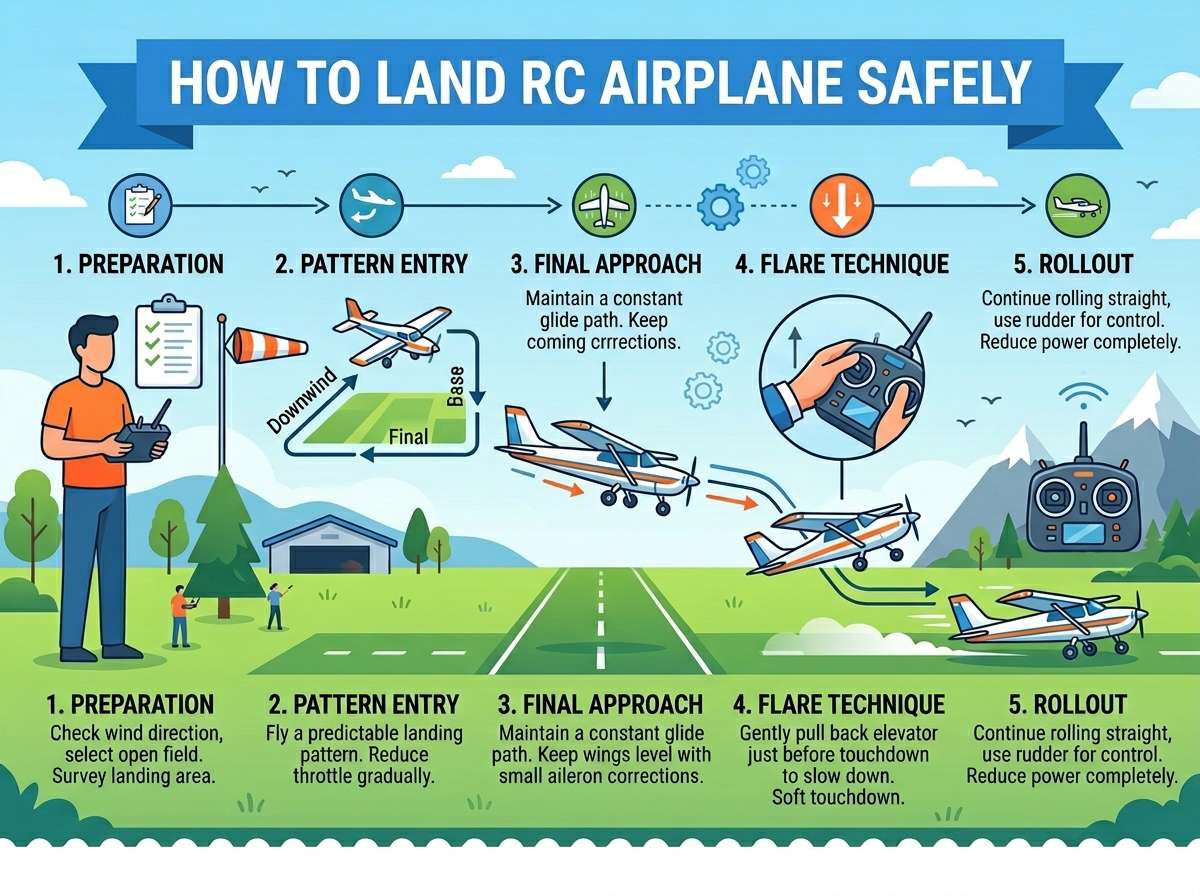
A good landing has three main parts. Each part is equally important.
The Approach
This is when you’re coming down toward the ground from high up. You need to lose height without going too fast. You also need to stay lined up with where you want to land.
The Flare
This happens right before you touch down. You pull up slightly on the control stick to slow the plane down even more. The plane’s nose goes up a little bit. You’re basically telling the plane to fly slower and slower.
The Touch Down
This is the actual moment when your wheels hit the ground. A good touch down is gentle and smooth. You barely feel it happen.
Each part flows into the next one. They work together to create a perfect landing.
Preparing Your RC Plane for Landing: Pre-Flight Checks
Before you even think about landing, make sure your plane is in good shape.
Check Your Control Surfaces
Look at your ailerons, elevators, and rudder. These are the flaps on your wings and tail. Make sure they move freely. Make sure they’re not bent or damaged. Move them by hand to see if there’s resistance.
Inspect Your Wheels
Your landing gear needs to work right. Look at each wheel. Spin them gently with your hand. They should spin freely without wobbling. Make sure they’re not flat or damaged.
Test Your Servos
Servos are the little motors that move your control surfaces. Before you fly, plug in your transmitter and move the control stick. Watch each surface move. Make sure nothing lags or stutters.
Check Your Battery
A dead battery mid-flight is a nightmare. Charge your plane’s battery fully before flying. Also charge your transmitter battery. A weak transmitter can cause control problems right when you need precision most.
Look for Loose Parts
Walk around your plane slowly. Look for anything that’s loose, bent, or broken. Check where the wings connect to the body. Check where the tail connects. Tighten any screws that look loose.
Understanding Your RC Airplane’s Flight Characteristics
Every plane flies a little differently. Some planes want to glide. Some planes want to drop. Some are twitchy and sensitive. Others are smooth and forgiving.
Before you try landing, spend time just flying your plane. Get to know how it feels.
Learn Your Plane’s Glide
Cut the throttle to zero while flying high up. How does your plane behave? Does it glide down smoothly? Does it drop like a rock? Does it want to turn to one side?
Understanding your plane’s natural glide helps you plan your approach better.
Feel the Control Response
Move the control stick all the way to one side. Does the plane respond right away or slowly? Is the movement smooth or jerky?
This tells you how much correction you’ll need to make during landing.
Discover Your Plane’s Stall Speed
A stall happens when the plane is going too slow to fly. You’ll feel the plane start to wobble and drop. If you pull the nose up more, the plane will stall and fall.
During landing, you want to go as slow as possible without stalling. Flying high up, gently pull the throttle back. Feel when the plane gets shaky. That’s close to stall speed. Now you know where the edge is.
Choosing the Right Landing Area
Your landing spot makes or breaks a safe landing.
Find Open Space
You need a flat area with no trees, power lines, buildings, or people. If something goes wrong, you want room for your plane to crash without hitting anything important.
A grass field is ideal. Grass is softer than pavement. Soft ground means less damage if you mess up.
Check for Wind
Always land into the wind. Landing into the wind means your plane needs less speed to land. A slower plane is easier to control.
If the wind is blowing from north to south, land heading north.
Look for Obstacles
Walk your landing area before you fly. Look for rocks, holes, or debris. Even a small rock can flip your plane over during landing.
If you’re landing on grass, make sure there are no ditches or slopes.
Keep People Away
Tell people to stay away from your landing zone. Make sure they’re at least a hundred feet back. If your plane goes off course, you want plenty of distance between it and people.
The Pre-Landing Flight Plan
Before you start your approach, have a plan.
Altitude and Speed Check
Get to a safe altitude. For most small RC planes, five hundred to one thousand feet is good. From this height, you have time to fix problems.
Reduce your throttle slowly. Your speed should be dropping steadily.
Line Up Your Approach
Point your nose at your landing zone. You should be heading straight toward it. If the wind is pushing you sideways, angle yourself into the wind slightly to stay lined up.
Plan Your Descent Rate
Your plane should be losing height steadily but not too fast. A nose-down attitude helps. This means the front of your plane points down a little bit. The angle shouldn’t be steep. Shallow is better.
Call Your Pass
If you’re flying with other pilots, call out that you’re entering your landing pattern. Say something like “RC-twelve on final approach.” This tells everyone else to stay out of your way.
Flying Your Downwind Leg Like a Pro
The downwind leg is your first move toward landing.
After you reduce power, you’re flying away from your landing zone. You’re at a right angle to where you want to touch down. This leg helps you lose altitude and set up for the final approach.
Descend Gradually
Don’t drop too fast. Your plane should descend slowly and smoothly. If you’re dropping at a steep angle, add a little power. Fly as smoothly as you can.
Keep Your Speed Reasonable
Your speed should be going down. If your plane is still going as fast as when you were cruising, you need less power.
Start Your Turn
About halfway through this leg, start turning toward your landing zone. Don’t make sharp turns. Keep them smooth and gentle.
A smooth turn helps you set up better for your final approach.
Executing Your Final Approach
This is where everything comes together.
Fly Toward Your Landing Zone
You should now be heading straight at where you want to land. You’re maybe three hundred feet up. Your speed is slower than cruise speed.
Check Your Alignment
Are you pointing straight at your landing zone? If the wind is pushing you sideways, make small corrections. Add a little rudder input to stay straight.
Monitor Your Descent
Your plane should be losing height steadily. You should reach ground level right as you reach your landing zone.
If you’re dropping too fast, add a touch of throttle. If you’re dropping too slow, reduce power a bit more.
Look Ahead, Not Down
Many beginners make a mistake here. They stare at the ground right in front of the plane. Instead, look ahead down the runway. This helps you see where you’re actually going and plan corrections better.
The Flare: The Most Important Part of Landing
The flare is where landings get smooth or get ugly.
The flare means you’re pulling the nose up slightly. You’re telling your plane to stop descending and start flying level. Your speed drops even more. The plane slows down as it approaches the ground.
Start Your Flare Early
Don’t wait until you’re touching the ground to flare. Start when you’re about ten to twenty feet up. This gives you room to make corrections if things go wrong.
Pull Back Gently
Pull the control stick back slowly. Don’t jerk it. A smooth, steady pull looks much better than a quick yank.
Your elevator should move up about a quarter of the way. Not all the way. Not a tiny bit. About a quarter.
Feel Your Plane’s Response
As you pull back, your plane’s nose comes up. Your speed drops more. Your sink rate (how fast you’re dropping) slows down.
Keep feeling what’s happening. If the plane is still dropping too fast, pull back a bit more. If the plane is starting to climb back up, you pulled too much. Let it come down gently.
Watch Your Airspeed
Your plane is flying slower and slower. You’re getting close to stall speed. That’s okay. That’s actually what you want during landing. You want to be going as slow as safely possible.
As you reach that slow speed, the plane naturally wants to drop. Let it. Keep your flare angle steady.
The Touchdown: Making Contact with the Ground
You’re almost there.
Stay Smooth
This is not the time to make big corrections. Your plane is seconds away from touching down. Keep your inputs small and smooth.
If the plane drifts left, use a tiny bit of rudder to correct. If it’s drifting down too fast, add a touch of elevator.
Keep Your Nose Up
Your plane’s nose should be pointing slightly up during touchdown. Not too much. Just a bit. This is called a “tail-dragger attitude.”
A nose-down landing is bad. Your propeller could hit the ground. Your nose could get damaged.
Let the Wheels Touch First
Your main landing wheels should touch the ground first. They should touch gently. If you hear a hard thud, you came down too fast.
Keep It Straight
After your wheels touch, keep the plane straight. Use your rudder to stay lined up with your runway. Don’t let the plane drift sideways.
After Touchdown: Controlling Your Plane on the Ground
Your plane just touched down. You’re not done yet.
Use Your Brakes
Some RC planes have brakes. Some don’t. If you have them, use them now. Gradually apply braking to slow the plane down.
Reduce Power to Zero
Cut your throttle completely. Your plane should coast to a stop.
Steer Gently
As you slow down, use rudder to steer around obstacles. Keep your movements small. A sharp turn at speed can flip your plane over.
Let It Roll
Just let your plane coast to a stop. Don’t fight it. Fighting the controls can cause crashes on the ground.
Once you’re stopped and the propeller has completely stopped spinning, you can walk over to your plane.
Common Landing Mistakes Beginners Make
Let’s talk about things that go wrong.
Coming In Too Fast
This is the number one mistake. A fast landing needs more space. You have less time to make corrections. Fast landings often result in overshooting your landing zone or running into things.
Fix this by reducing power more gradually. Start your descent earlier. Give yourself more time to slow down.
Flying Too Low on Approach
If you’re descending too fast, you might run out of time to flare. You’ll hit the ground hard.
Practice a shallower descent angle. Fly your approach path higher. Give yourself more altitude to work with.
Poor Alignment
If your plane isn’t lined up with your landing zone, you’ll land sideways or overshoot.
Pay more attention to wind direction. Adjust your heading to stay lined up. Do practice approaches where you just circle around without actually landing.
Over-Correcting
When something goes slightly wrong, beginners often make huge corrections. This creates a chain reaction of problems.
When your plane drifts a little left, use a small rudder input. Not a big one. Let the plane respond. Then wait to see if more correction is needed.
Forgetting About the Wind
Wind is invisible but powerful. It can push your plane sideways or speed it up without you realizing it.
Always land into the wind. Always check wind direction before flying.
Tips for Different Types of RC Airplanes
Not all planes land the same way.
High-Wing Planes
These planes have wings on top. They’re stable and forgiving. They land gently and naturally. These are great starter planes.
Land these planes as we’ve described. They almost teach themselves.
Low-Wing Planes
These have wings on the bottom. They’re sleeker and faster. They can be twitchier to land.
Go a little slower on approach. Be gentler with your inputs. These planes respond faster to control movements.
Tailwheel Planes
These have a wheel in the back instead of the front. They’re tricky. The tail wheel can catch grass and flip the plane.
Land these planes tail-wheel first. Keep the nose high. Go very slowly.
Retractable Gear Planes
Some planes have wheels that tuck up into the fuselage. Make sure you lower them before landing. Forgetting to do this is a crash waiting to happen.
Check your gear status before entering your approach pattern.
Practice Drills to Improve Your Landing Skills
You improve landings through practice. Here are drills that work.
The Approach-Only Drill
Fly toward your landing zone as if you’re going to land. But when you get close to the ground, add throttle and climb back up. Fly around and do it again.
This drill teaches you how to set up a good approach without the pressure of actually landing.
The High-Flare Drill
Start flaring much higher than normal. When you’re fifty feet up, start pulling back. This gives you lots of practice feeling how the plane responds to flare inputs.
The Slow-Speed Drill
Fly at the slowest speed you can without stalling. Get a feel for how the plane handles at landing speed.
The Crosswind Drill
Land with the wind coming from the side instead of head-on. This teaches you how to handle wind challenges.
Start with small crosswinds. Work your way up to stronger ones.
What To Do When a Landing Goes Wrong
Sometimes things don’t go to plan.
If You’re Coming In Too Fast
Add a little throttle and climb back up. Circle around and try again. There’s no prize for landing the first try.
If You’re Drifting Sideways
Use your rudder to straighten out. If you can’t straighten out in time, add throttle and try another approach.
If You’re Dropping Too Fast
Add some power. A little throttle can save a bad approach.
If You’re Going Too Slow and Dropping
Add power before you stall. A stall near the ground is dangerous. Better to come in faster and overshoot than to stall and drop.
If Something Hits You During Landing
Stay calm. Cut your throttle and try to control your descent. Try to land in an open area away from obstacles.
Understanding RC Airplane Control Surfaces and Their Role in Landing
Your plane has several control surfaces that work together during landing.
The Elevator
This control moves the tail up and down. When you pull the stick back, the elevator goes up. This makes the nose go up and slows the plane down. You use this most during flare.
The Ailerons
These are on the wings. They roll the plane left or right. During landing, use ailerons to keep the wings level.
The Rudder
This is the vertical tail fin. It makes the nose point left or right. Use this to keep your nose pointed at your landing zone.
The Throttle
This controls your engine speed. More throttle means more speed and climb. Less throttle means slower speed and descent.
Together, these controls let you fly a perfect landing pattern.
Landing at Different Times of Day
Lighting changes how you perceive your altitude and speed.
Landing in Bright Sunlight
It’s easy to judge distance in bright light. Landing is usually easier.
Be aware of shadows from trees or buildings. A shadow can hide obstacles.
Landing in Dim Light
When the sun is low, depth perception gets tricky. Things can look closer or farther than they are.
Start with higher approaches in dim light. Give yourself more room for corrections.
Landing at Dusk
Dusk is tough. The light is changing. Your eyes are adjusting. Contrast is poor.
Make your approaches shallower. Go slower. Be extra careful about your altitude.
Landing at Night
Night flying needs special equipment. You need lights on your plane so you can see it.
Night landings are advanced. Don’t try them until you’re very comfortable with day landings.
Safety Considerations for RC Airplane Landings
Safety isn’t boring. Safety keeps you flying longer.
Wear Your Goggles
If you’re flying FPV (first person view with a camera), wear goggles. But always have someone spotting for you too. They watch the actual plane and warn you about obstacles.
Keep Your Antenna Up
Your transmitter antenna should always point straight up or at an angle toward your plane. Antenna position affects your control range.
Check Frequency
If other pilots are nearby, make sure you’re on different frequencies. Flying on the same frequency as someone else causes interference.
Keep Distance from Power Lines
Power lines are invisible death traps. Stay far away. If your plane gets tangled in power lines, call professionals. Don’t try to retrieve it yourself.
Never Fly Over People
Always keep your plane away from people, cars, and buildings. If something goes wrong, you don’t want anyone to get hurt.
Building Confidence in Your Landing Skills
Landings feel scary at first. That’s normal. Everyone feels nervous before their first landing.
Confidence comes from practice. Every successful landing makes the next one easier.
Start with Short Flights
Take off and land right away. Don’t fly around for a long time. This keeps your focus on the landing.
Use Better Planes
Some planes are built to land easily. They’re forgiving of mistakes. Start with one of these. Once you master landing a stable plane, switch to trickier models.
Land Often
The only way to get good at landings is to land a lot. Fly short flights and practice lots of landings.
Record Your Flights
Set up a camera to film your landings. Watch the video after. You’ll see things you can improve that you didn’t notice while flying.
Join a Flying Club
Fly with other pilots. They can give you feedback. They can spot problems in your technique. Learning from others makes you better faster.
The Path Forward: From Nervous Beginner to Landing Expert
You started this article feeling nervous about landings. You end it knowing exactly what to do.
Landings are a skill. Skills improve with practice. Every time you land, you get better.
Start with short flights and shallow approaches. Land in open fields with good wind. Don’t rush. Take time to set up each landing carefully.
As you improve, challenge yourself. Try crosswind landings. Try landing in smaller spaces. Try landing in different light conditions.
One day soon, you’ll notice something cool. Landings feel automatic. You’re not thinking through each step anymore. You’re just doing it. Your hands and brain work together smoothly.
That’s when you know you’ve got it.
RC flying is an amazing hobby. Landings are the most important part of it. Master your landings and you unlock the whole hobby. You fly more. You enjoy it more. You crash less.
So get out there. Find a safe flying field. Start practicing. Land your RC plane over and over again until it feels natural.
Before long, you’ll be landing smoothly every single time. Other pilots will ask you how you do it. You’ll just smile and say you practiced.
That’s the secret. That’s always the secret. Practice, patience, and paying attention to what your plane is telling you.
Happy flying. Smooth landings ahead.

Peterson is an RC hobby enthusiast and product reviewer with a passion for remote-controlled cars, trucks, boats, drones, and accessories. He enjoys testing the latest RC products, comparing features, and sharing practical buying guides to help beginners and experienced hobbyists make informed decisions. Through RCThing.com, Peterson provides honest reviews, maintenance tips, and expert advice to help readers get the most from their RC adventures.