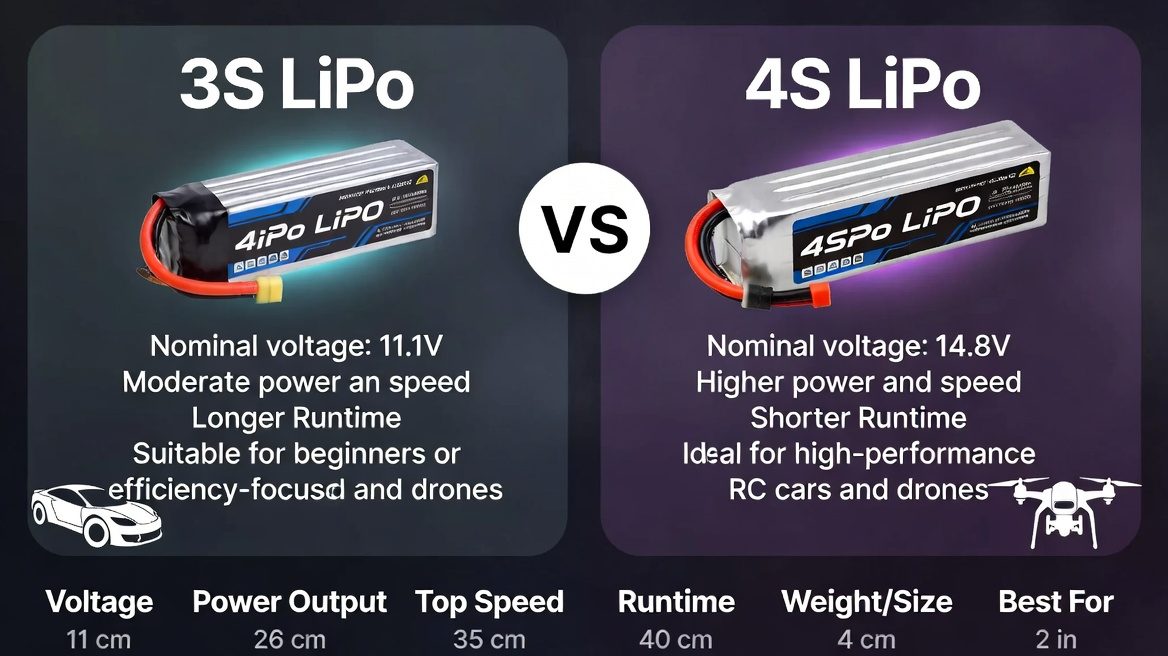
3S vs 4S LiPo Battery
So you just bought your first RC car or truck. You’re excited to get it running at full speed. But then you see all these different battery options. 3S this, 4S that. What does it all mean?
Don’t worry. I’m going to break it down for you in simple terms. By the end of this post, you’ll know exactly which battery fits your needs.
What Does the “S” Actually Mean?
Let’s start with the basics. That “S” stands for “series.” It tells you how many cells are connected together inside the battery pack.
Each LiPo cell produces about 3.7 volts when it’s resting. When fully charged, it hits 4.2 volts. A 3S battery has three cells connected in series. A 4S battery has four cells.
Here’s the simple math:
- 3S battery = 3 cells × 3.7V = 11.1V (nominal voltage)
- 4S battery = 4 cells × 3.7V = 14.8V (nominal voltage)
When fully charged:
- 3S battery = 3 cells × 4.2V = 12.6V
- 4S battery = 4 cells × 4.2V = 16.8V
That voltage difference is huge. It changes everything about how your RC vehicle performs.
The Power Difference You’ll Actually Feel
More voltage means more power to your motor. Think of voltage like water pressure in a hose. Higher pressure pushes more water through. Higher voltage pushes more current through your motor.
A 4S battery gives you about 33% more voltage than a 3S battery. That’s not a small bump. Your RC car will feel completely different.
With a 3S battery, your car runs quick and responsive. It’s fun and controllable. You can learn how to drive without things getting too crazy.
With a 4S battery, your car turns into a beast. The acceleration gets brutal. Top speed shoots up. Everything happens faster. Way faster.
Most beginners find 3S power perfect for learning. You get good speed without losing control. Once you master that, 4S becomes the natural next step.
Speed: How Fast Will You Actually Go?
Speed matters to most RC hobbyists. Let’s be honest about what to expect.
On a 3S battery, a typical 1/10 scale RC car hits around 30-35 mph. Some models push 40 mph if they’re built for speed. That’s already quick enough to be exciting.
Bump up to 4S, and that same car might hit 45-50 mph. Speed demons with good gearing can crack 60 mph. The jump is real and noticeable.
But speed isn’t everything. You also need to consider where you’re driving. In your backyard or a small parking lot, 3S gives you plenty of speed. You can actually use all that power without running out of space in two seconds.
At a big RC track or an empty field, 4S lets you stretch your legs. You’ve got room to really open it up.
Runtime: How Long Can You Drive?
Here’s where things get interesting. Battery capacity is measured in milliamp hours (mAh). A 5000mAh battery holds more energy than a 3000mAh battery.
But the voltage (3S vs 4S) affects how fast you drain that energy.
A 4S battery pushes more power, so your motor works harder. Your car goes faster. But that means you burn through the battery quicker.
Let’s say you have two batteries, both 5000mAh:
- 3S 5000mAh might give you 15-20 minutes of driving
- 4S 5000mAh might give you 10-15 minutes of driving
The exact times depend on how you drive. Full throttle all the time drains batteries fast. Cruising around conserves power.
Many people run 4S batteries but don’t go full throttle constantly. That gives them great performance with decent runtime.
Heat: The Enemy of Electronics
Motors and speed controllers generate heat when they work. More voltage means more current flowing through. More current means more heat.
Heat kills electronics. It’s the number one reason parts fail in RC vehicles.
A 3S setup runs cooler. Your motor stays at safe temperatures. Your electronic speed controller (ESC) doesn’t get too hot. Parts last longer.
A 4S setup generates more heat. You need to monitor temperatures, especially when you’re bashing hard. Some motors and ESCs need fans or heatsinks to cope with 4S power.
Before you jump to 4S, check if your ESC is rated for it. Not all speed controllers handle 4S voltage. If your ESC is only rated for 3S, plugging in a 4S battery can fry it instantly.
Same goes for your motor. Some motors handle 4S power fine. Others overheat and burn out. Always check the specs.
Cost: What’s It Going to Cost You?
4S batteries cost more than 3S batteries with the same capacity. You’re getting more cells, so the price goes up.
A typical 3S 5000mAh battery might cost around $40-60. The same capacity in 4S might run $50-70 or more. The difference isn’t massive, but it adds up if you buy multiple packs.
Battery chargers also matter. Basic chargers handle 3S fine. But if you want to charge 4S batteries, you might need a better charger. That’s another expense to consider.
Then there’s the wear on your vehicle. 4S power puts more stress on your drivetrain. Gears, diffs, and axles work harder. You might go through parts faster. Tires wear out quicker. Maintenance costs can creep up.
For someone just getting started, 3S keeps costs reasonable. You can enjoy the hobby without breaking the bank.
Weight and Size Differences
4S batteries are physically bigger and heavier than 3S batteries with the same capacity. They need to fit an extra cell inside.
In smaller RC vehicles like 1/18 or 1/16 scale cars, that size difference matters. A 4S pack might not even fit in the battery tray.
For 1/10 scale and larger vehicles, both usually fit fine. But the extra weight of a 4S battery affects handling. More weight up high raises the center of gravity. Your car might feel less nimble in corners.
The weight also affects what surfaces you can drive on. Heavier setups work great on smooth pavement. On grass or rough terrain, lighter 3S setups sometimes perform better because they don’t bog down as easily.
Durability and Wear on Parts
RC cars take a beating. You crash, you jump, you land hard. All that action stresses the parts.
4S power amplifies that stress. When you hit the throttle with 4S, the torque spike is intense. Gears can strip. Driveshafts can snap. Differentials can explode.
Quality parts handle it better. But even good parts wear faster under 4S abuse.
3S power is gentler on components. Things still break (this is RC after all), but failures happen less often. Your investment in the vehicle lasts longer.
If you’re bashing your car hard and breaking parts constantly, stepping down from 4S to 3S might save you money and frustration.
Control and Handling Characteristics
Here’s something people don’t talk about enough. The way your car handles changes dramatically between 3S and 4S.
With 3S power, throttle control is smooth. You can modulate speed easily. The car responds predictably to your inputs. You feel connected to the vehicle.
With 4S power, everything happens faster. Throttle response becomes very aggressive. The rear end wants to break loose. Controlling slides gets harder. You need quick reflexes.
For racing, 3S often works better. The predictable power delivery helps you hit your lines consistently. You can be smooth and fast.
For bashing and having fun, 4S is a blast. The wild power makes every drive exciting. Just be ready for the learning curve.
What Your Motor Can Actually Handle
Not all motors are created equal. Some motors thrive on 4S power. Others struggle or die.
Check your motor’s specifications. Look for something called the kV rating. This tells you how many RPMs the motor produces per volt.
A high kV motor (like 3000kV or higher) is designed for 3S batteries. It spins fast on lower voltage. If you run it on 4S, it might spin too fast and overheat.
A lower kV motor (like 1200kV to 2200kV) is built for higher voltage. These motors work great on 4S. They produce strong torque and can handle the extra voltage without overheating.
If you’re not sure, stick with 3S until you upgrade to a motor specifically rated for 4S use.
ESC Compatibility: Don’t Fry Your Electronics
Your electronic speed controller is the brain that controls your motor. It takes the signal from your receiver and adjusts motor power.
Every ESC has a voltage limit. It might say “3S LiPo max” or “4S LiPo capable.” This isn’t a suggestion. It’s a hard limit.
Plug a 4S battery into a 3S-rated ESC and you’ll see magic smoke. The ESC will fry. It’s not a maybe. It will happen.
Good quality ESCs that handle 4S often cost more. They need beefier components to manage the higher voltage and current. Budget ESCs usually top out at 3S.
Before you buy a 4S battery, confirm your ESC can handle it. Check the manual or the manufacturer’s website. Save yourself an expensive lesson.
Gearing: Getting the Most from Your Setup
Gearing is how you translate motor power into wheel speed. It’s like the transmission in a real car.
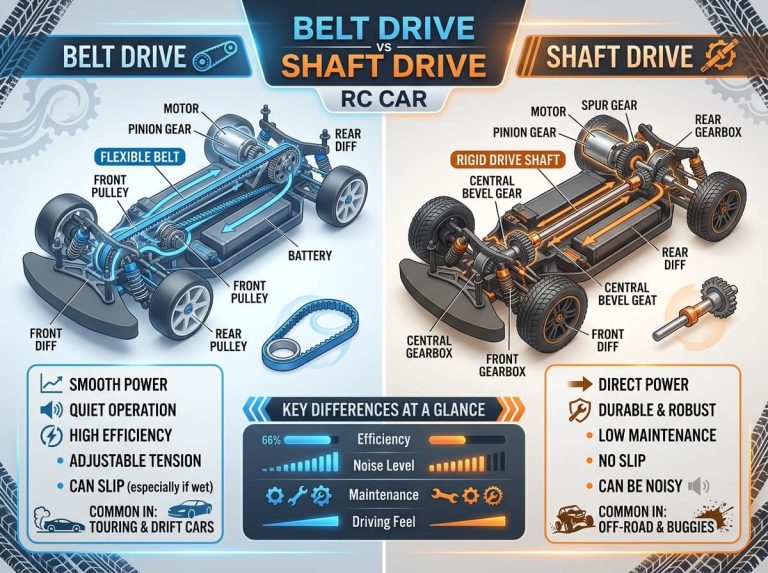
When you switch from 3S to 4S, you often need to change your gearing. The motor spins faster with more voltage. If you keep the same gearing, you might overheat the motor or ESC.
Most people gear down when moving to 4S. That means using a smaller pinion gear or a larger spur gear. This reduces top speed slightly but keeps temperatures safe.
Getting gearing right takes some trial and error. You want maximum performance without cooking your electronics. Temperature guns help you monitor motor and ESC temps while you dial in the perfect setup.
Real-World Performance Scenarios
Let’s talk about what this means in actual use.
Parking Lot Bashing: Both 3S and 4S work great. 3S gives you plenty of speed for the space. 4S is overkill but super fun if you want the extra kick.
Backyard Fun: 3S is perfect. You can rip around without worrying about overshooting into the neighbor’s yard. Control is easy.
Racing on a Track: 3S dominates club-level racing. The smooth power helps you be consistent. Some classes even mandate 3S to keep things fair.
Big Open Fields: 4S shines here. You’ve got space to use all that power. Top speed matters when you have room to stretch out.
Rough Terrain: 3S often works better. The lighter weight helps you float over bumps. Less power means less chance of breaking parts on rough landings.
Rock Crawling: 3S provides plenty of torque without being too aggressive. Crawlers need smooth power, not brutal acceleration.
Battery Maintenance and Lifespan
Both 3S and 4S batteries need proper care. LiPo batteries are powerful but sensitive.
You need to store them at the right voltage. Charge them correctly. Never over-discharge them. Keep them away from extreme temperatures.
4S batteries have an extra cell to monitor and balance. That’s one more thing that can go wrong. If one cell goes bad in a 4S pack, you lose the whole battery.
3S batteries are simpler with fewer cells. They’re easier to keep balanced during charging.
Both last about the same number of charge cycles if you treat them right. Expect 200-300 cycles from a quality pack with good care.
Making the Switch from 3S to 4S
So you’ve been running 3S and want to try 4S. Here’s how to do it safely.
First, verify your ESC and motor can handle 4S. Check the specs. If you’re not sure, ask on RC forums or contact the manufacturer.
Second, consider your gearing. You might need to gear down to prevent overheating.
Third, get a temperature gun. Monitor your motor and ESC temps during the first few runs. Keep both under 170°F (75°C) for safety.
Fourth, adjust your driving style. 4S hits hard. Ease into the throttle until you get used to the extra power.
Fifth, inspect your drivetrain. 4S stress can reveal weak points. Tighten screws. Check for worn gears. Replace anything questionable before it breaks.
The Beginner’s Best Choice
If you’re new to RC, start with 3S. Here’s why.
You need to learn how to drive before you need crazy power. 3S gives you enough speed to be exciting without being overwhelming.
You’ll make mistakes. You’ll crash. 3S power means softer crashes and less damage. Your wallet will thank you.
3S teaches you good throttle control. You learn smooth inputs. These skills matter way more than raw speed.
Once you’ve mastered 3S and feel limited by the power, then consider 4S. But most beginners find 3S power is plenty for quite a while.
The Experienced Driver’s Perspective
If you’ve been in the hobby for a while, 4S opens up new possibilities.
The extra power lets you run bigger tires without bogging down. You can tackle tougher terrain. Jumps get bigger. Wheelies get easier.
For speed runs, 4S helps you chase higher top speeds. Combined with good gearing and aerodynamics, you can hit impressive numbers.
Some experienced drivers keep both setups. 3S for technical driving and long runtime. 4S for bashing and showing off.
Having multiple battery options gives you flexibility. Match your power to your driving conditions.
Common Mistakes People Make
Don’t buy a 4S battery without checking compatibility first. This is the most common and most expensive mistake.
Don’t assume 4S is always better. More power isn’t better if you can’t control it or if it breaks your car.
Don’t ignore temperature. Running too hot shortens the life of every component in your vehicle.
Don’t cheap out on batteries. Quality LiPo packs are safer and last longer. Bargain batteries can be dangerous.
Don’t forget to adjust your driving style when switching between 3S and 4S. The muscle memory from 3S doesn’t translate directly.
Safety Considerations
LiPo batteries pack a lot of energy into a small space. That makes them great for RC but also potentially dangerous.
Never charge batteries unattended. Always use a LiPo-safe charging bag or container.
Never over-discharge your packs. Set your ESC’s low voltage cutoff correctly. For LiPo batteries, don’t go below 3.0V per cell.
Never use a damaged or puffed battery. If a pack swells up or gets punctured, it’s done. Dispose of it properly.
Both 3S and 4S batteries carry the same safety requirements. More voltage doesn’t mean more danger if you follow the rules.
Storage and Transportation
When you’re not using your batteries, store them at storage voltage (around 3.8V per cell). This extends their lifespan.
Keep batteries in a cool, dry place. Not in a hot car or cold garage. Room temperature works best.
For transportation, use a LiPo-safe bag. If a battery gets damaged in your car, you want it contained.
4S batteries take up more space than 3S batteries. Make sure you have room in your gear bag.
Which Battery Should You Buy?
Here’s the simple answer. If you’re new or if your vehicle is stock, go with 3S.
If you’ve upgraded your electronics specifically for 4S and you have the experience to handle the power, go for 4S.
If you’re not sure, 3S is the safe bet. You can always upgrade later. It’s easier to add power than to dial it back.
Think about where you drive, what you want to do, and your skill level. The right answer depends on your situation.
Final Thoughts
The 3S vs 4S debate doesn’t have a universal answer. Both have their place in RC.
3S offers great performance, excellent control, easier maintenance, and lower costs. It’s perfect for learning, racing, and most casual bashing.
4S delivers brutal acceleration, higher top speed, and that wow factor. It’s great for experienced drivers who want maximum performance.
Your choice comes down to your goals, your budget, and your vehicle’s capabilities. Start conservative and work your way up. That’s how you get the most enjoyment from this amazing hobby.
Now get out there and drive. That’s what it’s all about.