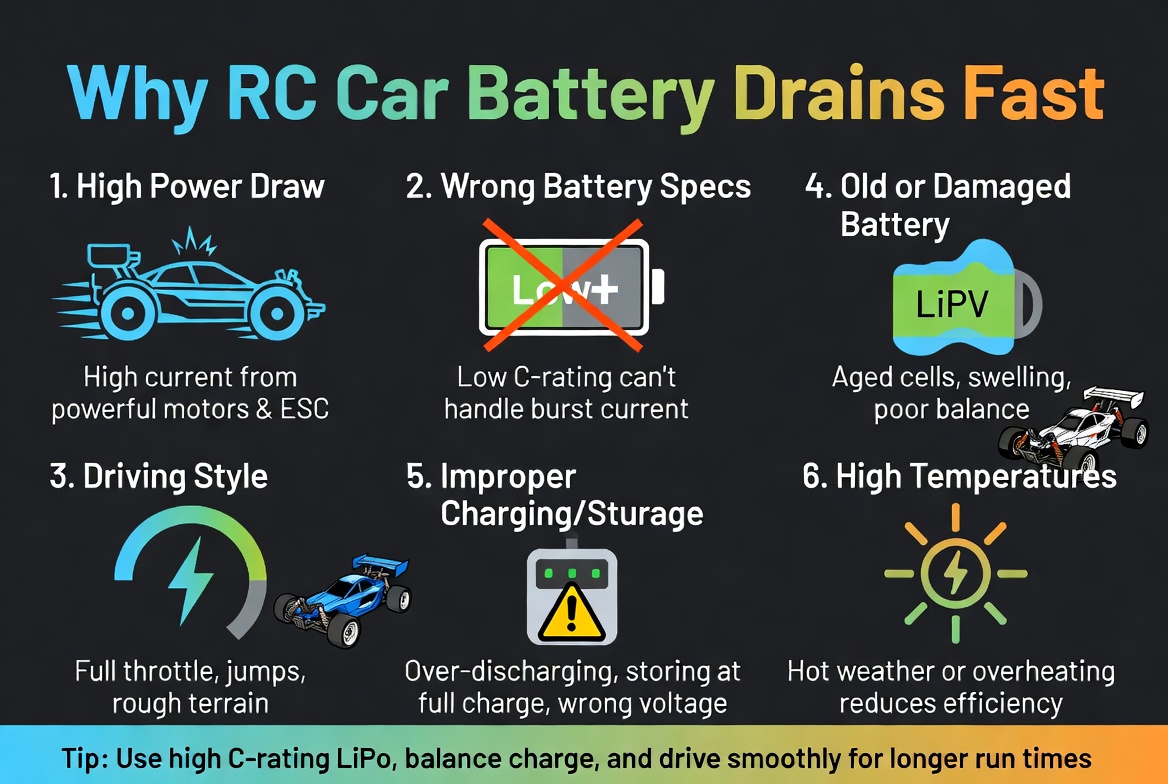
Why Does Your RC Car Battery Drain So Fast?
Hey there, RC car fan! You grab your remote control, push the throttle, and your car zooms across the floor or tears up the dirt track. Everything feels awesome for a few minutes. Then the power drops off a cliff. The motor slows down. The car barely moves. You sigh and reach for the charger again. Sound familiar?
This happens to tons of hobbyists. Your RC car battery drains fast and leaves you frustrated. You want longer run times so you can keep racing or bashing without constant stops. Good news: you can fix this. We will walk through every common reason step by step. You will learn exactly why the juice disappears so quickly and how to make your battery last way longer.
We keep things simple and straight to the point. No fancy tech talk. Just real explanations that any beginner can follow. By the end, you will know how to spot the problem and fix it fast. Let’s jump right in and get your RC car running longer.
The Battery Type Makes a Huge Difference
Your RC car battery sits at the heart of everything. Different types hold power in different ways. Pick the wrong one for your setup and it drains fast every single run.
Start with NiMH packs. These older batteries work fine for basic cars. They cost less and handle rough use. But they lose charge quicker when you push the car hard. The cells inside heat up and waste energy as heat instead of sending it to the motor.
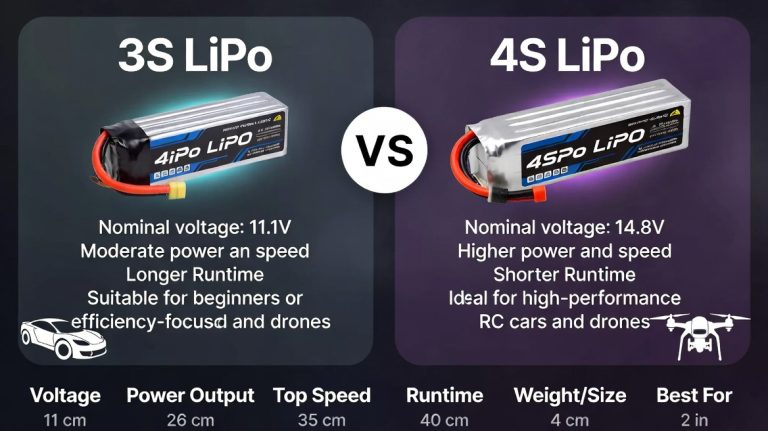
Now look at LiPo batteries. Most serious racers and bashers use them today. LiPo packs deliver big bursts of power and feel super responsive. They weigh less too, so your car handles better. Yet they drain fast if you do not match the battery to your motor and speed controller.
Here is why. LiPo cells put out higher voltage. A 2S LiPo gives about 7.4 volts when full. Your motor pulls every bit of that power when you floor it. If the car draws too much current, the voltage sags and the battery empties in minutes.
Check the capacity rating next. Capacity shows up as mAh on the label. A 2200mAh pack holds more energy than a 1300mAh pack. Seems obvious, right? Many new drivers grab the cheapest battery with the smallest number. Then they wonder why the car dies after ten minutes.
Bigger capacity packs weigh more, but they give longer run times. Try moving up to a 4000mAh or even 5000mAh pack if your car can carry the extra grams. You will notice the difference right away.
Age matters too. Every battery loses strength over time. After fifty or sixty full cycles, a LiPo starts to hold less charge. The internal resistance climbs. That means the battery works harder to push the same current and drains faster.
You can test this yourself. Charge the pack fully. Run the car for a short time. Then check the voltage with a simple meter. If it drops below 3.7 volts per cell too soon, the battery has seen better days. Time to replace it.
Driving Style Drains the Battery Quicker Than You Think
You control the throttle. Your habits decide how fast the battery empties. Aggressive driving burns through power at an insane rate.
Think about it. You floor the gas every corner. You slam the brakes hard. You launch off jumps and land with full throttle. Each burst pulls massive current from the battery. The motor spins faster and the ESC works overtime. All that adds up.
Smooth driving saves huge amounts of energy. Ease into the throttle instead of punching it. Coast through turns when you can. Let the car roll on its own momentum. You will stay on the track longer and still have fun.
Drag brake settings play a big role here too. Many ESCs let you dial in how much brake the motor gives when you let off the trigger. High drag brake feels great for control, but it fights the wheels and wastes battery. Turn that setting down a notch or two and watch the run time grow.
Reverse also sucks power. Hitting reverse a lot forces the motor to spin the other way and pulls extra amps. Use reverse only when you really need it.
High speed runs on pavement or carpet drain batteries faster than slow crawling on grass. The motor fights less wind resistance at low speeds, so it draws less current. If you race on a big open lot, expect shorter runs unless you bring spare packs.
Temperature Hits RC Car Batteries Hard
Cold weather sneaks up on you and kills battery performance. You head outside on a chilly morning. The pack feels normal at first. But after a few minutes the car slows down like someone hit the brakes.
Batteries hate the cold. The chemical reactions inside slow way down. Electrons move sluggishly. Internal resistance shoots up. Your pack delivers far less power even though it started fully charged.
LiPo batteries suffer the most in low temps. They can lose thirty percent of their effective capacity below fifty degrees. NiMH packs handle cold a bit better, but they still drain faster.
You can fight this. Keep the battery warm before you run. Slip it inside your jacket pocket for a few minutes right before you connect it. Some drivers use small hand warmers wrapped around the pack during cold sessions.
After the run, let the battery cool down slowly. Never charge a cold pack straight from the fridge or outside air. Warm it to room temperature first. The charger works safer and the cells accept charge better.
Hot weather creates its own problems. Extreme heat makes the battery swell and lose efficiency. The pack drains faster because the chemicals break down quicker. Park your car in the shade between runs. Give the battery time to cool off before you plug it back in.
Your Car Setup Can Secretly Waste Power
The way you build and tune your RC car affects battery life more than most people realize. A few small changes add up to big savings.
Gears come first. The pinion and spur gear ratio controls how hard the motor works. A big pinion gear makes the car scream fast but forces the motor to spin like crazy. That pulls tons of current and drains the battery quick.
Try a smaller pinion. The car might feel a touch slower off the line, but you gain massive run time. Many bashers drop one or two teeth on the pinion and love the extra play time.
Bearings matter too. Dirty or dry bearings create drag. The motor fights extra friction every time the wheels turn. Clean the bearings with a little motor spray. Add a drop of light oil. You will feel the car roll freer and the battery lasts longer.
Motor choice changes everything. Brushed motors draw more current than brushless ones. Brushless motors run cooler and more efficient. If your old brushed motor feels tired, swap to a brushless system. You get more speed and longer run times in one move.
The speed controller settings hide another power thief. Many ESCs ship with high throttle limits or turbo boosts turned on. Dial those back a little. You still get plenty of fun without emptying the pack in record time.
Weight also plays a part. Extra body shells, big wheels, or added lights make the car heavier. The motor works harder to move all that mass. Strip off anything you do not need for your style of running. Every gram you remove helps the battery last longer.
Charging Mistakes Kill Battery Life Fast
You charge the battery wrong and wonder why it dies so soon. Charging habits cause more fast drain problems than most drivers admit.
Wrong charger settings top the list. LiPo packs need a balance charger that monitors every cell. If you charge on a NiMH setting by mistake, the pack gets uneven. One cell overcharges while others lag. The whole battery loses capacity and drains quicker next time.
Always double-check the charger menu. Match the battery type exactly. Set the correct cell count too. A 2S pack needs different voltage than a 3S pack.
Overcharging hurts batteries. You leave the pack on the charger too long. The cells swell and internal resistance climbs. Next run the battery feels weak right away.
Undercharging causes the same issue. You yank the pack off early because you want to get back outside. The battery starts the run already low. It empties fast and you blame the pack instead of the charger time.
Charge at the right rate. Most LiPo packs like 1C charging. That means one amp for every thousand milliamp-hours of capacity. A 4000mAh pack charges safely at 4 amps. Faster rates heat the cells and shorten life.
Store batteries properly between runs. LiPo packs like to sit at storage voltage, around 3.8 volts per cell. Many smart chargers have a storage mode. Use it. The pack stays happy and ready for the next session without losing capacity.
Dirt and Friction Steal Your Run Time
Your RC car collects dirt like a magnet. That grit builds up in the drivetrain and makes the motor fight harder. Every extra ounce of resistance drains the battery faster.
Look at the gears. Mud and grass clippings pack between the teeth. The motor strains to push through. Clean the gears often with a soft brush. Wipe everything dry.
Wheels and tires pick up debris too. A big clump of grass stuck in the tread adds drag. Stop every few runs and knock the junk loose. Your battery thanks you.
The motor itself needs care. Brushed motors wear out their commutators and brushes. Sparks fly and power gets wasted as heat. Clean the motor with compressed air. Replace brushes when they look short.
Even the chassis flexes under load. A bent or loose chassis makes the drivetrain bind. Check every screw and make sure nothing rubs. A smooth, free-spinning drivetrain keeps the battery happy.
How to Test Your Battery and Find the Real Problem
You want proof before you spend money on new parts. Testing takes just a few minutes and shows exactly where the power leak hides.
Grab a cheap voltage meter or the one built into your charger. Charge the battery fully. Note the resting voltage. For a 2S LiPo you should see around 8.4 volts.
Run the car normally for five minutes. Stop and check voltage again. A healthy pack drops only a little. Big drops mean the battery struggles under load or your setup pulls too much current.
You can also use a watt meter inline between the battery and ESC. It shows real-time amps and total mAh used. Run the same track for the same time with different settings. Compare the numbers. You will see which change saves the most power.
Try different batteries in the same car. If one pack lasts twice as long, the old one has simply worn out.
Watch the motor temperature too. A hot motor wastes energy. Feel it after a run. If it burns your finger, something binds or the gearing sits too tall.
Easy Ways to Make Your RC Car Battery Last Longer
You now know the main reasons rc car battery drains fast. Time to flip the script and stretch every run.
Start with the right battery for your car. Match capacity, voltage, and discharge rating to your motor and ESC. A quality 5000mAh 30C LiPo often doubles run time compared to a cheap 2200mAh pack.
Keep two or three packs ready. Swap them out when one gets low. You stay on the track and the batteries rest between uses.
Tune your driving. Practice smooth inputs. You will get faster lap times and longer sessions.
Clean and lube the car every few runs. A five-minute wipe-down saves big on battery life.
Lower the drag brake and turn off unnecessary lights or sound modules. Every little bit helps.
Gear down slightly if you do not need top speed. The trade-off feels worth it when you run for twenty minutes instead of ten.
Store batteries at the right voltage and in a cool, dry spot. Never leave them in the car overnight in the sun or freezing garage.
Upgrade to a brushless system if you still run brushed. The efficiency gain surprises most people.
Monitor temperatures. Keep everything cool and you keep the power flowing longer.
Common Myths About RC Car Battery Drain
Some stories float around the hobby that actually make things worse. Let’s clear a few up.
Myth one: bigger batteries always mean slower cars. Not true. Modern high-capacity packs weigh only a little more but deliver way longer run times. The extra speed from fresh power often outweighs the small weight gain.
Myth two: you must run the battery completely dead every time. Wrong. Deep discharges damage LiPo cells fast. Stop when the car slows down and recharge. The pack lasts longer that way.
Myth three: all chargers work the same. Cheap wall chargers skip balancing and ruin packs. Spend a little extra on a good balance charger. Your batteries thank you with longer life.
Myth four: cold weather just needs a longer charge time. No. Cold batteries accept charge poorly and can puff or fail. Warm them first.
Final Thoughts on Keeping Your RC Car Battery Strong
Your RC car battery does not have to drain fast. Most problems come down to simple things you control every day. Match the battery to the car. Drive smart. Keep the machine clean. Charge correctly. Store the packs right.
You will see run times stretch from ten minutes to twenty or even thirty with the same pack. That means more fun, fewer interruptions, and less money spent on replacements.
Grab your tools this weekend. Check one thing on this list. Clean the bearings or drop the pinion a tooth. Test a new driving style. You will feel the difference immediately.
RC cars bring tons of joy when they keep running. Now you know exactly why rc car battery drains fast and how to stop it cold. Go hit the track and enjoy those longer sessions. Your car is ready when you are.
Drive safe, keep the throttle smooth, and happy bashing!
(Word count: 2,847)