Sensored vs Sensorless Brushless Motor
If you’ve been diving into the world of brushless motors, you’ve probably run into these two terms — sensored and sensorless. And if you’re a beginner, they sound confusing fast.
Don’t worry. By the end of this post, you’ll know exactly what they mean, how they differ, and which one fits your project best.
Let’s break it all down in plain, simple language.
What Is a Brushless Motor, Anyway?
Before we get into the sensored vs sensorless debate, let’s quickly cover what a brushless motor actually is.
A brushless motor is an electric motor that runs without physical brushes. Traditional brushed motors use metal brushes to transfer current to the spinning part of the motor. Brushless motors skip that. They use electronics instead.
The result? Less friction. Less heat. Less wear and tear. That’s why brushless motors are so popular in drones, RC cars, electric bikes, CNC machines, and a whole lot more.
But here’s the thing — to run a brushless motor, a controller needs to know the position of the rotor (the spinning part). It needs this info to send electricity to the right coils at the right time.
That’s exactly where sensored and sensorless motors split into two different paths.
What Is a Sensored Brushless Motor?
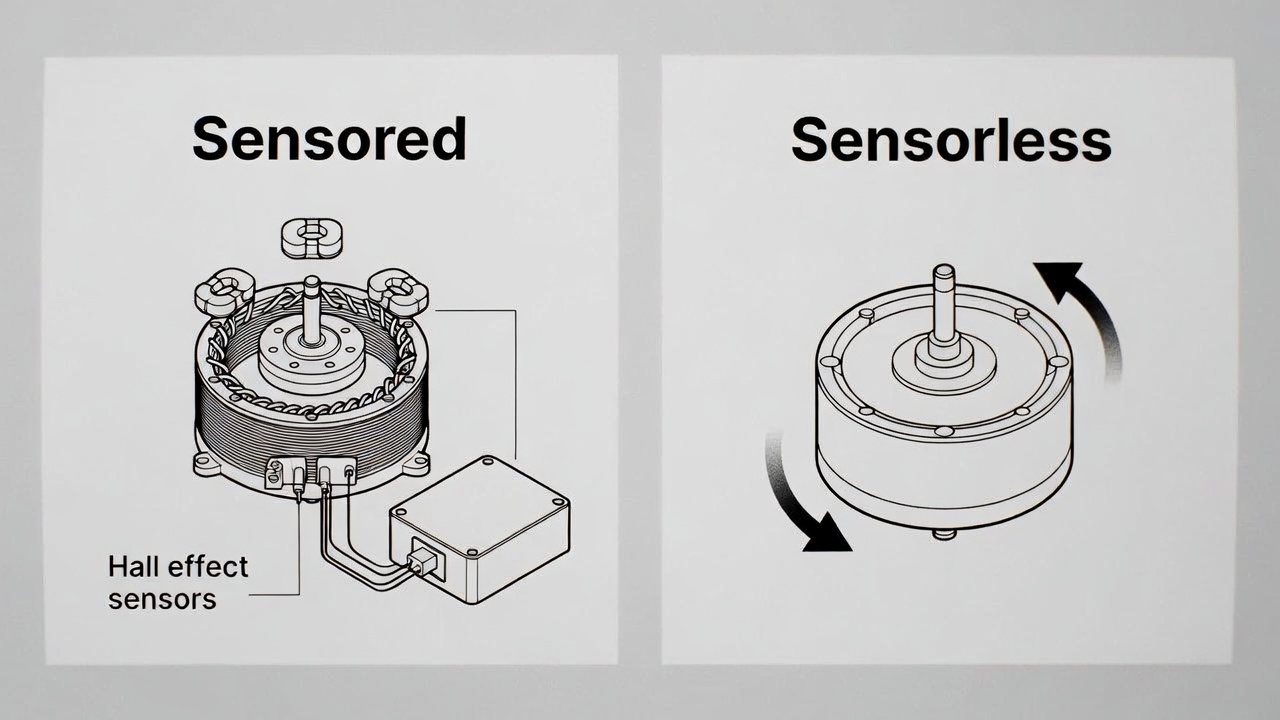
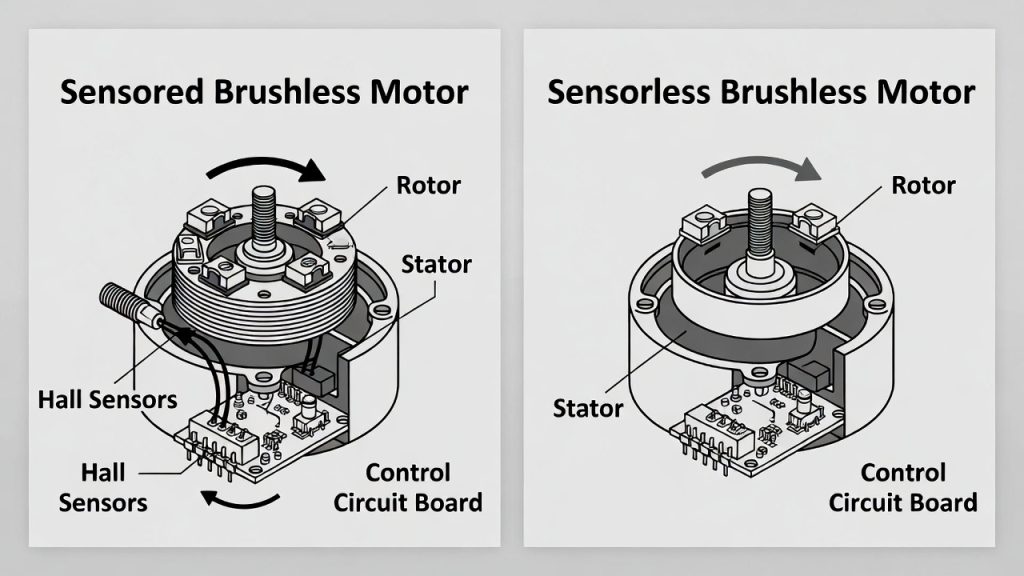
A sensored brushless motor has physical sensors built inside it. These are usually small devices called Hall effect sensors.
Hall effect sensors detect the magnetic field of the rotor. They tell the motor controller exactly where the rotor is at any given moment. The controller uses this real-time data to fire the right coils at the right time.
Think of it like this: the sensors are basically giving the controller a live GPS signal. The controller always knows where the rotor is, so it can react quickly and accurately.
How Hall Effect Sensors Work
Hall sensors are tiny chips placed around the stator (the stationary part of the motor). As the rotor spins and its magnets pass by, the Hall sensors detect the change in magnetic field. They send a signal to the ESC (Electronic Speed Controller) that says, “Hey, the rotor is right here.”
Most sensored motors use three Hall sensors placed 120 degrees apart. This gives the controller a very clear picture of rotor position throughout the full rotation.
Benefits of Sensored Motors
Sensored brushless motors shine in specific situations. Here’s why people love them:
Smooth start-up: Because the controller always knows where the rotor is, it can start the motor gently and smoothly. Even at zero RPM, it knows the exact position.
Great for low-speed control: Sensored motors handle slow speeds really well. You get precise control even when the motor is barely turning.
No cogging: Cogging is that jerky, stuttering feel you sometimes get when a motor starts from a stop. Sensored motors largely eliminate this.
Better efficiency at low loads: When the motor isn’t working hard, the sensors keep everything smooth and optimized.
Drawbacks of Sensored Motors
Nothing is perfect. Sensored motors come with their own trade-offs:
More complex design: There are extra wires and connectors — typically a sensor cable in addition to the three main motor wires. More connections mean more potential failure points.
Sensors can fail: If a Hall sensor gets damaged (from heat, vibration, or water), the motor may not run at all, or it may run poorly.
Slightly higher cost: The extra components and wiring make sensored motors a bit more expensive to produce.
Heavier and bulkier: The added sensor hardware adds weight, even if it’s small.
What Is a Sensorless Brushless Motor?
A sensorless brushless motor has no physical sensors inside. It doesn’t use Hall effect sensors or any other position-detecting hardware.
So how does the controller know where the rotor is?
It uses a trick called back-EMF sensing (back Electromotive Force). When the rotor spins, it generates a small voltage in the coils that aren’t currently powered. The controller reads this back-EMF signal to figure out where the rotor is.
It’s like listening to the motor instead of watching it.
How Back-EMF Works
Here’s the simple version: when a spinning magnet passes by a coil, it creates a tiny voltage in that coil. The ESC reads this voltage and calculates rotor position from it.
The faster the motor spins, the stronger and clearer this signal gets. At higher speeds, back-EMF sensing works really well.
But at very low speeds or at a standstill? The back-EMF signal is too weak to read. The motor basically has no idea where the rotor is until it starts moving.
That’s why sensorless motors have a quirky start-up behavior — they often use a “blind start” sequence where the controller forces the motor to spin by guessing rotor position, then locks onto the back-EMF once the motor picks up speed.
Benefits of Sensorless Motors
Sensorless motors are the most common type in many applications. Here’s what makes them appealing:
Simpler design: No sensor wires, no sensor connectors, no Hall sensor components. Fewer parts mean fewer things that can go wrong.
More durable: Without fragile sensors, these motors handle rough conditions better. Vibration, water, and dust are less of a problem.
Lighter weight: No extra hardware means a cleaner, lighter motor.
Lower cost: Simpler to build means cheaper to buy.
Better at high speeds: Back-EMF sensing becomes very accurate at high RPM. Sensorless motors are often preferred for high-speed applications.
Drawbacks of Sensorless Motors
Sensorless motors aren’t perfect either. Here are the downsides:
Rough start-up: The “blind start” can feel jerky or uncertain, especially under load. Some sensorless systems cogging badly at startup.
Poor low-speed performance: Fine control at very slow speeds is limited. The back-EMF signal is too weak to read accurately.
Not ideal for precision slow-speed work: Applications that need smooth, exact control at low RPM are tough for sensorless motors.
Sensored vs Sensorless: A Side-by-Side Look
Let’s put it all in one place so you can compare easily.
| Feature | Sensored | Sensorless |
|---|---|---|
| Position detection | Hall effect sensors | Back-EMF sensing |
| Start-up smoothness | Very smooth | Can be jerky |
| Low-speed control | Excellent | Poor |
| High-speed performance | Good | Excellent |
| Complexity | Higher | Lower |
| Durability | Lower (sensor risk) | Higher |
| Cost | Higher | Lower |
| Weight | Slightly heavier | Lighter |
| Wiring | More (sensor cable) | Less |
Where Each Motor Type Is Used
This is where it gets practical. Let’s look at real-world uses.
Sensored Motors Are Common In:
RC cars and trucks: Especially off-road and on-road crawlers where smooth take-off and precise low-speed handling matter a lot. Hobbyists who race on smooth tracks often choose sensored setups for consistent launches.
Robotics: Robots often need slow, precise movement. A robot arm picking up an object doesn’t want to jerk or stutter. Sensored motors give that smooth, controlled movement.
CNC machines: Precise positioning is everything in CNC. Sensored motors help the machine move accurately at slow feed rates.
Electric bikes and scooters: Many e-bikes use hub motors with Hall sensors. The sensored setup gives riders a smooth, natural start from a stop — no lurch or hesitation.
Industrial equipment: Factory machines that need precise low-speed control often rely on sensored brushless motors.
Sensorless Motors Are Common In:
Drones and multirotors: Drones typically run at high RPM and need lightweight motors. Sensorless motors are standard in the drone world because they’re light, powerful, and work great at speed.
RC planes and helicopters: Same logic — high RPM, lightweight, simple.
Power tools: Drills, circular saws, and angle grinders don’t need to run at super-slow speeds. Sensorless motors work great here.
Pumps and fans: These applications run at steady, medium-to-high speeds. Back-EMF sensing works perfectly.
Electric skateboards: At speed, sensorless motors perform well. Start-up feel can be different from an e-bike, but many riders don’t mind.
The Role of the ESC (Electronic Speed Controller)
You can’t talk about sensored vs sensorless motors without mentioning the ESC.
The ESC is the brain that controls the motor. It takes signals from your receiver or flight controller and translates them into motor power.
For sensored motors, you need an ESC that has a sensor input — a small connector that plugs into the sensor wire from the motor. Not all ESCs have this. A sensored motor plugged into a non-compatible ESC will simply run in sensorless mode (and might not work well at low speeds).
For sensorless motors, most ESCs work just fine. Back-EMF sensing is built into virtually every brushless ESC out there.
Some high-end ESCs can actually run in “sensored mode when slow, sensorless mode when fast” — this is called hybrid mode or sensored-to-sensorless transition. It’s a smart approach that gives you the best of both worlds.
Sensored vs Sensorless for RC Cars: A Deeper Dive
RC cars deserve a special mention because this debate is huge in that hobby.
In RC car racing, the sensored brushless setup is king for on-road and carpet racing. Drivers want a smooth, consistent launch every single time. A jerky start can cost them the race.
Off-road rock crawlers take it even further. Rock crawling needs extreme low-speed control. The crawler has to inch over obstacles slowly and precisely. Sensorless motors simply can’t deliver that kind of finesse.
Bash cars and general backyard bashers often use sensorless setups, though. They’re cheaper, tougher, and handle crashes better. If you’re just driving around and having fun, sensorless is totally fine.
Sensored vs Sensorless for Drones: Another Closer Look
In the drone world, sensorless is the clear standard.
Here’s why: drone motors spin at insanely high RPM — often 10,000 to 30,000+ RPM. At those speeds, back-EMF sensing is crystal clear. The controller always knows exactly where the rotor is.
Drones also need lightweight components above all else. Every gram matters. Adding sensor wires and connectors to tiny drone motors just isn’t practical.
Plus, drones don’t need to start at zero speed. They always start from a stopped state in the air or on the ground, and the slight jerk of a sensorless start is totally unnoticeable in flight.
So for drones: sensorless all the way.
Can You Use a Sensored Motor Without the Sensor Cable?
Yes, you can. A sensored motor can run without the sensor cable connected. It’ll just operate like a sensorless motor — using back-EMF for position sensing.
The performance will drop at low speeds, and you might notice some cogging at start-up. But the motor will still work.
This is handy if your sensor cable gets damaged. You can keep going without it, just with reduced low-speed performance.
Temperature, Vibration, and Reliability
One practical concern that often gets overlooked: reliability in tough conditions.
Hall effect sensors are small electronic components. They can fail from:
- High heat (if the motor runs hot)
- Strong vibration (common in RC cars and power tools)
- Water or mud exposure
- Physical damage from crashes
When a Hall sensor dies, the motor may not start, or it may run very roughly. You’d need to repair or replace the sensor — which isn’t always easy.
Sensorless motors don’t have this problem. There are no sensors to fail. The back-EMF system is entirely based on the motor’s own magnetic properties, which are extremely reliable.
This is a big reason why sensorless motors dominate in applications where durability matters more than precision.
The KV Rating and Motor Selection
When you’re looking at brushless motors, you’ll often see a KV rating. This tells you how many RPM the motor produces per volt with no load.
A 2000KV motor on a 3S LiPo (about 11.1V) would spin at roughly 22,200 RPM with no load.
KV rating is relevant to the sensored vs sensorless debate because:
- Low KV motors (slow-turning, high-torque) are often used where low-speed control matters — like e-bikes, CNC, and crawlers. These applications tend to use sensored setups.
- High KV motors (fast-spinning, lower torque) are common in drones and RC planes. These applications use sensorless setups.
So the KV rating can actually hint at which type of motor and control system makes sense.
Hybrid Mode: Getting the Best of Both
Some modern ESCs and motor systems offer a hybrid mode. This combines sensored and sensorless operation.
Here’s how it works:
- When the motor starts from a stop, the ESC uses the Hall sensors for smooth, precise start-up control.
- Once the motor reaches a certain speed, the ESC switches to back-EMF sensing for high-speed performance.
This hybrid approach is common in high-performance RC car systems. It gives drivers the smooth launch of a sensored system plus the efficiency and speed of a sensorless system.
If you want the absolute best performance across all speed ranges, a hybrid-capable system is worth looking into.
Cost Comparison
Let’s talk money.
Sensored motors generally cost more. The Hall sensors add to the manufacturing cost, and the extra sensor connectors and cables add to the overall system cost. You also need a compatible ESC with a sensor port.
Sensorless motors are cheaper to produce. No sensors, fewer wires, simpler design. This makes them a popular choice when budget matters.
For beginners, a sensorless setup is often the most affordable way to get into brushless motor territory. You can always upgrade later if you find you need the precision of a sensored system.
Noise and Vibration
Here’s a small detail that can make a big difference in some applications.
Sensored motors tend to run more quietly and smoothly at low speeds. The precise position sensing allows for perfectly timed coil switching, which reduces the buzzing and humming you sometimes hear from motors.
Sensorless motors at low speeds can produce more audible noise because the back-EMF signal is weak and the timing isn’t as precise. This leads to slightly rougher commutation and more vibration.
At high speeds, both types run smoothly. But if you’re building something where quiet operation matters — like a camera gimbal or indoor robot — sensored often wins on noise.
Which One Should You Pick?
Okay, so you’ve read all of this. Now the real question: which one do you actually need?
Here’s a simple guide:
Pick sensored if:
- You need smooth, precise start-up
- You run the motor at slow speeds a lot
- You’re building an RC car for racing or crawling
- You’re working on a robot or CNC machine
- You’re doing an e-bike build
- Smooth, quiet operation at low RPM is important
Pick sensorless if:
- You’re building a drone or RC plane
- High speed and lightweight design are priorities
- You need a durable, simple system
- Budget is a concern
- You don’t need fine low-speed control
- Harsh conditions like water, mud, or crashes are likely
Pick a hybrid system if:
- You want the best of both worlds
- You’re building a high-performance RC car
- You have the budget for a quality ESC and motor combo
Final Thoughts
The sensored vs sensorless debate isn’t really about one being better than the other. They’re both great — just built for different jobs.
Sensored motors are the right tool when you need smooth, precise, low-speed control. Sensorless motors are the right tool when you need lightweight, durable, high-speed performance.
Once you know what your project needs, the choice becomes pretty clear.
If you’re just starting out, don’t overthink it. Pick the type that fits your application, grab a compatible ESC, and get your motor spinning. You’ll learn a ton just by doing.
And if you ever want to go deeper — into FOC (Field Oriented Control), motor winding configurations, or stator design — that rabbit hole is always there waiting for you.
For now, you’ve got the basics locked in. Go build something awesome.
Have questions about your specific build? Drop them in the comments — happy to help you figure out which motor setup makes the most sense for your project.