How RC Car Differentials Work?
If you’re new to the RC car hobby, you might have heard people talk about differentials. They throw around terms like “open differential,” “limited-slip,” and “locked differential” at hobby shops and track days. It sounds complicated, but I promise it’s not. A differential is actually one of the most clever pieces of engineering in your RC car.
Think of your RC vehicle as a mini version of a real car. Just like full-size vehicles need a differential to work properly, so do RC cars. Without one, your RC car would have a hard time turning corners. It might even destroy itself trying to drive around a bend.
So what exactly does a differential do? And why should you care about it? Let’s break it down.
What Is an RC Car Differential?
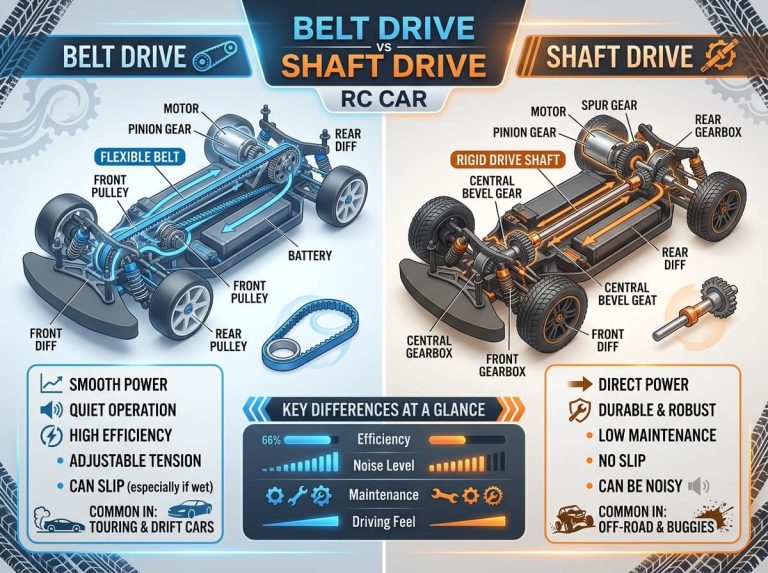
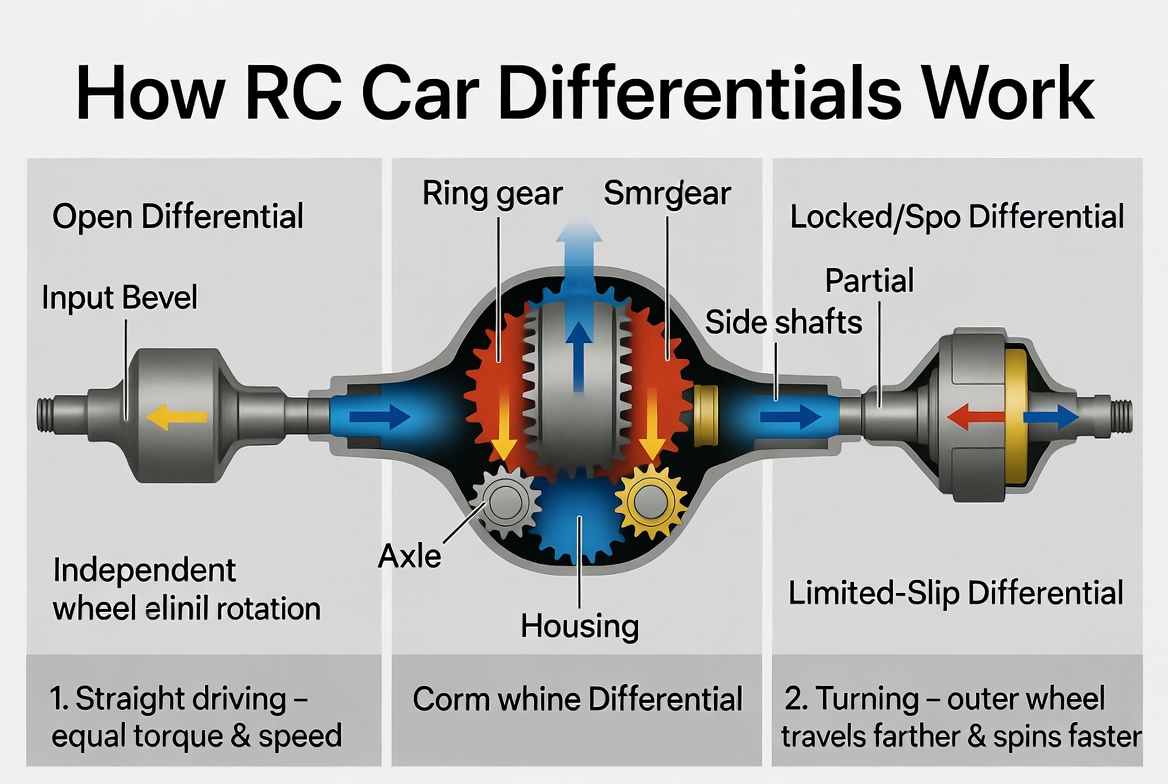
A differential is a mechanical device that lives inside your RC car’s transmission. Its job is simple: it lets the left and right wheels spin at different speeds. That’s it. That’s the whole concept.
You might be thinking, “Why would the wheels need to spin at different speeds?” Great question. The answer is all about how cars turn.
When your RC car goes around a corner, the outside wheel travels a longer distance than the inside wheel. If both wheels spin at the exact same speed, the inside wheel would have to slip or skid. It would fight against the ground. That creates friction, reduces speed, and puts strain on your gearbox and motor.
A differential solves this problem. It lets each wheel speed up or slow down independently. The inside wheel spins slower while the outside wheel spins faster. Your car takes the turn smoothly without fighting itself.
Why You Need a Differential in Your RC Car
Let’s think about a real-world example. Imagine walking around a cone with a friend. Your friend walks on the inside of the circle, closer to the cone. You walk on the outside, farther from the cone. To stay together, you have to walk faster than your friend, right?
Your RC car’s wheels face the same problem. Without a differential, both wheels would be forced to spin at the same speed. The inner wheel would slip backward relative to the car’s body. The outer wheel would push forward harder than it needs to. This creates a lot of friction and wear.
Your differential acts as a mechanical translator. It says, “Left wheel, spin a bit slower today. Right wheel, spin a bit faster.” Both wheels still get power from the motor, but they each get the right amount for their job.
This is why even beginner RC cars have differentials. It’s not a fancy upgrade. It’s a fundamental part of how these vehicles work.
Types of Differentials Used in RC Cars
Not all differentials are the same. RC cars use different types depending on the racing conditions and driving style. Let’s look at the main types you’ll encounter.
Open Differential
An open differential is the standard setup in most RC cars. It’s simple, cheap, and works well on flat, even ground.
Here’s how it works: The differential splits power equally between both wheels. Each wheel gets the same amount of rotational force (torque). But here’s the key: when one wheel spins faster, the other wheel automatically spins slower. The differential balances them out.
The open differential uses a clever system of gears. There’s a center gear (called the spider gear) that sits in the middle. On either side are the axle gears (also called side gears). When you turn, the spider gear shifts, causing one axle gear to speed up and the other to slow down.
Open differentials are great for smooth tracks and paved surfaces. But they have a weakness: if one wheel loses grip, it will spin freely while the other wheel stops moving. Imagine one wheel hits water or ice. That wheel spins like crazy while the other wheel doesn’t move. Your car goes in a circle or spins out. Not ideal.
Limited-Slip Differential
A limited-slip differential tries to fix the problem with open differentials. It still lets wheels spin at different speeds, but it adds friction to prevent one wheel from spinning too much faster than the other.
Think of a limited-slip differential as a middle ground. It gives you some of the benefits of an open differential (smooth turning) and some of the benefits of a locked differential (which we’ll talk about next).
Limited-slip differentials use friction discs or plates. These discs sit between the gears. When one wheel tries to spin much faster than the other, the discs catch and create friction. This friction slows down the spinning wheel and keeps both wheels moving together.
The amount of friction varies depending on the design. Some limited-slip differentials have more friction. Others have less. Racers often choose their differential type based on the track conditions.
Limited-slip differentials work great on loose surfaces like dirt and grass. They give you better traction than an open differential while still allowing the wheels to speed up and slow down as needed.
Locked Differential
A locked differential forces both wheels to spin at the exact same speed. No flexibility. No difference. Both wheels are locked together.
You might think this sounds bad based on what we said earlier. But locked differentials actually excel in certain situations. Off-road driving is one of them.
When you’re driving on rocks, dirt, or other rough terrain, wheel slip happens all the time. Both wheels need to bite into the ground with equal force. A locked differential delivers consistent power to both sides. This gives you maximum traction and makes your RC car rock-solid on rocks.
The problem with locked differentials shows up on smooth tracks. When you turn on pavement or smooth grass, both wheels still spin at the same speed. The inside wheel has to slip sideways. Your car pushes wide around the corner. It feels less responsive and you lose steering precision.
Most racers use locked differentials only on off-road courses. On-road racers stick with open or limited-slip differentials.
How the Differential Gearing System Works
Now let’s dig into the actual mechanics. How do these gears pull off this balancing act?
The differential uses a set of four gears:
The ring gear is the big gear that takes power from your motor through the transmission. It’s shaped like a ring and sits at the end of the motor shaft.
The spider gear (or cross-pin gear) sits perpendicular to the ring gear. When the ring gear turns, it makes the spider gear turn too.
The two axle gears (or side gears) are smaller. Each one sits on one of your car’s axles. The spider gear sits between them.
Here’s where the magic happens:
When you drive straight, all these gears turn together like one solid unit. The ring gear spins, the spider gear spins with it, and both axle gears spin at the same speed. Both wheels go straight.
When you turn, something different occurs. The steering causes resistance on the inside wheel. That resistance pushes back on one of the axle gears. The spider gear responds by shifting slightly. As it shifts, it speeds up one axle gear while slowing down the other.
The outside wheel (which has less resistance) speeds up. The inside wheel (which has more resistance) slows down. Both wheels get power, but one gets more turning motion than the other.
All of this happens automatically. You don’t have to think about it. The gears do the math for you.
Differential Lock vs. Open Differential: What’s the Real Difference?
Let’s compare these two side by side because many beginners mix them up.
An open differential lets each wheel spin freely at its own speed. When traction is even on both sides, they spin together. When traction changes, they slip relative to each other. This is great for turning but bad for traction when one wheel hits a slippery spot.
A differential lock forces both wheels to spin together. There’s no slipping. Both wheels must turn at the same speed. This is great for traction but bad for turning because the inside wheel has to slide sideways.
Some RC cars have a selectable differential. You can switch between locked and open while you drive. This gives you the best of both worlds: open diff for on-road corners, locked diff for off-road terrain.
Spool vs. Differential: Another Common Confusion
Here’s where people get really confused. Some RC cars don’t have a differential at all. They have something called a spool instead.
A spool is basically what you get when you lock the differential permanently. Both axles are connected to one solid shaft. Both wheels must spin at the same speed, always.
Spools are cheap and simple. They work great on drag racing where you only go straight. They also work okay on very tight rally courses where you’re constantly sliding sideways anyway.
But for general driving and turning, a spool makes your car feel twitchy and unstable. It doesn’t turn smoothly. Most people prefer differentials.
The Gear Ratio and Differential Relationship
Here’s something that confuses a lot of beginners: gear ratio and differential are not the same thing, but they work together.
The gear ratio tells you how many times the motor shaft spins compared to the wheel axle. A 3.5:1 ratio means the motor spins 3.5 times for every 1 time the wheels spin.
The differential, on the other hand, is about speed distribution between the two wheels once the power reaches the axles.
Think of it this way: The gear ratio controls overall speed. The differential controls how that speed distributes between left and right wheels.
You can have a fast gear ratio with an open differential. You can have a slow gear ratio with a locked differential. They work independently but together.
Choosing the Right Differential Type for Your RC Car
So which type should you use? That depends on where you’re driving.
On-road racing needs an open or limited-slip differential. You’re turning tight corners on smooth ground. Your wheels need to spin at different speeds to take those turns smoothly. An open differential is the cheapest choice. A limited-slip differential gives you better control on difficult sections.
Off-road and crawling works best with a locked differential or spool. You’re driving over rocks, dirt, and obstacles. Both wheels need to bite into the ground with equal force. The extra traction makes a huge difference. You’ll sacrifice some turning smoothness, but you gain serious traction.
Basher driving (casual backyard fun) can use either. If you’re driving in your yard on grass, an open differential is fine. If you’re climbing over obstacles and rough ground, lock it up.
Your differential type can usually be changed without replacing your whole transmission. Most RC cars let you swap out the differential gears. So don’t feel locked into your first choice.
How to Maintain Your RC Car’s Differential
Your differential needs care and attention to work its best.
Keep it clean. Dirt and grass get into your diff. They gunk up the gears and create friction. After each drive session, rinse out your RC car with water and let it dry. Pay special attention to the differential housing.
Use the right lubricant. Differentials need oil or grease to reduce friction between gears. Always use lubricant designed for RC cars. The wrong type can gunk up or evaporate. Most hobby shops sell differential oil or grease specifically formulated for RC transmissions. Apply a small amount to the gears during assembly and after cleaning.
Check the gears regularly. Look for chipped teeth or cracks. Gears wear down over time. If they’re damaged, replace them. Damaged gears make your car slow and create weird noises.
Tighten the differential housing. Over time, vibration loosens bolts. Use a small wrench or hex key to tighten the housing bolts after several drive sessions. Don’t over-tighten or you’ll crack the plastic.
Avoid water damage. While a quick rinse is okay, don’t soak your differential in water. Water damages the gears and causes rust on metal parts. Always dry it thoroughly after cleaning.
Common Differential Problems and How to Fix Them
Sometimes differentials break. Here are the most common issues and what they mean.
Grinding noises: This usually means the gears are damaged or the differential is dry. Take apart the transmission, inspect the gears, and apply fresh lubricant. If the gears are chipped, replace them.
Wheels locking up: If one wheel stops moving while the other spins, the differential might be stuck. Clean out the transmission and apply more oil. If it still sticks, the gears might be permanently damaged.
Uneven turning: If your RC car turns more sharply in one direction than the other, the differential might be failing. It could also be a bent axle. Check both.
Slow response: When the differential gets old, it might not respond as quickly to turning inputs. This is often just wear and tear. Cleaning and re-lubricating usually helps. If not, replace the differential.
Leaking oil: If oil is running out of your transmission, the housing seal is broken. You’ll need to reseal the transmission or replace the housing.
Most of these problems are preventable with regular maintenance. Keep your differential clean and well-lubricated, and it’ll last for years.
Upgrading Your Differential: When and Why
Sometimes the stock differential that came with your RC car just isn’t good enough. Maybe you want better handling. Maybe you want more durability. Maybe you want to switch between driving styles.
Aftermarket differentials are available for most popular RC cars. These are often built with higher-quality materials and tighter tolerances. They perform better and last longer than stock differentials.
Selectable differentials let you switch between locked and open while driving. Some models use electronic controls. Others use a manual knob. These are great for people who drive in multiple environments.
Precision-cut gears reduce friction and noise. If you upgrade to aftermarket gears, your car will feel faster and run more smoothly.
Stronger housings can take more punishment. If you drive hard and break things often, a reinforced housing is worth the investment.
Before upgrading, think about what you’re really trying to achieve. Do you want better speed? Better handling? Better durability? Different upgrades address different problems.
The Physics Behind Differential Action
If you’re curious about the deeper physics, here’s what’s happening.
When your RC car goes around a corner, the outside wheels travel on a larger circle than the inside wheels. The distance difference increases as the turn gets tighter.
Without a differential, both wheels would be forced to travel the same distance. One wheel would have to slip. The amount of slip depends on the turn radius and wheel width.
The differential eliminates this slip (or minimizes it with limited-slip) by adjusting wheel speed. It uses gears to do the math automatically. Each wheel gets the speed it needs for its specific path.
This works because of how gears transfer force and motion. Gears are like mathematical machines. When you mesh two different-sized gears, the smaller gear spins faster than the larger gear. The differential uses this principle to create the speed difference.
The amount of speed difference depends on the gear ratios and the exact configuration. Different differential designs produce different speed distributions.
Differential Break-In
When you first get an RC car or replace your differential, you need to break it in properly.
During break-in, lubricant distributes throughout the gears. Metal shavings from manufacturing get cleared out. The gears start working together smoothly.
Here’s the proper way to break in a new differential:
Drive gently for the first few sessions. Don’t go wide open throttle. Let the gears mesh and settle.
Apply power gradually. Smooth acceleration and deceleration are better than sudden jerking.
Drive in a straight line more than you turn. This lets the differential experience normal operation before facing heavy turning stress.
After a few hours of gentle driving, your differential should be fully broken in. You can then drive normally.
Some people use break-in oil, which is thinner than regular differential oil. This helps the break-in process. After break-in, you can switch to standard oil.
Comparing Differentials Across RC Car Types
Different types of RC cars need different differentials.
On-road touring cars usually have open differentials with high precision. They need smooth turning and consistent speed delivery.
Off-road buggies and trucks often have locked differentials. Some high-end models have selectable diffs. Traction matters more than turning smoothness off-road.
Rally cars might use limited-slip differentials. They need a balance between traction and turning.
Drag racing cars don’t need differentials at all. Many use spools or locked diffs. They’re only going straight.
Rock crawlers need strong locked differentials. They face extreme traction challenges.
The right differential depends on the car and the track. Always check what your RC car came with. If you’re not happy with performance, that’s a good clue that a different differential type might help.
Differential Tuning for Advanced Drivers
Once you understand how differentials work, you can tune them for performance.
Some differentials have adjustable friction. You can turn a knob or change washers to increase or decrease the friction between gears. More friction = more traction but less turning smoothness. Less friction = better turning but less traction.
You can also adjust which differential type you use. Some drivers carry multiple cars with different differentials. They pick the right one for each track or condition.
Some cars let you change gears without changing the whole differential. Different gear sets produce different torque distributions. This gives you more control over how your car handles.
Tuning a differential takes time and testing. You need multiple drive sessions to figure out what works best. But once you dial it in, your car will feel like an extension of your will.
Real-World Examples of Differentials in Action
Let’s talk about what you actually feel and see when you drive an RC car with different differentials.
With an open differential, your car turns smoothly and naturally. It responds to steering input immediately. But when you hit a muddy spot or ice, one wheel might spin freely and you’ll lose traction. Your car might even do a half-spin.
With a locked differential, your car feels planted. Both wheels stay gripped. Even on slippery spots, you have traction. But turning feels different. The front end tends to push wide on hard turns. Your car might feel less responsive and more difficult to control precisely.
With a limited-slip differential, you get something in between. It turns pretty smoothly but it also holds traction better than an open diff. It’s the Goldilocks option: not too much, not too little.
The best differential is the one that matches your driving style and your track conditions.
Conclusion: Why Your Differential Matters
Your RC car’s differential is one of the most important parts you’ll never think about. It works silently in the background, balancing power between your wheels.
Without a differential, RC cars would be jerky and difficult to control. They’d fight themselves on every corner. They’d lose traction constantly.
A good differential makes your car feel like it’s dancing. It turns smoothly. It grips consistently. It responds to your input instantly.
Now that you understand how differentials work, you can make better choices about your RC car. You can pick the right type for your conditions. You can maintain it properly. You can even tune it for better performance.
Start with basic knowledge. Drive with what came on your car. Learn how it feels. Then, if you want to improve, you’ll know exactly what to change.
The differential is simple in concept but brilliant in execution. It’s a perfect example of mechanical engineering doing what it does best: solving real problems with elegant solutions.
Next time someone mentions their differential at the hobby shop, you’ll know exactly what they’re talking about. And you’ll understand why it matters so much to your RC car’s performance.
Happy driving!