What Is a Brushless RC Motor?
You’ve probably heard RC car enthusiasts talk about brushless motors. Maybe you’ve seen one spinning in a hobby shop. Or you’re thinking about upgrading your RC car and keep hearing that brushless is the way to go. If you’re confused about what makes them different, you’re not alone. Let me break this down for you.
A brushless RC motor is an electric motor that doesn’t have brushes. Simple as that. But there’s way more to the story. These motors have become the standard in the RC hobby. They’re faster, stronger, and way more efficient than their older cousins. Let’s dive into why that matters and how these little powerhouses actually work.
The Basics: What Even Is an RC Motor?
Before we talk about brushless motors, let’s cover the basics. An RC motor is an electric motor designed to power remote control vehicles. It takes electrical power from your battery and turns it into mechanical motion. That motion spins your wheels, turns your propellers, or makes your drones fly.
The main job of any motor is simple: convert electrical energy into spinning power. How the motor does that job matters a lot. It affects your speed, your run time, your vehicle’s power, and your overall experience. Two different motor types handle this job in two different ways.
Brushed Motors: The Old School Way
Let’s talk about brushed motors first. These are the traditional motors that have been around forever. Your cheap toy-grade RC car probably uses a brushed motor. Some hobbyists still use them for casual driving around the yard.
Here’s how a brushed motor works. Inside the motor, you have a spinning part called a rotor or armature. This rotor has copper coils wrapped around it. When you send electricity through these coils, they create a magnetic field. This magnetic field interacts with permanent magnets in the motor’s outer case. The result? The rotor spins.
The “brush” part comes from carbon brushes. These brushes sit inside the motor and make electrical contact with the rotor. They slide along a part called the commutator. Think of the commutator as a switching mechanism. The brushes tap on different parts of the commutator as the rotor spins. This tapping switches which coils get power at any given moment. The switching keeps the rotor spinning in the same direction.
Brushed motors work fine for basic RC driving. They’re cheap. They’re simple. You can find replacement parts everywhere. But they have some real drawbacks.
The brushes and commutator create friction. All that friction means heat. The heat causes energy loss. You lose battery power to heat instead of using it to make your car go fast. Brushes also wear out. After a bunch of use, the brushes get short and stop working. You have to replace them. Over time, brushes leave carbon dust inside your motor. This dust can interfere with performance.
Enter Brushless Motors: The Modern Revolution
Brushless motors took the RC world by storm because they fixed all these problems. A brushless motor still converts electrical energy to spinning motion. But it does it completely differently.
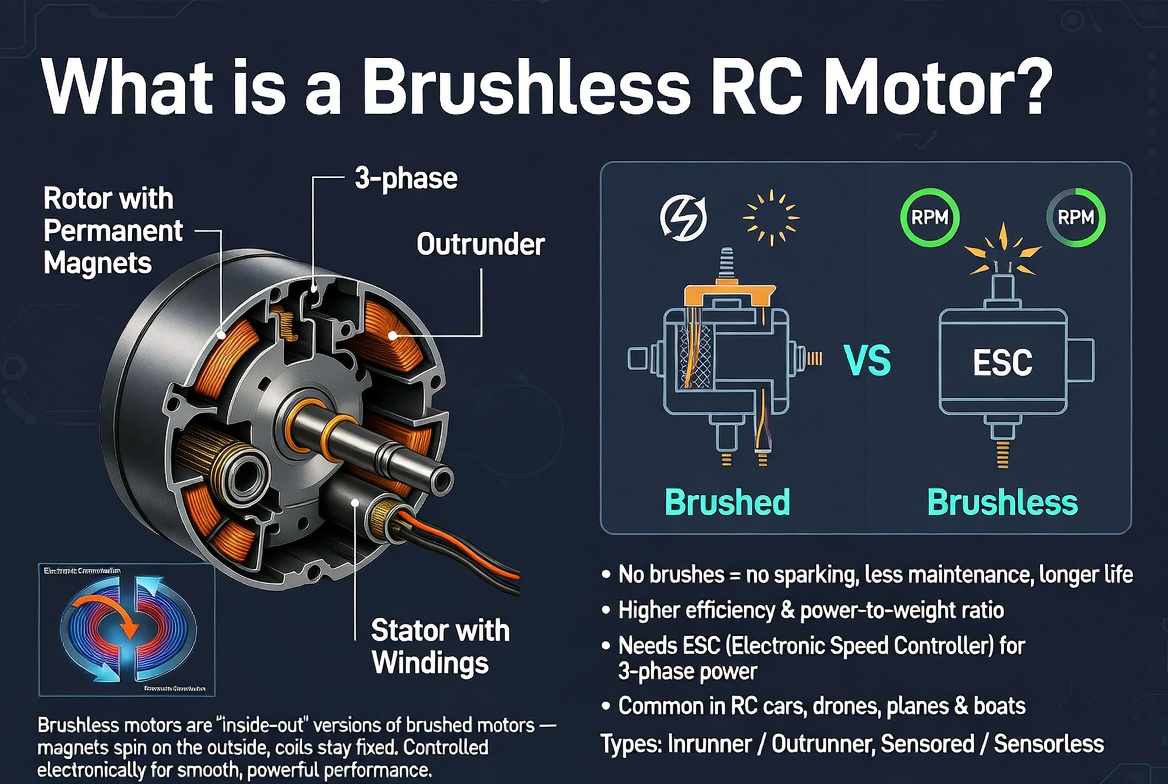
The biggest difference? No brushes. No carbon dust. No commutator to wear out. Instead of brushes switching power to the rotor, an electronic controller handles all the switching. This controller is called the ESC, which stands for electronic speed controller.
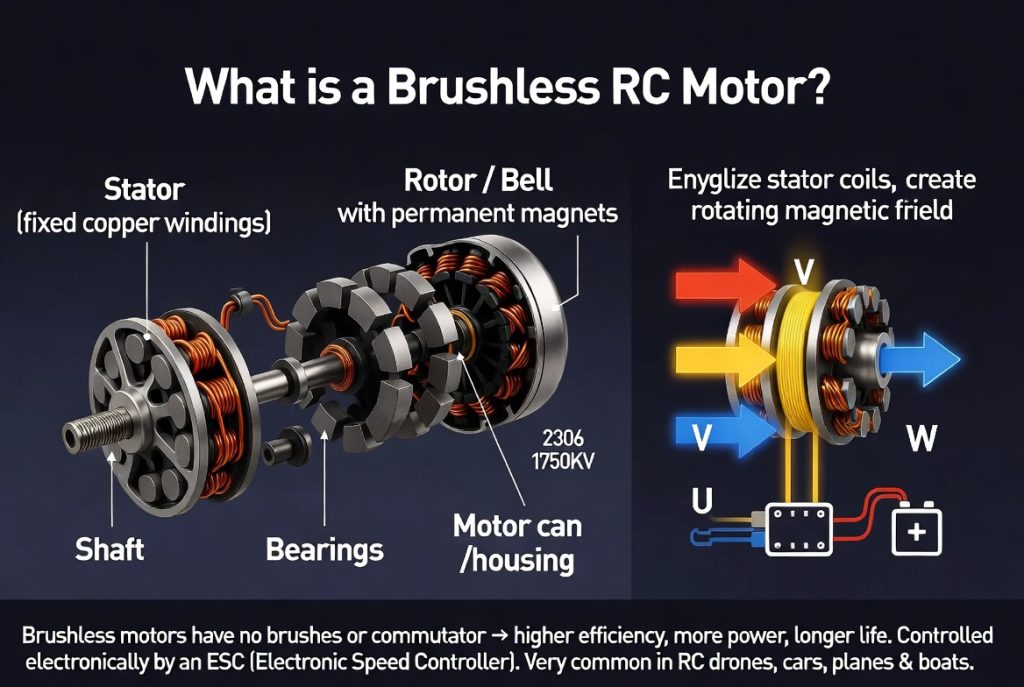
In a brushless motor, the permanent magnets are on the outside, and the coils are on the inside. It’s basically the opposite of a brushed motor. The rotor has permanent magnets on it. The stator has coils of wire wound around it. The stator is the non-moving part of the motor.
Here’s the cool part. The ESC tells each coil exactly when to turn on and off. It creates electromagnetic pulses in a specific pattern. These pulses push the magnetic rotor around at incredible speeds. The ESC uses sensors to know exactly where the rotor is at every moment. This allows it to time the pulses perfectly.
Why Brushless Motors Are Better: The Real Advantages
Let’s talk about why brushless motors have taken over the hobby. The advantages are huge.
Much More Power
Brushless motors pack way more power into a smaller package. They can deliver intense torque and speed. If you take a brushed motor and a brushless motor the same physical size, the brushless version will be stronger every single time. This is why racing drones use brushless motors. These drones need serious power to fly fast and maneuver crazily. A brushed motor couldn’t handle the demands.
Speed That Blows Your Mind
The top speed difference is dramatic. Brushed RC cars max out around forty or fifty miles per hour for decent quality ones. A brushless RC car easily hits sixty or seventy miles per hour. High-end racing cars can go eighty miles per hour or faster. The speed comes from the efficiency of brushless design. With no friction from brushes, more energy goes into making your car move.
Incredible Efficiency
Brushless motors waste way less energy as heat. Remember those brushes creating friction? That friction turned fuel into wasted heat. Brushless motors get way more power out of your battery. You can drive your car much longer before the battery dies. Or you can drive the same distance with a smaller battery. This efficiency is huge for drones. Battery weight affects flying time directly. Brushless motors let drones fly longer on the same battery.
Built to Last
There’s nothing inside a brushless motor that wears out. No brushes to replace. No commutator to get damaged. Brushless motors last way longer than brushed motors. You can run them hard and put them away wet without worrying. Many hobbyists report running their brushless motors for years with zero maintenance. Just keep them clean and you’re golden.
Smooth and Consistent Power
Brushless motors deliver smooth, consistent power delivery. The electronic controller manages power flow perfectly. This means your RC car feels smooth when you drive it. Brushed motors have some jerkiness to them. The brush switching isn’t as smooth as electronic control. For serious drivers, that smoothness matters a lot.
Less Maintenance Required
With brushless motors, you don’t have to open them up and replace brushes. You don’t have to deal with carbon dust problems. You don’t have to mess with adjusting brushes to get good performance. Just charge the battery, go drive, and have fun. The simplicity is amazing.
Understanding the Different Types: Inrunner vs Outrunner
Brushless motors come in two main types. These types are based on what spins and what stays still.
Inrunner Motors
An inrunner motor has the magnets on the inside spinning part, called the bell. The coils wrap around the outside on the stator. These motors are compact and spin really fast. They’re perfect for RC cars where you need speed. Inrunner motors can hit crazy high RPMs. You usually need a transmission or gears to convert that speed into usable power for your wheels.
Outrunner Motors
An outrunner motor flips the design. The magnets are on the outside bell, and the coils are on the inside stator. When power flows, the outer bell spins around the stator. Outrunner motors have a much wider diameter but shorter length. They produce massive torque at lower RPMs. You don’t need gearing with an outrunner. The torque is already there. This design is perfect for quadcopter drones. The motor can drive a propeller directly without any gears. It’s simple and reliable.
Both types are brushless. Both types have massive advantages over brushed motors. The choice between them depends on your specific RC vehicle. For cars, inrunners work great. For drones and helicopters, outrunners shine.
The Electronic Speed Controller: The Brains of the Operation
You can’t run a brushless motor without an ESC. That’s the electronic speed controller we mentioned earlier. This little circuit board is the brain of your brushless system.
The ESC takes signals from your receiver. Your receiver gets radio signals from your transmitter, your remote control. The ESC translates those signals into electrical pulses that flow to the motor. The pulses tell the motor coils when to turn on and off. The timing and intensity of the pulses determines how fast the motor spins and how much power it delivers.
Modern ESCs are really smart. They have programs you can adjust. You can set the punch, which is how quick your motor responds to throttle. You can set the braking power. You can program how the motor behaves in reverse. Some ESCs even have telemetry. That means they send information back to your transmitter, letting you see battery voltage, motor temperature, and other data in real time.
The ESC also protects your motor. If the motor gets too hot, the ESC can reduce power to keep it safe. If the battery voltage gets too low, the ESC can cut power to protect the battery. These safety features keep your stuff running longer.
Kv Rating: What Does It Mean?
You’ll see “Kv” numbers on brushless motors. Like 2200Kv or 5500Kv. New RC folks get confused by this. What’s the Kv number actually measuring?
Kv stands for “kilovolt.” It tells you how many revolutions per minute (RPM) the motor will turn for every volt you put into it. A 2200Kv motor spins at 2200 RPMs for every volt. If you power it with a 3-cell battery (11.1 volts), it spins at 24,200 RPMs.
Higher Kv numbers mean faster spin but less torque. Lower Kv numbers mean slower spin but more torque. This is a tradeoff built into physics. You pick the Kv number based on what you’re doing.
For RC cars, you typically want 2200Kv to 3500Kv motors. This gives good balance between speed and torque. For racing, people go higher, sometimes 4000Kv or more. For heavy-duty trucks, people go lower, maybe 1500Kv or 1800Kv. For drones, you might see 2300Kv to 4000Kv depending on the drone size and weight.
Don’t pick randomly. Match the Kv to your application. Get it wrong and your car will be slow or your motor will draw too much current and damage your ESC.
Battery Compatibility: What Do You Need to Power This Thing?
Brushless motors need lithium polymer batteries, called LiPo batteries. These are the standard in RC hobby these days. LiPo batteries pack tons of energy into a small package. They deliver huge current. That’s exactly what brushless motors need.
LiPo batteries come in different cell counts. A 1S battery has one cell and puts out about 3.7 volts. A 2S battery has two cells and puts out 7.4 volts. A 3S battery has three cells and puts out 11.1 volts. Most RC cars use 2S or 3S batteries.
The C rating tells you how much current the battery can deliver. A battery rated at 50C can deliver fifty times its capacity in current. A 5000mAh battery at 50C can deliver 250 amps. Brushless motors can pull serious current, especially when they first start spinning. You need a battery with enough C rating to handle it.
Always match your battery to your motor and ESC. Check the specifications. Make sure the voltage is correct. Make sure the C rating is high enough. A weak battery or wrong voltage causes problems. Your motor will get damaged. Your ESC might burn out. It’s not worth cutting corners here.
Motor Size and Performance: Does Size Matter?
Motor size absolutely matters. Bigger motors move more air and typically produce more power. The motor size number tells you the stator diameter and length.
A typical small brushless motor might be 1806 size. That means 18 millimeters in diameter and 6 millimeters long. A bigger racing motor might be 3660 size, with a much larger stator. The bigger motor turns slower but produces more torque.
Size relates directly to what your RC vehicle can do. Tiny drones use 1108 to 1306 motors. Mini racing drones use 1407 to 1606 motors. Quadcopter drones use 2205 to 2450 motors. RC cars use 3650 to 3660 motors. The size has to match the vehicle weight and the job the motor does.
A motor too small for the job overheats and fails quickly. A motor too big is wasteful and makes your vehicle sluggish. Getting the right size makes all the difference in performance.
Temperature: Keeping Your Motor Cool
Brushless motors run hot. When you’re driving hard, the motor temperature climbs fast. That heat can damage the windings and melt the insulation. Keeping your motor cool is important for reliability.
Good airflow around the motor helps cooling. That’s why many RC vehicles have motor heatsinks. These are metal fins bolted around the motor. They increase surface area and help dissipate heat. Some racing vehicles use oil-filled or water-filled cooling systems.
Don’t ignore motor temperature. If your motor is too hot to touch after driving, that’s too hot. Your motor is working too hard. Either use a weaker battery voltage, a higher Kv motor, or gearing that reduces motor load. Taking steps to keep your motor cool extends its lifespan dramatically.
Maintenance: Keeping Your Brushless Motor Happy
Here’s the great news. Brushless motors need almost no maintenance compared to brushed motors. You don’t need to replace brushes. You don’t need to clean out carbon dust. You just need to follow a few basic rules.
Keep your motor clean. Use compressed air to blow out dust and dirt. After running in sandy areas, clean the motor out before storage. Water can cause rust and electrical shorts. If you drive in wet conditions, let the motor dry completely before storing.
Check the motor bearings occasionally. Spin the motor shaft by hand when it’s off. It should spin freely with no resistance. If it feels gritty or rough, the bearing might need replacement. This happens rarely, but it’s worth checking if your motor feels odd.
Store your motor in a cool, dry place. Don’t leave it in extreme heat. Heat can damage the insulation on the motor windings. Keep it away from moisture. Don’t store it in a garage that gets really cold in winter.
Replace your ESC battery connectors if they get too corroded. Clean connections help power flow smoothly. Corroded connectors cause power loss and heat buildup. It’s a simple fix that prevents bigger problems.
Brushless vs Brushed: The Comparison Chart
Let’s do a quick side-by-side comparison.
Speed: Brushless wins by a huge margin. Brushed tops out around 50 mph. Brushless easily hits 70 mph or more.
Power: Brushless motors in the same size pack way more power. The difference is dramatic.
Efficiency: Brushless motors waste way less energy as heat. Your battery lasts longer.
Maintenance: Brushless needs almost none. Brushed motors need regular brush replacement.
Lifespan: Brushless motors last way longer. They have no parts that wear out quickly.
Smoothness: Brushless power delivery is smooth. Brushed has jerky transitions.
Cost: Brushless systems cost more upfront. But they save money long term because they last longer and need no maintenance.
Complexity: Brushless systems need an ESC. Brushed motors work without additional electronics.
Learning Curve: Brushless is slightly more complex for beginners. But it’s not hard to learn.
The verdict? Brushless motors win on almost every measure except initial cost. For serious hobbyists, brushless is the obvious choice.
Getting Started with Brushless: Practical Tips for Beginners
If you’re thinking about getting a brushless RC motor, here’s what you need to know.
Start with a Kit
Don’t buy individual parts at first. Get a complete brushless RC car kit. Everything matches. The motor, ESC, battery, and charger all work together. This takes the guesswork out.
Learn Your Equipment
Before you drive, learn about your motor and ESC. Read the manuals. Understand the Kv rating, battery requirements, and safety features. Take time to program your ESC settings. This knowledge keeps you safe and keeps your equipment working.
Invest in Good Batteries
Don’t cheap out on batteries. Get quality LiPo batteries with the right voltage and C rating for your motor. Bad batteries cause all kinds of problems. Good batteries make your whole experience better.
Use a Proper Charger
LiPo batteries need special chargers. Don’t use an old brushed motor charger. Get a balance charger designed for LiPo. These chargers keep all cells balanced and prevent damage. A good charger costs thirty to fifty dollars and lasts years.
Drive Responsibly
Don’t push a brand new motor to maximum power right away. Break it in gently for the first few battery cycles. Run it at moderate throttle. This lets the motor settle in and prevents damage. After break-in, you can run full power.
Join the Community
Connect with other RC hobbyists. Join forums. Watch YouTube videos. Visit local hobby shops. The community is friendly and loves helping newcomers. You’ll learn way faster and have more fun.
The Future of Brushless Motors
Brushless motor technology keeps improving. Engineers work on making them lighter, more powerful, and more efficient. New materials allow higher temperatures. Better electronics give more precise control.
Direct drive setups are becoming more common. Traditionally, brushless motors spin fast and need gearing to convert that speed to usable power. Direct drive eliminates the gearbox. The motor spins slower but delivers power straight to the wheels or propellers. It’s simpler and more reliable.
Programmable ESCs are getting smarter. They can adjust power delivery in real time. Some can sense track conditions and adjust automatically. Soon ESCs might learn your driving style and optimize performance.
The competition in the brushless motor market keeps prices reasonable while quality goes up. A quality brushless RC car system costs much less now than it did a few years ago. That affordability brings more people into the hobby.
Common Mistakes to Avoid
Here are mistakes people make with brushless motors.
Wrong Battery Voltage: Using a battery with wrong voltage damages the motor and ESC. Always check specifications.
Insufficient Battery C Rating: A weak battery can’t deliver the current the motor needs. The motor underperforms and overheats.
Running with Bad Connections: Corroded battery connectors or loose motor leads cause power loss and heat. Check connections regularly.
Ignoring Motor Temperature: Motors get extremely hot when run hard. If it’s untouchable, something’s wrong. Give it a break.
Skipping ESC Programming: ESCs come with default settings. Learning to program yours improves performance and reliability.
Mixing Brushed and Brushless Components: Brushed ESCs don’t work with brushless motors. They’re incompatible. Always match parts.
Overcharging Batteries: LiPo batteries can be damaged by overcharging. Use a smart charger with automatic shutoff.
Avoid these mistakes and your brushless system will serve you well for years.
Conclusion: Brushless Is the Clear Winner
So what is a brushless RC motor? It’s an electric motor without brushes. It’s controlled by an electronic speed controller instead of mechanical brushes. It’s faster, stronger, more efficient, and more reliable than brushed motors. It needs special batteries and a bit more knowledge to set up right.
Is brushless the right choice for you? If you’re serious about RC hobby, the answer is yes. If you just want to play with something occasionally, maybe brushed is fine. But honestly, brushless systems are affordable enough now that there’s no reason not to go brushless.
The RC hobby has changed dramatically because of brushless motors. Racing drones wouldn’t exist without them. RC cars hit speeds people never imagined years ago. The future of RC vehicles is brushless all the way.
Start researching specific brushless motors for your application. Find the Kv rating that matches your vehicle. Get quality batteries and a proper charger. Join the community and learn from others. Then get out there and enjoy the incredible power and speed that brushless motors deliver.
Your RC experience is about to get way better.