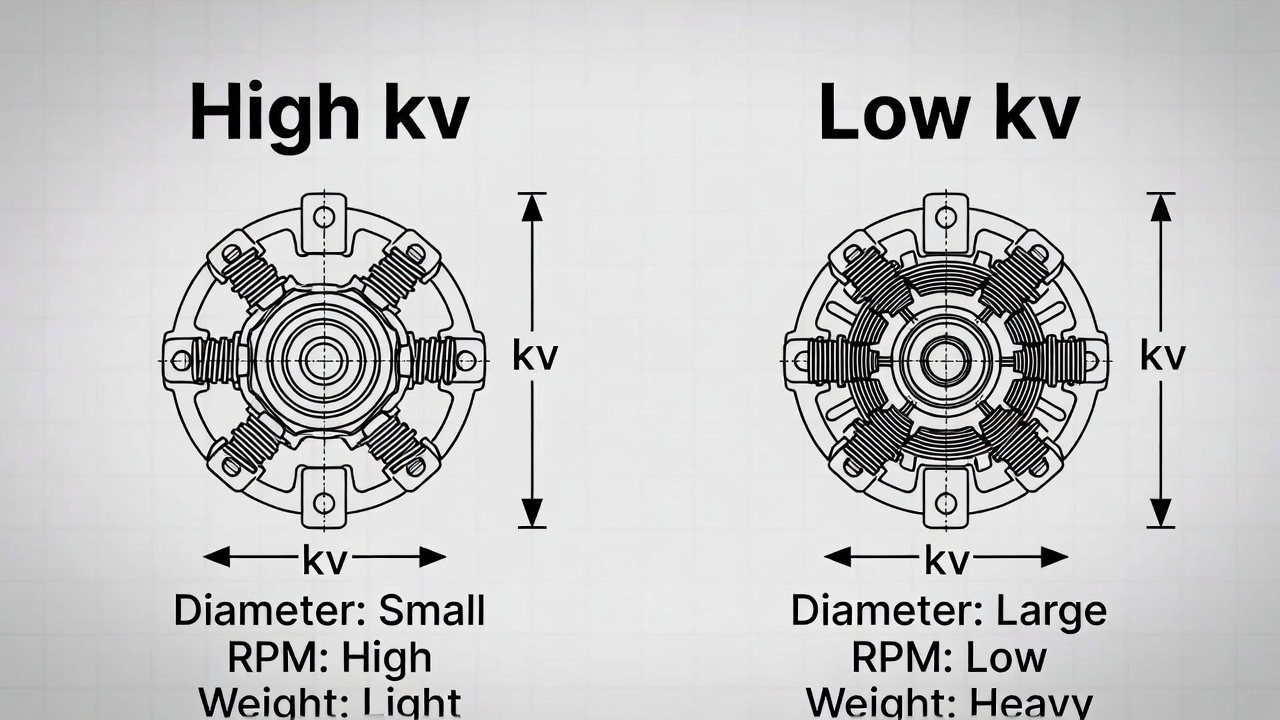
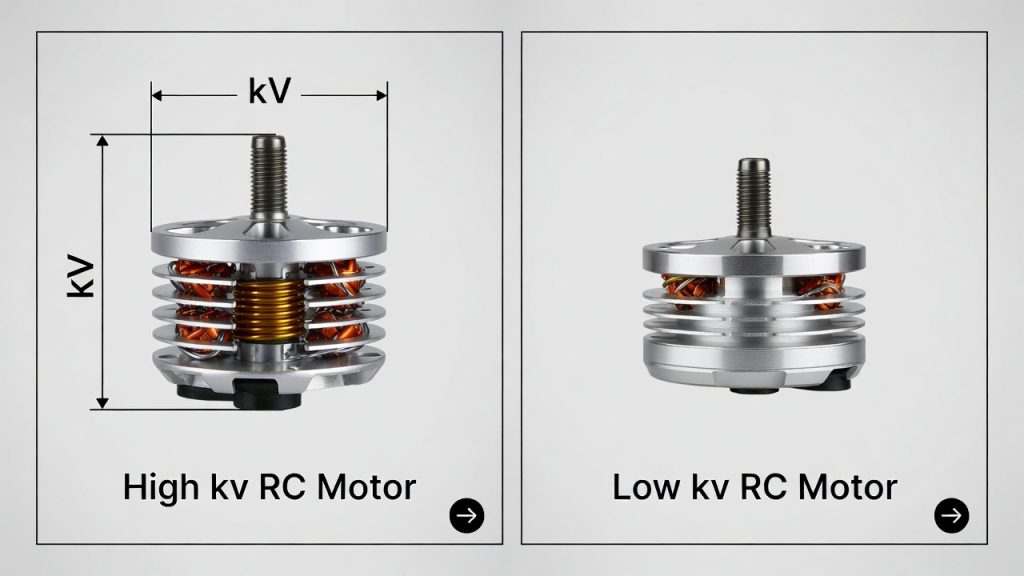
High KV vs Low KV RC Motors
So you’re getting into RC cars, drones, or helicopters, and you keep hearing people talk about KV motors. You’re probably wondering what the heck KV even means, right? Don’t worry. This guide will break it down for you in plain English so you can pick the right motor for your RC setup.
What Does KV Actually Mean?
Let’s start simple. KV stands for “kilovolt” but it doesn’t work the way you might think. It’s not about electrical voltage at all.
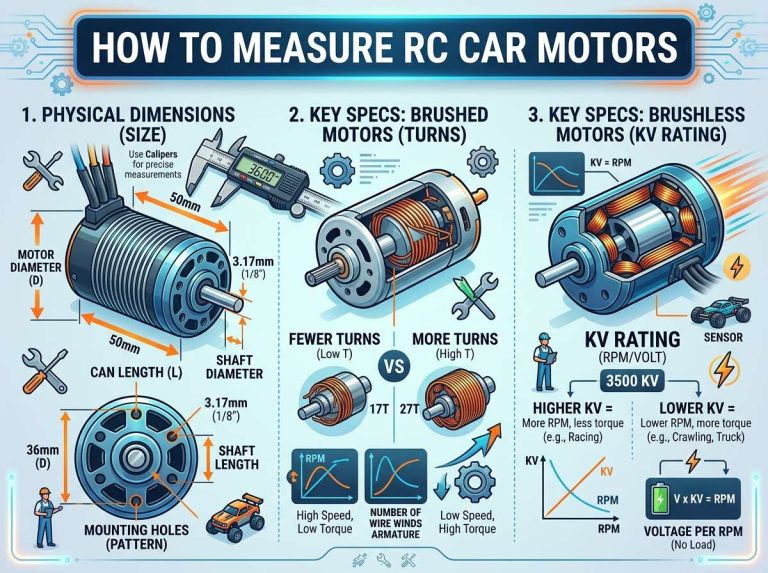
KV is a measurement of how fast a brushless motor spins. Specifically, it tells you how many times per minute the motor shaft will spin for every single volt of electrical power you feed it. That’s it.
So a 3000 KV motor will spin 3,000 RPM for each volt you give it. A 1000 KV motor will spin only 1,000 RPM per volt. The higher the KV number, the faster the spin speed at the same voltage.
Think of it like the engine of a car. A sports car engine might run at 7,000 RPM at full throttle. A truck engine might run at only 3,500 RPM. Same fuel, different speeds. KV works the same way with electric motors.
High KV Motors Explained
High KV motors are speed demons. They’ll spin really fast. We’re talking 4000+ KV motors here.
What You Get With High KV
Speed is the main game. A high KV motor will make your RC car zoom faster. Your drone will climb faster. Everything moves quicker. If you love going fast, high KV sounds great, right?
There are more benefits too:
Lighter load handling – High KV motors don’t need much torque to run well. They handle light vehicles nicely. A small RC car or a racing drone loves high KV.
Less current draw – These motors use less electrical current to reach peak speed. Your battery lasts a bit longer during straight speed runs. Your battery and speed controller get less stressed.
Better for light applications – Racing drones, fast RC cars, and light helicopters do great with high KV motors.
The Downside of High KV
High KV comes with real tradeoffs. Don’t jump in blind.
Weak torque – This is the big one. Torque is the twisting force. High KV motors have low torque. They struggle to accelerate quickly from a standstill. They also struggle with hills or rough terrain.
Harder on the battery – While you get longer runtime in some cases, the motor will pull more peak current when accelerating hard. This stresses the battery and can cause voltage dips.
Requires smaller propellers or gears – High KV motors spin fast but weak. You need small props or small gears on your vehicle. This limits power delivery.
More heat generation – Pushing a high KV motor to the limit creates lots of heat. The motor can overheat if you don’t watch it.
Needs low resistance gearing – The motor’s speed means nothing if you’ve got bad gears. You need efficient power transfer from motor to wheels.
Low KV Motors Explained
Low KV motors are torque machines. They run slow but powerful. We’re talking 1000 or 2000 KV motors here.
What You Get With Low KV
Massive torque – This is the real feature. Low KV motors have tons of twisting power. They accelerate hard. They climb hills like they’re nothing. They can handle heavy loads.
Better hill climbing – Off-road RC cars love low KV motors. The torque means you can tackle steep terrain without bogging down.
Handles rough terrain – Mud, rocks, sand – low KV motors push through it all. You won’t get stuck as easily.
Great for heavy vehicles – Scale RC crawlers, heavy trucks, and strong lifting drones all prefer low KV. The weight doesn’t matter as much when you’ve got tons of power.
Smoother acceleration – Low KV motors ramp up power gradually. You get controllable, predictable acceleration. No sudden jerky movements.
Lower heat – The motor doesn’t need to spin as fast to deliver power, so it runs cooler even under load.
The Downside of Low KV
Low KV has real limitations too. You’re trading speed for power.
Slow top speed – Low KV means low maximum RPM. Your vehicle won’t go as fast. Period. A low KV RC car will be noticeably slower than a high KV racer.
Heavy current draw – Low KV motors pull massive amounts of current at peak power. Your battery drains faster. Your speed controller needs to handle the current.
Need bigger propellers or gears – To get useful speed, you need large propellers (drones) or heavy gearing (cars). This adds weight and takes up space.
Heavier overall package – You need a beefier battery and speed controller to handle the current. The vehicle gets heavier, which defeats some of the power advantage.
Harder to use in tight spaces – The slow spin means slow response time. In fast-paced situations, the motor can feel sluggish.
KV and Propeller Size (For Drones and Helicopters)
Here’s something really important that trips up beginners: KV and propeller size have an inverse relationship.
High KV motors (let’s say 5000 KV) need small propellers. Small props spin fast without losing control. They work fine with fast-spinning motors.
Low KV motors (let’s say 1000 KV) need large propellers. Big props spinning slow still push a lot of air. They match up perfectly with slow-spinning motors.
Why does this matter? Because a wrong prop setup kills performance instantly.
Use a large prop on a high KV motor, and the motor stalls. It can’t handle the load. The speed controller shuts down. Your drone crashes.
Use a small prop on a low KV motor, and you waste all that potential torque. The motor spins easily but doesn’t push enough air to lift your drone properly.
The key is matching the prop size to the motor KV. This creates efficiency. The motor spins at a speed where propeller blades do their job best.
KV and Gear Ratios (For RC Cars and Trucks)
RC cars use gearing to connect the motor to the wheels. KV and gear ratios work together here too.
A high KV motor needs low gearing. That means small gears on the motor side and big gears on the wheel side. This gearing reduces the final wheel speed while increasing torque. It’s a tradeoff between speed and power, built into the chassis.
A low KV motor needs high gearing. That means big gears on the motor side and small gears on the wheel side. This gearing keeps more of the speed while delivering acceptable torque.
Get the gearing wrong, and your vehicle either moves too slow or the motor can’t handle the load.
The pros know this. They pick their motor KV, then they dial in the exact gearing to match their driving style and terrain.
How Voltage Affects KV Performance
Here’s another thing that confuses people. The battery voltage matters a ton.
Remember, KV is how many RPM per volt. So:
- A 3000 KV motor on a 2S battery (7.4V) spins at 22,200 RPM
- A 3000 KV motor on a 3S battery (11.1V) spins at 33,300 RPM
- A 3000 KV motor on a 6S battery (22.2V) spins at 66,600 RPM
Same motor, different voltages, wildly different speeds.
This is why battery selection is huge. Upgrading your battery voltage is like getting a new motor. The RPM jumps instantly.
But here’s the catch: increasing voltage also increases current draw and heat. Your speed controller and motor need to handle it.
Real-World Applications and Motor Selection
Now let’s talk about what motor type you actually want for your specific RC hobby.
FPV Racing Drones
Racing drone pilots want high KV motors (4500-6000 KV range). Speed is everything. They need fast takeoff, quick turning, and high top speed. The small racing frame handles high KV well. Battery life doesn’t matter when races last two minutes.
Heavy Lift Drones
If you’re flying a cargo drone or a big video platform, go low KV motors (500-1500 KV range). You need the lifting power. Large propellers on low KV motors create the thrust to haul weight. Speed doesn’t matter. Stability does.
RC Off-Road Trucks and Crawlers
Off-road vehicles need low to mid-range KV motors (2000-4000 KV depending on vehicle weight). You need torque to climb hills and handle rough ground. The gearing system then adjusts the final speed based on your preference.
RC Racing Cars
Racing cars want high KV motors (5000-8000 KV range). Flat terrain means you don’t need massive torque. Top speed wins races. Lightweight cars pair perfectly with these motors.
RC Helicopters
RC helicopters are picky. They usually need mid-range KV motors (2000-4000 KV). The swashplate mechanics and control requirements mean you need a balance of speed and power. Going too high or too low kills stability.
Climbing and Brawler RC Cars
Heavy vehicles that climb and bash need low KV motors (1000-3000 KV). These cars are built for power, not speed. The motor torque is essential.
Motor Stator Size and KV Relationship
Here’s something interesting: KV relates to motor size too.
A large motor (3000+ stator size) spinning at 2000 KV might actually produce more power than a tiny 1000 KV motor in a micro size. Size matters as much as KV.
A bigger motor has more internal surface area. It can produce more torque even at lower KV. A tiny motor is always limited by its physical size.
This is why you see micro drones with 1500+ KV motors and large cargo drones with 300-500 KV motors. The size compensates for KV differences.
When shopping for motors, look at both KV AND stator size. You need both specs to understand real performance.
Understanding Motor Efficiency and Losses
All motors lose power to heat. It’s just physics.
High KV motors have a couple efficiency issues. When they spin fast without much load, they generate heat from air friction and internal resistance. They run hot and lose energy.
Low KV motors have a different problem. They pull massive current to operate. High current means more heat in the wires and speed controller. The battery voltage drops under load, reducing efficiency.
The sweet spot is a motor that’s sized right for its job. A motor working near its designed power range runs most efficiently. A motor pushed way beyond its limits or underworked both waste energy.
This is why matching motor KV to your application matters. It’s not just about go-fast or climb-hard. It’s about running the motor in its happy zone where it performs efficiently.
Resistance and Timing
Here’s the technical bit that affects performance: motor resistance and timing.
Motor resistance measures how much the coils fight electrical current. Low KV motors typically have higher resistance. This can cause voltage sag when you push current through them.
Timing is the electronic control that tells the motor when to fire coils. Brushless motors use electronic timing. Some speed controllers let you adjust it. More aggressive timing makes the motor respond faster but can make it hotter.
You don’t need to become an expert in timing, but know this: your speed controller settings matter. The default settings work fine for most people, but tuning them can unlock better performance.
Battery Chemistry and Motor Performance
Your battery type affects how your motor behaves.
LiPo batteries are the standard for RC. They deliver high current easily, work great with both high and low KV motors, and offer good power density. Most RC builds use LiPo.
Li-Ion batteries are newer and safer. They deliver consistent power and run cool. They’re becoming more popular but cost more and charge differently than LiPo.
NiMH batteries are the old standard. They’re safer and more forgiving than LiPo but heavier and weaker. You mostly see these in older builds now.
Your motor doesn’t care much about chemistry, but battery voltage and current capacity do matter hugely. A weak battery can’t deliver the current your motor needs, limiting performance.
The Speed Controller’s Role
Your speed controller (ESC) bridges the battery and motor. It handles the current and timing. The ESC determines how much power reaches the motor.
A weak ESC limits your motor’s performance. A beefy ESC unlocks it. The ESC also needs to match your motor’s current draw. A high KV motor might use less current than a low KV motor, but a low KV motor under load can demand massive current spikes.
Always match your ESC size to your motor KV and your expected current draw. Undersizing your ESC creates problems. Oversizing is fine but wastes money.
Common Beginner Mistakes With KV
Let’s talk about things that trip people up.
Buying by KV alone – Don’t do this. You need to know your application first. High KV sounds cool but it’s wrong for lots of builds.
Ignoring stator size – A 1000 KV motor in a huge stator is powerful. A 4000 KV motor in a tiny stator is weak. Size matters.
Wrong prop size for drones – This kills drones instantly. Match prop size to motor KV. Look at the manufacturer specs.
Assuming higher KV means better – Higher KV is faster but not “better.” Better depends on what you want to do.
Mixing motor types – Use the same KV and size motors together. Mismatched motors cause unstable flight and poor handling.
Forgetting about current limits – High current draw from low KV motors can melt your battery connectors if they’re too thin. Use proper connectors rated for the amperage.
KV for Beginners: Start Simple
Here’s real talk: if you’re just starting, pick a beginner-friendly setup.
Buy an established RC kit. It comes with a motor already matched to everything else. The manufacturer figured out the KV, the gearing, the props, the battery, the speed controller, and how they all work together.
Once you fly or drive that setup for a while, you’ll develop feel for how motors work. Then you can experiment with KV swaps.
Trying to optimize KV before you understand your vehicle usually leads to spending money on parts that don’t fit your needs.
Upgrading Your Motor: When and Why
Eventually you might want a different motor. Common reasons:
You want more speed – Upgrade to higher KV, matching new props or gearing. Keep other parts compatible.
You want more power – Upgrade to lower KV or a larger stator. You might need a bigger battery and ESC too.
Your motor burned out – Time for a replacement. Get the same specs or compatible ones.
You’re moving to heavier vehicle – Low KV with higher stator capacity handles weight better.
Before you buy, check forums and communities for your specific vehicle type. People have already done the testing. They know what motors work.
Reading Motor Specs Sheet
When you look at a motor for sale, you’ll see specs. Here’s what matters:
- KV – RPM per volt. We covered this.
- Stator size – Physical dimensions. Bigger is more powerful.
- Pole count – How many magnetic poles. More poles = smoother power but less speed.
- Resistance – Measured in ohms. Lower is generally better but it varies.
- Max current – What the motor can handle continuously. Don’t exceed this.
- Recommended battery range – This guides your power choice.
Don’t get overwhelmed. Start with KV and stator size. Those two specs tell you 90% of what you need to know.
Temperature and Motor Life
Motors generate heat. Too much heat kills them.
High KV motors at full throttle get hot fast. You need cooling. A heatsink helps. Or run smaller packs with breaks between flights.
Low KV motors pulling massive current also get hot. They need good power delivery and cooling.
Most brushless motors handle brief heat spikes fine. Sustained overheating burns out the windings though. If your motor smells hot or the can feels too hot to touch, stop flying or driving.
Letting your motor cool between sessions extends its life significantly.
RC Motor KV: The Bottom Line
Here’s what you actually need to remember:
High KV motors spin fast with low torque. They’re for speed applications. Drones that race. RC cars that need velocity. They want light loads and small props or gearing.
Low KV motors spin slow with high torque. They’re for power applications. Climbers. Heavy-lift drones. Off-road bashers. They want heavy loads and large props or gearing.
KV is just one spec. Match it to stator size, battery voltage, propeller size (for drones), and gearing (for cars). Everything needs to work together.
Your speed controller, battery, and motor form a system. Upgrade one and you might need to upgrade others.
Start with a kit that has everything matched. Learn how it behaves. Then experiment with swaps once you have experience.
Pick the right motor KV for what you actually want to do. That’s the real secret. Not higher, not lower. Just right for your specific build and flying or driving style.
Conclusion
KV seems confusing at first. But it’s just a simple number telling you motor speed. High KV is fast and weak. Low KV is slow and strong. Everything flows from that basic truth.
Spend time researching what others are using for your exact vehicle type. Check out forums, YouTube channels, and manufacturer recommendations. Real users have already solved the problem of finding the right motor KV.
And remember: the best motor is one that’s properly matched to everything else in your build. Not the one with the highest number or the coolest brand name. The one that actually works right for your application.
Now get out there and pick a motor. Your RC adventure is waiting.