What Is mAh in RC Batteries?
If you’ve started getting into remote control vehicles, drones, or model cars, you’ve probably seen those three letters on every battery: mAh. It shows up on the label, in product descriptions, and in forums. But what does it actually mean? Don’t worry. By the end of this guide, you’ll understand mAh and why it matters for your RC hobby.
The Basics: What Does mAh Actually Stand For?
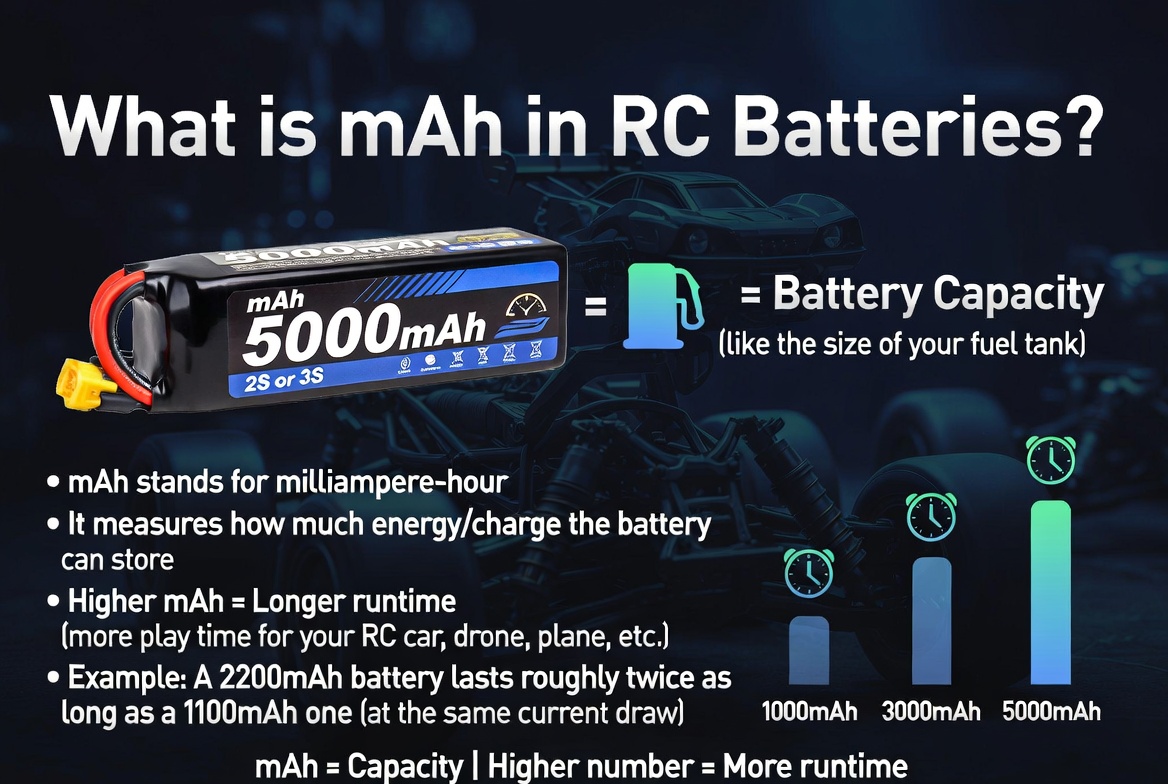
Let’s start simple. mAh stands for milliampere-hour. That’s a mouthful, so let’s break it down into pieces you can understand.
Ampere is a unit that measures electric current. Think of it like water flowing through a pipe. The more amperes, the more electricity flowing.
Hour is just time. You know what an hour is.
Milliampere is just a smaller version of an ampere. One milliampere is one-thousandth of an ampere. If amperes are large gallons, milliamperes are small teaspoons.
So mAh is a measurement of how much electric charge your battery can deliver over one hour of use. It tells you how much power your battery stores.
Why Does mAh Matter for RC Batteries?
Here’s the practical side: mAh tells you how long your RC device will run before it dies.
A higher mAh number means your battery lasts longer. A lower mAh number means your battery runs out faster.
Think of it like this. You have a smartphone with a 2000 mAh battery and another with a 4000 mAh battery. All else being equal, the 4000 mAh phone runs twice as long before you need to charge it.
The same logic applies to your RC car, drone, or airplane.
Real-World Examples of RC Battery mAh
Let’s look at some actual examples so this makes sense.
A small RC car might use a 1000-1500 mAh battery. That gives you about 15 to 20 minutes of fun before the battery dies.
A mid-range drone probably has a 2000-3000 mAh battery. You’ll get around 20 to 30 minutes of flight time.
A larger RC truck might pack a 4000-5000 mAh battery. That’s good for 30 to 45 minutes of driving, depending on how hard you push it.
Racing drones are different. They often use 1000-1500 mAh batteries but drain them quickly because racing is intense. You might only get 5 to 8 minutes of flight time.
These numbers aren’t perfect because other factors matter too. But they show you how mAh relates to run time.
The Connection Between mAh and Running Time
Here’s something important to understand: more mAh doesn’t always mean double the run time.
If you go from a 2000 mAh battery to a 4000 mAh battery, you might get 1.5 times the run time, not twice the run time. Why?
The answer involves how much power your RC device draws.
A bigger battery adds weight. Your motor has to work harder to move the extra weight. So it draws more power. That cuts into your run time advantage.
Also, other parts of your battery might wear out before you run out of charge. Internal resistance builds up as you use the battery.
So yes, higher mAh is better. But the math isn’t always perfect.
mAh vs. Voltage: They’re Not the Same Thing
Here’s where many beginners get confused. They mix up mAh with voltage.
mAh measures capacity. Voltage measures power.
Think of a water tank. The mAh is how big the tank is. The voltage is the water pressure.
You need both to work well. A huge tank with low pressure might not work. A small tank with high pressure might be dangerous.
For RC batteries, you see different voltage options:
- 3.7 volts is standard for a single lithium cell
- 7.4 volts is standard for two cells together (called “2S”)
- 11.1 volts is standard for three cells together (called “3S”)
A 5000 mAh battery at 7.4 volts is very different from a 5000 mAh battery at 11.1 volts. The second one has way more power and will drain faster.
Your RC device’s motor is designed for a specific voltage. You can’t just swap batteries with different voltages. You’ll break something or create a safety problem.
Understanding Battery Chemistry and mAh
The type of battery also affects how mAh works in real life.
Nickel-Cadmium (NiCd) batteries were used in old RC toys. They hold mAh less efficiently. You’d lose performance quickly as you drained them.
Nickel-Metal Hydride (NiMH) batteries came next. Better mAh performance. More reliable.
Lithium Polymer (LiPo) batteries are the modern standard for serious RC hobbyists. They deliver more power for their mAh rating. Your drone or racing car almost certainly uses these.
Lithium Iron Phosphate (LiFe) batteries are newer. They’re safer and last longer than LiPo batteries.
The chemistry matters because different types of batteries work differently. A 3000 mAh LiPo battery feels very different from a 3000 mAh NiMH battery in terms of actual performance.
Most RC products today use LiPo batteries because they give you the most power and performance for your mAh rating.
How to Read mAh on Your RC Battery
Okay, let’s look at an actual battery label. Here’s what you’ll see:
3500 mAh
11.1V (3S)
30C Discharge Rating
The 3500 mAh is the capacity. That’s how much power the battery stores.
The 11.1V (3S) is the voltage. This battery has three cells, so you multiply 3.7 by 3 to get 11.1 volts.
The 30C is the discharge rate. This number tells you how fast the battery can safely release power. We’ll cover that next.
The Discharge Rate (C Rating): A Bonus Skill
While we’re talking about reading batteries, let’s discuss the “C” rating. This matters for your mAh battery.
The C rating tells you how fast the battery can discharge. It’s a multiple of the battery’s capacity.
A 3500 mAh battery with a 30C rating can discharge 30 times its capacity per hour.
So: 3500 mAh × 30 = 105,000 mAh per hour = 105 amps per hour
That’s a lot of power coming out fast.
A 50C rating on the same battery would mean even faster discharge. More power, hotter battery.
A 10C rating would mean slower discharge. Less power, but runs cooler.
Higher C ratings let you fly aggressively or race hard. Lower C ratings work better for casual use and longer flight times.
The C rating affects how much power your motor gets at any moment. It affects your performance and fun. But mAh still determines how long you play before the battery dies.
Battery Capacity and Weight Considerations
Here’s a practical issue: bigger mAh batteries are heavier.
A 1000 mAh battery weighs less than a 5000 mAh battery. This matters a lot for drones and airplanes.
For a drone, adding battery weight reduces flight time. Your motor has to work harder. The battery runs out faster because it’s powering a heavier load.
There’s a sweet spot where the mAh capacity gain doesn’t make up for the weight increase.
For a race car, weight affects speed and handling. A heavier car might last longer between charges. But it’ll be slower and harder to control.
Smart RC enthusiasts balance mAh capacity against weight for their specific needs.
Choosing the Right mAh Battery for Your RC Device
So how do you know which mAh battery to buy?
First, check your device’s manual or specs. It’ll tell you the exact battery requirements. mAh, voltage, and discharge rating all matter.
Second, think about how you use your device. Will you fly for speed and tricks? Go for a lower mAh that’s lighter. Will you fly for distance and endurance? Go for higher mAh.
Third, think about how often you charge. High mAh batteries take longer to charge. If you want to play all day, you might buy two smaller batteries and swap them instead of buying one giant battery.
Fourth, check what fits physically. Not all batteries fit in all devices. Dimensions matter. A 5000 mAh battery might be too big for your tiny racing drone.
Fifth, respect your budget. Higher mAh batteries cost more money. A 5000 mAh battery costs way more than a 1500 mAh battery.
The “best” mAh battery isn’t a universal answer. It depends on your device, your goals, and your budget.
The Relationship Between mAh and Power Output
Let’s clear up one more common confusion. mAh is not power output. mAh is capacity.
Power output depends on voltage and the current draw.
A 5000 mAh battery at 11.1 volts with a 50C rating delivers more power than a 5000 mAh battery at 7.4 volts with a 20C rating.
The mAh is the same. But the power is different.
This is why you can’t just look at mAh when comparing batteries. You need to look at voltage, discharge rating, and mAh together.
A experienced RC pilot knows this. A beginner often gets tripped up here.
Common mAh Battery Sizes in RC Hobbies
Let’s catalog the mAh sizes you’ll see out there:
Small RC toys and basic drones:
- 300-500 mAh (very short flights, 5-10 minutes)
- 500-1000 mAh (short flights, 10-15 minutes)
Mid-range RC cars and drones:
- 1500-2200 mAh (decent flight time, 15-25 minutes)
- 2200-3000 mAh (good flight time, 20-30 minutes)
Serious RC vehicles and photography drones:
- 3000-5000 mAh (extended flight, 25-40 minutes)
- 5000-6500 mAh (long flight, 35-50 minutes)
Racing and high-performance:
- 800-1500 mAh (intense use, 5-12 minutes)
- 2200-5000 mAh (variety depending on flight style)
These ranges are rough. Your actual run time depends on many factors beyond mAh.
How mAh Degrades Over Time
Here’s something most beginners don’t think about: batteries lose capacity as they age.
A 3000 mAh battery that’s new actually holds 3000 mAh of charge. After 50 charging cycles, it might only hold 2850 mAh. After 200 cycles, maybe 2400 mAh.
This is just how chemistry works. You can’t stop it. You can only slow it down.
To keep your mAh batteries healthy longer, follow these rules:
Store them partially charged. A fully charged battery sitting in a box will lose capacity. A battery at 50-60% charge lasts longer.
Avoid extreme heat and cold. Temperature damages the chemistry. Keep batteries in a cool, dry place.
Discharge them fully before long storage. Or recharge them before using if they’ve been stored a while. This keeps the chemistry balanced.
Don’t overcharge them. Most modern chargers stop automatically. But don’t leave them charging overnight.
Use a good charger. Cheap chargers damage battery chemistry. Good chargers monitor voltage and current carefully.
Let them cool between uses. Hot batteries lose capacity faster than cool batteries.
These habits keep your mAh batteries performing close to their rated capacity for longer.
mAh and Battery Safety
Safety matters with RC batteries. Let’s talk about mAh and safety together.
Higher mAh batteries store more energy. More energy means more danger if something goes wrong.
A 1000 mAh battery has less stored energy than a 5000 mAh battery.
If a 1000 mAh battery shorts out, it creates less heat and danger than a 5000 mAh battery shorting.
But don’t avoid high mAh batteries because you’re scared. Just respect them.
Use a battery bag when charging. These fireproof bags contain fires if something goes wrong.
Don’t leave batteries charging unattended. Stay nearby in case of problems.
Don’t damage your battery. Don’t poke holes in it. Don’t drop it. Don’t crush it.
Don’t use damaged batteries. If the case is cracked or puffy, throw it away safely.
Use the right charger. Chargers designed for your battery chemistry matter.
These precautions keep you and your equipment safe.
Comparing Batteries: Beyond Just mAh Numbers
Let’s say you’re comparing two drone batteries:
Battery A: 2500 mAh, 7.4V (2S), 35C discharge rate, 150 grams
Battery B: 2500 mAh, 11.1V (3S), 30C discharge rate, 180 grams
They have the same mAh. But they’re totally different.
Battery B delivers way more power because of the higher voltage. Your drone would fly faster and more aggressively.
Battery B is heavier. Your flight time would be shorter.
Battery B charges and discharges hotter. You need to manage it carefully.
You can’t just compare mAh numbers. You need to look at the whole picture.
Smart shopping means reading specs carefully and thinking about what you actually need.
Real Talk: What mAh Means for Your RC Experience
After all this technical stuff, let’s get real about what mAh means for you.
When you’re flying a drone or racing an RC car, mAh determines how long you have fun.
Low mAh means short sessions. Maybe 5-10 minutes of flying. Then you charge for 30 minutes. Then you fly again.
High mAh means longer sessions. Maybe 30-40 minutes of flying. Then you’re tired anyway.
This affects how much fun you have. Short mAh batteries are frustrating. You barely get warmed up before you’re done.
But high mAh batteries come with trade-offs. More weight. More cost. Longer charging times.
Most casual RC enthusiasts buy two medium-mAh batteries. They fly with one while charging the other. This gives them almost continuous fun without the weight penalty of huge batteries.
Racers often go low mAh because weight matters more than run time.
Photographers and explorers go high mAh because they want maximum flight time.
There’s no wrong choice. It depends on what you want from your RC hobby.
Learning to Manage Your RC Battery mAh
Once you understand mAh, managing batteries gets easier.
You’ll develop a feel for how long each battery lasts in your device.
You’ll stop worrying about numbers and start thinking about real flight time.
You’ll learn your device’s limits. Some devices fly better with lower mAh batteries. Others benefit from higher mAh.
You’ll learn to charge efficiently. You’ll know which batteries charge fast and which ones charge slow.
You’ll handle batteries with respect because you know what they can do.
This knowledge makes your RC hobby better and safer.
mAh in Different RC Device Types
Different RC devices prioritize mAh differently.
Racing drones care less about mAh. They want fast discharge and light weight. A 1300 mAh battery is typical.
Camera drones care a lot about mAh. They want maximum flight time for photography. 5000+ mAh is common.
RC cars and trucks use bigger mAh batteries because weight matters less. 4000-5000 mAh is typical.
RC planes vary wildly. Slow trainers use low mAh. High-speed planes need high discharge rates. mAh depends on the plane.
Helicopters need balanced batteries. Too light and they can’t hover. Too heavy and they can’t fly. Medium mAh is typical.
Each device type has different needs. That’s why mAh numbers vary so much across the RC world.
FAQ: Quick Answers About mAh
Q: Does higher mAh always mean better? A: Not always. You need the right mAh for your device and needs. Bigger isn’t always better.
Q: Can I use a higher mAh battery than my device recommends? A: No. Stick to the recommendations. Wrong batteries cause problems.
Q: How long does it take to charge a 3000 mAh battery? A: Usually 1-3 hours with a normal charger. Fast chargers do it in 30-60 minutes.
Q: Why do batteries puff up? A: Internal chemical reactions create gas. This is bad. Stop using puffy batteries immediately.
Q: Should I discharge batteries before storage? A: Partially yes. Store at 50-60% charge. Fully discharged is bad. Fully charged is bad.
Q: How many times can I recharge a battery? A: LiPo batteries usually last 200-500 charge cycles before capacity drops noticeably.
Q: Is a 5000 mAh battery five times better than a 1000 mAh battery? A: Not exactly. Weight and power draw matter too. But it’s roughly 5 times the energy.
The Bottom Line: Why You Should Care About mAh
To wrap up: mAh is the battery capacity. It tells you how much charge your battery holds.
Understanding mAh helps you:
- Predict run times before you buy
- Choose batteries that match your needs
- Manage your RC hobby more effectively
- Handle batteries safely
- Get better value for your money
- Avoid frustration when batteries die too fast
You don’t need to become a battery expert. But knowing what mAh means puts you ahead of many RC beginners.
Next Steps: Getting Started With mAh Knowledge
Now that you know what mAh is, think about your own RC devices.
Look at the batteries you own. Find the mAh number. Compare it to the run times you actually get. Does it match what we discussed?
When you buy your next battery, check the mAh carefully. Think about whether the capacity fits your needs.
Talk to other RC enthusiasts about their mAh choices. You’ll learn what works for different goals.
Experiment with different mAh levels if you can. You’ll develop your own preferences.
This hands-on experience turns mAh from abstract knowledge into practical wisdom.
Final Thoughts
The RC battery hobby can seem overwhelming. All those numbers and specs feel confusing at first.
But mAh is actually straightforward. It’s just capacity. How much charge the battery holds. That’s it.
Higher mAh means longer run times. Lower mAh means shorter run times. Everything else follows from that simple truth.
Once you get this one concept right, everything else becomes clearer.
You’ll shop smarter. You’ll fly better. You’ll enjoy your RC hobby more.
And that’s what it’s all about. Having fun with RC vehicles while understanding the tools you’re using.
So the next time you see mAh on a battery label, you’ll know exactly what it means. No more mystery. Just knowledge.
Happy flying, racing, or driving. Your RC adventures await.