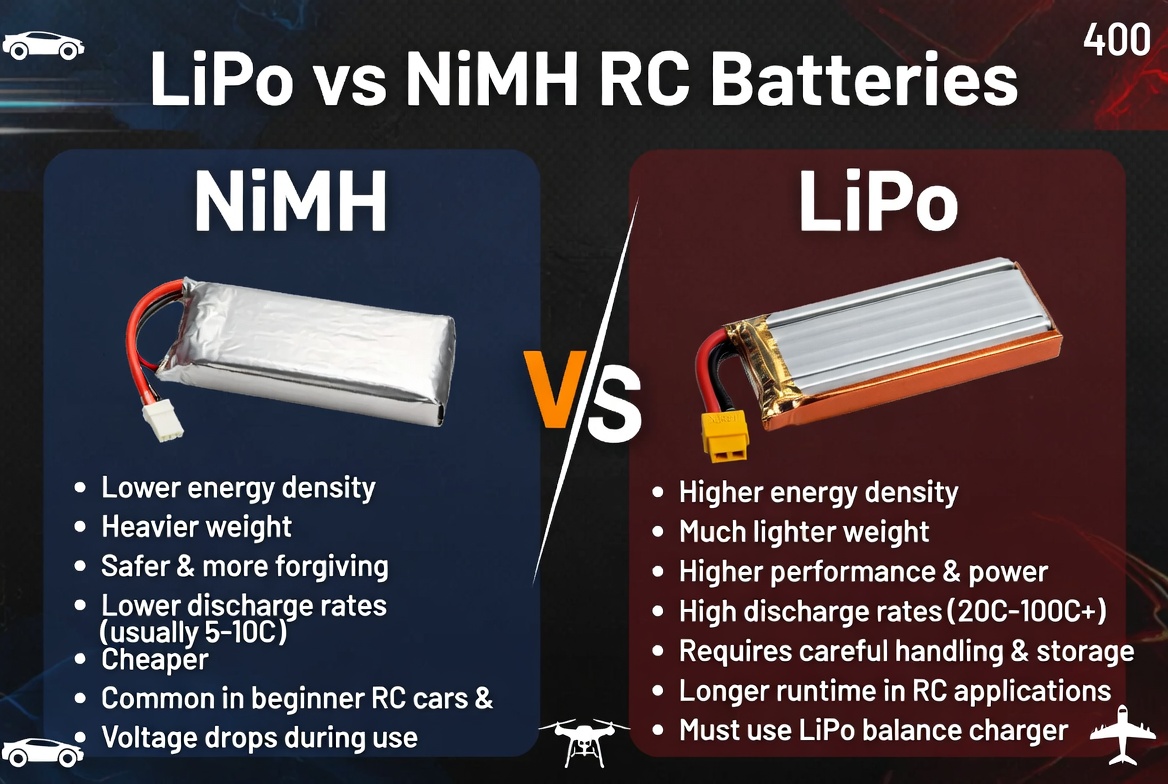
LiPo vs NiMH RC Battery
So you’re getting into RC cars, drones, or other remote control toys. You’ve looked at the battery options and now you’re confused. LiPo? NiMH? What’s the difference? Don’t worry—this guide breaks it down so you actually get it.
What You Need to Know About RC Batteries
Before we dive into the nitty-gritty, let’s talk about why batteries matter for your RC hobby. Your battery is basically the heart of your remote control device. It powers everything. A bad battery choice means your RC car dies fast, your drone crashes, or your toy just sits there being useless. A good battery choice? Your RC toys run smooth, last long, and perform like they should.
There are basically two main battery types used in RC hobby equipment today: lithium polymer (LiPo) and nickel-metal hydride (NiMH). Both work great. Both have pros and cons. Your job is figuring out which one fits your needs.
The Basics: What Is a NiMH Battery?
NiMH batteries have been around for ages. They’re the old reliable friend who always shows up. These batteries use a chemical reaction between nickel oxide hydroxide and metal hydride to store energy. Sounds complex, right? It’s not. Just think of it as proven technology that works.
Here’s the thing about NiMH cells: they’re tough as nails. You can drop them, bang them around, leave them sitting for months, and they still work. They’re forgiving. This is huge for beginners who are still learning the ropes.
NiMH batteries come in packs. A typical pack might have six cells connected together. Each cell puts out about 1.2 volts, so six cells give you 7.2 volts total. Some packs have eight cells for 9.6 volts. It depends on what your RC car or drone needs.
Another great thing about NiMH packs: they’re cheap. Really cheap compared to other options. If you destroy a NiMH battery, it’s not a total financial disaster. You can replace it without emptying your wallet.
The Basics: What Is a LiPo Battery?
LiPo stands for lithium polymer. These are the newer kids on the block. They use lithium ions moving between a positive and negative terminal to create energy. The tech is fancier, and that makes LiPo batteries perform differently than NiMH.
The first thing you notice about LiPo batteries is they’re light. Really light. This matters because less weight means your RC car goes faster and your drone flies longer. Every ounce counts in this hobby.
LiPo batteries also pack way more power into a smaller space. That means higher performance and more speed. Serious RC enthusiasts love LiPo for this reason. A LiPo-powered car will beat a NiMH car almost every time because of the power output.
Each LiPo cell puts out 3.7 volts. So a two-cell LiPo pack (called 2S) gives you 7.4 volts. A three-cell pack (3S) gives you 11.1 volts. This is important because you need to match your battery voltage to what your RC device can handle.
LiPo vs NiMH: Battery Chemistry Explained Simply
Let’s get technical for just a minute. It helps to understand what makes these batteries tick.
NiMH batteries rely on a reversible chemical reaction. Energy gets stored when the battery charges, and that energy comes back out when the battery discharges. This process is stable and can happen thousands of times. The chemistry is forgiving. Even if you overcharge it a little, it’ll probably be fine.
LiPo batteries work differently. The lithium ions literally move from one end to the other during discharge. This creates electric current. It’s brilliant engineering, but it’s also more sensitive. These batteries need respect. You can’t just hook them up and forget about them.
The chemistry differences lead to real-world differences you’ll notice:
- Energy density: LiPo wins here by a lot. Smaller battery, bigger power output.
- Lifespan: NiMH stays more stable over many charge cycles. LiPo degrades faster.
- Charging sensitivity: NiMH is chill about charging. LiPo needs proper chargers and can’t be overcharged.
- Temperature handling: NiMH handles cold better. LiPo can get cranky in cold weather.
Performance Comparison: Speed and Power
This is where RC enthusiasts get excited. LiPo batteries perform better, period. Your RC car will go faster. Your drone will fly longer and more aggressively. Your robot will move quicker.
Why? It comes down to power output. LiPo batteries deliver consistent, high power throughout the entire discharge cycle. They maintain voltage even as the battery drains. NiMH batteries drop off as they drain. You start with good performance, but by the end of your run, things slow down.
If you’re doing competitive RC racing, you want LiPo. The extra power means winning races. The consistent power delivery means predictable handling. You know exactly how your car will behave from the first second to the last.
For casual flying or cruising around the neighborhood? NiMH gets the job done. You won’t have the absolute best performance, but you’ll have fun. You’ll also spend way less money.
Safety: A Critical Difference
Here’s something important: LiPo batteries need more respect. These batteries can catch fire if you mess up badly. Not often, but it happens. Overcharge them, short them, puncture them, or expose them to extreme heat, and they can go boom.
NiMH batteries? They’re basically safe. You can abuse them pretty hard and they’ll just keep working. Worst case, they get warm. They won’t burst into flames.
This is why many RC clubs recommend NiMH for beginners. It’s not because NiMH is better—it’s because NiMH is more forgiving of mistakes. New RC pilots make mistakes. It’s just part of learning.
If you go with LiPo, you need to:
- Use a proper LiPo charger (not just any charger)
- Never overcharge them
- Store them in a safe LiPo bag or box
- Keep them away from water
- Use a battery monitor to check voltage during flights
- Never let them discharge completely
This isn’t meant to scare you. Millions of people use LiPo batteries safely every day. You just need to be smart about it.
Cost Analysis: Initial Investment and Long-Term Spending
Money matters. Let’s talk about what you’ll actually spend.
A decent NiMH battery pack costs between $20 and $50. A good charger for NiMH runs another $15 to $40. So you’re looking at $35 to $90 to get started with battery equipment.
LiPo battery packs cost $30 to $100 or more, depending on capacity. A proper LiPo charger is more expensive—usually $50 to $150. That’s $80 to $250 minimum.
But here’s where it gets interesting: LiPo batteries don’t last as long. A LiPo pack typically handles 300 to 500 charge cycles before performance drops noticeably. NiMH packs can handle 500 to 1000 cycles.
Let’s say you fly or drive your RC device five times a week. That’s five charge cycles per week. A NiMH pack might last you a year or more. A LiPo pack might last six months. Do the math, and NiMH starts looking cheap again, especially when you factor in the expensive charger for LiPo.
That said, many serious hobbyists buy multiple LiPo packs. They rotate them and charge them properly. This spreads out the replacement costs over time. If you’re just starting out with one battery, NiMH is the budget-friendly choice.
Charging: How These Batteries Drink Power
Charging NiMH batteries is simple. Plug them in. Wait a few hours. Done. You can use basic chargers or fancy smart chargers. Both work. NiMH batteries are very hard to overcharge with modern chargers. They just stop taking power when they’re full.
LiPo charging is more involved. You need a charger specifically designed for lithium batteries. These chargers have special programming that monitors each cell in the pack to make sure they charge evenly. It’s not complicated, but it’s not as simple as NiMH.
LiPo chargers typically have settings for:
- Battery type (2S, 3S, 4S, etc.)
- Charge rate (measured in amps)
- Balance charging (to keep cells even)
- Storage mode (for when you’re not using the battery)
It seems complicated, but once you do it a few times, it becomes second nature. Most LiPo chargers have presets that take the guesswork out.
The big rule with LiPo: never overcharge. Overcharging damages cells permanently and can create fire risk. NiMH batteries? They’re designed to handle slight overcharging. It’s one less thing to worry about.
Runtime: How Long Does Each Battery Last?
This is a practical question. How long can you actually fly or drive before needing to swap batteries?
NiMH runtime is typically shorter. A full charge on a standard NiMH pack might give you 15 to 30 minutes of flight time on a drone, or 20 to 40 minutes of driving time on an RC car. Times vary based on pack capacity and your specific device.
LiPo runtime is often longer. The same device with a LiPo pack might run 25 to 40 minutes flying or 35 to 50 minutes driving. The numbers aren’t crazy different, but they’re noticeably better.
Here’s the thing: runtime depends on pack capacity, measured in milliamp-hours (mAh). A 2500 mAh NiMH pack and a 2500 mAh LiPo pack will run roughly similar times. LiPo has a slight edge because of efficiency, but it’s not huge.
Capacity matters more than battery type for runtime. A big NiMH pack beats a small LiPo pack every time.
Weight and Size: A Major Advantage for LiPo
RC hobbyists care about weight. Lighter gear means better performance. LiPo wins here decisively.
For the same capacity, a LiPo pack weighs significantly less than a NiMH pack. This is because lithium technology is more energy-dense. You get more power per pound.
For drones, this is huge. Less weight means longer flights. For RC cars, less weight means faster acceleration and better handling. Weight distribution matters in this hobby.
If you’re trying to squeeze maximum performance from your RC device, LiPo’s weight advantage is real and noticeable.
Storage and Maintenance: Day-to-Day Care
NiMH batteries are low-maintenance. Store them in a cool, dry place. That’s it. You can leave them sitting for months and they’ll still work fine. Grab them, charge them, and go fly.
LiPo batteries need more attention. If you’re not using them, they need to be stored in a partially charged state—usually around 3.8 volts per cell. Storing them fully charged or fully discharged shortens their lifespan. Many people keep LiPo packs in special LiPo bags made of fireproof material.
Check LiPo batteries regularly. If a pack swells or feels puffy, stop using it. That’s a sign the battery is failing. It’s not an emergency, but it means the battery is near the end of its life and needs replacement.
NiMH packs? Just store them and forget about them. They’re boring, but that’s the point. They work without requiring much thought.
Temperature and Weather: When Things Get Tricky
Weather affects both battery types, but differently.
NiMH batteries actually perform better in cold. They’re stable across temperature ranges. If you’re flying a drone in cool weather, NiMH is the safer bet. Performance stays consistent.
LiPo batteries don’t like cold. Fly a LiPo battery in freezing weather and performance drops dramatically. The battery won’t deliver power as effectively. In extreme cold, LiPo can fail completely. Let it warm up, and it’ll work again, but during flight? You might lose control of your RC device.
Heat is bad for both types, but LiPo is more sensitive. Hot temperatures shorten LiPo lifespan faster. If you fly in hot climates regularly, you’ll replace LiPo packs more often.
Depth Discharge and Battery Lifespan
Every time you use a battery, you shorten its lifespan slightly. This is called cycling. After a certain number of cycles, batteries lose their ability to hold a charge.
NiMH batteries handle deep discharge well. You can run them all the way down to nearly empty without permanent damage. Do this a thousand times and the battery still works.
LiPo batteries hate deep discharge. Running them all the way down damages them. Your LiPo charger usually has a low-voltage cutoff that stops your RC device before the battery gets dangerously low, but it’s still not as forgiving as NiMH.
This is another reason NiMH is popular with casual users. You don’t have to think as hard about care and feeding. Use it, charge it, use it again. Simple.
Compatibility: What Fits Your Gear
Before you buy any battery, check what your RC device needs. This is critical.
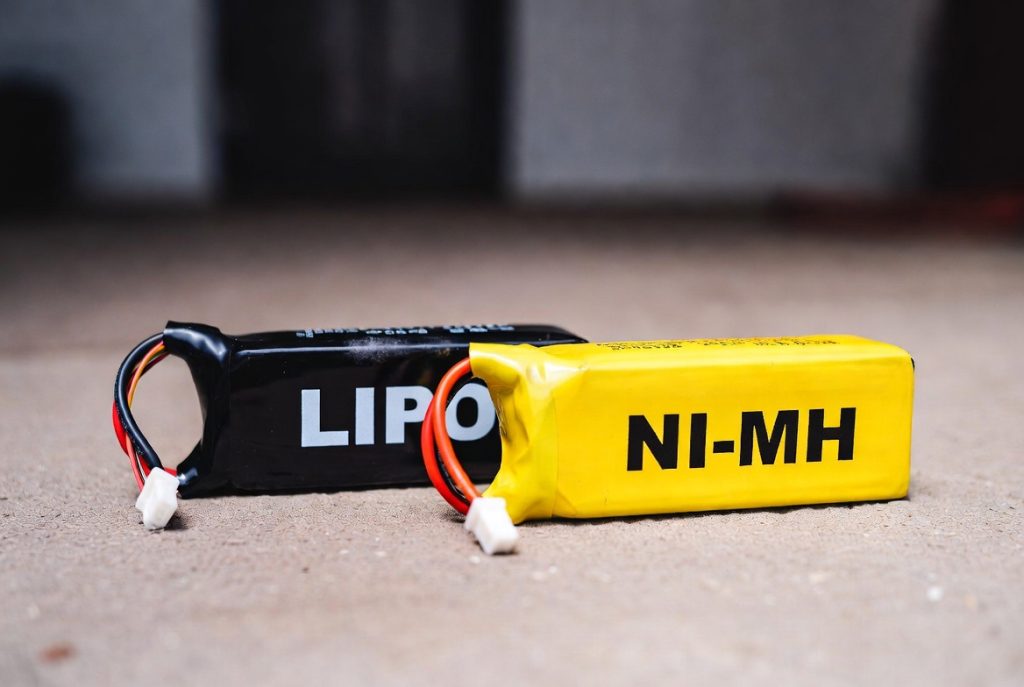
Most RC cars, drones, and robots use either NiMH or LiPo, but not both simultaneously. Your device has a connector designed for one or the other. Some high-end gear lets you use either, but you need an adapter cable.
Check your device’s manual. Look for voltage requirements (7.2V, 9.6V, 11.1V, etc.) and the battery connector type (Deans connector, XT60, Traxxas connector, etc.).
Voltage is especially important. A device designed for 7.2V might not work with an 11.1V battery. Too much voltage can fry electronics. A device designed for high voltage won’t run at full speed on a low-voltage battery.
Which Battery Should You Choose?
This depends on your situation.
Go with NiMH if:
- You’re brand new to the RC hobby
- You want to keep costs low
- You fly or drive casually for fun
- You live in a cold climate
- You value simplicity and durability
- You want a battery you can ignore
Go with LiPo if:
- You want maximum performance
- You’re willing to learn battery care
- You fly or race competitively
- Weight is a priority
- You’re ready for the higher upfront cost
- You want longer runtime
Honestly? Many people start with NiMH. They learn the hobby without worrying about complex battery care. After a few months, they get the itch for better performance and switch to LiPo. That’s a perfectly normal progression.
The Hybrid Approach: Having Both
Here’s a secret that experienced RC people know: you don’t have to choose. Buy one of each.
Start with NiMH to learn the hobby without stress. Once you feel comfortable with RC basics, get a LiPo pack and a proper charger. Now you have options. Casual flying? Grab the NiMH. Racing with friends? Grab the LiPo.
This approach costs more upfront, but it lets you explore the hobby fully. You’ll learn what performance level you actually want. Some people discover they prefer NiMH’s reliability and simplicity. Others discover they’re obsessed with LiPo’s performance. Either way, you’re making an informed choice.
Common Mistakes People Make
Let’s talk about what not to do.
Mistake 1: Buying the cheapest charger. Your battery is only as good as your charger. A bad charger ruins good batteries. Spend a little extra on a quality charger.
Mistake 2: Ignoring voltage compatibility. Your device needs the right voltage. Too much voltage causes fire. Too little voltage causes nothing to work. Check your manual.
Mistake 3: Leaving LiPo batteries charged for weeks. LiPo batteries sitting fully charged degrade faster. If you won’t use a LiPo pack for a while, charge it to storage voltage—around 3.8 volts per cell.
Mistake 4: Assuming all NiMH batteries are identical. Capacity and discharge rate vary. A 5000 mAh NiMH pack gives you longer runtime than a 1600 mAh pack. Read the specs.
Mistake 5: Buying a LiPo battery without a battery monitor. A battery monitor tells you voltage, helps you detect problems, and prevents deep discharge. They cost $10 to $30. Worth every penny.
Real-World Performance: What Users Actually Experience
Let’s get honest. In real-world use, what’s the difference you’ll actually notice?
NiMH gives you steady, predictable performance. Your RC car drives smoothly. Your drone flies consistently. Nothing flashy, but nothing disappointing either. It’s reliable. That reliability is valuable.
LiPo gives you excitement. That RC car launches off the line with a burst of speed. That drone zooms around the sky with snappy responsiveness. It feels more “alive.” For some people, that’s worth the extra expense and complexity.
Neither is objectively better. It depends what you value. Predictability and ease? NiMH. Excitement and speed? LiPo.
Troubleshooting Battery Problems
Sometimes batteries act weird. Here’s how to diagnose problems.
Battery won’t charge: Check the charger. Check the connector. Make sure settings are correct. If nothing works, the battery might be dead.
Battery won’t hold a charge: If a battery drains quickly, it’s probably at the end of its life. Buy a replacement.
Battery runs hot during use: This is normal to some degree. Batteries generate heat under load. But if it gets too hot to touch, stop using it immediately.
LiPo battery is puffy: Stop using it and replace it. A puffy battery is dying.
Battery connector feels loose: Loosen connections reduce performance and create fire risk. Replace the connector or buy a new battery.
Recycling and Disposal
Here’s something people don’t talk about enough: what do you do with dead batteries?
Never throw batteries in the trash. Batteries contain toxic materials. They belong in recycling programs.
Most communities have battery recycling centers. Some hobby shops take old batteries. Check online for drop-off locations in your area.
Proper disposal protects the environment. It’s easy to do and it’s the right thing to do.
Final Thoughts: Making Your Decision
Choosing between LiPo and NiMH batteries doesn’t have to be stressful. Both work great. Both have dedicated fans. Both will let you have fun with RC hobbies.
Ask yourself: What matters more to me—simplicity or performance? Do I want to spend money now or worry about batteries later?
There’s no wrong answer. You pick the one that fits your style.
Many people discover they like both. That’s totally cool too. Start with whichever feels right, and you can always switch later. This hobby is supposed to be fun. Your battery choice should support that fun, not create stress.
Get out there and fly. Drive. Race. Have fun. The right battery for you is the one that gets you excited about your RC hobby.