540 vs 550 RC Motor
So you are shopping for an RC motor and you keep seeing the numbers 540 and 550 everywhere. You are not sure what they mean. You wonder if one is just a “better” version of the other. You might even think the difference is too small to matter.
Trust me — it matters a lot. The wrong motor can make your RC car sluggish, overheat, or burn out way too fast. The right one makes everything smooth, fast, and fun.
Let’s break this down in plain language. No jargon. No complicated math. Just the stuff you actually need to know.
What Do 540 and 550 Even Mean?
First things first. Those numbers are not a power rating. They are not about speed. They are about size.
Specifically, they describe the diameter and length of the motor can — the outer metal shell that holds everything together inside.
Here is the quick version:
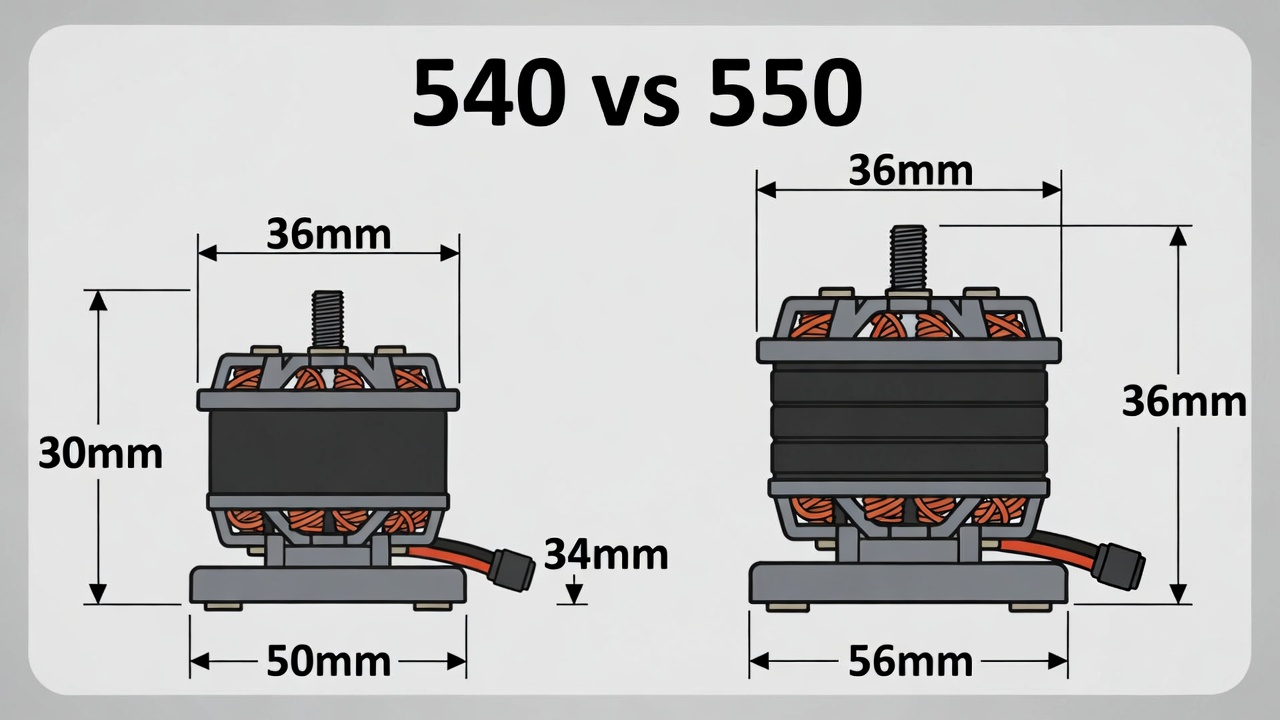
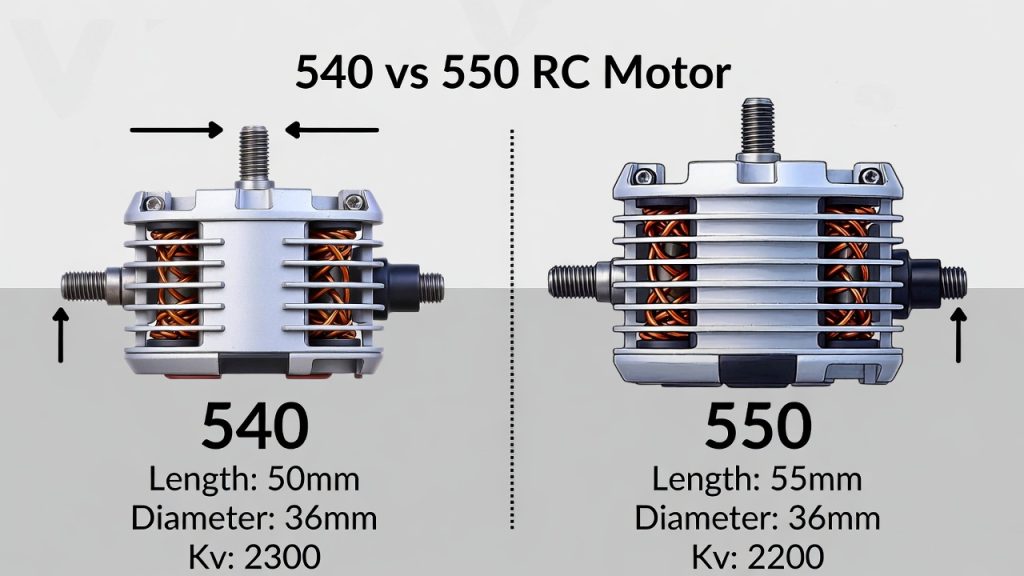
- 540 motor = 36mm long, roughly 36mm in diameter
- 550 motor = 50mm long, roughly 36mm in diameter
That is the only physical difference. Same width. Different length.
But that small size difference changes a whole lot about how the motor performs.
Inside the Motor: Why Size Matters
Think of the motor can like a container. A longer container holds more stuff.
A 550 motor has a longer can. That means it can fit:
- A bigger stator (the stationary part that creates the magnetic field)
- More windings (more copper wire wrapped around the core)
- Larger magnets
More copper and bigger magnets mean the motor can produce more torque. It can handle more current. It stays cooler under load.
A 540 motor has a shorter can. It is lighter and more compact. It does not produce as much torque, but it is still plenty powerful for most RC cars.
Think of it this way. A 540 is like a small but capable engine. A 550 is like a slightly bigger engine in the same engine bay.
The Main Differences at a Glance
| Feature | 540 Motor | 550 Motor |
|---|---|---|
| Can Length | ~36mm | ~50mm |
| Weight | Lighter | Heavier |
| Torque Output | Moderate | Higher |
| Heat Management | Good | Better |
| Power Handling | Standard | Higher |
| Common Use | On-road, stadium trucks | Crawlers, bashers, heavy builds |
| Price | Usually cheaper | Usually a bit more |
Torque: The Big Deal
If you are new to RC cars, you might focus a lot on speed. But torque is actually what makes your car feel powerful.
Torque is the twisting force that gets your wheels spinning from a stop. It is what helps you climb a hill, push through dirt, or haul a heavy RC truck body.
The 550 motor wins on torque. Its longer can and bigger internals give it the ability to produce more twisting force at lower RPMs. That makes it a great fit for:
- Rock crawlers
- Short course trucks
- Heavy-duty bashers
- Scale rigs with lots of weight
The 540 motor is not weak by any means. It still delivers solid torque for lighter builds and faster on-road setups. It just does not hit as hard at the low end as a 550.
Heat: A Big Factor You Cannot Ignore
Heat is the enemy of any RC motor. Too much heat and the windings start to break down. The magnets can lose their strength. The motor can fail entirely.
Because the 550 has more copper wire and bigger magnets, it can spread heat across a larger surface area. It runs cooler under the same load compared to a 540.
If you bash hard, run long sessions, or push your RC on rough terrain, a 550 motor keeps its cool better. That means longer runs and fewer burnt-out motors.
A 540 can still handle heat just fine in normal conditions. But if you are really pushing the limits, the 550 has more headroom before things get dangerous.
Weight and Fit: Does It Actually Matter?
This is where the 540 shines.
The 540 motor is shorter and lighter. That extra few grams and centimeters can make a real difference in certain setups. In competitive RC racing, weight balance matters. In tight chassis designs, space is limited.
A lot of on-road touring car chassis are designed specifically for the 540 size. The motor bay is just the right length for a 540 to slot in perfectly.
If you try to cram a 550 into a chassis built for a 540, it might not fit at all. Always check your chassis specs before buying a motor.
On the flip side, many short course trucks, rock crawlers, and bashers are built with a 550-sized motor bay from the factory. Those cars expect the longer motor and have room for it.
Brushed vs Brushless: Does the 540/550 Naming Change?
Yes and no.
The 540 and 550 designations originally came from brushed motors. Brushed motors were the standard for RC cars for a long time. They use physical carbon brushes to transfer electricity to the spinning armature inside.
When brushless motors came along, manufacturers kept using the same size naming system. So you will see brushless motors labeled 540 and 550 as well. The can size is the same. The internal tech is totally different.
Here is the short version:
- Brushed 540/550 = older tech, simpler, cheaper, needs maintenance
- Brushless 540/550 = modern tech, more efficient, faster, longer lifespan
Most people today run brushless systems. But the 540 vs 550 debate applies to both worlds.
The Turn Rating and KV Rating: What You Also Need to Know
Here is something that beginners often miss. The 540 vs 550 size is only part of the story. The turn rating (for brushed) and KV rating (for brushless) matter just as much.
For Brushed Motors: Turn Rating
The turn rating tells you how many times the copper wire is wound around the armature.
- Low turns (like 10T or 15T) = faster, more aggressive, less torque, needs more power
- High turns (like 25T or 35T) = slower, more torque, smoother, easier on the battery
A 550 with 35 turns is totally different from a 540 with 15 turns — even though the 540 is “smaller.”
For Brushless Motors: KV Rating
KV stands for RPM per volt. Higher KV = faster motor.
- High KV (like 3500KV) = great for on-road racing
- Low KV (like 1800KV or 2100KV) = better for crawlers and bashers
A 550 brushless motor at 2100KV will be torquey and smooth. A 540 brushless at 4000KV will be a screaming speed demon.
So when you compare motors, always look at the turn/KV rating alongside the can size.
Common RC Car Types and Which Motor Fits Best
Let’s make this super practical. Here is a quick guide based on the type of RC car you have:
On-Road RC Cars (Touring Cars, Drift Cars)
These are light, low to the ground, and built for speed on smooth surfaces.
Best choice: 540 motor
The 540 fits perfectly in most touring car chassis. You do not need heavy torque — you need smooth, efficient power delivery at higher RPMs. A 540 brushless around 3500KV to 5000KV is perfect here.
Stadium Trucks and Buggy
These are mid-size cars that run both on and off road.
Best choice: 540 motor (or 550 for heavier builds)
A 540 brushless in the 3000KV to 4000KV range works great for most stadium trucks. If your truck is on the heavy side or you like to bash hard, a 550 in the 2500KV to 3500KV range is a solid pick.
Short Course Trucks
These are popular and tend to be heavier than buggies.
Best choice: 550 motor
Short course trucks love the extra torque of a 550. The heavier body and wider tires demand more power to get moving quickly. A 550 brushless around 2200KV to 3000KV hits that sweet spot.
Rock Crawlers and Scale Rigs
These need serious torque to crawl over rocks, logs, and obstacles at low speed.
Best choice: 550 motor (low KV brushless or high turn brushed)
Crawlers thrive with low-KV 550 brushless motors. Something like a 550 at 1200KV to 1800KV gives you massive low-end grunt and smooth, controllable power. High-turn 540 brushed motors also work, but the 550 brushed in high-turn specs is even better.
Bashers and All-Around Runners
You bash over jumps, slam into curbs, and just have fun wherever.
Best choice: 550 motor
Bashers take abuse. You need a motor that handles heat well, delivers solid torque, and does not give up easily. A 550 brushless around 2400KV to 3200KV is the sweet spot for most 1/10 scale bashers.
Efficiency and Battery Life
Here is something most people do not think about upfront — efficiency.
A 550 motor is actually more efficient per unit of torque. Because it has bigger windings and magnets, it does not have to work as hard to produce the same amount of force. That means it draws less current for the same output.
Less current draw = longer battery life.
If you run long sessions and hate stopping to recharge, a 550 motor in a heavy RC can actually help your pack last longer compared to a stressed-out 540 working at the edge of its limits.
Of course, if you are running a lightweight setup and the 540 is well within its comfort zone, efficiency is not a big issue. But for heavy builds, the 550 wins here too.
Price Difference: Is It Significant?
In general, 550 motors cost a bit more than comparable 540 motors. But the gap is usually not dramatic.
For budget brushed motors, a 540 might cost a few dollars and a 550 might cost a dollar or two more. Not a big deal.
For quality brushless systems, the cost difference depends more on brand and quality than on the 540 vs 550 distinction. A premium 540 brushless can cost more than a budget 550 brushless.
So do not let price alone drive your decision. Focus on what fits your chassis and what suits your driving style.
Common Mistakes Beginners Make
Let’s save you some headaches. Here are mistakes people make when picking between 540 and 550 motors:
Mistake 1: Buying a motor without checking if it fits
Always check your chassis manual or look up your specific RC car model to see which motor size it supports. A 550 will not fit in a chassis built for a 540 and vice versa — at least not without modifications.
Mistake 2: Thinking bigger always means better
A 550 in a lightweight touring car is overkill. It adds unnecessary weight and may not even fit. Match the motor to the application.
Mistake 3: Ignoring the KV or turn rating
The physical can size is just one factor. A high-turn 540 brushed motor will feel totally different from a low-turn 540 brushed motor. Always check both the size AND the power rating.
Mistake 4: Skipping cooling for high-power setups
If you run a 540 brushless in a heavy build and push it hard, add a motor heatsink or small cooling fan. The same goes for any motor you run at the edge of its specs.
Mistake 5: Buying cheap motors for demanding builds
Budget motors are fine for casual use. But if you crawl rocks, bash hard, or run competition, invest in a quality motor. A cheap motor in a demanding setup will fail quickly.
Quick Buying Tips
Here is a short checklist to run through before you hit “add to cart”:
- Check your chassis — What motor size does it support? Look in the manual.
- Know your use case — Speed on smooth roads? Torque on rough terrain? Both?
- Brushed or brushless? — Brushless is almost always the better long-term investment.
- Pick the right KV/turn rating — Match the power delivery to your needs.
- Think about heat — Long runs or heavy use? Go with a 550 for better thermal headroom.
- Set a realistic budget — Do not cheap out on a motor that gets pushed hard.
Final Thoughts
The 540 and 550 RC motors are more similar than they are different. They share the same basic design. They look almost identical from the outside. But that extra length in the 550 makes a real difference when you need torque, heat resistance, and sustained power.
Here is the simple bottom line:
- Go with a 540 if you have a light RC car, run on smooth surfaces, or your chassis specifically calls for it.
- Go with a 550 if you have a heavy RC, run off-road or crawl, bash hard, or want better heat management.
Neither motor is “better” in every situation. The best motor is the one that matches your RC car and your driving style.
Start by checking your chassis specs. Then match the motor size to how and where you drive. Get the KV or turn rating right. From there, you are set up for a great experience on the track, trail, or wherever you take your RC.
Happy driving!
What About the ESC? Does Motor Size Affect That Choice?
Yes, absolutely. The ESC (Electronic Speed Controller) and motor have to be matched properly. The ESC controls how much power flows to the motor. If they are not matched, you can damage one or both.
Here is what to keep in mind:
Amp Rating
The ESC has a continuous amp rating and a burst amp rating. The motor draws current based on how hard it works. A 550 motor under load can pull more amps than a 540 under the same load — because it has more wire and can handle more current.
Make sure your ESC is rated high enough for the motor you pick.
- For a 540 brushless setup on a mid-size buggy, a 60A to 80A ESC is usually solid.
- For a 550 brushless setup on a heavy basher or short course truck, look at 80A to 120A.
Going with an ESC that is too small causes it to overheat and fail. Going with a bigger ESC than needed is totally fine — it just runs cooler.
Sensored vs Sensorless
Brushless motors come in two types: sensored and sensorless.
Sensored motors have a small sensor wire that tells the ESC exactly where the rotor is at all times. This gives you super smooth throttle response, especially at low speeds. Great for crawlers and touring cars.
Sensorless motors skip that sensor. They are simpler and slightly cheaper. They work great at higher speeds but can feel a bit jerky at very low throttle. Still totally fine for most bashing and casual driving.
Both 540 and 550 brushless motors come in sensored and sensorless versions. Pick based on how precise you need your throttle control to be.
How to Read RC Motor Specs
When you look at a motor listing online, you will see a wall of numbers. Here is how to read them fast:
Example: “Hobbywing Xerun 550 Brushless Motor 3652SD 3800KV”
- 550 = the can size (what this whole guide is about)
- Brushless = no brushes, modern tech
- 3652SD = motor series/model name (can be ignored for now)
- 3800KV = 3800 RPM per volt of input voltage
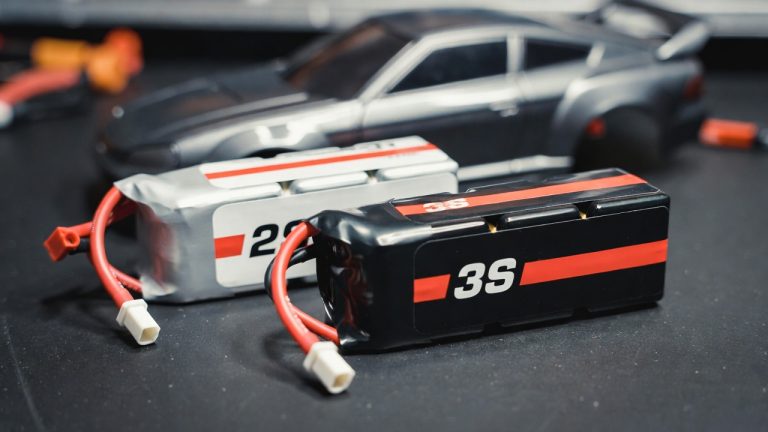
If you run a 3S LiPo battery (about 11.1V), that motor spins at roughly 3800 x 11.1 = 42,180 RPM at full throttle with no load. Under load (actual driving), it will be lower, but that gives you the ballpark.
Now take a 550 motor at 2100KV on the same 3S battery. That is 2100 x 11.1 = 23,310 RPM max. Much slower top speed, but much more torque at low RPM.
This is why a crawler needs a low-KV motor and a speed run car needs a high-KV motor. The physical size (540 vs 550) sets the limits of what the motor can handle — but the KV rating sets the personality.
Brushed Motor Turns: A Deeper Look
If you are running a brushed setup, turns are your guide instead of KV.
Here is a rough guide for 540 and 550 brushed motors:
| Turn Rating | Feel | Best For |
|---|---|---|
| 10T to 15T | Very fast, aggressive | On-road racing, light cars |
| 17T to 20T | Fast, still punchy | All-around use |
| 21T to 27T | Moderate speed, good torque | Bashers, medium builds |
| 35T | Slow, high torque | Crawlers, scale rigs |
| 55T and up | Very slow, massive torque | Heavy scale builds |
A 550 brushed motor at 35T is a popular choice for rock crawlers. It gives you smooth, powerful crawling ability and does not need a fancy brushless system to work well.
A 540 brushed motor at 20T is a classic all-around pick for budget bashers and beginners. It is affordable, easy to replace, and good enough for casual fun.
Maintaining Your Motor
Both 540 and 550 motors need some care to stay in top shape. The upkeep is a bit different depending on the type.
Brushed Motor Maintenance
Brushed motors have carbon brushes that wear down over time. You need to:
- Check brush wear regularly
- Replace brushes before they wear out completely
- Clean the commutator (the copper ring the brushes contact) with a commutator cleaner
- Keep the motor free of dirt and debris
Brushed motors are simple to maintain. Parts are cheap and easy to find.
Brushless Motor Maintenance
Brushless motors have no brushes to replace. That is a big advantage. But they still need some attention:
- Check the bearings — worn bearings cause friction, heat, and noise
- Keep the motor clean — dust and grit inside a brushless motor can cause issues
- Inspect the can — look for dents or damage after crashes
- Keep wires tidy — loose wires can snag or short out
Brushless motors last much longer than brushed motors when cared for properly. Some brushless motors run for years without needing any internal servicing.
Real Talk: What Most RC Hobbyists Actually Use
You will find strong opinions in the RC community. Here is what the general consensus looks like in the real world:
Casual backyard bashers tend to grab whatever motor fits their RTR (ready-to-run) car. Most RTR cars come with a 540 brushed motor. It does the job and is easy to replace.
Enthusiasts who upgrade usually move to a 540 or 550 brushless system. The power jump is huge and the reliability is much better. The 540 brushless is probably the single most popular upgrade motor out there.
Crawler fans almost always go with a 550 sensored brushless at low KV. The torque and control are unmatched for technical crawling.
Racers often stick with specific motor specs set by the rules of their class. Many racing classes mandate a 540 stock brushed motor or a specific brushless turn count.
Builders and scale enthusiasts like to play with different sizes to get just the right power curve for their rig. The 550 is popular here for its realistic pulling power and smooth response.
One More Thing: Rotor Poles and Timing
If you want to go slightly deeper without getting totally lost, here are two more terms worth knowing.
Rotor Poles
Most RC brushless motors have either 2-pole or 4-pole (or more) designs. More poles generally means smoother, lower-speed torque. Crawlers often benefit from multi-pole motors. Racers tend to prefer 2-pole for high RPM efficiency.
Both 540 and 550 motors come in multiple pole configurations. The can size does not lock you into a specific pole count.
Timing
Timing refers to when the motor’s magnetic field is switched relative to the rotor position. Higher timing generally means more top-end speed but more heat. Lower timing means smoother, cooler power.
Many modern brushless ESCs let you adjust timing digitally. Some motors have physical timing adjustment rings. This is more of an advanced tuning topic, but it is good to know it exists.
Summary: 540 vs 550 RC Motor
Let’s wrap it all up in one clean summary.
The 540 motor is:
- Compact and lightweight
- Perfect for on-road cars and light builds
- Available in a huge range of turns and KV ratings
- The most common motor size in the hobby
The 550 motor is:
- Slightly longer, with more copper and bigger magnets
- Better for torque-heavy applications
- Runs cooler under heavy loads
- Great for crawlers, bashers, short course trucks, and heavier builds
The right pick comes down to your chassis, your driving style, and what you want out of your RC car. There is no wrong answer as long as you match the motor to the machine.
Start with your chassis specs. Pick the right size. Nail the KV or turn rating. Pair it with a proper ESC. Then go have fun.
That is really all there is to it.
Related topics: brushless RC motor guide, RC motor KV explained, best motors for rock crawlers, how to choose an RC ESC, RC motor cooling tips, 540 brushless motor recommendations, electric RC car setup for beginners