What Scale Means in RC Cars?
If you are new to RC cars, one of the first things you will hear about is scale. People throw around terms like 1/10, 1/8, or 1/18 all the time. And if you have no idea what any of that means, don’t worry. You are not alone.
Scale is one of those things that sounds confusing at first. But once you get it, everything else about RC cars starts to make more sense. So let’s break it all down in the simplest way possible.
What Does Scale Actually Mean?
Scale tells you how big an RC car is compared to the real thing.
That’s it. Simple as that.
When someone says an RC car is 1/10 scale, they mean the RC car is 10 times smaller than the actual full-size vehicle it is based on. So if the real car is 10 feet long, the RC version would be 1 foot long.
The first number is always 1. The second number tells you how many times smaller the RC car is than the real car. A bigger second number means a smaller RC car. A smaller second number means a bigger RC car.
Here is a quick way to think about it:
- 1/5 scale = very large RC car
- 1/8 scale = large RC car
- 1/10 scale = medium RC car (most common)
- 1/18 scale = small RC car
- 1/24 scale = very small RC car
Why Does Scale Matter?
Scale affects almost everything about your RC car experience.
It affects the size of the car. It affects the price. It affects how fast the car goes, how it handles, and even where you can drive it.
Bigger scale cars tend to be more powerful. They can handle rough terrain better. But they also cost more money and need more space to drive.
Smaller scale cars are easier to use indoors. They are cheaper and easier to transport. But they are not as powerful and can struggle on rough ground.
So scale is not just a number on a box. It shapes your whole experience with the hobby.
The Most Common RC Car Scales Explained
Let’s go through each major scale one by one. This will give you a clear picture of what to expect from each size.
1/5 Scale
This is one of the largest RC car sizes you can buy. These things are massive. We are talking about RC cars that can be 3 to 4 feet long. Some of them are powered by actual gas engines, not just electric motors.
A 1/5 scale RC car is not really a beginner toy. It is a serious piece of equipment. These cars can hit very high speeds. They are loud and heavy. They need a lot of space to run.
If you are just getting into RC cars, a 1/5 scale is probably not the best starting point. But if you love power and big performance, this scale is exciting once you have more experience.
Best for: Advanced hobbyists who want maximum power and don’t mind the extra cost and maintenance.
1/8 Scale
The 1/8 scale is another large option. These cars are smaller than 1/5 but still very capable. Many serious RC bashers and racers use 1/8 scale cars.
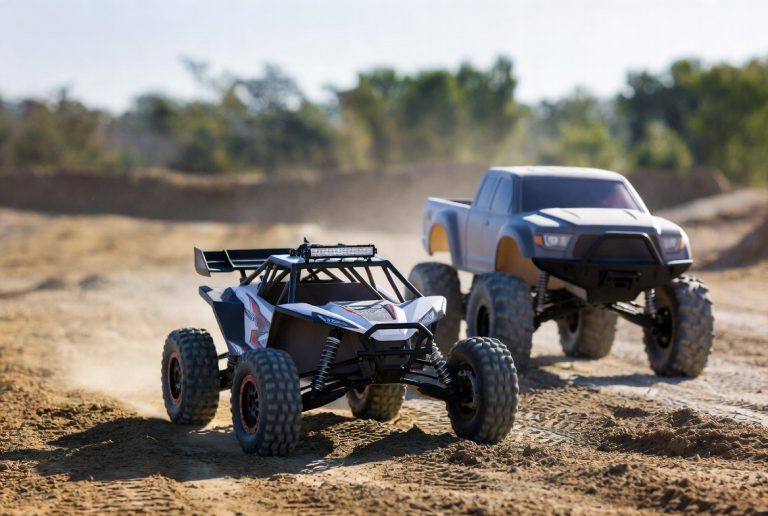
RC buggies, truggies, and monster trucks often come in 1/8 scale. These cars handle rough terrain really well. They have enough size and weight to plow through bumps and uneven ground without getting thrown off track.
Electric 1/8 scale cars are popular right now. They give you a lot of power without the noise and fumes of a gas engine. Brands like Arrma, Traxxas, and Losi all make well-known 1/8 scale models.
Best for: Intermediate to advanced hobbyists who want performance and durability for outdoor bashing or racing.
1/10 Scale
This is the sweet spot. The 1/10 scale is the most popular RC car size in the hobby. It is not too big and not too small. You get good performance, decent speed, and a huge variety of options.
Almost every major RC car brand offers tons of 1/10 scale models. You can find 1/10 scale on-road cars, off-road buggies, short course trucks, rally cars, drift cars, and much more.
The parts and upgrades for 1/10 scale cars are widely available. If something breaks, you can usually find a replacement part easily. This is a big deal for beginners and experienced hobbyists alike.
Many RC racetracks are built specifically for 1/10 scale cars. So if you ever want to get into competitive RC racing, starting with 1/10 scale is a smart move.
Best for: Beginners and intermediate hobbyists. The most versatile scale overall.
1/12 Scale
The 1/12 scale sits between 1/10 and 1/18. These cars are a bit less common than 1/10 scale, but you can still find quality models at this size.
Some mini RC touring cars run in 1/12 scale. They are popular for indoor carpet racing. They are nimble, light, and fun to drive in tight spaces.
If you are interested in precision handling and indoor racing, 1/12 scale might be a great pick.
Best for: Indoor racing enthusiasts who want a slightly smaller but still capable car.
1/14 Scale
Tamiya is famous for its 1/14 scale RC trucks. These are highly detailed scale models of real semi-trucks. They are incredibly realistic and attract a dedicated fan base.
These are not speed machines. They are more about the craftsmanship and the fun of driving a detailed replica. Many people build these as display models that also actually drive.
If you love trucks and enjoy a build project, 1/14 scale Tamiya trucks are a special corner of the RC hobby worth exploring.
Best for: Scale modelers and collectors who love detail and realism.
1/16 Scale
The 1/16 scale is a popular beginner size. Cars in this range are affordable, easy to handle, and compact enough to drive in a backyard or a park.
Traxxas makes some well-known 1/16 scale mini versions of their popular models like the E-Revo and Slash. These cars are still capable little machines. They can handle light off-roading and reach decent speeds for their size.
For kids and new hobbyists on a budget, 1/16 scale is a solid entry point into the world of RC cars.
Best for: Kids, beginners, and anyone on a tight budget who still wants a capable car.
1/18 Scale
The 1/18 scale is one of the most common sizes for entry-level RC cars. You see them in toy stores and online all the time. They are small, cheap, and easy to drive.
These cars are great for younger kids or for people who just want to have casual fun without spending a lot of money. You can drive them indoors without knocking everything over.
That said, the cheaper 1/18 scale cars from toy stores are often not hobby-grade. They break more easily and have fewer upgrade options. If you want a hobby-grade 1/18 scale car, look at brands like Arrma or Team Associated for better quality.
Best for: Young kids, casual drivers, and anyone who wants something small and affordable.
1/24 and Smaller
Once you go below 1/18, you are getting into micro RC territory. These tiny cars can fit in the palm of your hand. They are fun little gadgets but don’t expect serious performance.
Micro RC cars are great for driving on a desk or indoors. Some of them have surprisingly good controls for their size. Brands like Kyosho Mini-Z are well known for making high-quality micro RC cars that serious hobbyists actually enjoy.
Best for: Indoor play, desk toys, and collectors who love tiny details.
Scale vs. Size: Don’t Get Confused
Here is something that trips up a lot of new hobbyists.
Scale and physical size are related, but they are not the same thing.
Two different RC cars can both be labeled as 1/10 scale but have slightly different actual dimensions. That’s because 1/10 scale just means it is 10 times smaller than the real vehicle it is based on. And not all real vehicles are the same size.
A 1/10 scale monster truck will be bigger than a 1/10 scale touring car. The monster truck it is based on is larger in real life. So even though both are 1/10 scale, they look very different in size.
This is important when you are buying bodies, tires, and spare parts. Always check the actual measurements too, not just the scale number.
How Scale Affects Performance
Scale has a big effect on how your RC car performs on the road and off it.
Bigger scale cars are heavier and have more grip. They can handle bumps better. They carry bigger motors and bigger battery packs. This means more power and longer run times.
Smaller scale cars are lighter. They can accelerate faster relative to their size. But they get thrown around more on rough terrain. A small rock that a 1/8 scale car barely notices might stop a 1/24 scale car dead in its tracks.
Wind resistance also matters more at higher speeds for smaller cars. And small cars are harder to see when driving at a distance, which can make them trickier to control outdoors.
How Scale Affects Cost
This is where things get real. Scale plays a big role in how much money you spend.
In general, larger scale cars cost more. They need bigger motors, stronger frames, and more material to build. Replacement parts are also pricier.
A decent 1/8 scale ready-to-run RC car can cost anywhere from a few hundred dollars upward. A beginner 1/18 scale car might cost under a hundred dollars.
Running costs also differ. Bigger cars use more battery power. If you run brushless electric motors, larger cars need bigger battery packs that cost more to replace. If you run nitro or gas engines, fuel costs add up too.
Keep your budget in mind when picking a scale. It is not just the upfront purchase price. It is the ongoing cost of batteries, parts, and upgrades.
How Scale Affects Parts Availability
One of the best things about buying a popular scale is the parts. When your car breaks — and it will break — you want to find replacement parts quickly and cheaply.
1/10 scale wins here. It is the most common scale in the hobby. Parts, upgrades, and aftermarket options are everywhere. You can find hop-ups from dozens of brands to make your car faster, stronger, or better looking.
Less common scales like 1/12 or 1/14 can be harder to source parts for. You might need to order directly from the manufacturer or wait longer for shipping.
Before you buy any RC car, check the parts availability for that specific model. Search online for the car’s name plus “replacement parts” and see what comes up. If there is not much there, you might be in trouble when something eventually breaks.
Body Shells and Scale
RC car body shells are tied directly to scale. A body made for a 1/10 scale car won’t fit on a 1/8 scale car.
But as we touched on before, even within the same scale, you need to check the wheelbase and width. These measurements determine if a body will actually fit your car.
Most manufacturers list the wheelbase and body width in millimeters. Match these to your car’s specs when shopping for replacement or upgrade bodies.
Painted body shells can cost anywhere from $20 to over $100. Clear shells that you paint yourself are usually cheaper and give you more creative freedom.
Scale and RC Racing
If you want to get into competitive RC racing, scale matters a lot. Most racing classes are organized by scale and sometimes by drivetrain type too.
1/10 touring cars are popular on carpet tracks and smooth asphalt. They are fast and precise. Competitive racing in this class requires a lot of tuning and skill.
1/10 off-road buggies are raced on dirt tracks with jumps and bumps. These classes are very popular and well-organized at most RC clubs.
1/8 scale nitro and electric cars race at a slightly larger track size. These classes are known for high speeds and exciting racing.
If you plan to race, find out what classes your local RC track runs first. Then buy a car that fits those classes. There is no point buying a scale that no one at your local track races.
Scale for Bashing vs. Scale for Racing
Not everyone wants to race. A lot of RC enthusiasts just love to bash — driving hard over rough terrain, launching jumps, and generally pushing the car to its limits.
For bashing, 1/8 scale and 1/10 scale are both excellent. They are durable enough to take hard hits and repairs are relatively straightforward.
For racing, 1/10 scale is usually the entry point. The cars are precise, affordable, and the racing classes are easy to find.
For kids and casual fun, 1/16 scale and 1/18 scale are great. They are easy to drive and do not cost a fortune to replace if they get damaged.
Tips for Picking the Right Scale
Here are a few simple tips to help you land on the right scale for you:
Think about where you will drive it. A small backyard or indoor space? Go with 1/18 or smaller. A large outdoor area or a park? A 1/10 or 1/8 scale car will thrive.
Think about your budget. Bigger scale = more money in most cases. Set a realistic budget and work from there.
Think about who will use it. Young kids do better with smaller, more forgiving cars. Adults and teenagers can handle larger, faster models.
Think about your goals. Just want casual fun? Any scale works. Want to race competitively? Go with the scale that your local track supports.
Think about parts and support. Stick to popular scales and well-known brands. Your future self will thank you when you need replacement parts fast.
Real-World Scale Comparisons
Let’s make the numbers feel more real.
A standard RC car is usually modeled after a real vehicle. Here’s how the math works with a common example.
Take a real 2WD short course truck. In real life, it might be around 5 meters long. An RC version of that truck in 1/10 scale would be about 50 centimeters long. That’s roughly the length of your forearm from elbow to fingertip.
The same truck in 1/8 scale would be around 62 centimeters long. A bit bigger, but not dramatically different in daily use.
In 1/16 scale, that same truck shrinks down to about 31 centimeters. Small enough to fit in a large backpack.
These real-world comparisons help you visualize what you are actually getting before your car even arrives at your door.
What About Licensed Scale Models?
Some RC cars are officially licensed replicas of real vehicles. These often come in specific scales to match the real car’s proportions closely.
For example, a licensed 1/10 scale replica of a specific rally car will look just like the real thing. The proportions are accurate. The livery (paint scheme) matches the actual race car.
These models are popular with collectors and scale enthusiasts. They care more about realism and accuracy than raw performance.
Drift RC cars often fall into this category too. Many drift car enthusiasts want bodies that look exactly like the real JDM cars they admire. Scale accuracy matters a lot to them.
Common Mistakes Beginners Make About Scale
Let’s go over a few classic beginner mistakes so you can avoid them.
Mistake 1: Thinking bigger always means better. Bigger RC cars are powerful but they are also more expensive to buy and maintain. They are harder to transport and need more space to drive properly. Bigger is not always better — it depends on your specific situation.
Mistake 2: Buying the wrong scale for the track. If you plan to race at a club or a local track, buy the scale they support. Don’t show up with a 1/8 scale car to a 1/10 scale race. Check first.
Mistake 3: Ignoring parts availability. This is a trap. Some small brands or obscure scales have almost no aftermarket support. When something breaks, you are stuck. Stick with popular scales from well-supported brands.
Mistake 4: Assuming the same scale means parts are interchangeable. Two 1/10 scale cars from different brands often share very few parts. Always check compatibility before buying spares or upgrades.
Final Thoughts
Scale is one of the most basic but important concepts in the RC car hobby. It shapes the size, performance, cost, and overall experience of your RC car.
The most popular scale is 1/10 for good reason. It offers the best mix of performance, price, and parts support. It is a great starting point for almost anyone.
But every scale has its place. Tiny 1/24 scale cars are fun for indoor play. Massive 1/5 scale cars deliver raw, heart-pounding power. And everything in between offers its own unique experience.
The key is to match the scale to your needs. Think about where you will drive, what your budget is, and what kind of experience you want. Get that right, and you will love every second behind the transmitter.
Now that you know what scale means in RC cars, you are already ahead of most beginners. Go out there and pick the car that fits your life — and have a blast doing it.
Related Topics: RC car scales explained, best scale for beginners, RC car size guide, 1/10 scale RC cars, RC bashing vs racing, hobby grade RC cars, remote control car buying guide, RC car body shells, RC car upgrades, brushless RC cars, nitro RC vs electric RC