What Upgrades Make RC Cars Faster?
So you just got your first remote control car. You’re having a blast tearing around the backyard, but then you see someone else’s RC car zoom past like lightning. You think, “How is that thing so fast?” Well, the answer is usually upgrades.
RC car modifications aren’t magic. They’re simple changes you can make to turn your normal car into a speed machine. The good news is that most of these upgrades are things you can do yourself, even if you’re just starting out.
In this guide, we’re going to walk through every upgrade you need to know about to make your RC car faster. We’ll keep it simple, explain everything clearly, and help you understand what each change does.
The Motor: The Heart of Speed
The motor is basically the engine of your RC car. It’s what makes the wheels spin. If you want your car to go faster, upgrading the motor is one of the best places to start.
Why Motor Matters for Speed
Your stock motor (the one that comes with the car) is pretty basic. It does the job fine, but it’s not designed for maximum speed. Aftermarket motors are built specifically to spin faster and put out more power.
Brushless vs Brushed Motors
There are two main types of motors: brushless and brushed.
Brushed motors have small metal brushes inside that touch a rotating part called a commutator. They’re simple and cheap, but they’re not very efficient. A lot of the power gets wasted as heat.
Brushless motors don’t have brushes. Instead, they use magnets and electronics to spin. They’re more efficient, which means more of the power goes into making your car go fast. They also last longer because there’s less friction inside.
If you’re serious about speed, going brushless is the way to go. Brushless motors are a huge jump in performance compared to brushed motors.
KV Rating: What It Means
When you’re looking at motors, you’ll see something called KV rating. The KV stands for “Kilo Volts per 1000 RPM.” This tells you how fast the motor spins.
A higher KV number means a faster motor. A 6000 KV motor spins faster than a 3000 KV motor. But here’s the catch: faster motors use more power from the battery and can be harder to control. They’re also more likely to overheat if you push them too hard.
For beginners, a brushless motor in the 3000-4500 KV range is a good starting point. You get great speed without making the car impossible to handle.
Timing and Performance
Some high-end motors have adjustable timing. Don’t worry if that sounds confusing. Timing controls when the motor gets power. Better timing means smoother power delivery and more speed. Most stock motors have fixed timing, but upgraded motors often let you adjust this.
The Battery: Fuel for Your Speed
Your battery is like the fuel tank of your RC car. A better battery means more power, longer run times, and faster speeds.
LiPo Batteries Are the Gold Standard
LiPo stands for Lithium Polymer. These are the batteries that serious RC enthusiasts use. They’re lighter than older Ni-Mh batteries, they hold more charge, and they deliver power much faster.
When you upgrade from a stock battery to a quality LiPo, your car will feel like a completely different machine. The acceleration will be snappier, and top speed will jump significantly.
Understanding Battery Specs
Batteries have numbers on them that might look confusing at first. Let’s break it down.
Voltage: Most RC cars run on either 2S or 3S LiPo batteries. The “S” stands for “Series,” which is just a fancy way of saying how many cells are in the battery. Each cell gives 3.7 volts. So a 2S battery gives you 7.4 volts, and a 3S battery gives you 11.1 volts.
A 3S battery will make your car faster than a 2S. But check your car’s manual first. Not all cars can handle a 3S battery. If you use one in a car that’s not designed for it, you could burn out the motor or damage the electronics.
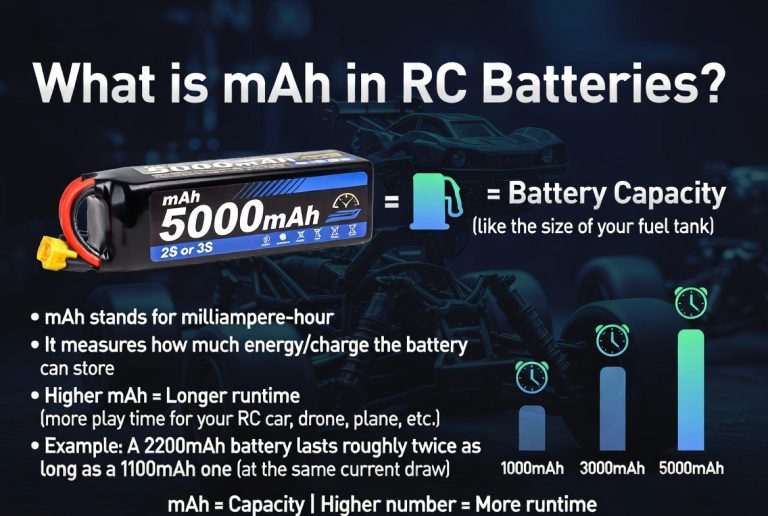
Capacity: This is measured in mAh (milliamp hours). Higher capacity means longer run times. A 3000 mAh battery will keep you running longer than a 1500 mAh battery. For speed, capacity matters less than voltage, but a good capacity helps you maintain speed throughout your driving session.
Discharge Rate: This is shown as a number followed by “C.” A 50C battery discharges faster than a 30C battery. Faster discharge means more power delivered to the motor, which means more speed and better acceleration.
The Gearing: Fine Tuning Your Speed
Gearing is about the ratio between the motor and the wheels. Change the gears, and you change how the power transfers from the motor to the wheels.
Pinion and Spur Gears
The motor connects to a small gear called the pinion gear. The pinion gear meshes with a larger gear called the spur gear, which drives the wheels.
If you want more top speed, use a smaller pinion gear or a larger spur gear. This means the motor has to spin more times to turn the wheels once. It takes a little more acceleration time, but you’ll get higher top speed.
If you want faster acceleration and don’t care as much about top speed, do the opposite. Use a larger pinion gear or a smaller spur gear. The wheels will spin faster for the same motor speed, so you’ll accelerate quicker.
Gear Ratio Basics
The ratio is simple math. If your motor spins 1000 times and your wheels only spin 100 times, your ratio is 10:1.
For speed, many people run ratios between 3:1 and 5:1, depending on the track or terrain. On a large open track, a lower ratio (like 3:1 or 3.5:1) gives you higher top speed. On a tighter track or in smaller spaces, a higher ratio (like 4.5:1 or 5:1) gives you better acceleration.
Material Quality
Gears come in different materials. Cheap plastic gears wear out fast and can strip easily. Steel gears last much longer and can handle more power without breaking. If you’re upgrading the motor and battery, upgrading the gears too makes sense.
The Tires and Wheels: Where Speed Meets the Ground
You can have the fastest motor in the world, but if your tires are terrible, your car won’t go fast. Tires are where your RC car meets the ground, and they matter a lot.
Tire Compound
Tire compound is basically how soft or hard the rubber is. Softer tires grip better but wear out faster. Harder tires last longer but don’t grip as well.
For speed on smooth surfaces like pavement, harder tires actually help. They roll with less friction, so your car goes faster. For off-road driving in dirt or grass, softer tires give you better traction, which prevents the wheels from spinning without gripping.
Tire Tread and Design
Slick tires (with no tread) are fastest on smooth surfaces. They have less friction and roll smoother. Tread tires are better for dirt and rough ground because they dig in and grab the surface.
If you mostly drive on pavement or smooth concrete, switch to slick or semi-slick tires. You’ll see an immediate jump in speed.
Wheel Weight and Design
Lighter wheels help your car accelerate faster. Less weight spinning means the motor doesn’t have to work as hard to speed up the wheels.
Wide wheels also help with stability at high speeds. Skinny wheels can make your car twitchy and hard to control. Most upgraded wheel packages are wider and lighter than stock wheels.
The Suspension: Control at High Speed
You might think suspension is just for comfort, but it’s actually crucial for speed.
Springs and Dampers
Springs control how much your suspension moves up and down. Dampers (also called shocks) control how quickly that movement happens.
Stiffer springs and dampers help your car stay stable at high speeds. They reduce the bouncing and keep the tires planted on the ground. When your tires stay on the ground, you get better traction, which means you can go faster without losing control.
Soft suspension is great for bumpy tracks because it absorbs the bumps. But on smooth surfaces, stiff suspension is faster because the car stays lower to the ground and moves more predictably.
Anti-Roll Bars
An anti-roll bar (also called a sway bar) connects the left and right wheels. It reduces how much the car leans when you turn. Less leaning means the tires stay flatter on the ground, which improves grip.
Better anti-roll bars give you more control during high-speed turns. You can maintain speed while turning without sliding out.
The ESC: The Smart Controller
The ESC (Electronic Speed Controller) is basically the brain of your RC car. It takes commands from your remote and tells the motor how much power to give.
Brushless ESCs Are Necessary
If you upgrade to a brushless motor, you need a brushless ESC. A brushed ESC won’t work with a brushless motor. The good news is that quality brushless ESCs are affordable.
Timing and Power Delivery
Better ESCs have adjustable timing, which controls when the motor gets power. Proper timing makes the motor run more efficiently and smoothly. This means less power wasted and more power going into speed.
Some ESCs also have different driving modes. Sport mode gives you more aggressive power delivery for maximum speed. Beginner mode softens the acceleration. For pure speed, use sport mode.
Cooling Matters
When you push an ESC hard, it heats up. Overheating causes the ESC to reduce power (called thermal throttling) to protect itself. A good ESC has better heat dissipation, which means it stays cooler and keeps delivering maximum power for longer.
Some people add small heatsinks or fans to their ESCs. It sounds excessive, but on a hot day when you’re pushing your car hard, it can make a difference.
The Servo: Steering at Speed
Your servo controls the steering. When you’re going fast, accurate steering becomes even more important.
High-Speed Servos
Stock servos are slow. They take a while to respond. High-speed servos react instantly to your remote input.
At low speeds, slow servos don’t matter much. But when you’re flying down the track at top speed, you need your steering to respond right away. A fast servo prevents over-steering and gives you better control.
Torque Considerations
Servo torque is how much pulling power it has. Higher torque means it can steer harder against the resistance of the tires sliding across the ground at high speed.
For fast RC cars on pavement or smooth surfaces, look for servos with at least 8 kg-cm of torque. For off-road, you might need more.
Aerodynamics: The Invisible Force
Air resistance is real, even for RC cars. At high speeds, aerodynamics actually matters.
Body Modifications
Some people cut their RC car bodies to reduce drag. Lower bodies mean less air pushes against the car. This is an advanced mod, but it works.
You can also switch to more aerodynamic body styles. Some designs are just shaped better to cut through the air.
Splitters and Wings
Some RC cars have small splitters on the front or wings on the back. These help with downforce (pushing the car down onto the ground) at high speeds. More downforce means better traction.
Most of this is for racing on smooth tracks, but it’s cool to know it exists.
The Drivetrain: Getting Power to the Wheels
How power travels from the motor to the wheels matters for speed.
Ball Bearings vs Bushings
Ball bearings let the wheels spin freely with minimal friction. Bushings are cheaper but create more friction.
If you replace all the stock bushings with quality ball bearings, you’ll feel a noticeable jump in speed. Less friction means the wheels spin easier, and your car rolls faster.
Drive Shaft and Universal Joints
These parts connect the motor to the wheels. Better materials and tighter tolerances mean less power loss. If these parts are bent or worn, your car loses speed even if everything else is upgraded.
The Chassis: Everything Comes Together
The chassis is the frame that holds everything together.
Stiffness
A stiffer chassis helps the car handle better at high speeds and transfers power more efficiently. Some people add braces or use different chassis materials to increase stiffness.
Excessive chassis stiffness can make the car harsh and twitchy, so there’s a balance. But for speed, a slightly stiffer chassis than stock is usually better.
Weight Distribution
Moving the weight around can affect how the car handles. For example, moving the battery more toward the back can help with rear-wheel traction on acceleration.
This is more advanced tuning, but it’s something to keep in mind as you get more experienced.
Building Your Upgrade Plan
So now you know what you can upgrade. But where should you start?
The Budget Approach
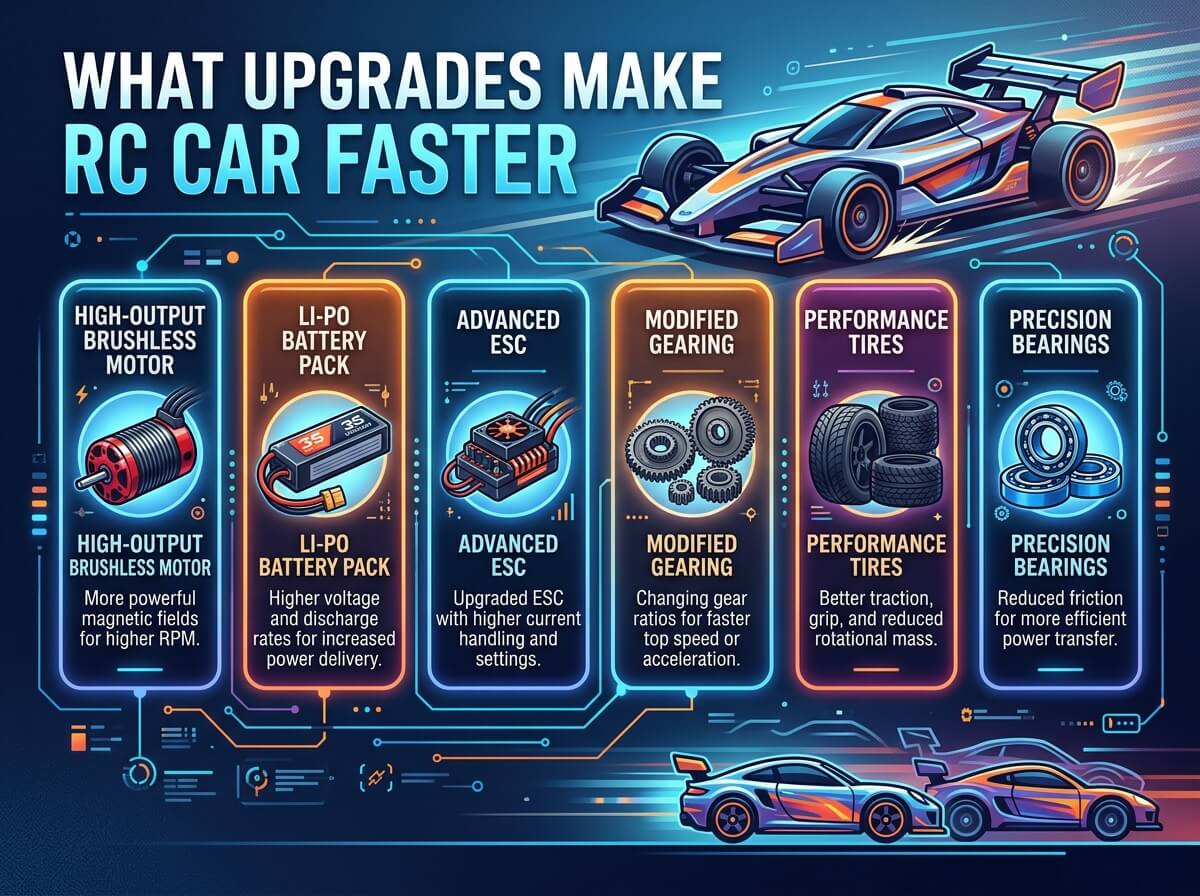
If you have limited money, start with the motor and battery. These two upgrades give you the biggest jump in speed for the least money. A decent brushless motor and 3S LiPo battery will transform your car.
The Balanced Approach
If you have more to spend, go with motor, battery, gearing, and tires. These four upgrades create a well-rounded faster RC car that handles well and stays in control.
The Full Package
If you’re going all out, you can upgrade everything: motor, battery, ESC, servo, gears, tires, suspension, bearings, and chassis bracing. This creates a seriously fast RC car that’s fun to drive.
Compatibility and Safety
Before you buy upgrades, always check compatibility with your specific car model.
Reading the Manual
Your RC car comes with a manual (if you can find it). The manual tells you what the car can handle. If your car is rated for 2S batteries, don’t use a 3S battery just because you think it’s faster. You could damage the electronics.
Testing Gradually
When you install upgrades, test them carefully. Start slowly and build up speed. If something feels wrong, stop and check it.
Maintenance is Key
Upgrades help, but so does maintenance. Clean your car regularly. Tighten loose screws. Check that nothing is cracked or broken. A well-maintained car with basic upgrades will always beat a neglected car with fancy upgrades.
Common Mistakes to Avoid
People often make mistakes when upgrading their RC cars. Here are some things to avoid.
Upgrading Everything at Once
If you upgrade the motor, battery, ESC, and gears all at the same time, you won’t know which upgrade actually made the difference. Do one upgrade at a time so you can feel the improvement.
Ignoring the Cooling System
High-performance upgrades generate heat. If your motor, battery, and ESC all get hot, they’ll throttle back power to protect themselves. This defeats the purpose of upgrading. Make sure everything can cool down properly.
Neglecting the Wheels and Tires
New beginners spend tons of money on the motor but stick with stock tires. This is backwards. Good tires matter as much as a good motor. Bad tires waste the motor’s power.
Using the Wrong Battery Connector
Batteries use different connectors: XT60, T-Plug, Deans, etc. Make sure your battery and ESC use the same connector. If they don’t match, you need an adapter. Better yet, just buy the right battery.
Real-World Speed Improvements
Let’s talk numbers. What kind of speed increases can you actually expect?
Stock vs Basic Upgrades
A stock RC car might reach 20-25 mph (about 32-40 km/h). With a brushless motor and 2S LiPo battery upgrade, you’re looking at 35-45 mph (56-72 km/h). That’s almost double the speed.
Stock vs Full Upgrades
A fully upgraded car (motor, battery, ESC, gears, tires) can easily hit 60-80 mph (96-128 km/h) on a good track. Some cars go even faster.
These numbers vary based on the car model, the quality of upgrades, and the driving conditions. But the point is clear: upgrades make a massive difference.
Maintaining Your Upgraded RC Car
Once you’ve invested in upgrades, you need to take care of them.
Regular Cleaning
Dirt and dust shorten the lifespan of every component. Clean your car after each session. Pay special attention to the motor, ESC, and bearings.
Storage
Store your car in a dry place. Moisture and heat are the enemies of RC components. Never leave your LiPo battery charged and sitting around. Store it at about 50% charge in a cool place.
Bearing Maintenance
Good ball bearings reduce friction, but they need care. Every few months, clean them and apply a tiny drop of bearing oil. Don’t use regular motor oil. Use oil designed for RC bearings.
Checking for Wear
Inspect your car regularly. Look for cracks in the chassis, bent components, or worn tires. Fix problems immediately. A small crack can become a big break during a high-speed run.
The Fun Part: Now You Can Race
Once you’ve upgraded your car, you can finally keep up with those fast cars you saw before. More importantly, you’ll have a blast driving it.
The journey doesn’t end here, though. After you’ve made these upgrades, you might want to dial in the suspension, adjust the gearing for different tracks, or experiment with different tire compounds. There’s always something to tweak and improve.
Final Thoughts
Making your RC car faster doesn’t require buying expensive parts you don’t understand. It just requires knowing what each upgrade does and choosing the ones that fit your needs and budget.
Start with the basics: motor and battery. Feel the difference. Then move on to the next upgrade when you’re ready. Before you know it, your RC car will be smoking past all the others.
The best part? You did it yourself. You understand your car, you know what makes it fast, and you can keep improving it. That’s way cooler than buying a pre-built speed machine.
So get out there, pick your first upgrade, install it, and get ready to feel your RC car absolutely fly.