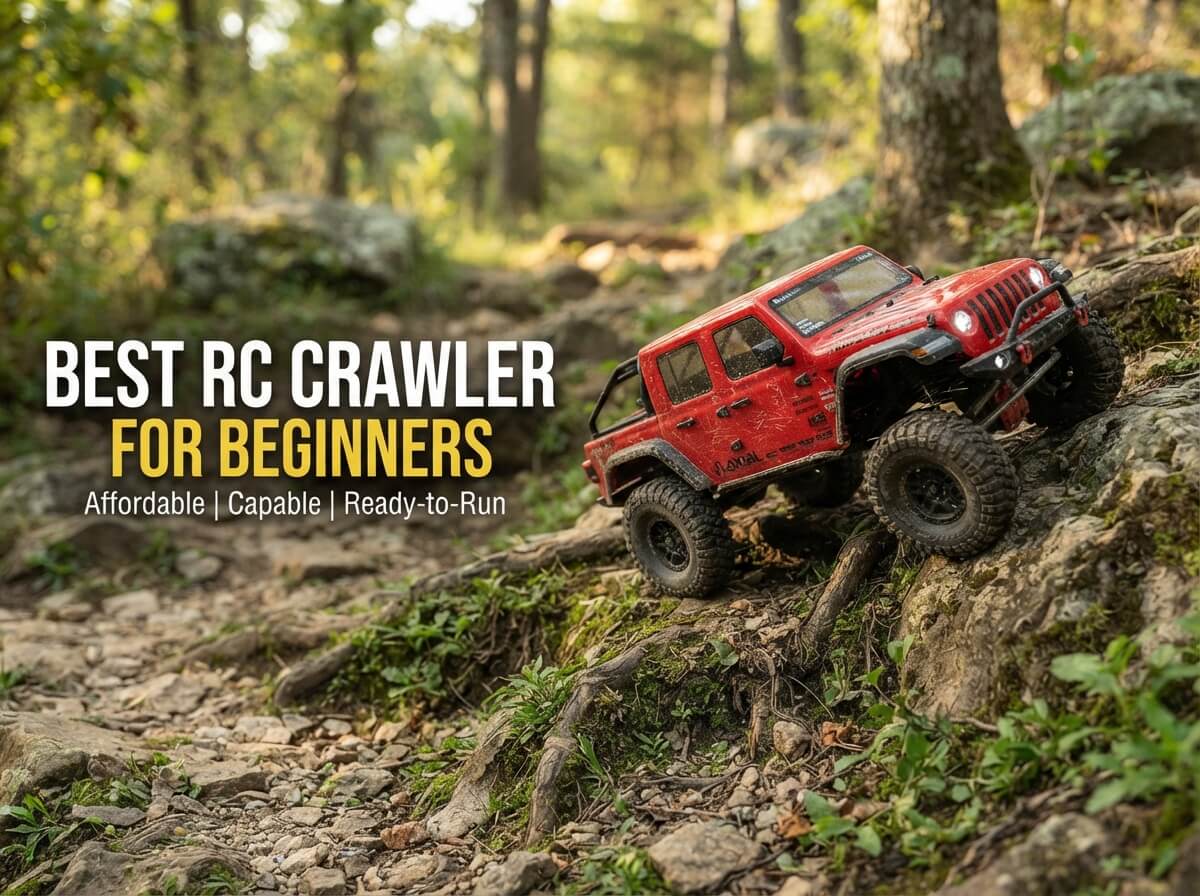
5 Best RC Crawler for Beginners In 2026
If you are just getting into the RC hobby, a rock crawler is one of the most fun ways to start. These little trucks are built to climb over rocks, roots, sand, and mud without flipping over or getting stuck. They move slow and steady, so new drivers get plenty of time to learn how to steer, throttle, and balance the truck instead of chasing a fast car around a parking lot.
The problem is that the market is packed with options, and a lot of them are either too cheap to survive a single backyard session or too advanced for someone who has never touched a transmitter before. In this guide, we break down five popular RC crawlers that are often recommended for new hobbyists. We will look at what each one does well, where it falls short, and who it actually fits best.
This is not a “buy the most expensive one and hope for the best” kind of article. We go product by product, explain the features in plain language, and give you real talk on pros, cons, and value. By the end, you will know exactly which crawler matches your budget, your skill level, and what you actually plan to do with it.
Let’s get into it.
Quick Answer: Our Top Picks
- Best overall for true beginners: WPL C24 RC Rock Crawler
- Best budget pick for kids: DEERC DE125 Monster Truck
- Best mini crawler for tight spaces: HLSFWDRIVE WPL C24-1
- Best step-up hobby-grade crawler: Redcat Racing Danchee Ridgerock
- Best for speed lovers who still want an easy learning curve: HYPER GO H16BM
Now let’s look at each truck in detail.
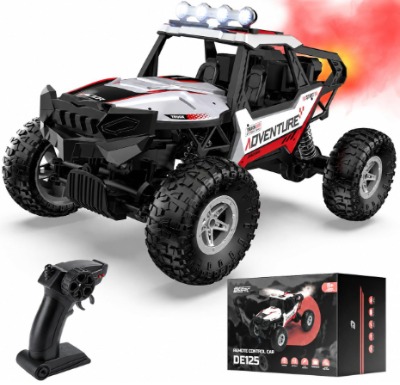
1. DEERC DE125 1:14 RC Car for Kids – 4WD Remote Control Off-Road Monster Truck
Product Description
The DEERC DE125 is built as an entry-level off-road truck rather than a strict rock crawler, but it gets grouped into crawler and off-road lists all the time because of its rugged tires and 4-wheel drive setup. It runs on a 1:14 scale body, has big rubber tires with deep tread, and uses a simple 2.4GHz remote that almost anyone can pick up and understand in under a minute.
This truck is aimed squarely at kids, teens, and adults who want a rough and tumble toy-grade truck without spending a lot of money. It is not designed for scale rock crawling competitions, but it handles grass, dirt, gravel, and light mud without much trouble.
Best Use Cases
- Backyard bashing and driveway runs
- A first RC truck for a child (with adult supervision on the battery and charging)
- Gift purchases where the buyer wants something fun out of the box, no assembly needed
- Casual weekend driving on dirt trails or a local park
Key Features Explained Simply
- 4WD system: All four wheels get power, so the truck has an easier time climbing over bumps, roots, and small rocks compared to 2WD toy trucks.
- 2.4GHz remote control: This means multiple people can run their own DE125 trucks near each other without the signals messing with one another.
- High-torque motor: Gives the truck enough pulling power to climb small slopes and push through soft dirt.
- Shock absorbers: Basic spring shocks smooth out bumps so the truck stays planted instead of bouncing wildly.
- Rechargeable battery with USB charging: No need to buy a separate charger, you just plug it into a USB port.
Real-Life Usage Insight
Buyers who pick up the DE125 usually report that it survives typical backyard crashes into fences, curbs, and furniture without cracking apart, which says a lot about the plastic body quality at this price point. Run time tends to land in the 20 to 30 minute range per charge, which is fairly normal for toy-grade trucks in this class. Many parents note that setup takes just a few minutes since it comes mostly ready to run.
Pros
- Very low price, easy entry point for the hobby
- No tools or assembly needed
- Tough plastic shell handles bumps and light falls
- Simple two-stick or trigger-style control layout
- Good gift option for kids
Cons
- Not a true scale rock crawler, so it struggles on steep rock piles
- Battery life is short compared to hobby-grade trucks
- Suspension travel is limited, so bigger obstacles can stop it cold
- Not really upgradeable if you want to grow into the hobby later
Performance Discussion
On flat dirt, grass, and light gravel, the DE125 moves along at a decent clip and handles turns without tipping easily thanks to its wide stance. Where it starts to struggle is on anything resembling a real rock crawling course with tall rocks or deep ruts. The ground clearance and axle articulation just are not built for that kind of terrain. Think of it as an off-road basher rather than a technical crawler.
Ease of Use
This is about as beginner-friendly as it gets. The remote has simple forward, reverse, left, and right controls, and there is no steep learning curve. A child as young as 6 or 7 can usually operate it with a little guidance.
Value for Money
For the price, you get a fun, durable truck that holds up to rough play. It will not satisfy someone chasing scale realism, but as a low-stakes first truck or gift, it delivers solid value.
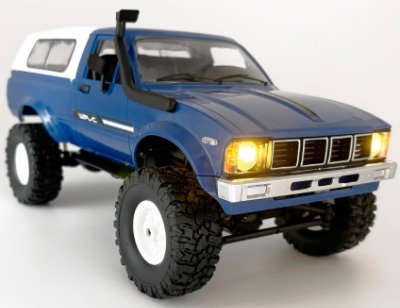
2. WPL C24 RC Rock Crawler – RC Truck 4×4 Off Road RTR
Product Description
The WPL C24 is a proper mini rock crawler shaped like a classic pickup truck. RTR stands for “ready to run,” so it comes fully assembled and does not need any building before your first drive. It uses a 4×4 drivetrain, a simple radio system, and a scale-style body that looks like a small pickup truck, complete with a roll cage and spare tire mount on some versions.
This one sits right in the sweet spot for beginners who want to try actual rock crawling and scale driving without spending hobby-grade money.
Best Use Cases
- Learning basic rock crawling lines over small rocks and roots
- Indoor obstacle courses using books, boxes, or ramps
- Backyard rock gardens or dirt piles
- Anyone who wants to experiment with light modding and upgrades later
Key Features Explained Simply
- 4×4 drivetrain with portal axles: Portal axles raise the differential higher off the ground, giving extra ground clearance so the truck clears rocks and bumps more easily.
- Low gear ratio: This gives the truck strong crawling torque at slow speeds, which is exactly what you want for climbing instead of racing.
- Scale truck body: Looks like a mini pickup, which adds to the fun factor for hobbyists who like the appearance side of RC as much as the driving.
- Simple 2-channel radio: Easy throttle and steering control without extra switches to confuse a new driver.
- Rubber tires with soft compound: Grips well on rocks, wood, and carpet for indoor practice runs.
Real-Life Usage Insight
New hobbyists often mention that the WPL C24 is where they really start to understand what crawling is about, since it climbs obstacles that a toy-grade truck like the DE125 simply cannot handle. Because parts and upgrades for the WPL C24 platform are widely available online, a lot of beginners use this truck to learn basic maintenance too, like swapping tires or servos, which builds useful hobby skills early on.
Pros
- Real crawling ability thanks to portal axles and low gearing
- RTR, no assembly required out of the box
- Affordable entry into true scale rock crawling
- Wide aftermarket support for upgrades and replacement parts
- Compact size, good for indoor practice
Cons
- Plastic gears can wear out if pushed too hard on tough terrain
- Stock battery life is on the shorter side
- Waterproofing is limited, so mud and puddle runs need some caution
- Top speed is low, which is great for crawling but boring if you want a fast basher
Performance Discussion
Where this truck shines is low-speed technical climbing. It crawls over rocks, roots, and uneven ground with more confidence than most toy-grade trucks in its price range. It is not built for speed, and if you try to bash it hard and fast over rough terrain, the drivetrain will show its limits faster. Treat it like a crawler, not a race truck, and it performs really well.
Ease of Use
The controls are simple, and the slow crawling speed actually makes it easier for beginners to learn steering and throttle control without the truck getting away from them. It is a forgiving truck to learn on.
Value for Money
Given how much real crawling capability you get for the price, the WPL C24 offers strong value. It is a great “graduate from toy-grade” option without jumping straight into expensive hobby-grade pricing.
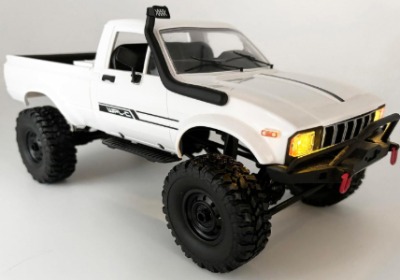
3. HLSFWDRIVE WPL C24-1 RC Rock Crawler – 1/16 Scale All Terrain
Product Description
The C24-1 is a close cousin to the standard WPL C24, built on a similar 1/16 scale platform with small tweaks to the body style, electronics, or accessories depending on the seller bundle. It keeps the same core idea: a compact, portal-axle 4×4 crawler that is RTR and beginner-friendly, with a scale look that mimics a small off-road pickup.
Since it shares a lot of DNA with the C24, expect a similar driving feel, but check the specific listing for small differences like LED lights, extra battery packs, or a slightly different body shell, since sellers sometimes bundle different accessories.
Best Use Cases
- First rock crawler for someone who wants a compact size that is easy to store
- Indoor practice on carpet, books, or DIY obstacle courses
- Small yard or balcony driving where space is limited
- Hobbyists who want a lightweight truck that is gentle on furniture and floors if it bumps into something
Key Features Explained Simply
- 1/16 scale size: Small enough to fit in a backpack or drawer, easy to transport and store.
- Portal axle 4×4 setup: Same benefit as the standard C24, more ground clearance and better crawling torque.
- All-terrain tires: Grippy tread pattern designed to bite into rocks, dirt, and carpet fibers alike.
- RTR setup: No building needed, charge the battery and drive.
- Lightweight chassis: Easier on indoor floors and furniture during those inevitable beginner bumps.
Real-Life Usage Insight
Because of its small footprint, this crawler gets used a lot for indoor obstacle courses using stacked books, cardboard ramps, and pillows. Beginners who live in apartments or do not have a big yard tend to lean toward this size since it is easier to store and does not need a huge outdoor area to be fun. It is also a popular pick for people introducing a partner or friend to the hobby since two small crawlers can run side by side in a limited space.
Pros
- Compact and lightweight, great for small spaces
- Real crawling capability despite the small size
- RTR and beginner-friendly right out of the box
- Fun scale look for the price
- Easy to carry along on trips or to a friend’s house
Cons
- Smaller size means it can struggle on bigger outdoor obstacles compared to larger crawlers
- Battery life is limited, typical of small-scale trucks
- Durability can vary depending on the specific bundle and parts used
- Less aftermarket support compared to the more established WPL C24 line
Performance Discussion
On small to medium indoor obstacles, this truck performs impressively for its size. Outdoors, it does fine on grass and light gravel, but very large rocks or deep ruts can be tough for a 1/16 scale chassis to clear. It is best thought of as a technical, slow-and-steady crawler for tighter spaces rather than an all-terrain speed machine.
Ease of Use
Very approachable for new drivers. The slow speed and small size make it forgiving, and there is little risk of the truck getting away from you the way a faster basher might.
Value for Money
If you want a compact crawler that still delivers real climbing fun, this is a solid pick. It might not have the widest parts support, but for casual use and learning the basics, it does the job well.
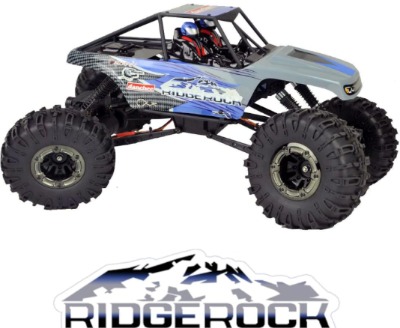
4. Redcat Racing Danchee Ridgerock – 1/10 Scale 4WD Electric RC Rock Crawler
Product Description
The Danchee Ridgerock from Redcat Racing is a step up from the mini crawlers above. It runs on a 1/10 scale chassis, which is a common and well-supported size in the hobby-grade RC world. It comes RTR with a 2.4GHz radio, dual motors, and 4-wheel steering, plus a USB charger and included Li-ion battery so you can get moving right out of the box.
This truck is built with more serious crawling in mind. The dual motor setup and 4-wheel steering give it capabilities that go beyond what toy-grade and mini crawlers can offer, making it a good choice for someone who wants to grow into more technical driving.
Best Use Cases
- Backyard and trail rock crawling on medium to large obstacles
- Learning advanced techniques like tight turning with 4-wheel steering
- Hobbyists who want a truck they can upgrade and customize over time
- Anyone planning to eventually join local RC crawling meetups or clubs
Key Features Explained Simply
- 1/10 scale size: A larger, more substantial chassis than mini crawlers, giving it better stability and the ability to tackle bigger obstacles.
- Dual motors: Instead of one motor powering all four wheels through a shared drivetrain, dual motors give more direct power delivery, which helps with climbing power and control.
- 4-wheel steering: All four wheels can turn, not just the front two. This lets the truck make tighter turns and crab-walk sideways in tricky spots, which is a big help on technical courses.
- 2.4GHz radio system: Reliable connection with low interference, standard for most modern RC trucks.
- Li-ion battery with USB charger: Convenient charging without needing a separate balance charger, though serious hobbyists sometimes upgrade to a smart charger later.
Real-Life Usage Insight
Hobbyists moving up from mini crawlers often point to the Ridgerock as their bridge into “real” hobby-grade crawling. The 4-wheel steering takes a little practice to get used to since it changes how the truck handles compared to standard front-steering trucks, but once it clicks, it opens up a lot of technical driving options on tight rock gardens or narrow trail sections. Because it is part of an established hobby-grade lineup, replacement parts and upgrade options are relatively easy to track down.
Pros
- Strong climbing performance thanks to dual motors and low gearing
- 4-wheel steering adds real technical capability
- 1/10 scale size handles bigger obstacles with more confidence
- Solid upgrade path if you want to swap in better electronics later
- RTR setup with everything needed to start driving quickly
Cons
- Higher price point than the mini crawlers on this list
- Larger size needs more storage and transport space
- 4-wheel steering has a learning curve for brand-new drivers
- Heavier truck means you will want a reliable charging routine to keep runs going
Performance Discussion
This is where the list moves from “toy that can crawl a little” to “actual crawling truck.” The Ridgerock handles bigger rocks, steeper inclines, and tighter technical sections with noticeably more confidence than the mini crawlers above. The dual motor setup gives strong, controlled power at crawling speeds, and once you get comfortable with the 4-wheel steering, tight technical lines become much easier to pull off.
Ease of Use
Slightly less beginner-simple than the smaller trucks on this list, mainly because of the 4-wheel steering learning curve. That said, it is still approachable, and most new drivers get comfortable with it after a short practice session or two. Think of it as beginner-friendly with a small learning ramp rather than instantly intuitive.
Value for Money
For someone serious about getting into rock crawling and planning to stick with the hobby, this truck offers strong value. You are paying more upfront, but you are also getting a platform that can grow with your skills instead of something you will outgrow in a month.
5. HYPER GO H16BM – 1/16 Brushless Fast RC Car for Adults
Product Description
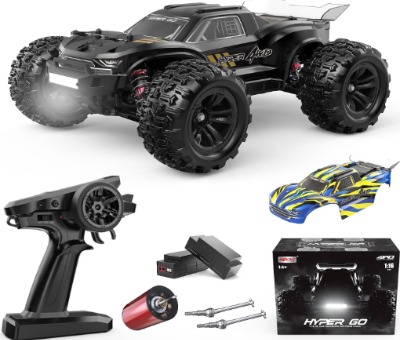
The HYPER GO H16BM is a bit of an outlier on this list since it leans more toward speed than technical crawling. It uses a brushless motor system, which means stronger power output and better efficiency compared to standard brushed motors. Built on a 1/16 scale chassis, it is aimed at hobbyists, often adults, who want quick, punchy performance in a smaller truck body.
We include it here because a lot of beginners searching for their first RC truck end up torn between crawling and speed, and this model gives you a taste of brushless power without jumping into a full-size, expensive race truck.
Best Use Cases
- Open driveway, parking lot, or park runs where speed matters more than rock climbing
- Beginners who want to experience brushless power without a big price tag
- Adults looking for a fast, fun truck rather than a slow technical crawler
- Mixed terrain bashing on dirt, grass, and pavement
Key Features Explained Simply
- Brushless motor: Delivers more power and runs cooler and more efficiently than a standard brushed motor, translating into faster acceleration and higher top speeds.
- 1/16 scale size: Compact and easy to transport, while still being able to handle decent speed thanks to the brushless setup.
- 4WD system: Helps keep the truck stable and controllable even at higher speeds, especially through turns.
- Waterproof electronics (check specific listing): Many brushless trucks in this class include water-resistant parts, which helps them survive puddles and wet grass better than basic toy-grade trucks.
- Adjustable shocks: Lets you fine-tune the ride height and stiffness depending on the terrain you are driving on.
Real-Life Usage Insight
Adults picking this truck up for the first time are often surprised by how much power a small 1/16 scale brushless truck can put out compared to a similarly sized brushed truck. It is common to hear that the biggest adjustment for new drivers is learning to control the throttle since brushless power comes on fast, and a light touch goes a long way until you get a feel for it.
Pros
- Genuinely fast for its size thanks to the brushless motor
- More efficient power delivery, which usually means better run times per charge compared to similar brushed trucks
- 4WD keeps it stable at speed
- Compact size, easy to store and transport
- Fun option for adults who want something more exciting than a slow crawler
Cons
- Not built for technical rock crawling, it prioritizes speed over climbing ability
- Higher top speed means a slightly steeper learning curve for total beginners
- Brushless systems can be pricier to repair if something breaks
- Small scale means less ground clearance for big obstacles
Performance Discussion
On open ground, this truck is genuinely quick, and the brushless motor gives it a noticeably punchier feel compared to brushed alternatives in the same size class. Where it does not compete is technical rock crawling, since the low ground clearance and speed-focused gearing are not designed for climbing. If your main interest is off-road racing and bashing rather than slow technical crawling, this is the pick from our list that fits that style best.
Ease of Use
A little trickier for absolute first-timers because of the speed, but nothing too intimidating. Most 4WD systems help keep things stable, and a beginner who takes it slow at first will get comfortable quickly. Just expect a slightly faster learning curve compared to the slower crawlers above.
Value for Money
If speed is what you are after, this truck delivers a lot of performance for the price, especially with a brushless motor included at this size and cost. It is not the right pick if crawling is your main goal, but for fast, fun driving, it is a strong value option.
Comparison Insights
| Product | Scale | Drive Type | Best For | Speed | Crawling Ability | Beginner Friendliness |
|---|---|---|---|---|---|---|
| DEERC DE125 | 1/14 | 4WD | Casual bashing, kids | Moderate | Basic | Very high |
| WPL C24 | 1/16-ish scale RTR | 4×4 portal axle | True beginner crawling | Slow | Strong | High |
| HLSFWDRIVE WPL C24-1 | 1/16 | 4×4 portal axle | Compact indoor/outdoor crawling | Slow | Strong (small obstacles) | High |
| Redcat Danchee Ridgerock | 1/10 | 4WD dual motor, 4-wheel steer | Serious crawling, growth hobby | Slow-Moderate | Excellent | Medium-High |
| HYPER GO H16BM | 1/16 | 4WD brushless | Speed and bashing | Fast | Limited | Medium |
A few patterns stand out here. If your main goal is learning how a rock crawler actually climbs and handles obstacles, the WPL C24 and its C24-1 cousin are the clearest fits, since both use portal axles and low gearing built for that job. If you want something tougher and ready for bigger obstacles down the line, the Ridgerock is the truck that scales with you as your skills grow. The DEERC DE125 works best as a low-cost starter toy, especially for younger kids, while the HYPER GO H16BM is the odd one out that trades crawling ability for straight-line speed and fun.
Buying Guide: What to Look For in a Beginner RC Crawler
1. Ground Clearance and Axle Type
Ground clearance decides how easily a truck clears rocks, roots, and uneven terrain. Portal axles, like the ones on the WPL C24 line, raise the differential higher off the ground, giving noticeably better clearance than standard straight axles at the same price point.
2. Gear Ratio and Torque
A low gear ratio means the truck moves slower but pulls harder, which is exactly what you want for climbing instead of racing. If a listing brags mainly about top speed, it is probably built more for bashing than technical crawling.
3. RTR vs Kit
RTR trucks come fully built and ready to drive after a charge. Kits require assembly and are usually better suited for hobbyists who already have some experience with tools and electronics. Every truck on this list is RTR, which is the right call for a first purchase.
4. Battery Type and Run Time
Most beginner trucks use Li-ion or Li-po batteries. Run time in the 20 to 40 minute range is fairly typical for this class. It helps to grab a second battery early on so you are not stuck waiting for a recharge mid-session.
5. Waterproofing
Basic toy-grade electronics are not always sealed against water, so a puddle or wet grass session can cause damage. Hobby-grade trucks tend to have better sealed electronics, but it is always smart to check the specific listing rather than assume.
6. Scale Size
Smaller scales like 1/16 are easier to store and transport but usually have less ground clearance for big obstacles. Larger scales like 1/10 handle rougher terrain better but need more storage room and typically cost more.
7. Parts Availability
Trucks built on popular platforms, like the WPL line or established brands like Redcat, tend to have wider access to spare parts and upgrades. This matters a lot once you start driving regularly, since parts wear out with use and crashes happen.
Who Should Buy These Products
- Parents buying for a young child: The DEERC DE125 is the safest and simplest starting point, with tough construction and dead-simple controls.
- Adults or teens wanting real crawling experience on a budget: The WPL C24 gives you actual technical climbing without a big investment.
- Anyone with limited space, like an apartment or small yard: The HLSFWDRIVE WPL C24-1 fits the bill thanks to its compact size.
- Hobbyists ready to commit to the hobby long term: The Redcat Danchee Ridgerock offers room to grow, with stronger performance and upgrade potential.
- Drivers who care more about speed and excitement than climbing: The HYPER GO H16BM delivers a fun, fast experience that stands apart from the crawlers on this list.
Common Mistakes to Avoid as a Beginner
Buying based on top speed alone. A fast truck is fun, but if your goal is learning to crawl over rocks and obstacles, speed is not the metric that matters. Torque, gearing, and ground clearance matter far more for that job.
Skipping a second battery. Run times are short on most beginner trucks, and nothing kills the fun faster than a dead battery ten minutes into a session. Grab a spare early so you can keep driving while the other one charges.
Ignoring the terrain you actually plan to drive on. A mini crawler built for indoor obstacle courses will struggle on a rocky mountain trail, while a big hobby-grade crawler might feel like overkill for someone who just wants to drive around a small backyard.
Charging with the wrong charger or leaving batteries unattended. Li-ion and Li-po batteries need proper care. Always use the charger that comes with the truck or a matching replacement, and never leave a battery charging unattended for long stretches.
Driving hard before learning the basics. It is tempting to gun the throttle right away, but slow, controlled practice on flat ground first helps you understand steering response and throttle control before tackling harder terrain.
Assuming all “RC crawlers” climb the same way. Not every off-road-looking truck is built for technical crawling. Some, like the DEERC DE125 or the HYPER GO H16BM, lean more toward general bashing or speed rather than slow, technical climbing.
Forgetting to check part compatibility before buying random upgrades. Not every accessory fits every truck, even within the same general size class. Double check compatibility before ordering replacement tires, servos, or motors.
Final Verdict
There is no single “best” truck here, since it really comes down to what you want out of the hobby.
If you want the simplest, cheapest way to get a kid excited about RC trucks, go with the DEERC DE125. It is tough, easy to use, and does not demand much from a first-time driver.
If your goal is learning actual rock crawling technique without spending a lot of money, the WPL C24 is hard to beat. Portal axles and low gearing give it real climbing chops, and it is still simple enough for a total beginner to pick up fast.
If space is tight or you just want something small and portable that still climbs well, the HLSFWDRIVE WPL C24-1 is a smart pick, especially for indoor practice sessions.
If you are serious about sticking with this hobby and want a truck that can grow with your skills, spend a bit more on the Redcat Danchee Ridgerock. The dual motors and 4-wheel steering open up a level of technical driving the smaller trucks simply cannot match.
And if crawling is not really your thing and you just want a fast, fun truck to rip around the driveway, the HYPER GO H16BM brings brushless speed at a size that will not break the bank.
Whatever you land on, the best move as a beginner is to start slow, learn how your specific truck handles, and build good habits around battery care and maintenance early. Rock crawling rewards patience more than speed, and once you get a feel for how these trucks climb, it turns into one of the most satisfying corners of the RC hobby.