How Do RC Cars Work?
RC cars are some of the coolest toys you can own. They zoom around, they turn on a dime, and they make awesome sounds while you’re playing with them. But have you ever wondered what makes them actually work? How does that little remote control in your hand tell a car sitting 50 feet away to speed up, slow down, or turn left? It’s actually way simpler than you might think, and that’s what we’re diving into today.
What Exactly Is an RC Car?
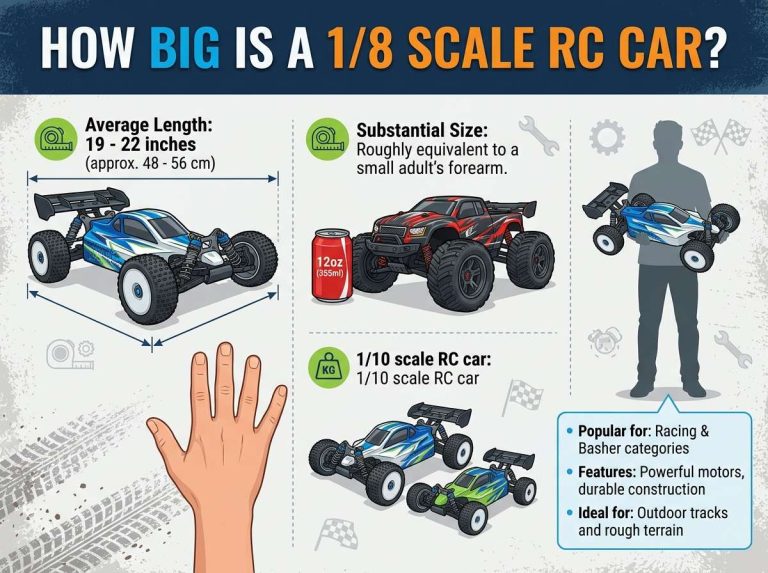
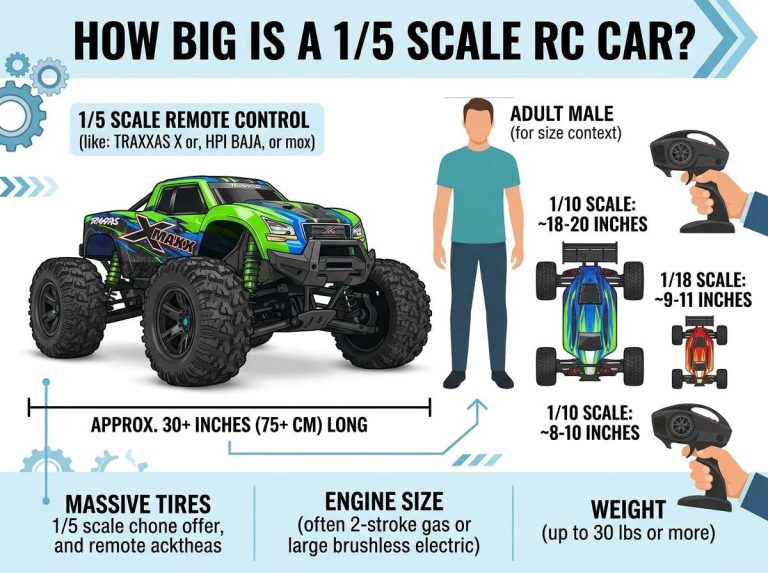
Let’s start with the basics. An RC car is a small vehicle that you control using a remote control device. You hold the remote, press buttons or move sticks, and the car responds to your commands. The “RC” stands for remote control, which is pretty straightforward. These cars come in all sorts of sizes, from tiny ones that fit in your hand to large ones that are almost half your height.
The amazing thing about RC cars is that they contain all the same components as a real car, just in miniature form. They have engines or motors, wheels, suspension systems, steering mechanisms, and brakes. Some people think RC cars are just plastic toys, but serious RC car enthusiasts know that these vehicles are incredible feats of engineering.
The Remote Control System
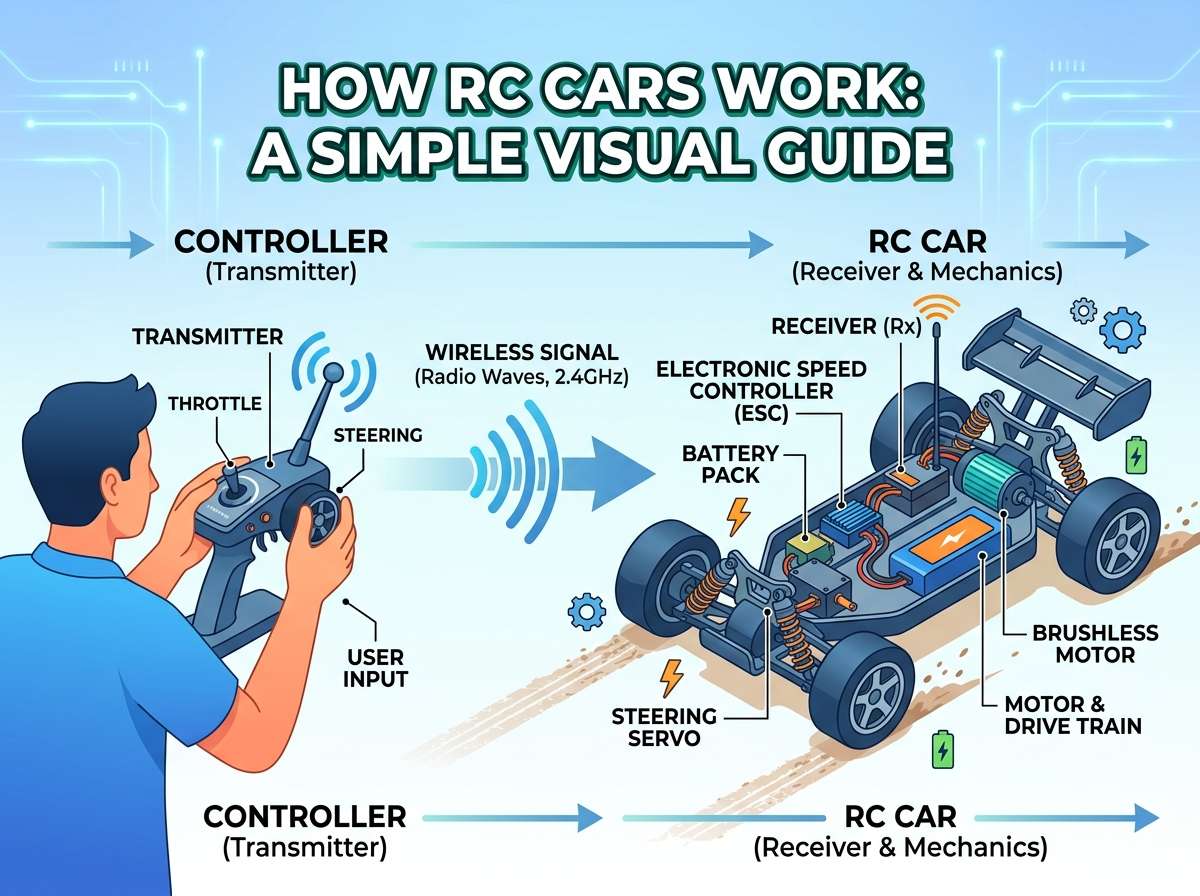
Let’s talk about how you actually control the car. You hold a remote, which is a transmitter that sends signals. The car receives these signals through a receiver unit built into its chassis. Think of it like a walkie-talkie system for your car.
The transmitter sends radio signals on a specific frequency. Early RC cars used simple AM or FM radio frequencies, similar to what regular radios pick up. Modern cars often use digital frequency-hopping systems that are way more reliable and resistant to interference. The receiver in the car picks up these signals and translates them into actions.
Types of Transmitters
You’ll run into different transmitter styles out there. The pistol-grip remote looks kind of like a gun with a trigger and a steering wheel. You pull the trigger to go forward or backward, and you turn the wheel to steer. Kids and beginners usually love these because they’re intuitive and easy to hold.
The stick transmitter, also called a radio box or radio controller, looks like a video game controller. It has two sticks that you move around, and usually a bunch of buttons. Serious racing drivers prefer these because they give more precise control. Some people use wheels with pedals that bolt to a table for an even more realistic racing experience.
The Power Source
Every RC car needs power to run, and that’s where the battery comes in. Most modern RC cars use rechargeable lithium polymer batteries, often called LiPo batteries. These batteries pack a lot of power into a small package and give you more runtime than old nickel-cadmium batteries that we used years ago.
The battery stores electrical energy, and when you drive the car, this energy flows through wires and electronic circuits to power everything. Without the battery, nothing works. The battery is basically the car’s lifeblood. A typical RC car battery might last 15 to 30 minutes of continuous driving, depending on how hard you’re pushing it and the battery’s capacity.
Charging the battery is important. You can’t just pop them in a regular wall outlet. You need a charger specifically made for LiPo batteries that knows how to safely charge them. Overcharging or damaging a LiPo battery can cause it to catch fire or explode, so manufacturers take this seriously and design safe charging systems.
The Motor and Engine System
This is where things get interesting. RC cars have two main types of power sources: electric motors or gas/nitro engines.
Electric Motors
Electric motors are the most popular choice for beginners and casual users. These motors have magnets and coils that use electrical current to create motion. When electricity flows through the motor, the magnetic field pushes and pulls, making the shaft spin. This spinning shaft connects to the wheels through a system of gears, and boom—your car drives.
Electric RC cars are quiet, clean, and require less maintenance than gas cars. You just charge the battery and go. They’re also faster to start up since there’s no engine to warm up. Many professional racers actually use electric cars because they’re so reliable and fast.
Gas and Nitro Engines
Some RC cars run on small gasoline or nitro-methane engines. These are tiny internal combustion engines, similar to what’s in a real car but much, much smaller. They have pistons, cylinders, and spark plugs. You mix fuel and oil, pull a starter cord or button to ignite them, and they roar to life.
Nitro engines are cool and they sound amazing, which a lot of people love. They also last a long time if you take care of them. But they’re harder to maintain, they’re louder, and the fuel is more expensive than electricity.
The Gearbox and Transmission
Between the motor and the wheels sits the gearbox. This is a mechanical system of gears that transfers the motor’s spinning motion to the wheels at the right speed and power. The gears work together to multiply the force from the motor or multiply the speed, depending on which gears are engaged.
Think of it like a bicycle. A bicycle has gears that make pedaling easier on steep hills or faster on flat ground. RC car gearboxes work the same way. They let the motor run at its most efficient speed while the wheels turn at the right speed for the car to move properly.
A simple gearbox might have a spur gear that connects directly to the wheels. More complex systems have multiple gears that transfer power more efficiently. The gearing ratio affects how fast your car goes and how much force it has to climb hills or push through rough terrain.
The Steering System
Steering is simpler than you might think. Inside the car sits a servo, which is basically an electric motor with some extra smarts. When you turn the steering wheel on your remote, it sends a signal to the servo. The servo responds by moving a lever that’s connected to the steering linkages.
These linkages are rods and arms that push and pull the front wheels left or right. It’s the same principle as a real car’s steering system, just with a servo doing the work instead of you turning a steering wheel. The servo can only turn so far in each direction, which limits how much the wheels can turn.
Servos are precise and respond quickly to your commands. A good servo can react to your input in less than a tenth of a second. This is why experienced RC car drivers can do tricks like drifting or jumping in a way that looks almost impossible.
The Braking System
Most RC cars have either friction brakes or electronic braking. Friction brakes work the same way as real car brakes. When you press the brake button, pads push against a spinning disc and create friction that slows the car down.
Electronic braking is cooler in some ways. On electric cars, the motor can reverse its spin direction to brake. The motor actually becomes a generator, turning the wheels’ motion back into electrical energy that goes into the battery. This is called regenerative braking, and it helps preserve your battery charge while you’re driving.
Braking is important for safety and control. A car with good brakes is easier to drive precisely and won’t careen out of control down a hill.
The Chassis and Suspension
The chassis is the frame that holds everything together. It’s usually made from plastic, aluminum, or carbon fiber. The chassis needs to be strong enough to handle crashes and jumps while being light enough that the motor can move it quickly.
Inside the chassis, you’ll find the suspension system. This includes springs, shocks, and arms that let the wheels move up and down independently. Good suspension absorbs impacts from bumps and keeps the wheels on the ground even when the car is bouncing around. This helps the car stay controllable and go faster because all four wheels stay in contact with the ground.
The suspension is one of the things that separates a basic RC car from a serious hobby vehicle. A cheap RC car might have plastic springs and stiff shocks. A high-end racing car might have oil-filled shock absorbers that you can adjust for different terrains and driving conditions.
Wheels and Tires
The wheels connect the car to the ground. RC car wheels come in all sorts of sizes and designs. Off-road cars have big, chunky tires with deep treads that grip dirt and grass. On-road racing cars have smooth, slick tires that stick to pavement.
The tire compound matters too. Hard tires last longer but don’t grip as well. Soft tires grip better but wear out faster. Serious racers swap tires depending on whether it’s hot or cold outside, wet or dry—just like real racing teams.
The Receiver and Electronic Speed Controller
The receiver is a circuit board that sits in the car and listens for signals from your transmitter. When it gets a signal, it processes that information and tells other parts of the car what to do.
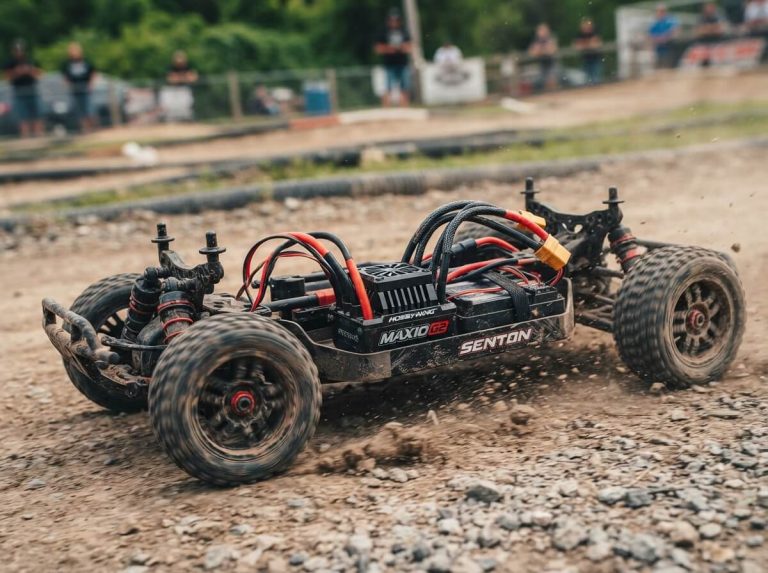
The electronic speed controller, or ESC, is like the car’s brain for movement. When the receiver says “go forward at 50 percent power,” the ESC regulates the electrical current flowing to the motor. It makes sure the motor spins at the right speed. Without the ESC, the motor would just spin at full speed all the time, and you’d have no speed control.
Modern ESCs are incredibly sophisticated. They can control speed smoothly, provide regenerative braking, limit acceleration to prevent wheelies, and even cut power if you crash to protect the motor. Some ESCs are programmable, letting you fine-tune how the car behaves.
Assembling the System
So here’s how all these parts work together. You hold your transmitter and push a button or move a stick. That sends a radio signal from the transmitter to the receiver in the car. The receiver gets this signal and sends commands to the ESC and the servo.
The ESC controls the motor, making it spin at the right speed. The motor’s spinning shaft connects to the gearbox. The gearbox transfers this spinning motion to the wheels, making them rotate. At the same time, the servo moves the steering linkages, turning the wheels left or right. The wheels grip the ground, and the car moves according to your commands.
All of this happens nearly instantaneously. The delay between you moving the remote and the car responding is measured in milliseconds. This is why RC cars feel responsive and fun to drive.
Different Types of RC Cars
RC vehicles come in several flavors, each with its own purpose.
Racing cars are built for speed. They’re lightweight, low to the ground, and designed to go fast in a straight line or around a course. They’re usually electric and can reach speeds of 40, 50, or even 70 miles per hour.
Off-road buggies and trucks are made for rough terrain. They have bigger wheels, better suspension, and stronger frames. They climb hills, drive through mud, and handle obstacles. They’re more durable than racing cars but usually a bit slower.
Crawlers and rock crawlers are super tough vehicles designed to climb over huge obstacles and navigate incredibly rough terrain. They move slowly but can go places that seem impossible.
Drift cars are built to slide around corners in a controlled way. They have special tires that let the wheels spin without gripping. Watching a good drift car do its thing is mesmerizing.
Trucker and monster truck styles are popular for casual driving and jumping. They have big wheels and crazy suspension that lets them do backflips and fly through the air.
Hobby Grade vs Toy Grade
There’s a big difference between a $20 RC car from a toy store and a $200 hobby-grade car from a hobby shop. Toy-grade cars are simple, durable, and meant for casual play. They’re usually slower, less precise, and use cheaper components.
Hobby-grade cars are the real deal. They have better motors, more precise servos, programmable ESCs, and suspension that you can adjust. Serious hobbyists spend hundreds or even thousands of dollars on their vehicles and their supporting equipment like chargers, spare parts, and tools.
The good news is that even toy-grade RC cars are fun and let you experience the basic excitement of RC driving. As you get more interested, you can upgrade to hobby-grade equipment.
Maintenance and Upkeep
RC cars need some care to keep running well. After driving in dirt, you should rinse the car with water to clean out dust and debris. The motor, gearbox, and bearings need occasional lubrication with special RC lubricants.
Tires wear out with use and need replacing. Servos and motors can burn out if you use them roughly. Batteries lose charge capacity over time. These are all normal wear items.
The good news is that RC cars are built to be repaired. Most parts are replaceable, and there are tons of replacement parts available online. A broken servo? Buy a new one and swap it in. Worn-out tires? Get a new set. This is actually part of what makes the hobby fun for many people—they get to work on their cars, upgrade parts, and customize them.
Getting Started with RC Cars
If you want to get started with RC cars, here’s what you need. First, you need the car itself. Buy something in your budget that matches the type of driving you want to do.
You’ll need a battery charger and batteries. Most cars come with a basic battery, but having a spare means you can drive longer if you have two batteries and charge one while using the other.
A small toolkit is helpful. You’ll need a screwdriver set and maybe a wrench or two. Some lubricants for the gearbox and motor help things last longer.
Most importantly, you need a place to drive. Empty parking lots are great. Some people build tracks in their yards. Others drive at organized racing events or parks.
The Fun Factor
At the end of the day, RC cars are fun because you control them and they respond to your input instantly. You can make them zoom, jump, spin, and do amazing things. You can race friends, tackle challenging terrain, or just enjoy the simple pleasure of watching a tiny vehicle zoom around at high speed.
The hobby aspect is deep too. People customize their cars with different colors, upgrade components, join clubs, and attend events. For some people, it’s a serious hobby with lots of learning and community involved.
Conclusion
RC cars work through a surprisingly elegant system. A radio transmitter sends signals to a receiver in the car. The receiver tells the motor how fast to spin and tells the servo which way to turn the wheels. The motor powers the drivetrain through a gearbox. The servo steers the wheels. Everything works together to create a vehicle that responds to your commands in real-time.
From the battery supplying power to the complex electronic controllers managing everything, each part plays a role. The gearbox multiplies force or speed as needed. The suspension absorbs bumps. The tires grip the ground. The brakes slow you down when you need to stop.
Whether you’re just curious about how they work or you’re thinking about getting one for yourself, understanding these basics gives you a real appreciation for the engineering packed into these tiny vehicles. RC cars prove that you don’t need something big or expensive to have real fun. Sometimes the best toys are the ones you understand and can tinker with yourself.
So next time you see an RC car racing down the street or flying through the air, you’ll know exactly what’s happening inside. You’ll understand the radio signals being sent, the motors spinning, and the servos moving. You’ll appreciate the little marvel of engineering and control. And maybe you’ll be inspired to grab one yourself and experience the joy of driving something you can hold in your hand.? A Complete Beginner’s Guide to Remote Control Vehicles
RC cars are some of the coolest toys you can own. They zoom around, they turn on a dime, and they make awesome sounds while you’re playing with them. But have you ever wondered what makes them actually work? How does that little remote control in your hand tell a car sitting 50 feet away to speed up, slow down, or turn left? It’s actually way simpler than you might think, and that’s what we’re diving into today.
What Exactly Is an RC Car?
Let’s start with the basics. An RC car is a small vehicle that you control using a remote control device. You hold the remote, press buttons or move sticks, and the car responds to your commands. The “RC” stands for remote control, which is pretty straightforward. These cars come in all sorts of sizes, from tiny ones that fit in your hand to large ones that are almost half your height.
The amazing thing about RC cars is that they contain all the same components as a real car, just in miniature form. They have engines or motors, wheels, suspension systems, steering mechanisms, and brakes. Some people think RC cars are just plastic toys, but serious RC car enthusiasts know that these vehicles are incredible feats of engineering.
The Remote Control System
Let’s talk about how you actually control the car. You hold a remote, which is a transmitter that sends signals. The car receives these signals through a receiver unit built into its chassis. Think of it like a walkie-talkie system for your car.
The transmitter sends radio signals on a specific frequency. Early RC cars used simple AM or FM radio frequencies, similar to what regular radios pick up. Modern cars often use digital frequency-hopping systems that are way more reliable and resistant to interference. The receiver in the car picks up these signals and translates them into actions.
Types of Transmitters
You’ll run into different transmitter styles out there. The pistol-grip remote looks kind of like a gun with a trigger and a steering wheel. You pull the trigger to go forward or backward, and you turn the wheel to steer. Kids and beginners usually love these because they’re intuitive and easy to hold.
The stick transmitter, also called a radio box or radio controller, looks like a video game controller. It has two sticks that you move around, and usually a bunch of buttons. Serious racing drivers prefer these because they give more precise control. Some people use wheels with pedals that bolt to a table for an even more realistic racing experience.
The Power Source
Every RC car needs power to run, and that’s where the battery comes in. Most modern RC cars use rechargeable lithium polymer batteries, often called LiPo batteries. These batteries pack a lot of power into a small package and give you more runtime than old nickel-cadmium batteries that we used years ago.
The battery stores electrical energy, and when you drive the car, this energy flows through wires and electronic circuits to power everything. Without the battery, nothing works. The battery is basically the car’s lifeblood. A typical RC car battery might last 15 to 30 minutes of continuous driving, depending on how hard you’re pushing it and the battery’s capacity.
Charging the battery is important. You can’t just pop them in a regular wall outlet. You need a charger specifically made for LiPo batteries that knows how to safely charge them. Overcharging or damaging a LiPo battery can cause it to catch fire or explode, so manufacturers take this seriously and design safe charging systems.
The Motor and Engine System
This is where things get interesting. RC cars have two main types of power sources: electric motors or gas/nitro engines.
Electric Motors
Electric motors are the most popular choice for beginners and casual users. These motors have magnets and coils that use electrical current to create motion. When electricity flows through the motor, the magnetic field pushes and pulls, making the shaft spin. This spinning shaft connects to the wheels through a system of gears, and boom—your car drives.
Electric RC cars are quiet, clean, and require less maintenance than gas cars. You just charge the battery and go. They’re also faster to start up since there’s no engine to warm up. Many professional racers actually use electric cars because they’re so reliable and fast.
Gas and Nitro Engines
Some RC cars run on small gasoline or nitro-methane engines. These are tiny internal combustion engines, similar to what’s in a real car but much, much smaller. They have pistons, cylinders, and spark plugs. You mix fuel and oil, pull a starter cord or button to ignite them, and they roar to life.
Nitro engines are cool and they sound amazing, which a lot of people love. They also last a long time if you take care of them. But they’re harder to maintain, they’re louder, and the fuel is more expensive than electricity.
The Gearbox and Transmission
Between the motor and the wheels sits the gearbox. This is a mechanical system of gears that transfers the motor’s spinning motion to the wheels at the right speed and power. The gears work together to multiply the force from the motor or multiply the speed, depending on which gears are engaged.
Think of it like a bicycle. A bicycle has gears that make pedaling easier on steep hills or faster on flat ground. RC car gearboxes work the same way. They let the motor run at its most efficient speed while the wheels turn at the right speed for the car to move properly.
A simple gearbox might have a spur gear that connects directly to the wheels. More complex systems have multiple gears that transfer power more efficiently. The gearing ratio affects how fast your car goes and how much force it has to climb hills or push through rough terrain.
The Steering System
Steering is simpler than you might think. Inside the car sits a servo, which is basically an electric motor with some extra smarts. When you turn the steering wheel on your remote, it sends a signal to the servo. The servo responds by moving a lever that’s connected to the steering linkages.
These linkages are rods and arms that push and pull the front wheels left or right. It’s the same principle as a real car’s steering system, just with a servo doing the work instead of you turning a steering wheel. The servo can only turn so far in each direction, which limits how much the wheels can turn.
Servos are precise and respond quickly to your commands. A good servo can react to your input in less than a tenth of a second. This is why experienced RC car drivers can do tricks like drifting or jumping in a way that looks almost impossible.
The Braking System
Most RC cars have either friction brakes or electronic braking. Friction brakes work the same way as real car brakes. When you press the brake button, pads push against a spinning disc and create friction that slows the car down.
Electronic braking is cooler in some ways. On electric cars, the motor can reverse its spin direction to brake. The motor actually becomes a generator, turning the wheels’ motion back into electrical energy that goes into the battery. This is called regenerative braking, and it helps preserve your battery charge while you’re driving.
Braking is important for safety and control. A car with good brakes is easier to drive precisely and won’t careen out of control down a hill.
The Chassis and Suspension
The chassis is the frame that holds everything together. It’s usually made from plastic, aluminum, or carbon fiber. The chassis needs to be strong enough to handle crashes and jumps while being light enough that the motor can move it quickly.
Inside the chassis, you’ll find the suspension system. This includes springs, shocks, and arms that let the wheels move up and down independently. Good suspension absorbs impacts from bumps and keeps the wheels on the ground even when the car is bouncing around. This helps the car stay controllable and go faster because all four wheels stay in contact with the ground.
The suspension is one of the things that separates a basic RC car from a serious hobby vehicle. A cheap RC car might have plastic springs and stiff shocks. A high-end racing car might have oil-filled shock absorbers that you can adjust for different terrains and driving conditions.
Wheels and Tires
The wheels connect the car to the ground. RC car wheels come in all sorts of sizes and designs. Off-road cars have big, chunky tires with deep treads that grip dirt and grass. On-road racing cars have smooth, slick tires that stick to pavement.
The tire compound matters too. Hard tires last longer but don’t grip as well. Soft tires grip better but wear out faster. Serious racers swap tires depending on whether it’s hot or cold outside, wet or dry—just like real racing teams.
The Receiver and Electronic Speed Controller
The receiver is a circuit board that sits in the car and listens for signals from your transmitter. When it gets a signal, it processes that information and tells other parts of the car what to do.
The electronic speed controller, or ESC, is like the car’s brain for movement. When the receiver says “go forward at 50 percent power,” the ESC regulates the electrical current flowing to the motor. It makes sure the motor spins at the right speed. Without the ESC, the motor would just spin at full speed all the time, and you’d have no speed control.
Modern ESCs are incredibly sophisticated. They can control speed smoothly, provide regenerative braking, limit acceleration to prevent wheelies, and even cut power if you crash to protect the motor. Some ESCs are programmable, letting you fine-tune how the car behaves.
Assembling the System
So here’s how all these parts work together. You hold your transmitter and push a button or move a stick. That sends a radio signal from the transmitter to the receiver in the car. The receiver gets this signal and sends commands to the ESC and the servo.
The ESC controls the motor, making it spin at the right speed. The motor’s spinning shaft connects to the gearbox. The gearbox transfers this spinning motion to the wheels, making them rotate. At the same time, the servo moves the steering linkages, turning the wheels left or right. The wheels grip the ground, and the car moves according to your commands.
All of this happens nearly instantaneously. The delay between you moving the remote and the car responding is measured in milliseconds. This is why RC cars feel responsive and fun to drive.
Different Types of RC Cars
RC vehicles come in several flavors, each with its own purpose.
Racing cars are built for speed. They’re lightweight, low to the ground, and designed to go fast in a straight line or around a course. They’re usually electric and can reach speeds of 40, 50, or even 70 miles per hour.
Off-road buggies and trucks are made for rough terrain. They have bigger wheels, better suspension, and stronger frames. They climb hills, drive through mud, and handle obstacles. They’re more durable than racing cars but usually a bit slower.
Crawlers and rock crawlers are super tough vehicles designed to climb over huge obstacles and navigate incredibly rough terrain. They move slowly but can go places that seem impossible.
Drift cars are built to slide around corners in a controlled way. They have special tires that let the wheels spin without gripping. Watching a good drift car do its thing is mesmerizing.
Trucker and monster truck styles are popular for casual driving and jumping. They have big wheels and crazy suspension that lets them do backflips and fly through the air.
Hobby Grade vs Toy Grade
There’s a big difference between a $20 RC car from a toy store and a $200 hobby-grade car from a hobby shop. Toy-grade cars are simple, durable, and meant for casual play. They’re usually slower, less precise, and use cheaper components.
Hobby-grade cars are the real deal. They have better motors, more precise servos, programmable ESCs, and suspension that you can adjust. Serious hobbyists spend hundreds or even thousands of dollars on their vehicles and their supporting equipment like chargers, spare parts, and tools.
The good news is that even toy-grade RC cars are fun and let you experience the basic excitement of RC driving. As you get more interested, you can upgrade to hobby-grade equipment.
Maintenance and Upkeep
RC cars need some care to keep running well. After driving in dirt, you should rinse the car with water to clean out dust and debris. The motor, gearbox, and bearings need occasional lubrication with special RC lubricants.
Tires wear out with use and need replacing. Servos and motors can burn out if you use them roughly. Batteries lose charge capacity over time. These are all normal wear items.
The good news is that RC cars are built to be repaired. Most parts are replaceable, and there are tons of replacement parts available online. A broken servo? Buy a new one and swap it in. Worn-out tires? Get a new set. This is actually part of what makes the hobby fun for many people—they get to work on their cars, upgrade parts, and customize them.
Getting Started with RC Cars
If you want to get started with RC cars, here’s what you need. First, you need the car itself. Buy something in your budget that matches the type of driving you want to do.
You’ll need a battery charger and batteries. Most cars come with a basic battery, but having a spare means you can drive longer if you have two batteries and charge one while using the other.
A small toolkit is helpful. You’ll need a screwdriver set and maybe a wrench or two. Some lubricants for the gearbox and motor help things last longer.
Most importantly, you need a place to drive. Empty parking lots are great. Some people build tracks in their yards. Others drive at organized racing events or parks.
The Fun Factor
At the end of the day, RC cars are fun because you control them and they respond to your input instantly. You can make them zoom, jump, spin, and do amazing things. You can race friends, tackle challenging terrain, or just enjoy the simple pleasure of watching a tiny vehicle zoom around at high speed.
The hobby aspect is deep too. People customize their cars with different colors, upgrade components, join clubs, and attend events. For some people, it’s a serious hobby with lots of learning and community involved.
Conclusion
RC cars work through a surprisingly elegant system. A radio transmitter sends signals to a receiver in the car. The receiver tells the motor how fast to spin and tells the servo which way to turn the wheels. The motor powers the drivetrain through a gearbox. The servo steers the wheels. Everything works together to create a vehicle that responds to your commands in real-time.
From the battery supplying power to the complex electronic controllers managing everything, each part plays a role. The gearbox multiplies force or speed as needed. The suspension absorbs bumps. The tires grip the ground. The brakes slow you down when you need to stop.
Whether you’re just curious about how they work or you’re thinking about getting one for yourself, understanding these basics gives you a real appreciation for the engineering packed into these tiny vehicles. RC cars prove that you don’t need something big or expensive to have real fun. Sometimes the best toys are the ones you understand and can tinker with yourself.
So next time you see an RC car racing down the street or flying through the air, you’ll know exactly what’s happening inside. You’ll understand the radio signals being sent, the motors spinning, and the servos moving. You’ll appreciate the little marvel of engineering and control. And maybe you’ll be inspired to grab one yourself and experience the joy of driving something you can hold in your hand.
Peterson is an RC hobby enthusiast and product reviewer with a passion for remote-controlled cars, trucks, boats, drones, and accessories. He enjoys testing the latest RC products, comparing features, and sharing practical buying guides to help beginners and experienced hobbyists make informed decisions. Through RCThing.com, Peterson provides honest reviews, maintenance tips, and expert advice to help readers get the most from their RC adventures.