How Big Is a 1/10 Scale RC Car?
When you first hear about 1/10 scale remote control cars, your brain probably does some quick math. One-tenth of something, right? So a 1/10 scale RC car is one-tenth the size of a full-size car. That sounds simple enough, but there’s actually a lot more to know about what that means and why it matters.
Let me break this down for you in plain English so you can really understand what you’re getting into with these mini vehicles.
The Basic Size Measurement
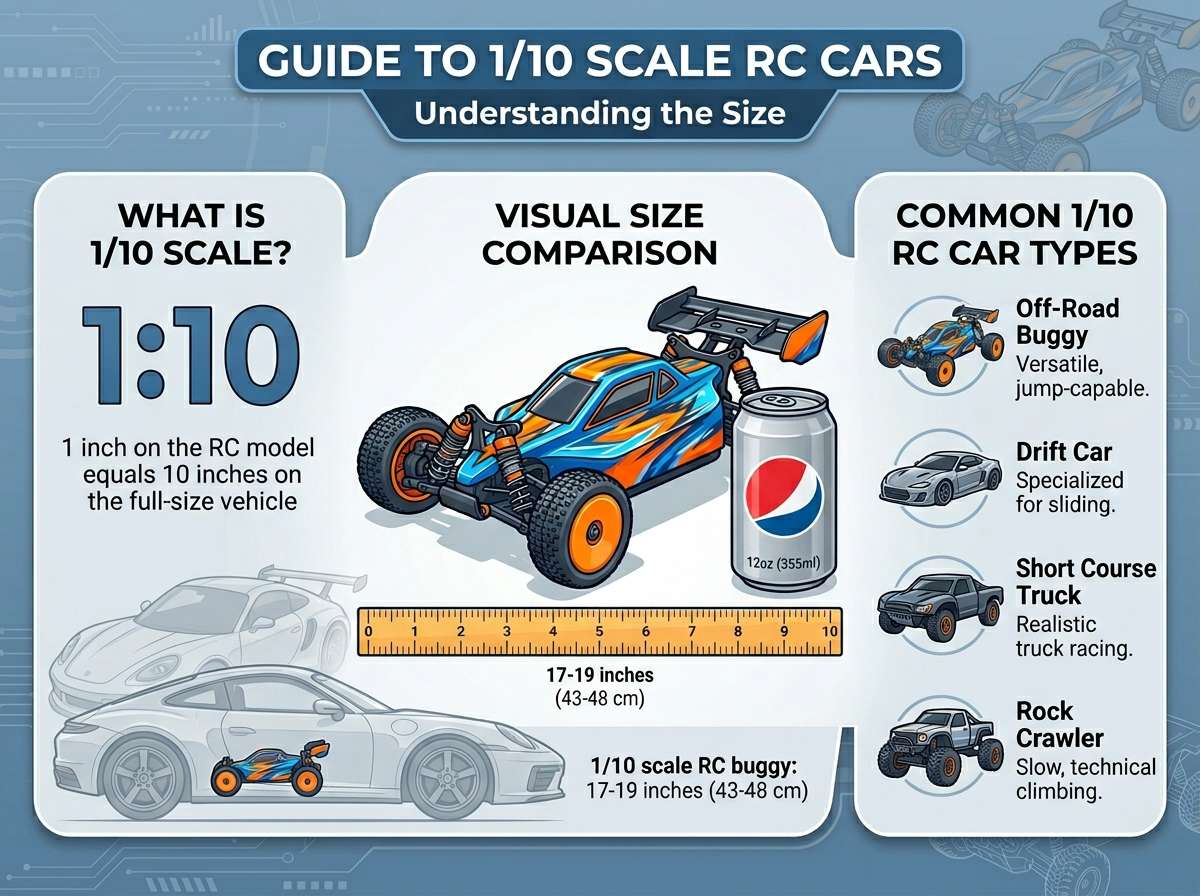
A 1/10 scale RC car is roughly 17 to 20 inches long. Think about it this way: a standard full-size car is about 180 inches long. When you divide that by 10, you get around 18 inches. So your RC vehicle sits right in that sweet spot.
To put it in real-world terms, a 1/10 scale car is about the size of a large toaster. It’s bigger than a shoe box but smaller than a briefcase. If you hold one in your hands, it feels substantial and impressive without being unwieldy or too heavy to carry around.
The width of a 1/10 scale RC car typically runs between 8 and 10 inches. That’s about as wide as a standard piece of paper or a dinner plate. The height is usually around 6 to 8 inches, similar to a large coffee mug lying on its side.
These measurements make 1/10 scale remote control vehicles really practical. They’re big enough to feel like real cars and perform well, but small enough to transport easily and run in most spaces like a driveway, parking lot, or large basement.
Understanding the Scale Concept
The scale is a ratio. It tells you the relationship between your RC car and a real car. When we say 1/10, we mean one unit on the car equals ten units on the real thing.
So if your RC car is 2 inches tall, the real car it represents would be 20 inches tall. If it’s 18 inches long, the real car would be 180 inches long. It’s a proportional measurement that keeps everything balanced and looking like an actual automobile.
This is different from other RC vehicle scales you might see. A 1/18 scale car is smaller—it’s about 10 inches long. A 1/8 scale car is bigger—it runs around 24 inches in length. The 1/10 scale strikes a nice balance in the middle, which is why it’s by far the most popular size for remote control cars.
The scale affects more than just the physical dimensions. It also impacts how the car performs, how much it costs, and what terrain it can handle. Bigger scales generally mean more power and durability. Smaller scales are lighter and easier to control.
Why 1/10 Scale Is So Popular
The 1/10 scale RC car dominates the hobby for good reasons. It’s the Goldilocks of remote control vehicles—not too big, not too small, just right.
This size is ideal for real-world driving. You can run your car almost anywhere a full-size vehicle can go, but at the small scale. A parking lot becomes a massive race track. A driveway turns into an off-road course. The 1/10 scale is large enough to handle rough terrain without getting damaged easily but small enough that you won’t need a huge property to enjoy it.
The motor and battery size at 1/10 scale gives you excellent runtime. You get 20 to 40 minutes of driving time on a single charge, depending on the model. That’s long enough to have real fun without constant stops to charge.
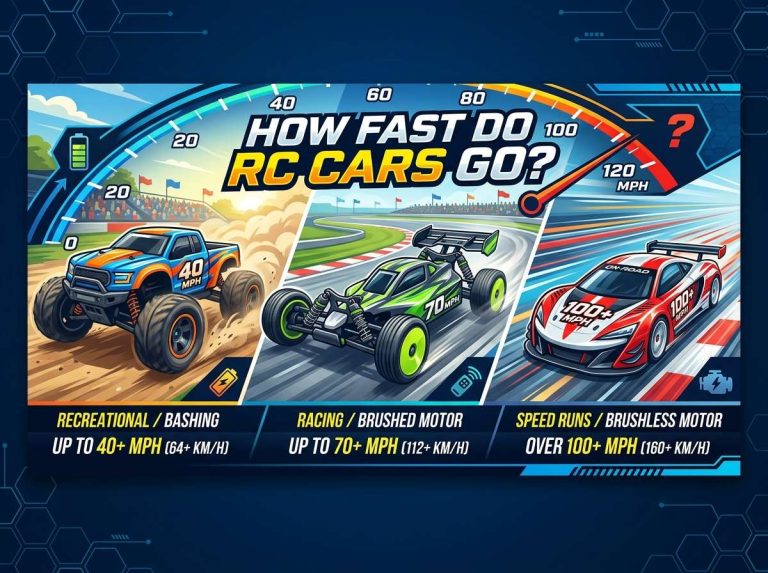
Speed is another big draw. A 1/10 scale RC car can reach 35 to 60 mph. That’s fast enough to feel exciting and challenging to drive but controlled enough for beginners to learn without immediately crashing into something.
Cost matters too. A 1/10 scale RC car is not cheap, but it’s much more affordable than larger scales. You can get a decent beginner model for $150 to $300. A quality racing-grade vehicle runs $400 to $800. This price point makes the hobby accessible for most people.
Parts and accessories for 1/10 scale cars are everywhere. Because so many people buy them, manufacturers make tons of upgrades, spare parts, and add-ons. If something breaks, you can find a replacement. If you want to improve performance, upgrades are available.
Types of 1/10 Scale RC Cars
The 1/10 scale category breaks down into several types, each designed for different driving styles and terrain.
Off-road buggies are four-wheel drive vehicles with high ground clearance and knobby tires. They handle dirt, grass, gravel, and rough ground easily. These cars have suspension systems that soak up bumps and keep the wheels in contact with the ground. If you plan to drive off pavement, an off-road buggy is your best bet.
On-road touring cars look like real sports cars or sedans. They sit low to the ground with slick tires designed for smooth pavement. These are racers. They corner hard and move fast on asphalt or smooth concrete. Touring cars need flat surfaces to perform their best.
Drift cars are modified touring vehicles that slide around corners deliberately. They have smooth tires and special setups that make them skid in controlled ways. Drift cars are fun for people who want to show off tricks and practice driving skills.
Trucks and monster trucks are larger and more powerful. They sit high off the ground with big tires and chunky suspension. These vehicles crush over obstacles and handle extreme terrain. Monster trucks are tough and fun for people who like destruction and chaos.
Short-course trucks (SCT) are a middle ground. They have the height and ground clearance of a truck but the nimbleness of a buggy. They handle mixed terrain well, from dirt to grass to pavement.
Each type costs about the same at 1/10 scale, but they perform differently. Your choice depends on where you want to drive and what style appeals to you.
Weight and Handling Characteristics
A 1/10 scale RC car typically weighs between 2 and 4 pounds. That’s heavier than you might expect for something that size, but the weight is necessary.
The extra weight comes from the motor, battery, metal chassis parts, and all the electronic components. A lighter car would be harder to control because it would get tossed around by wind and bumps. The weight gives the car stability and momentum that makes it feel realistic.
This weight range means you can easily carry your car to a driving spot. It won’t tire you out or take up much space in a backpack. If you drop it, your hands can take the impact without injury, though the car might get scratched.
Weight distribution matters a lot in RC cars. The best designs balance weight across the vehicle so it handles smoothly. Too much weight in the front makes steering hard. Too much in the back causes sliding. Good RC car manufacturers get this balance right from the factory.
The weight also determines what surfaces the car can drive on. A 4-pound car can cross soft grass, sand, and loose gravel without sinking. A lighter car might bog down in those conditions.
Space Requirements for Driving
Despite their small size, 1/10 scale RC cars need room to really perform. You can run them indoors in a large basement or warehouse, but outdoor space is ideal.
A parking lot provides the perfect size space. A single parking space is enough room to practice turning and stopping. A few parking spaces together give you room to really stretch out and go fast.
For off-road driving, you need an open field or dirt lot. Bigger is better here. Twenty feet by twenty feet is enough for basic driving. Fifty feet by fifty feet gives you room to get wild. National or state parks with empty fields are great options in many areas.
Some people drive their 1/10 scale cars on closed tracks designed specifically for RC racing. These tracks have jumps, turns, and obstacles built in. Track racing is the most competitive way to enjoy RC cars.
Indoors, a school gymnasium or parking garage works well. Concrete surfaces are smooth and predictable. Hardwood floors work too, though some surfaces might be slippery depending on the tires.
The point is, you don’t need a huge property. Anywhere you have about 20 feet of open space will let you drive and have fun. This is one reason the 1/10 scale is so practical.
Comparison with Other RC Scales
To really understand the 1/10 scale, let’s look at how it compares to other sizes.
A 1/18 scale car is about half the length of a 1/10. These tiny cars are around 10 inches long. They’re cute and fun, but they’re harder to control precisely. The smaller size means less room for components. They’re usually slower and have less battery runtime. The advantage is they fit in tight spaces and cost less.
A 1/16 scale car is a step up from 1/18. It’s about 12 to 14 inches long. These cars offer a nice middle ground between price and performance. Many truck-style RC vehicles come in 1/16 scale. They’re still easier to carry around than 1/10 cars but feel more substantial than 1/18.
The 1/8 scale is bigger than 1/10. These vehicles run 22 to 26 inches long and weigh 5 to 8 pounds. They’re powerful and handle rough terrain exceptionally well. But they’re more expensive, harder to transport, and need more space to drive. 1/8 scale cars are for dedicated enthusiasts.
Even larger scales exist. 1/5 scale cars are huge—over 30 inches long and weighing 15 to 25 pounds. These vehicles have real gasoline engines and can cost thousands of dollars. They’re serious machines for serious hobbyists.
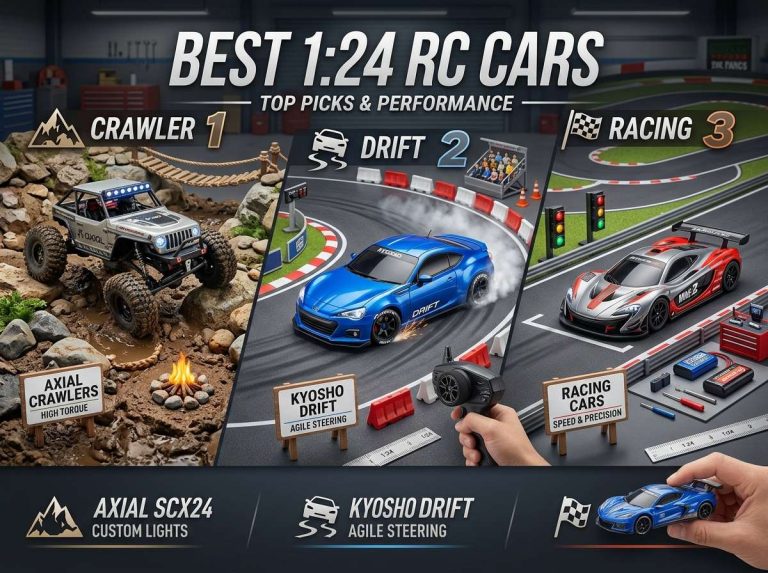
Below 1/18 scale, you get into nano and micro sizes. A 1/24 or 1/27 scale car is tiny—like a toy you hold in your palm. These are fun for kids or casual play but lack the performance and durability of larger scales.
The 1/10 scale lands in the perfect spot for most people. It’s bigger than the tiny toy cars but smaller and cheaper than the giant racing machines. It has the best combination of size, price, performance, and availability.
Interior Space and Electronics
Inside a 1/10 scale RC car, the engineering is tight but organized. The main compartments hold the motor, battery, radio receiver, and servo.
The motor is usually a brushless electric motor about 3 to 4 inches long. It spins incredibly fast to power the wheels. The battery sits near the motor, typically a lithium polymer pack measuring about 4 inches long and 2 inches wide. These batteries are powerful and lightweight.
The receiver is a small circuit board that picks up signals from your remote. It’s only about 2 inches long. The servo is a motorized control that steers the wheels. It looks like a small box, maybe 1.5 inches across.
All these parts are packed together efficiently. The chassis is hollow on the bottom, which creates space for components while keeping weight minimal. The battery often sits directly on the frame.
Wires run throughout connecting everything. The motor needs power from the battery. The receiver needs power too. Servos need signal wires from the receiver. It’s like a miniature electrical system.
Modern 1/10 scale cars use wireless remote controls. Your hand controller connects to the receiver via radio waves. This lets you stand at a distance and control the car. Range typically goes up to 300 feet for quality systems.
The electronics are sealed or protected from water and dirt in most cases. Some cars are waterproof, which means they can drive through puddles and mud. Others aren’t sealed, so you need to keep them dry.
Tires and Traction
The tires on a 1/10 scale RC car vary wildly depending on the vehicle type.
On-road cars use slick tires that look like tiny racing slicks. These tires are smooth with no tread. Smooth means more grip on pavement. They stick to asphalt and concrete like glue. On smooth surfaces, slick tires let you corner hard and brake effectively.
Off-road cars use knobby tires with big tread blocks. These tires look like tiny versions of truck tires. The knobs dig into dirt, grass, and gravel. Off-road tires are wider and sit higher on the rim. They absorb impacts better and prevent sinking.
Drift cars use special smooth tires similar to slicks but even lower-grip. The low grip helps the car slide sideways. Drift drivers practice techniques to control and direct the slides.
Tires come in hard, medium, and soft compounds. Hard tires last longer but grip less. Soft tires grip better but wear out faster. Most people use medium tires for balanced performance.
Tire maintenance keeps your RC car running well. You need to check tire pressure if your tires are pneumatic (filled with air). Most 1/10 cars use solid foam tires or plastic tires that don’t need inflation.
Replacing tires is usually cheap and quick. A set of tires costs $15 to $40. You pop off the old ones and press on new ones. It takes five minutes.
Battery and Runtime
The battery is one of the most important parts of your 1/10 scale RC car. Without a good battery, your car won’t run long or fast.
Most 1/10 cars use lithium polymer (LiPo) batteries. These are lightweight and powerful. A typical pack for 1/10 cars is 7.4 volts with around 3000 to 5000 milliampere-hours (mAh) of capacity.
Voltage determines power. A 7.4V battery gives good speed and torque. Some cars use 11.1V packs for even more power, but they’re overkill for beginners.
Capacity determines runtime. A 5000 mAh battery typically gives 25 to 40 minutes of driving time, depending on driving style. Racing hard and doing jumps drains the battery faster than cruising gently.
Charging takes 1 to 3 hours depending on the charger. Fast chargers cut this down but can damage the battery if used too much. Most people use standard chargers and charge overnight.
Battery care is critical. LiPo batteries need balance charging to stay healthy. They need to sit unused for a while if not in use for extended periods. They can’t get too hot or too cold. A good quality battery can last 100 to 200 charge cycles.
Extra batteries are essential if you want extended driving sessions. Buy two or three batteries so you always have a charged one ready. Swap them out when one gets low and keep driving.
Battery costs vary. A basic pack runs $40 to $80. A quality racing pack costs $100 to $150. It’s worth spending more on batteries because they directly affect how much fun you have.
Assembly and Setup
Most 1/10 scale RC cars come partially assembled. You’ll need to put some pieces together before you can drive.
The frame usually comes as a kit. The motor and battery are separate. The body shell (the plastic covering) comes off. You’ll install the motor and battery into the chassis. This takes about 30 minutes and requires some basic tools.
The remote control usually comes ready to use. You just install batteries in the transmitter and turn on the receiver in the car. Binding the remote to the car takes one minute of holding a button.
The body goes on last. You slip the plastic shell over the chassis and secure it with rubber bands or clips. The body is just a shell, not structural.
Beginners often get intimidated by assembly, but it’s really simple. If you can use a screwdriver, you can assemble a 1/10 RC car. The instruction manual walks you through every step.
Once assembled, you need to calibrate the steering and throttle. This means adjusting the remote so the wheels point straight and the motor responds correctly. Calibration takes five minutes and requires no tools.
Many RC shops will assemble your car for you if you don’t want to do it. This costs $50 to $150 but saves you time and worry.
Durability and Maintenance
A 1/10 scale RC car is tougher than it looks. These vehicles can crash repeatedly and keep going.
The plastic body is the most fragile part. Hard crashes crack or break the shell. Replacements cost $30 to $80 and take ten minutes to swap out.
The suspension components take a beating. Springs, shocks, and control arms get bent or broken. Repairs require taking the car apart and either bending parts back or replacing them. This is more involved than body work.
The motor and electronics are well-protected in most cases. They rarely break unless water gets inside or the car gets crushed.
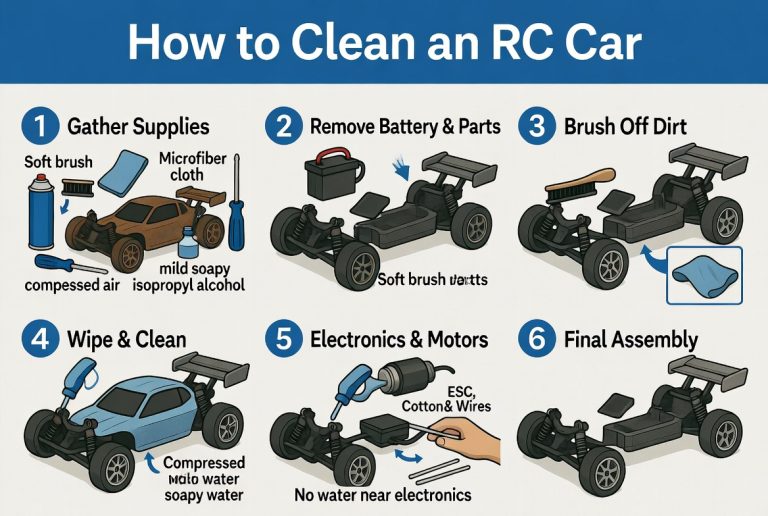
Maintenance keeps your car running smoothly. After every few driving sessions, you should clean the car. Dirt builds up in the suspension and motor. A soft brush or compressed air removes it.
Check the wheel bearings occasionally. These spin freely and can get packed with dirt. Cleaning them out keeps the wheels rolling freely.
Tighten screws every few months. Vibration loosens them over time. A missing screw might not break your car immediately, but it can lead to bigger problems.
Replace worn tires when they get flat spots or chunks missing. Worn tires don’t grip well and make driving frustrating.
Check moving parts for wear. If something spins slowly or doesn’t move smoothly, it probably needs cleaning or lubrication.
Overall, maintenance is minimal. Spend 15 minutes every few weeks keeping your car clean and checked. This prevents major problems and keeps your car running great for years.
Cost Breakdown
Understanding the total cost of 1/10 scale RC cars helps you budget properly.
A quality beginner car costs $200 to $400. This gets you a complete, ready-to-run vehicle that performs well out of the box.
An intermediate racing car costs $400 to $700. These vehicles are faster, handle better, and have better quality components.
High-end racing cars cost $700 to $1500. These are competition-grade machines used in serious racing.
Extra batteries run $40 to $150 each. Most people need at least two.
A good charger costs $60 to $150.
Spare parts and repairs average $100 to $300 per year of active driving.
So your first year cost might be $500 to $800 including the car, extra batteries, and a charger. After that, annual maintenance and parts cost less.
This might sound like a lot, but it’s comparable to other hobbies. It’s cheaper than gaming with a high-end PC. It’s comparable to playing golf a few times a month. For the hours of entertainment you get, it’s a good investment.
Getting Started Tips
If you’re thinking about buying your first 1/10 scale RC car, here are some practical tips.
Start with a reputable brand. Traxxas, HPI, Associated, and Team Losi are trusted names that make quality cars. Knockoff brands might be cheaper, but they break easily and customer support is nonexistent.
Buy ready-to-run if you’re new. Don’t buy a kit that requires building from scratch unless you enjoy that kind of work. Ready-to-run cars come assembled and you just charge the battery and start driving.
Get two batteries from the start. One battery isn’t enough for extended fun. Two lets you swap and keep driving.
Consider a brushless motor. These are more efficient and faster than brushed motors. They cost a bit more but last longer.
Choose a vehicle type that matches where you’ll drive. If you have access to a smooth parking lot, get a touring car. If you want to drive on dirt and grass, get an off-road buggy.
Find other enthusiasts in your area. RC car clubs organize meet-ups and races. Driving with others is more fun than solo runs and you learn tons from experienced drivers.
Join online communities. Forums and social media groups for 1/10 RC cars have thousands of helpful people. If you have a question, someone will answer it.
Start slow when learning. Practice gentle acceleration and steering. Once you get the feel for the controls, you can push harder.
Don’t expect perfection. You’ll crash. You’ll lose your car in the grass. These things happen to everyone. It’s part of the learning process.
Final Thoughts
A 1/10 scale RC car is a perfect introduction to the remote control vehicle hobby. It’s big enough to feel real, small enough to transport easily, and cost-effective enough for most budgets.
At roughly 18 inches long and 2 to 4 pounds, a 1/10 scale car fits easily in your life. You can drive it in most places from parking lots to open fields. The performance is impressive—these cars are fast and handle well.
The hobby appeals to kids and adults alike. Whether you’re interested in competitive racing, casual backyard fun, or just tinkering with machines, 1/10 scale RC cars offer endless entertainment.
Start with a ready-to-run beginner model from a quality brand. Get some extra batteries. Find a place to drive. Connect with other enthusiasts. Before you know it, you’ll understand why millions of people around the world love 1/10 scale RC cars.
The size might be small, but the fun is anything but.
Peterson is an RC hobby enthusiast and product reviewer with a passion for remote-controlled cars, trucks, boats, drones, and accessories. He enjoys testing the latest RC products, comparing features, and sharing practical buying guides to help beginners and experienced hobbyists make informed decisions. Through RCThing.com, Peterson provides honest reviews, maintenance tips, and expert advice to help readers get the most from their RC adventures.