5 Best ESC for RC Car In 2026
If you have ever swapped parts on an RC car, you already know one truth. The engine of the whole system is not the motor. It is the ESC. This small box tells your motor how fast to spin, when to brake, and how to handle power without frying itself. Get a weak or cheap one, and your fast motor will feel sluggish, hot, or downright unreliable. Get a good one, and even a modest motor will feel snappy and controlled.
This guide breaks down five solid electronic speed controllers that cover almost every kind of RC car build out there, from slow crawlers climbing rocks to fast on-road machines that scream down a straight track. We will walk through each one in plain language, point out where it shines, where it falls short, and who it actually fits. By the end, you will know exactly which ESC matches your build, your budget, and your driving style.
Let’s get into it.
Why the ESC Matters More Than Most Beginners Think
New hobbyists often pour all their attention into the motor, tires, or body shell. The ESC gets an afterthought glance. That’s a mistake, and here’s why.
The ESC sits between your battery and your motor. It reads signals from your receiver and converts those signals into actual power delivery. A rough or underpowered ESC can cause jerky throttle response, overheating, voltage drops, or even burned-out wires. A well-matched ESC gives you smooth acceleration, dependable braking, and a motor that runs cooler for longer.
There are two broad categories you need to know before shopping:
Brushed ESC — pairs with brushed motors, tends to be simpler, cheaper, and forgiving. Great for beginners, crawlers, and casual bashing.
Brushless ESC — pairs with brushless motors, delivers more power, more speed, and more efficiency, but usually costs more and needs a bit more care in setup.
Knowing which type your car uses (or which type you want to upgrade to) is step one before you even look at brand names or amp ratings.
Quick Overview Before We Dive Deep
Here’s a fast snapshot of the five ESCs we’re covering today:
- Radiolink CL9030 90A Brushed ESC — waterproof, budget-friendly, great for crawlers and trucks
- WP 1060 60A Brushed ESC — simple, reliable, ideal for entry-level 1/10 scale rigs
- XC C8 Sensorless Brushless ESC — high-power, app-programmable, built for serious 1/8 scale cars
- Surpass Hobby Rocket Brushless ESC 60A — waterproof, compact, solid mid-tier brushless pick
- Waterproof S3650 4300KV Motor + 60A ESC Combo — a full plug-and-play upgrade kit for 1/10 scale cars
Now let’s break each one down properly.
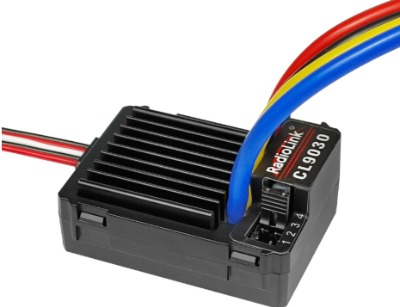
1. Radiolink CL9030 90A 2S-4S Brushed ESC
Product Description
The Radiolink CL9030 is a brushed electronic speed controller rated at 90A, supporting 2S to 4S battery setups. It comes with a built-in 5A BEC that switches between 5.5V and 7.5V output, and it uses the common XT60 plug. It is fully waterproof, which matters a lot if you like crawling through mud, shallow puddles, or wet grass.
This ESC is aimed squarely at crawlers, tanks, trucks, and boats running on 1/10 scale platforms. It is not built for blazing speed. It is built for control, torque, and durability in rough conditions.
Best Use Cases
This unit fits rock crawlers, scale trail trucks, slow-speed tanks, and even RC boats that need a brushed setup. If your hobby involves climbing over rocks, navigating tight trails, or splashing through creeks, this ESC handles that environment without flinching.
It is not the right pick for high-speed bashing or drag racing. Brushed systems simply do not deliver the top-end speed that brushless setups can reach.
Key Features Explained Simply
- 90A rating: This tells you how much current the ESC can safely handle. Ninety amps gives you plenty of headroom for most brushed motors used in crawling and trail trucks.
- 2S-4S compatibility: You can run anywhere from a two-cell to a four-cell LiPo battery, giving you flexibility as you upgrade your power source later.
- Waterproof housing: Sealed components protect the ESC from water damage, dust, and mud, which is a common failure point in cheaper units.
- 5A BEC with dual voltage output: BEC stands for Battery Eliminator Circuit. It powers your receiver and servo without needing a separate battery. The dual voltage option lets you run standard 5.5V servos or beefier 7.5V high-torque servos.
- XT60 plug: A widely used connector that is easy to find replacements for and simple to solder if needed.
Real-Life Usage Insight
For anyone running a scale crawler on rocky terrain or through wet trails, this kind of setup is common in the hobby. Brushed systems paired with a solid waterproof ESC are a dependable combo for slow, torque-heavy driving where control matters more than raw speed. Drivers who favor methodical, technical crawling over fast bashing tend to gravitate toward setups like this one because the power delivery feels predictable and easy to modulate at low throttle.
Pros
- Genuinely waterproof, not just water-resistant
- Handles 2S to 4S batteries, giving room to grow
- Strong 90A rating covers most brushed motor demands
- Dual voltage BEC adds flexibility for different servo types
- Straightforward wiring with a standard XT60 plug
- Budget-friendly compared to brushless alternatives
Cons
- Brushed systems top out at lower speeds than brushless
- Not ideal if you plan to race or want high-speed thrills
- Brushed motors wear down faster over time and need brush replacement eventually
- Limited programming options compared to advanced brushless ESCs
Performance Discussion
In terms of raw output, this ESC handles typical 1/10 crawler and truck motors without breaking a sweat. The 90A ceiling leaves comfortable headroom, so you won’t be pushing it to its limit under normal use. Braking feels smooth rather than jerky, which matters a lot when you’re inching down a steep rock face. Heat management is solid thanks to the waterproof casing, which also happens to help with dust and debris resistance.
Ease of Use
Setup is beginner-friendly. Wiring is standard, and there’s no complicated app or software involved. You plug it in, bind it to your receiver, and you’re ready to drive. This simplicity is a major selling point for anyone new to the hobby who doesn’t want to mess with firmware or programming cards.
Value for Money
Given the waterproofing, the flexible battery range, and the reliable BEC, this ESC delivers strong value for anyone building or upgrading a crawler or scale truck. It won’t win any speed contests, but that’s not its job.
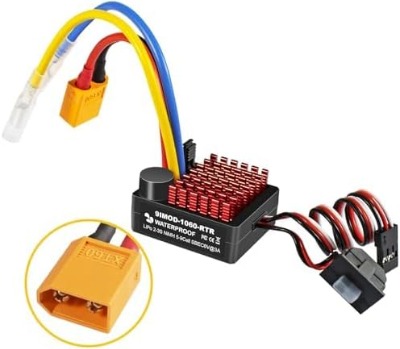
2. WP 1060 2-3S 60A Brushed ESC
Product Description
The WP 1060 is a straightforward 60A brushed ESC designed for 2S to 3S batteries. It uses an XT60 plug, includes a switch mode BEC, and is fully waterproof. This one is built with entry-level 1/10 scale crawlers and trucks in mind, and it comes with an on/off switch built right into the unit.
Best Use Cases
This is a fantastic pick for anyone stepping into the hobby for the first time. It suits basic 1/10 scale crawlers, casual bashers, and trucks that don’t need massive power. If your goal is learning the ropes of RC driving without dealing with complicated wiring or programming, this ESC removes a lot of friction.
Key Features Explained Simply
- 60A rating: Enough current for smaller brushed motors typically found in entry-level crawlers and trucks.
- 2S-3S compatibility: Covers the most common battery setups for beginner and intermediate builds.
- Switch mode BEC: This type of BEC is more efficient than older linear designs, producing less heat and using power more wisely.
- Built-in power switch: A physical on/off switch means you don’t have to unplug your battery every time you want to power down, which is a small convenience that beginners often appreciate.
- Waterproof design: Protects internal components from moisture and dirt during outdoor sessions.
Real-Life Usage Insight
For someone just getting into RC crawling or casual bashing, a simple and forgiving ESC like this removes a lot of guesswork. New drivers benefit from predictable throttle response and a low learning curve, and this unit delivers exactly that. It’s often recommended in beginner build guides precisely because there’s little room for user error during setup.
Pros
- Very beginner-friendly with minimal setup steps
- Switch mode BEC runs cooler and more efficiently
- Handy built-in power switch
- Solid waterproofing for outdoor use
- Affordable price point
- Reliable for casual driving and learning
Cons
- 60A ceiling limits it to smaller or moderate brushed motors
- Not suited for high-torque or high-speed applications
- Fewer advanced features compared to programmable brushless units
- Brushed motor limitations still apply here, meaning less top speed overall
Performance Discussion
Within its intended range, the WP 1060 performs consistently. Throttle response feels linear rather than twitchy, which helps new drivers build confidence. The BEC keeps servo and receiver power stable even during longer sessions, and the waterproof housing holds up well against dust and light water exposure.
Ease of Use
This is about as plug-and-play as brushed ESCs get. Wiring is simple, the physical switch adds convenience, and there is no firmware or app involved. Anyone who has never touched an ESC before can get this running within minutes.
Value for Money
For the price, this unit delivers real reliability without unnecessary extras. It’s a smart pick for beginners who want to learn the fundamentals of RC driving before investing in pricier brushless gear.
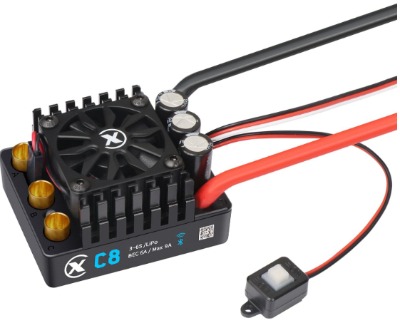
3. XC C8 Sensorless Brushless ESC for 1/8 RC Car
Product Description
The XC C8 is a high-performance sensorless brushless ESC built for 1/8 scale cars, rated at 160A and supporting 3S to 6S batteries. It stands out with Bluetooth app programming, multiple BEC voltage options (6.0V, 7.4V, 8.4V), an IP67 waterproof rating, and layered protection features. This is a serious piece of gear meant for drivers who want speed, power, and fine-tuned control.
Best Use Cases
This ESC is built for 1/8 scale bashers, off-road buggies, and speed-focused builds that demand serious power delivery. If you’re running a high-KV brushless motor and want to push real speed while keeping thermal and voltage protection in check, this is the class of ESC you want.
It’s overkill for casual crawling or slow scale trucks. Save it for cars that actually need the headroom.
Key Features Explained Simply
- 160A rating: This is a big number, giving you huge current capacity for powerful brushless motors used in 1/8 scale platforms.
- 3S-6S compatibility: Wide battery range means you can scale up your power setup as your skills and confidence grow.
- Bluetooth app programming: Instead of fumbling with a small programming card and tiny buttons, you connect through a phone app and adjust settings like throttle curve, braking strength, and cutoff voltage with a few taps.
- Multiple BEC voltage options: 6.0V, 7.4V, and 8.4V give you flexibility for different servo strengths, from standard to high-torque digital servos.
- IP67 waterproof rating: This is a serious industrial-grade water resistance rating, meaning it can handle submersion in shallow water for a short time, not just splashes.
- Multiple protection features: Includes safeguards like low-voltage cutoff, overheat protection, and overcurrent protection to keep the ESC and battery safe during hard runs.
Real-Life Usage Insight
Drivers running 1/8 scale buggies or trucks at speed often need an ESC that can keep pace with high-KV brushless motors without cutting out or overheating mid-run. App-based programming has become a popular feature in this power class because it lets drivers fine-tune throttle response and braking on the fly, right from a phone, instead of carrying a separate programming card to the track or trail.
Pros
- Massive 160A capacity handles serious brushless power
- Bluetooth app programming is intuitive and beginner-friendly despite the advanced power class
- IP67 rating offers genuine water and dust protection
- Multiple BEC voltage settings add real flexibility
- Strong protection suite reduces risk of burnout
- Wide battery compatibility from 3S to 6S
Cons
- Higher price point compared to brushed or lower-amp brushless ESCs
- Overkill for beginners or casual crawlers
- Sensorless design means slightly less smooth low-speed control compared to sensored brushless systems
- App dependency means you need a phone nearby for deep setting changes
Performance Discussion
Where this ESC really shines is under load. High-speed runs, aggressive acceleration, and hard braking all stay stable thanks to the strong protection suite and generous amp headroom. The sensorless design does mean throttle response at very low speeds isn’t quite as buttery smooth as a sensored setup, but at speed, this thing delivers confident, consistent power.
Ease of Use
Despite being a high-power unit, the Bluetooth app makes programming approachable even for less experienced users. You don’t need to memorize button-press sequences or squint at tiny LED blink codes. Just open the app, adjust sliders, and save your profile.
Value for Money
Given the amp rating, waterproofing, and app-based tuning, this ESC earns its higher price tag if you’re building a serious 1/8 scale rig. It’s not the right pick for a budget crawler build, but for a fast, power-hungry off-road machine, it delivers strong value.
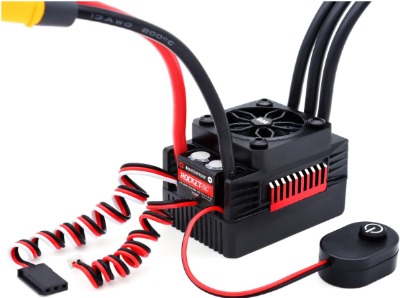
4. Surpass Hobby Rocket Waterproof Brushless ESC 60A
Product Description
The Surpass Hobby Rocket is a 60A waterproof brushless ESC designed for 1/10 scale RC cars. It’s compact, comes with a plug already attached, and targets drivers who want to step up from brushed power without jumping straight into high-end 1/8 scale territory.
Best Use Cases
This ESC fits 1/10 scale on-road cars, off-road trucks, and buggies that want a taste of brushless speed without the higher cost of 1/8 scale gear. It’s a natural upgrade path for someone who started with a brushed system and now wants more punch and efficiency.
Key Features Explained Simply
- 60A rating: Solid mid-range capacity, enough for most 1/10 scale brushless motors without going overboard.
- Brushless design: Brushless motors and ESCs run cooler, last longer, and deliver more power per watt compared to brushed systems.
- Waterproof build: Keeps the ESC safe from splashes, mud, and light rain during outdoor sessions.
- Compact size: Fits easily into tighter 1/10 scale chassis without needing major modifications.
- Pre-attached plug: Saves you the hassle of soldering connectors before your first run.
Real-Life Usage Insight
Stepping up from a brushed system to a brushless one is a common upgrade path in this hobby, and a mid-power unit like this one makes that transition smoother. Drivers moving from slower brushed setups often notice the difference immediately in throttle response and acceleration, without needing to relearn their whole driving style the way a jump straight to 160A gear might demand.
Pros
- Noticeable speed and efficiency boost over brushed systems
- Waterproof housing suits outdoor and off-road use
- Compact size fits most 1/10 scale chassis
- Reasonable price for a brushless unit
- Simple wiring with pre-attached plug
- Good middle ground between beginner and advanced power levels
Cons
- 60A ceiling means it’s not built for the most extreme power builds
- Fewer advanced programming features compared to app-based competitors
- May need a programming card for deeper setting adjustments
- Not ideal for 1/8 scale or very high-KV motor setups
Performance Discussion
For 1/10 scale applications, this ESC delivers smooth, confident acceleration and dependable braking. The brushless design keeps heat lower than a comparable brushed setup, which means longer run times before things start getting toasty. It handles moderate off-road bashing and on-road driving with equal comfort.
Ease of Use
Wiring is simple thanks to the pre-attached plug, and basic setup doesn’t require much technical know-how. Advanced tuning options are more limited than the app-based XC C8, but for most drivers, the default settings work well right out of the box.
Value for Money
This is a strong middle-tier pick. You get real brushless performance without paying 1/8 scale prices, making it a smart choice for anyone ready to move beyond brushed power on a 1/10 scale build.
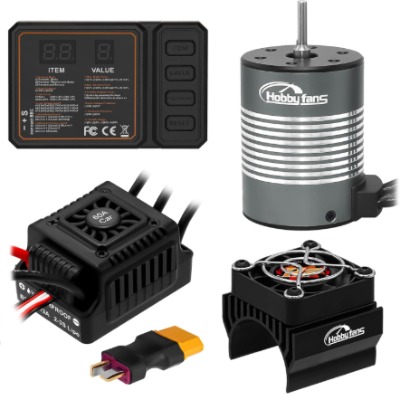
5. Waterproof S3650 4300KV Brushless Motor + 60A ESC Combo
Product Description
This is a combo set pairing a 3650-sized 4300KV brushless motor with a matching 60A brushless ESC, a heatsink, and a programming card. It’s built for 1/10 scale cars and trucks, with a 3.175mm shaft to fit standard pinion gears. The whole package is waterproof and designed as a plug-and-play upgrade.
Best Use Cases
This combo is perfect for anyone upgrading an entire 1/10 scale car’s powertrain in one shot. Instead of separately shopping for a motor and ESC and hoping they match well, this set takes the guesswork out of pairing components.
It works well for off-road trucks, bashers, and general all-around 1/10 scale driving where you want a noticeable power jump without a complicated shopping list.
Key Features Explained Simply
- 4300KV rating: KV tells you how many RPM the motor spins per volt applied. A 4300KV motor delivers a good balance of speed and torque for general 1/10 scale use, not too twitchy, not too sluggish.
- 60A ESC: Matched specifically to the motor’s power needs, so you don’t have to calculate compatibility yourself.
- 3.175mm shaft: The standard shaft size for most 1/10 scale pinion gears, meaning easy installation without special adapters.
- Included heatsink: Helps dissipate heat from the motor during hard runs, extending its lifespan.
- Programming card: Lets you adjust ESC settings like throttle response, braking force, and battery cutoff without needing a phone app.
- Waterproof design: Both motor and ESC are sealed against water and dust for outdoor use.
Real-Life Usage Insight
Buying a motor and ESC as a matched combo removes one of the more confusing parts of the hobby for newer drivers, since mismatched KV ratings and amp capacities are a common cause of overheating or poor performance. A pre-matched set like this one is often the easiest route for someone doing their first full powertrain upgrade, since the pairing has already been worked out for you.
Pros
- Motor and ESC are pre-matched, removing compatibility guesswork
- Included heatsink adds extra thermal protection
- Programming card allows for real customization without an app
- Standard 3.175mm shaft fits most common pinion gears
- Waterproof across both components
- Great value since you’re buying two parts as one bundle
Cons
- 4300KV is a middle-ground rating, not the fastest option for dedicated speed builds
- Programming card interface is less intuitive than an app-based system
- 60A ceiling limits headroom for future high-power upgrades
- Combo sets sometimes limit flexibility if you later want to mix and match brands
Performance Discussion
As a matched set, this combo runs smoothly right out of the box. The 4300KV rating offers a solid all-around feel, enough zip for exciting bashing sessions without being so twitchy that new drivers struggle with control. The heatsink noticeably helps keep temperatures down during extended runs, and the waterproof design holds up well in damp conditions.
Ease of Use
Since the motor and ESC are designed to work together, setup is more forgiving than piecing together parts from different brands. The included programming card does require a small learning curve since it uses button presses and blink codes rather than an app interface, but the included instructions typically walk you through the basics.
Value for Money
Buying this as a bundle often costs less than purchasing a comparable motor and ESC separately, and you skip the risk of picking mismatched parts. For anyone doing a full powertrain upgrade on a 1/10 scale car, this combo offers excellent bang for your buck.
Comparison Insights: How These Five Stack Up
Let’s line these up side by side based on what matters most.
Power Type: The Radiolink CL9030 and WP 1060 are brushed, making them simpler and cheaper but capped in top speed. The XC C8, Surpass Hobby Rocket, and the S3650 combo are all brushless, offering more power and efficiency.
Amp Rating: The XC C8 leads with a massive 160A rating built for serious 1/8 scale power. The Radiolink CL9030 follows at 90A, while the WP 1060, Surpass Hobby Rocket, and S3650 combo all sit around 60A, a comfortable range for most 1/10 scale builds.
Programming Options: The XC C8 stands out with Bluetooth app programming, a genuinely modern convenience. The S3650 combo includes a traditional programming card. The Radiolink CL9030, WP 1060, and Surpass Hobby Rocket rely on simpler default settings without dedicated programming tools.
Waterproofing: All five products offer waterproof protection, though the XC C8’s IP67 rating is the most rigorously tested and documented standard among the group.
Best for Beginners: The WP 1060 and Radiolink CL9030 are the easiest entry points thanks to their simple brushed setups and straightforward wiring.
Best for Serious Speed: The XC C8 wins this category by a wide margin thanks to its high amp ceiling and wide battery range.
Best All-Around Upgrade Path: The Surpass Hobby Rocket and the S3650 combo both offer a smart middle ground for drivers moving from brushed to brushless without jumping to extreme power levels.
Buying Guide: What to Actually Look For
Shopping for an ESC can feel confusing with all the numbers and acronyms flying around. Here’s how to cut through the noise.
Match Your ESC to Your Motor Type
Brushed motors need brushed ESCs. Brushless motors need brushless ESCs. This sounds obvious, but mismatched pairings are a common beginner mistake that leads to poor performance or damaged components.
Check the Amp Rating Against Your Motor’s Draw
Your ESC’s amp rating should comfortably exceed your motor’s expected current draw. Running an ESC right at its limit constantly leads to overheating and shortened lifespan. A little headroom goes a long way toward reliability.
Look at Battery Cell Compatibility
Make sure the ESC supports the battery configuration you’re using or planning to use. A 2S-3S ESC won’t safely handle a 6S battery, and running outside the rated range risks serious damage.
Consider the BEC Output
The BEC powers your receiver and servo. If you’re running a high-torque digital servo, you’ll want an ESC with a BEC rated for higher voltage output, like 7.4V or 8.4V, rather than a basic 5V setup.
Think About Waterproofing Based on Your Environment
If you drive exclusively indoors on carpet or dry tracks, waterproofing matters less. If you’re out in mud, wet grass, or shallow puddles regularly, a sealed, waterproof ESC is worth the investment to avoid corrosion and short circuits.
Programming Flexibility
Beginners often do fine with default factory settings. As you grow more experienced, having access to programmable throttle curves, braking strength, and cutoff voltages becomes genuinely useful for fine-tuning your driving feel.
Who Should Buy Each of These Products
New hobbyists building their first crawler or basher should look at the WP 1060 or Radiolink CL9030. Both offer forgiving, simple setups without overwhelming options.
Drivers ready to step up from brushed to brushless power on a budget will find the Surpass Hobby Rocket a natural fit, offering real performance gains without a steep price jump.
Anyone doing a full powertrain rebuild on a 1/10 scale car should strongly consider the S3650 combo set, since it removes the guesswork of matching a motor and ESC separately.
Serious speed enthusiasts running 1/8 scale rigs who want maximum power, app-based tuning, and rugged protection features should go straight for the XC C8.
Boat and tank hobbyists running brushed systems will also find the Radiolink CL9030 a solid match thanks to its waterproof design and flexible battery range.
Common Mistakes to Avoid When Buying an ESC
Ignoring amp headroom: Buying an ESC that just barely covers your motor’s needs leaves no safety margin. Always leave some breathing room above your expected draw.
Mismatching battery cell counts: Running a battery configuration outside your ESC’s rated range is one of the fastest ways to damage components or create a safety hazard.
Overlooking BEC voltage needs: If you upgrade to a high-torque servo later, a weak BEC output can leave your servo underpowered and sluggish.
Skipping waterproofing when you drive outdoors: Water damage is one of the most common and preventable causes of ESC failure. If your driving involves any moisture at all, don’t skip this feature.
Assuming brushless always means better: Brushless is more powerful and efficient, but it’s not always the right choice for every build. Slow, torque-focused crawling often works just fine with a good brushed setup, and jumping straight to a high-power brushless ESC without matching gearing or tires can actually hurt performance.
Forgetting to check connector compatibility: Different ESCs come with different plug types. Make sure the connector matches your battery and receiver setup, or be ready to do some soldering.
Not reading the programming instructions: Advanced ESCs with programmable settings can be tuned poorly if you skip the setup guide. Take a few minutes to actually read through the instructions before your first run.
Final Verdict
There’s no single “best” ESC that works for every driver, and that’s actually good news. It means you can match your choice to exactly what you need instead of overpaying for features you’ll never use.
If you’re just starting out and want something simple and forgiving, the WP 1060 or Radiolink CL9030 will treat you well without overwhelming you with settings and options.
If you’re ready to feel the difference brushless power makes without spending a fortune, the Surpass Hobby Rocket hits a great middle ground.
If you want a hassle-free full upgrade with parts guaranteed to work together, the S3650 combo set takes the stress out of shopping for a matched motor and ESC.
And if speed, power, and modern app-based tuning are what you’re after, the XC C8 stands out as the clear performance leader in this roundup.
Whatever you pick, remember that the ESC is the quiet workhorse of your RC car. Treat it with the same care you’d give your motor and battery, keep it within its rated limits, and it’ll reward you with smooth, reliable runs for a long time to come.