1:8 vs 1:10 Scale RC Cars
If you’re new to the world of remote control cars, you’ve probably noticed a lot of talk about scale sizes. The numbers 1:8 and 1:10 get thrown around everywhere, and it’s easy to feel confused about what they actually mean and how they affect your driving experience. Don’t worry—I’m here to break it all down for you in a way that makes sense.
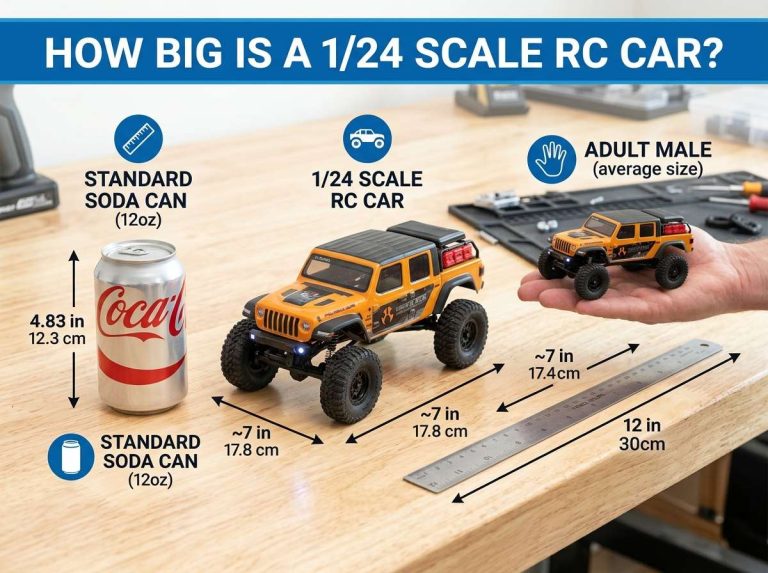
Think of the scale number as a way to describe how big your RC car is compared to a real vehicle. When we say 1:8 scale, that means your RC car is one-eighth the size of a full-size car. A 1:10 scale car, on the other hand, is one-tenth the size of a real car. This simple ratio changes a lot about how your car performs and handles on the track or in your yard.
What Does Scale Really Mean?
Let me explain the scale concept in super simple terms. If you have a 1:8 scale RC car and a real car that’s 8 times bigger, then your RC car’s dimensions would be exactly one-eighth the size. So if a real car is 15 feet long, a 1:8 scale model would be about 22.5 inches long.
The same logic applies to 1:10 scale vehicles. If a full-size car is 15 feet long, a 1:10 scale version would be about 18 inches long. This means 1:8 cars are always bigger than 1:10 cars.
Here’s something cool to remember: the scale affects more than just the overall size. The engine or motor is proportionally bigger, the wheels are larger, and the whole vehicle is heavier. This creates some real differences in how these cars perform.
Size Comparison Between 1:8 and 1:10 RC Cars
Let’s get specific about the size differences. A typical 1:10 scale buggy or off-road truck is usually about 17 to 19 inches long and weighs somewhere between 2 to 3 pounds. The wheelbase (the distance from the front wheel to the back wheel) is usually around 10 to 11 inches.
A 1:8 scale RC car is noticeably bigger. These vehicles typically range from 20 to 24 inches in length and weigh between 4 to 6 pounds or more. The wheelbase is usually 12 to 14 inches. When you put them side by side, the 1:8 looks like the big brother of the 1:10.
If you’re tight on space, this size difference matters. A 1:10 scale car takes up less room in your garage, your car, or your storage shelf. For people who live in apartments or have limited space, this can be a real deciding factor.
Price Differences: What Will You Pay?
Money is usually one of the first things people think about when deciding between two options. Let me be straight with you: 1:8 scale RC cars generally cost more than 1:10 scale cars.
A basic 1:10 scale RTR (ready-to-run) vehicle costs somewhere between 80 to 200 dollars. You can get a decent car that’s ready to drive right out of the box. Some budget-friendly options are even cheaper, while higher-end 1:10 cars can run up to 400 or 500 dollars.
1:8 scale cars jump up in price significantly. You’ll typically spend between 300 to 800 dollars or more for a quality 1:8 RC car. The bigger engine, stronger components, and more advanced technology all add to the cost. If you get a high-end nitro or electric 1:8 buggy, you might spend over 1,000 dollars.
The price gap exists because bigger cars need more materials, stronger parts, and more complex engineering. Parts and repairs also tend to cost more for 1:8 scale vehicles since they need heavier-duty components.
Power and Speed: Who Wins the Race?
This is where things get really interesting. 1:8 scale RC cars are noticeably faster and more powerful than 1:10 scale cars.
Most 1:10 electric buggies max out around 35 to 45 miles per hour. Nitro-powered 1:10 cars can push up to 50 or even 60 miles per hour in some cases. These speeds are already thrilling if you’re just starting out.
1:8 scale cars, though, can reach 50 to 70+ miles per hour depending on the motor or engine size. Some crazy fast 1:8 buggies have hit speeds over 80 miles per hour. The raw power and acceleration feel completely different compared to a 1:10 car.
If raw speed is your main goal, 1:8 wins hands down. But here’s the thing: for beginners, the slower speed of a 1:10 car is actually better. You have more time to react, it’s easier to control, and you’re less likely to crash into a wall.
Handling and Control: What’s the Difference?
When you drive an RC car, handling is everything. The way a car responds to your controller inputs changes your whole experience.
1:10 scale cars are generally easier to control because they’re lighter and more responsive. They turn faster and react quickly to your movements. The smaller wheelbase also means they can pivot and make tighter turns. For beginners, this feels more manageable and fun.
1:8 scale cars have more weight and momentum, which makes them feel “heavier” to drive. They require more careful steering inputs because they take longer to stop. The larger wheelbase gives them more stability but less agility. This means turning feels slower and more deliberate.
Think of it this way: a 1:10 car is like riding a bicycle, while a 1:8 car is like driving a truck. Both are fun, but they feel completely different in your hands.
However, there’s a flip side. The extra weight and momentum of 1:8 cars make them more stable at high speeds. They don’t bounce around as much when you’re flying down a track at maximum velocity. 1:10 cars can feel a bit twitchy when they’re going really fast.
What About Durability?
Durability matters because you don’t want your RC car falling apart after a few crashes.
1:8 scale vehicles are built with heavier gauge materials and stronger components across the board. The chassis is thicker, the suspension parts are more robust, and the overall engineering is designed to handle serious punishment. These cars can take hit after hit and keep going.
1:10 scale cars, while still durable, have smaller and lighter components. They can handle crashes fine, but they’re not quite as bulletproof as 1:8 cars. A really bad crash is more likely to bend a part or damage a servo in a 1:10.
This doesn’t mean 1:10 cars fall apart easily. Most quality 1:10 vehicles are plenty durable for regular use. It just means that 1:8 cars can take more abuse. If you’re the type of person who crashes a lot and wants a car that shrugs it off, 1:8 is the safer choice.
Battery and Fuel Considerations
Most modern RC cars come in two types: electric and nitro fuel. The scale you choose affects both types.
For electric vehicles, 1:10 cars typically use smaller batteries with less capacity. A standard 1:10 LiPo battery might give you 15 to 25 minutes of driving time. The charger is smaller and cheaper.
1:8 electric cars need much bigger batteries to power those larger motors. A 1:8 LiPo battery is bigger, heavier, and more expensive. You’ll get similar driving time, but the battery itself costs way more. You might spend 100 to 200 dollars just on a good 1:8 battery.
Nitro cars work differently. A 1:8 nitro buggy uses more fuel because the engine is bigger and more powerful. You’ll burn through a tank faster than a 1:10 nitro car, which means more frequent refueling during a driving session.
From a cost perspective, 1:10 electric cars are way cheaper to operate. Electricity is cheap, and the batteries are affordable. If money is tight, this is worth thinking about.
Terrain and Driving Environment
Not all RC cars are built for the same surfaces. Think about where you plan to drive your car.
1:10 scale cars are perfect for indoor tracks, carpet, hard floors, and smooth outdoor surfaces. They’re nimble enough to navigate tight spaces and precise enough for technical tracks. Many 1:10 cars are made specifically for indoor racing.
1:8 scale cars dominate off-road environments. They handle rough terrain, dirt, grass, and outdoor tracks way better than 1:10 cars. The bigger tires, more suspension travel, and extra weight make them stable on uneven ground. If you’re planning to bash through a field or race on a rocky track, 1:8 is your car.
Some people buy both because they want to use them in different places. A 1:10 car at the local indoor track, and a 1:8 car for outdoor adventure. But if you can only get one, think hard about where you’ll actually be driving it.
Maintenance and Repair Costs
RC cars need care and attention to run well. Maintenance and repairs are part of the hobby.
1:10 scale cars are cheaper to fix. Replacement parts cost less because they’re smaller and use less material. A servo for a 1:10 car might cost 30 dollars, while a servo for a 1:8 car could run 50 to 100 dollars. Suspension parts, gears, and other components follow the same pattern.
When you look for spare parts, you’ll also find 1:10 parts are more readily available because more people own them. Finding a specific part for a 1:10 car is usually easy and quick.
1:8 parts are pricier and sometimes harder to find depending on the brand. You’ll spend more money keeping a 1:8 car in top shape.
Learning and Skill Development
For absolute beginners, the learning curve matters a lot.
1:10 scale RC cars are better for learning because they’re forgiving. They don’t go as fast, so you have time to understand how the controls work. The lighter weight means mistakes don’t punish you as hard. You can practice and build skills without dropping tons of money on repairs.
1:8 cars have a steeper learning curve. The speed and power can overwhelm new drivers. The weight and momentum mean your steering inputs have bigger consequences. You’ll learn eventually, but you might crash more often before you get the hang of it.
If this is your first RC car ever, I’d genuinely recommend starting with a 1:10. Get comfortable with the controls, learn how to handle crashes, and build your confidence. Then, when you’re ready, you can upgrade to a 1:8 for that extra thrill and challenge.
Community and Available Models
The RC car community is huge, and certain scales are more popular in different areas.
1:10 scale is the most popular size in the hobby. This means there are tons of models available from every major brand. You have choices. Whether you want a buggy, a truck, a sedan, or something weird, you can find it in 1:10 scale. The community is also massive, so finding tips, tricks, and fellow enthusiasts is easy.
1:8 scale is less common but has a dedicated following. The selection is smaller, but the cars that do exist are usually high-quality and serious machines. The 1:8 community tends to be people who are deeper into the hobby and more experienced.
For beginners, the variety and community support of 1:10 is a real advantage. You’ll find more help online and more cars to choose from.
Speed Comparison and Real-World Performance
Let me give you some real-world numbers so you can actually picture what these speeds feel like.
A 1:10 scale RC car going 40 miles per hour looks insanely fast up close. When you’re standing right next to the track, watching this little car zip past you, it’s impressive. In real terms, 40 miles per hour at 1:10 scale is equivalent to a full-size car going 400 miles per hour. That’s absolutely bonkers when you think about it that way.
A 1:8 scale car going 60 miles per hour is on another level. It sounds like a tiny race car and moves with serious aggression. The acceleration is snappy and powerful. The speed difference between 1:10 and 1:8 feels like the difference between a sports car and a supercar.
Both are incredibly fun. Which one is “right” depends on what you’re looking for.
Racing Considerations
If you think you might want to race your RC car competitively, the scale matters.
Many local racing clubs and competitions focus on 1:10 scale vehicles. There are more races, more participants, and more opportunities to compete. If you want to join a racing community and test your skills against others, 1:10 opens more doors.
1:8 racing exists but is less common. Some tracks have 1:8 classes, but they’re not everywhere. If competitive racing interests you, you’ll have more opportunities with a 1:10 car.
Environmental Factors
Where you live affects which scale makes sense for you.
If you live in a hot climate, you might want a 1:10 electric car because batteries charge faster and you won’t be waiting around as much. In cooler climates, both types work fine.
If you live somewhere with lots of dirt and outdoor space, a 1:8 car makes sense. If you live in a city with mostly pavement and limited space, a 1:10 is smarter.
Wind is another factor. Lighter 1:10 cars can get pushed around by strong wind more easily than heavier 1:8 cars.
The Final Decision: Which Scale Is Right For You?
Okay, let me help you think through this clearly.
Choose a 1:10 scale car if you’re a beginner, if you have limited space, if you want to spend less money, if you plan to race, or if you want tons of model options to choose from. The 1:10 is the safe choice that opens the door to the hobby without overwhelming you.
Choose a 1:8 scale car if you’re experienced, if you want raw power and speed, if you have outdoor space to use it, if you don’t mind spending more money, or if you’re looking for more durability. The 1:8 is for people who are ready to step up their game.
The honest truth is that you can’t go wrong either way. Both scales are awesome. Both will give you hours of fun. The “best” choice is the one that fits your situation, your budget, and your goals.
Key Takeaways
Here’s what you need to remember about 1:8 versus 1:10 scale RC cars. The 1:8 is bigger, faster, more expensive, more durable, and better for outdoor racing. The 1:10 is smaller, slower, cheaper, easier to control, and better for beginners. Size differences are noticeable but not huge. Speed differences are significant and the 1:8 is definitely faster. Price differences are substantial. Both types are fun and rewarding.
Start with what makes sense for your situation. If you have questions, join an RC car forum or club. Talk to people who own both types. Watch videos of both scales in action. The more you learn, the clearer your decision will become.
The RC car hobby is about having fun and enjoying something you built and drove yourself. Whether you go with 1:10 or 1:8, you’re making a great choice.
Getting Started With Your New RC Car
Once you pick your scale, here are a few things to think about. Buy a quality charger because cheap chargers damage batteries. Get extra batteries if possible because one battery runs out fast. Practice in a safe space before you take your car anywhere public. Watch maintenance videos for your specific model so you know how to keep it running.
Join the online community for your specific car or brand. These communities are incredibly helpful and friendly. People love sharing tips about tuning, upgrading, and fixing cars.
Stock up on spare parts. You’ll crash. Everyone crashes. Having spare parts on hand means you can fix problems without waiting for shipping.
Most importantly, remember that RC cars are about having fun. Don’t get too stressed about winning races or going super fast at first. Just enjoy the experience of driving a cool vehicle that you control.
The scale you choose is just the beginning of an awesome hobby. Welcome to the RC car world. You’re going to love it.
Conclusion
The 1:8 versus 1:10 debate comes down to personal preference and your specific needs. Both scales have devoted fans and great reasons to choose them. If you’re just starting out, 1:10 is the friendlier option. If you’re ready for more challenge and speed, 1:8 won’t disappoint.
Take your time making your decision. Think about the factors that matter most to you. Budget, space, speed, durability, and community are all worth considering. Once you decide, you’ll have picked the perfect RC car scale for your situation.
Get out there and enjoy your new hobby. RC cars are one of the most rewarding things you can do. The excitement of racing down a track or tearing through dirt is something you have to experience for yourself. Welcome to an amazing community of people who love remote control cars.
Peterson is an RC hobby enthusiast and product reviewer with a passion for remote-controlled cars, trucks, boats, drones, and accessories. He enjoys testing the latest RC products, comparing features, and sharing practical buying guides to help beginners and experienced hobbyists make informed decisions. Through RCThing.com, Peterson provides honest reviews, maintenance tips, and expert advice to help readers get the most from their RC adventures.