How Big Is a 1/8 Scale RC Car?
If you’re new to the world of remote control cars, you’ve probably stumbled across the term “1/8 scale” and wondered what it actually means. Don’t worry—you’re not alone. Many people get confused by scale sizes when shopping for their first RC vehicle. This guide will break down everything you need to know about 1/8 scale RC cars, from their actual dimensions to why they matter for your hobby.
What Does 1/8 Scale Actually Mean?
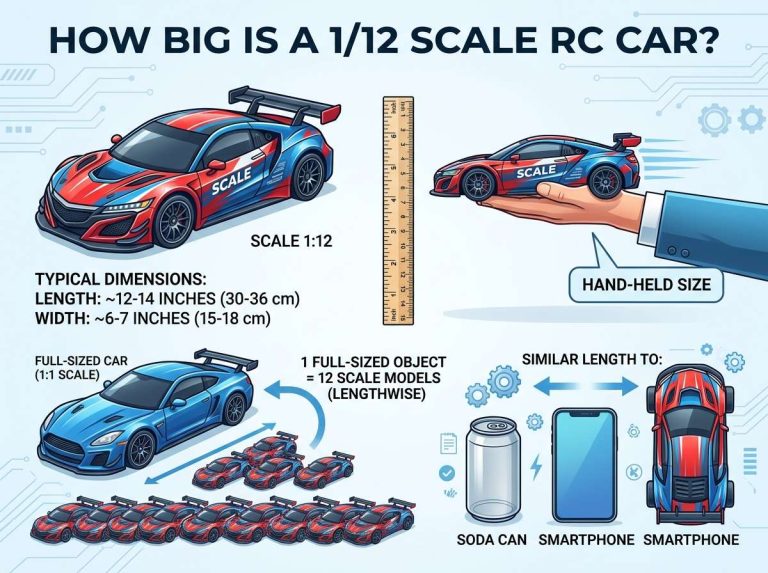
The scale of an RC car is pretty simple to understand once you know the basic concept. When someone says a car is 1/8 scale, they mean it’s one-eighth the size of the real, full-sized version. Think of it as a ratio: 1 to 8.
Here’s how it works in real numbers. If a full-sized car is 16 feet long, a 1/8 scale version would be 2 feet long. You just divide the real car’s size by 8, and boom—you get the RC car’s size. This ratio applies to the length, width, and height of the vehicle.
The scale system helps RC enthusiasts quickly understand how big a model is. Instead of saying “this car is 2 feet long,” people say “this is a 1/8 scale buggy.” Everyone in the hobby immediately knows what size range we’re talking about.
The Actual Dimensions of 1/8 Scale RC Cars
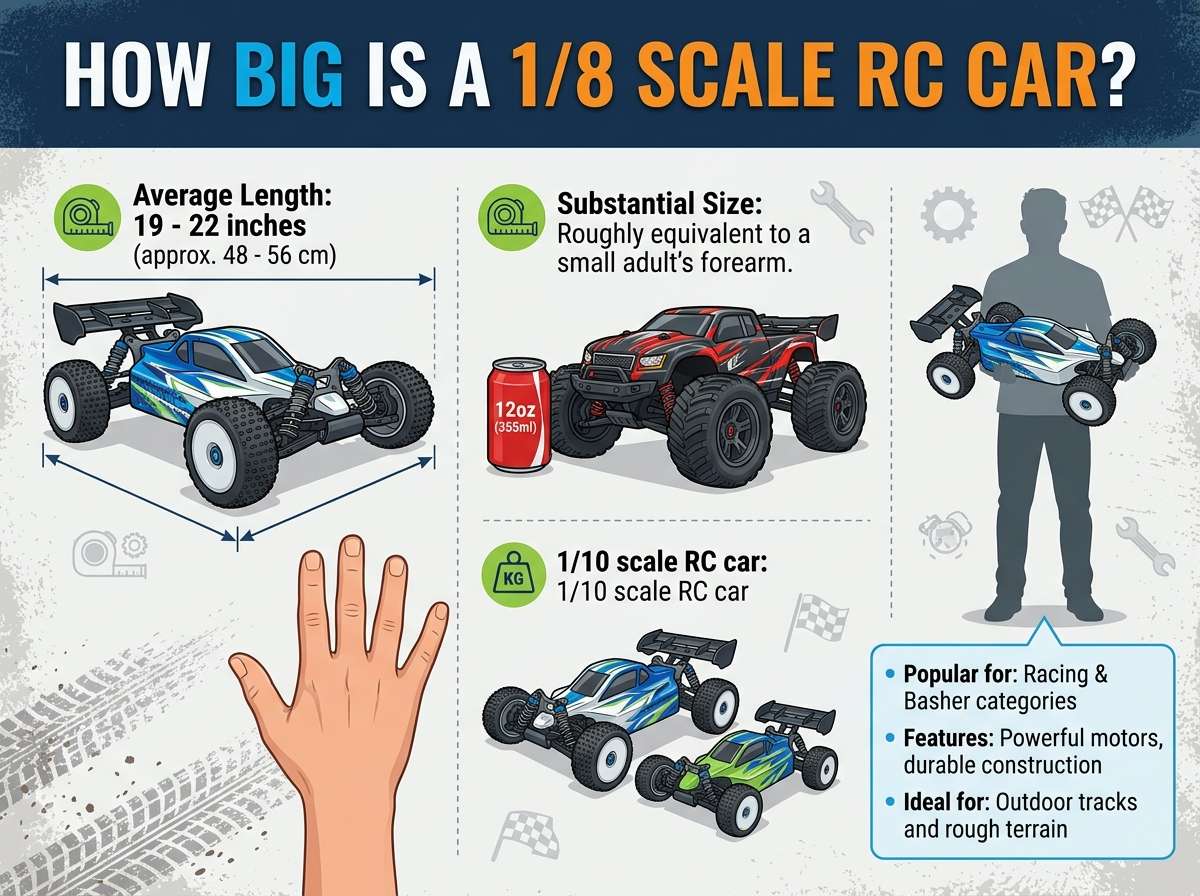
Most 1/8 scale RC vehicles fall into a predictable size range. Typically, these cars measure between 20 and 24 inches in length. That’s roughly the length of a ruler and a half. Some models are slightly smaller at around 18 inches, while others stretch to 26 inches depending on the body style and design.
The width usually comes in around 13 to 15 inches. The height sits between 6 and 8 inches from the ground to the top of the chassis or body. These measurements make them significantly larger than smaller RC cars like 1/10 scale models, but still manageable for most people to handle and transport.
When you hold a 1/8 scale RC car in your hands, you’ll feel the weight. These vehicles typically weigh between 4 and 6 pounds. Some racing models might weigh a bit less, while off-road buggies and trucks can tip the scales at 7 or 8 pounds. That heft comes from the more powerful motors, bigger batteries, and heavier-duty components needed to power such a large model.
How 1/8 Scale Compares to Other RC Car Sizes
Understanding where 1/8 scale fits in the RC world helps you make better decisions about which vehicle to buy. The RC car market offers several different scales, each with its own benefits and drawbacks.
1/10 Scale
The 1/10 scale is the most popular size in the hobby. These cars measure around 16 to 20 inches long and are easier to store and transport than 1/8 scale models. They’re lighter, less expensive to run, and perfect for beginners. However, they’re not as powerful or impressive to watch in action.
1/5 Scale
This is the big boy of RC vehicles. 1/5 scale cars measure 30 to 38 inches long and weigh 15 to 25 pounds. They have serious power, incredible detail, and command attention wherever you take them. The downside? They cost way more money and need bigger spaces to drive. They also eat batteries quickly.
1/8 Scale: The Goldilocks Size
1/8 scale sits right in the middle. It’s bigger and more impressive than 1/10 scale models without being as massive and expensive as 1/5 scale vehicles. You get solid power, great speed, and impressive visuals without needing a football field to run your car.
The size difference between 1/8 and 1/10 might not sound huge, but it makes a real difference in performance. The bigger frame means more space for components, stronger structural support, and better stability at high speeds.
Why Size Matters for Performance
The size of your RC car affects how it performs in several important ways. Bigger isn’t always better, but 1/8 scale offers some real advantages.
Speed and Power
1/8 scale RC cars can handle more powerful motors and larger batteries than their smaller cousins. This means they accelerate faster, reach higher top speeds, and maintain that speed better. You might see 1/8 scale racing cars hitting 70 mph or more on a straight track. That’s serious speed for a model.
Durability
The larger frame and heavier construction make 1/8 scale cars tougher than smaller models. They handle crashes better, deal with rough terrain more effectively, and generally last longer under hard use. The bigger suspension components can absorb bigger impacts.
Battery Life
Despite having bigger engines and batteries, 1/8 scale cars can sometimes run longer than smaller models because they’re more efficient at converting battery power into motion. A single charge might get you 15 to 20 minutes of solid driving time, depending on how hard you push the vehicle.
Handling and Control
The extra size provides better stability at high speeds. You’ll experience less twitchy steering and smoother handling through turns. This makes 1/8 scale cars easier to drive smoothly, even for people who are still learning the ropes.
Different Types of 1/8 Scale RC Cars
1/8 scale vehicles come in different styles designed for different driving experiences. Knowing the types helps you pick the right one for your interests.
Off-Road Buggies
Off-road buggies are built for dirt tracks, grass fields, and rough terrain. They feature high-ground clearance, flexible suspension systems, and aggressive tire tread. These cars love jumping, sliding through turns, and plowing through sand. If you want an adrenaline rush, a buggy delivers it.
Racing Buggies
Racing buggies are lightweight and optimized for speed on smooth tracks. They have lower profiles, stiffer suspensions, and are tuned for maximum acceleration and straight-line velocity. These aren’t for jumping around in fields—they’re for competitive racing.
Trucks
1/8 scale trucks look like pickup trucks and come with higher ride heights and chunkier tires. They handle rough ground really well and can tackle obstacles that would stop a buggy. Trucks are perfect for bashing around outdoors.
Short-Course Trucks
Short-course trucks combine truck styling with race-track speed. They’re built for competition on short-course tracks with jumps, whoops, and tight turns. They’re faster than regular trucks but tougher than pure racing buggies.
Crawlers
Rock crawlers are specialized for climbing over rocks, logs, and extreme terrain. They’re the slowest 1/8 scale option but can handle obstacles that seem impossible. These cars prioritize torque and traction over speed.
Components That Make 1/8 Scale Cars Special
1/8 scale vehicles need beefier parts than smaller RC cars. Understanding these components helps you appreciate what makes these models work.
Motors
Most 1/8 scale cars use brushless electric motors with 3500 to 6000 KV (kilovolt) ratings. Some high-end racing models use even more powerful motors. There are also nitro-powered 1/8 scale cars that use small gas engines, but electric has become the standard for most hobbyists.
Batteries
1/8 scale vehicles typically use LiPo (Lithium Polymer) batteries with 3S or 4S configurations. That means three or four cells wired together to boost power. A typical battery pack might be 3000 to 5000 mAh (milliamp-hours) with discharge rates between 50C and 100C. These are serious power sources.
Transmission
Many 1/8 scale cars use slipper clutches and adjustable gear ratios. This allows you to fine-tune your car’s acceleration and top speed. Some vehicles have single-speed gearboxes, while others feature multi-speed transmissions for different driving conditions.
Suspension
1/8 scale suspension systems are complex. They feature double wishbone front ends, multi-link rear suspensions, oil-filled shocks, and adjustable ride height. The suspension needs to handle the vehicle’s weight and power while keeping the chassis stable.
Tires and Wheels
1/8 scale tires are substantially larger than those on smaller RC cars, typically ranging from 2.5 to 3.5 inches in diameter. Different tire compounds and tread patterns are available for various surfaces—soft rubber for dirt, medium for mixed terrain, and hard rubber for asphalt.
Where to Use Your 1/8 Scale RC Car
The size of a 1/8 scale car opens up many driving options. Here’s where these vehicles really shine.
Outdoor Dirt Tracks
Many communities have dedicated RC racing tracks with groomed dirt surfaces designed specifically for RC vehicles. 1/8 scale cars are perfect for these venues. You’ll find regular racing events, casual practice sessions, and a community of fellow enthusiasts.
Grassy Fields and Parks
Taking your 1/8 scale car to an open field is pure fun. The vehicle is big enough to handle grass, small bumps, and rough ground. You can practice jumps, work on driving techniques, and enjoy the freedom of open-space driving.
Concrete and Asphalt
Parking lots, tennis courts, and smooth concrete surfaces are excellent for high-speed runs. The larger size keeps the car visible and stable on hard surfaces. You’ll get great camera angles if you want to film your driving.
Indoor Facilities
Some areas have indoor RC racing facilities with smooth concrete floors. 1/8 scale cars work great indoors, though you need to be careful about the turning radius in tight spaces.
Rock Crawling Courses
If you own a rock crawler, there are natural courses and man-made obstacle areas where these specialized vehicles excel. Some parks have designated areas for RC car enthusiasts.
Cost Considerations for 1/8 Scale RC Vehicles
Budget matters when you’re entering a new hobby. Let’s talk about what you’ll actually spend.
Initial Purchase
A ready-to-run 1/8 scale RC car from a reputable brand costs between $300 and $600. High-end racing models or specialized vehicles can run $800 to $1500 or more. Budget models exist at lower price points, but quality and reliability increase with price.
Battery and Charger
You’ll need a quality battery pack ($80 to $150) and a good charger ($60 to $200). Having multiple batteries is smart so you can keep driving while one charges. Total battery investment: $150 to $400.
Spare Parts
Motors burn out, parts break, and components wear out. Keeping spare parts on hand is smart. Budget $100 to $300 for an initial spare parts supply. You’ll probably spend more as you continue the hobby.
Fuel Costs
If you choose nitro-powered cars, fuel is an ongoing expense. Electric cars cost much less to run—just electricity to charge batteries.
Maintenance Items
Oil for shocks, differential fluid, replacement bearings, and cleaning supplies add up. Budget $50 to $150 per season for maintenance.
Track Time or Event Fees
Many racing facilities charge entry fees. Expect $10 to $30 per session for casual driving or racing events.
Maintenance and Care for Your 1/8 Scale RC Car
Keeping your 1/8 scale car in good shape ensures it runs well and lasts a long time.
Regular Cleaning
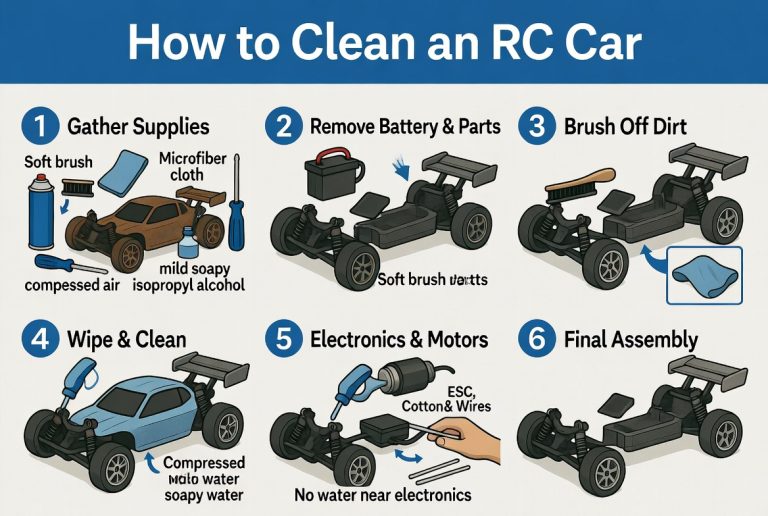
After each driving session, clean off dirt, grass, and debris. Use compressed air or a soft brush to remove particles. For the chassis, a slightly damp cloth works well. Keep water away from electronics.
Shock Oil Changes
The oil inside your shock absorbers breaks down over time. Change it every 5 to 10 hours of driving. Fresh oil keeps suspension performance consistent.
Bearing Inspection
Bearings keep wheels spinning smoothly. Inspect them regularly and replace any that are making grinding sounds or feeling rough.
Motor Maintenance
Brushless motors need occasional cleaning to remove dirt. Nitro motors need more intensive care with regular plug changes and break-in procedures.
Suspension Tuning
Adjusting springs, ride height, and shock stiffness lets you dial in perfect handling. Take time to learn how changes affect performance.
Battery Care
Store batteries in a cool, dry place. Don’t let them fully discharge or overcharge. Use a quality charger designed for LiPo batteries to keep them safe.
Getting Started with 1/8 Scale RC Cars
If you’ve decided 1/8 scale is right for you, here’s how to get rolling.
Start with a Quality Ready-to-Run Model
Don’t build from scratch as your first vehicle. Buy a complete, ready-to-run model from brands like Losi, Axial, Team Associated, or HPI. These companies make reliable vehicles that are fun right out of the box.
Join a Local Club
Connecting with experienced hobbyists is invaluable. They’ll show you best practices, answer your questions, and help you troubleshoot problems. Most areas have RC clubs that welcome newcomers.
Invest in Good Tools and Supplies
You’ll need a small toolkit, spare parts, extra batteries, and a quality charger. Don’t cheap out on these items. Quality tools make everything easier.
Take Time to Learn
Watch online tutorials, read instruction manuals carefully, and ask experienced drivers for advice. Learning proper driving techniques and maintenance procedures from the start prevents bad habits.
Start Slow and Gentle
When you first get your 1/8 scale car, resist the urge to push it to the limit immediately. Gentle driving for the first few sessions helps the vehicle settle in and lets you develop control.
Common Questions About 1/8 Scale RC Cars
Are 1/8 scale cars hard to drive?
Not at all. While they’re more powerful than smaller RC cars, they’re actually easier to control smoothly because of their size and weight. Most people find them more enjoyable to drive than 1/10 scale models.
Can kids drive 1/8 scale cars?
Absolutely. Older children and teens enjoy 1/8 scale vehicles. The larger size makes them easier to see and control. Younger kids might struggle with the speed and size, so consider their age and maturity level.
How fast can a 1/8 scale RC car go?
This depends on the model and setup. Most 1/8 scale off-road buggies reach 50 to 60 mph. Racing-focused models might hit 70 mph or more. Trucks and crawlers are typically slower, in the 30 to 50 mph range.
Do I need a transmitter to run these cars?
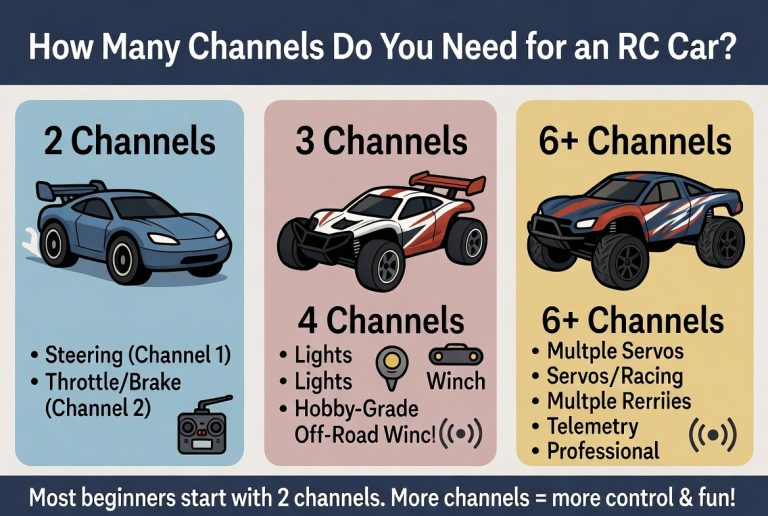
Yes, all RC cars require a remote control transmitter to operate. Most 1/8 scale vehicles use 2.4 GHz digital systems that are reliable and safe.
Can I bash outdoors with a 1/8 scale car?
Absolutely. Taking your 1/8 scale vehicle outdoors and driving it hard is half the fun. Just watch out for water crossings, which can damage electronics.
How long does a battery last?
A fully charged battery usually gives you 15 to 25 minutes of driving time. Heavy acceleration uses more power than cruising, so pushing your car hard shortens run time.
What’s the difference between brushed and brushless motors?
Brushless motors are more efficient, more powerful, and require less maintenance. Brushed motors are simpler and cheaper but don’t perform as well. Most modern 1/8 scale cars use brushless motors.
Can I modify and upgrade my 1/8 scale car?
Yes. The aftermarket parts availability for 1/8 scale vehicles is excellent. You can upgrade motors, suspension components, tires, and electronic speed controllers.
Conclusion: Is 1/8 Scale Right for You?
1/8 scale RC cars offer an excellent balance of size, performance, and fun. They’re big enough to be impressive and powerful enough to deliver genuine excitement. They’re smaller and cheaper than 1/5 scale vehicles while offering more power and presence than 1/10 scale models.
The hobby world has welcomed 1/8 scale cars with open arms because they deliver results. Whether you want to race competitively, bash around outdoors, or join a club and make friends, 1/8 scale vehicles provide everything you need.
The actual size—roughly 20 to 24 inches long and weighing 4 to 6 pounds—makes these cars manageable for nearly anyone. You can transport them easily, store them in a garage, and operate them almost anywhere. The power and performance justify their size, and the durability means they’ll handle the beating that comes with real-world driving.
If you’re standing at the beginning of your RC car journey, don’t overlook 1/8 scale. This size category sits in a sweet spot that delivers genuine thrills without the complexity or expense of larger models. Get yourself a quality ready-to-run vehicle, invest in spare parts and batteries, and dive into a hobby that brings real joy.
The RC car community is welcoming and helpful. People across all experience levels share the passion for these amazing machines. Your 1/8 scale RC car will open doors to new friendships, skills, and adventures. Now that you know how big these cars actually are and what they can do, you’re ready to make an informed decision and join thousands of happy hobbyists who’ve already discovered the magic of 1/8 scale RC cars.
Peterson is an RC hobby enthusiast and product reviewer with a passion for remote-controlled cars, trucks, boats, drones, and accessories. He enjoys testing the latest RC products, comparing features, and sharing practical buying guides to help beginners and experienced hobbyists make informed decisions. Through RCThing.com, Peterson provides honest reviews, maintenance tips, and expert advice to help readers get the most from their RC adventures.