Why RC Batteries Puff Up?
Your RC car was running great. You charge your LiPo battery like always. But then you notice something weird. The battery is swollen. It looks puffy. The sides are bulging out. You touch it and feel it’s warm. What happened? Why did your battery puff up?
This happens to a lot of RC enthusiasts. It’s one of the most common problems people face with remote control toys and drones. The good news is that understanding why it happens helps you prevent it. Let me explain everything about battery swelling in plain English.
What Is Battery Puffing?
Battery puffing is when your RC battery gets fat. Literally. The cell swells up like a balloon. You can see it happening right before your eyes. A battery that should be flat gets bumpy. A battery that should fit snugly in your car starts to not fit.
The technical name is “battery bloat” or “battery swelling.” But RC people just call it puffing. And it’s a big deal because it’s dangerous.
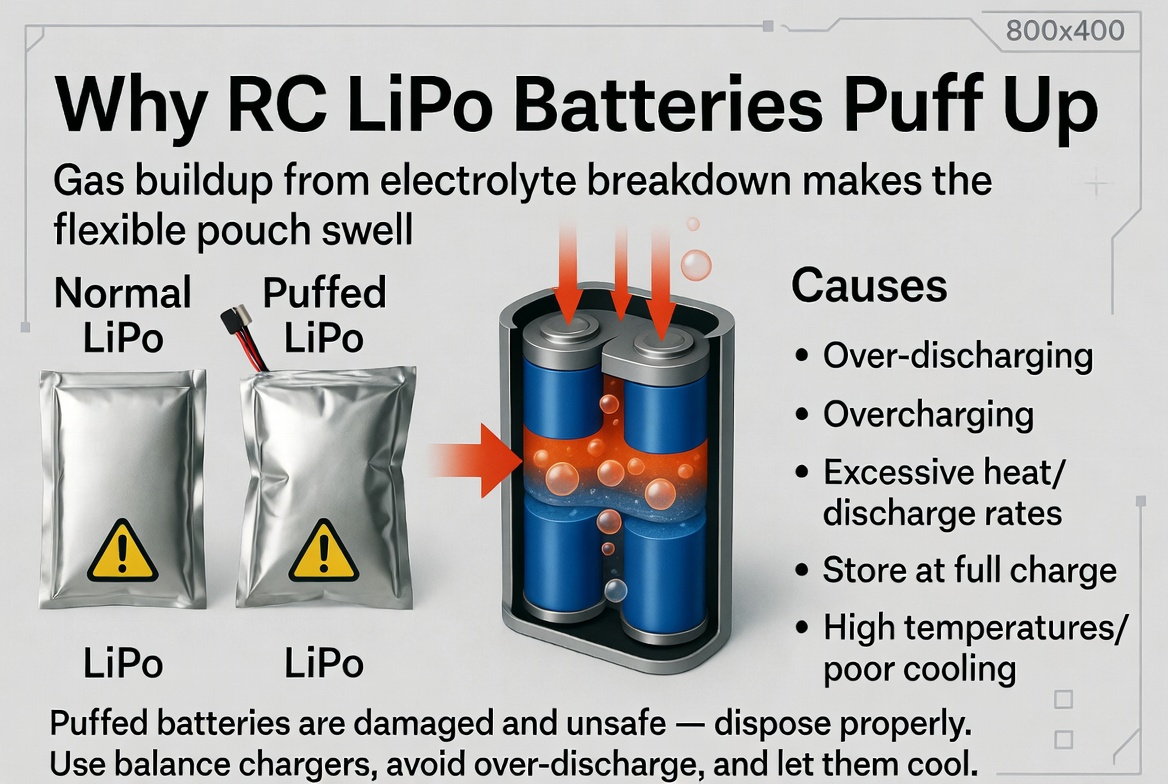
Your battery doesn’t just puff up for no reason. There’s always a cause. Something inside the battery is going wrong. Gas is building up. That gas pushes out on the battery case. The case expands. That’s what you’re seeing.
Most RC batteries that puff are lithium polymer batteries. These are called LiPo batteries. They’re super popular because they have a lot of power in a small package. But they can also puff up if you don’t treat them right.
The Real Cause: Gas Building Up Inside
Here’s what happens inside your battery when it starts to puff.
Batteries work by moving electrons. Chemical reactions inside create energy. When you use your RC car, the battery pushes out power. When you charge it, you’re reversing those chemical reactions.
But sometimes things go wrong. The chemicals inside the battery can react in ways they shouldn’t. These bad reactions create gas. The gas builds up with nowhere to go. It pushes against the battery walls. The flexible case expands to hold all that gas. That’s the puffing you see.
The main gas is hydrogen. Another gas is oxygen. These form when the battery chemicals break down. This breakdown happens for several reasons. I’ll tell you what causes it.
Overcharging: The Number One Culprit
Overcharging is the most common reason your battery puffs.
When you charge your LiPo battery, you need to stop at the right time. Each cell should reach 4.2 volts when fully charged. Not higher. If you keep charging after 4.2 volts, bad things happen.
The charger keeps pushing electrons into the battery. But the battery can’t hold any more. The extra energy has to go somewhere. It starts breaking down the chemicals inside. This creates heat and gas. The gas builds pressure. The battery swells.
Most of us use automatic chargers. These chargers should stop when the battery is full. But sometimes chargers break. Sometimes they have bugs. Sometimes you use the wrong charger settings. Any of these mistakes can overcharge your battery.
I’ve seen people charge their batteries overnight. They think more charging means more power. That’s wrong. Charging overnight means overcharging. Your battery sits there getting filled with gas.
The fix is simple. Use a good charger. Check the voltage when you’re done. Stop at 4.2 volts per cell. For a three-cell battery, that’s 12.6 volts total. Don’t go higher.
Deep Discharging Causes Puffing Too
Deep discharging is the opposite problem. It also causes puffing.
Your LiPo battery should never go below 3.0 volts per cell. When you drop below that number, the battery structure gets damaged. The chemicals inside break down. This creates the same gas that causes swelling.
Some people run their RC cars until the battery is completely dead. They think they should use all the power. That’s a mistake. Running the battery too low damages it permanently.
Deep discharge can happen by accident. Maybe you forgot your battery in your RC car over the winter. The battery slowly drains itself. In a few months, it drops below safe levels. When you finally charge it, you might see puffing.
Deep discharge can also happen from damaged chargers. A charger with a problem might drain your battery instead of charging it. This is rare but it happens.
The fix is to charge your battery before it gets too low. Most RC hobbyists charge their batteries every time they go out. Check the voltage regularly with a meter. If any cell drops below 3.0 volts, it’s in trouble.
Heat Makes Everything Worse
Heat is the enemy of RC batteries. Heat speeds up all the bad chemical reactions. If your battery gets hot, puffing happens faster.
Heat comes from several places. Heavy use creates heat. Racing your car at top speed generates heat in the battery. Charging creates heat. Discharging creates heat. Even sitting in the sun on a hot day creates heat.
When a battery gets hot, the internal chemicals get more active. They react faster. They create more gas. The swelling happens quicker.
Some people charge their batteries right after use. The battery is already hot from running the car. Then the charger adds more heat. This is a double attack. The battery gets super hot. Gas builds up fast.
Heat also damages the separator inside the battery. The separator is a thin wall that keeps the positive and negative sides apart. Heat can melt it. When the separator fails, the battery short-circuits. This creates a ton of gas very fast.
The fix is to let your battery cool down before charging. Run your car, then wait. Let the battery sit for an hour before you charge it. Charge in a cool place. Don’t leave your batteries in hot cars. Don’t leave them in direct sunlight.
Charging at the Wrong Temperature
Temperature matters a lot. Charging when it’s cold causes problems. Charging when it’s hot causes problems.
Lithium batteries have a safe temperature range for charging. For most LiPo batteries, this is between 40 and 104 degrees Fahrenheit. Outside this range, strange things happen.
Charging when it’s too cold makes it hard for electrons to move through the battery. They build up on one side. This creates pressure. The battery can’t charge properly. You might even damage the battery structure.
Charging when it’s too hot speeds up all the bad reactions. The heat makes the chemicals super active. Gas builds up fast. The battery swells.
Many RC people charge in their garage or workshop. If your garage gets really cold in winter, wait for it to warm up. If it gets really hot in summer, charge at a different time of day.
Physical Damage to Your Battery
Sometimes puffing comes from physical damage. A cracked battery case can cause gas leaks. But more commonly, damage causes internal problems that lead to puffing.
If you crash your RC car hard, the battery takes impact. This can damage cells inside. The damage might not show up right away. But over time, the cells start to fail. They react wrong. Gas builds up.
Dropping your battery causes damage. Sitting on it causes damage. Storing it in a place where it gets crushed causes damage.
The battery case looks okay. But inside, something is broken. The battery still works. But soon it starts to puff.
Be gentle with your batteries. Store them carefully. Protect them from crashes. Don’t stack heavy stuff on top of them.
Using the Wrong Charger
Not all chargers work with all batteries. Using the wrong charger is dangerous.
A charger designed for NiMh batteries might not work right with LiPo batteries. It might overcharge them. It might charge too fast. It might not stop at the right voltage.
Some cheap chargers don’t have safety features. They keep charging until you pull the plug. No automatic stop. These chargers are a recipe for puffing.
Always use a charger made for your battery type. If you have LiPo batteries, use a LiPo charger. These chargers have safety features. They stop at the right voltage. They monitor the temperature.
Charging Too Fast Causes Problems
Speed is not always better. Charging your battery too fast creates heat and pressure.
Every battery has a maximum charge rate. This is written as C. A 1C charge rate means you charge the battery in one hour. A 2C rate means two hours. A 0.5C rate means two hours.
Charging at a super high rate, like 5C or 10C, puts stress on the battery. The chemicals can’t keep up. They react all wrong. Gas builds up inside. The battery starts to swell.
Most beginner chargers charge at safe speeds. But some advanced chargers let you choose the speed. If you set it too high, you’re asking for trouble.
Stick with moderate charging speeds. A 1C or 0.5C rate is safe. Yes, it takes longer. But your battery will last much longer.
Battery Age and Wearing Out
Old batteries puff more than new batteries.
Every time you charge and discharge a battery, it gets a little bit worn. The chemicals inside degrade. The separator gets weaker. Small cracks form inside.
After hundreds of charge cycles, the battery is tired. It doesn’t work as well. It gets hotter when you use it. It gets hotter when you charge it. All this heat and stress leads to swelling.
A battery that’s three or four years old is getting old for RC use. It might be fine. Or it might start puffing for no obvious reason. The damage is just catching up.
Replace old batteries. They’re not worth the risk. A new battery costs less than a new RC car.
Manufacturing Defects
Sometimes batteries puff because they were made wrong.
The factory has quality control. But mistakes happen. A separator might be installed wrong. A seal might be loose. Chemicals might be mixed wrong.
A battery with a manufacturing defect might work fine for a while. Then one day it starts puffing. The defect finally shows up.
This is rare with good brands. But it happens. If your brand new battery puffs right away, it’s probably a defect.
Buy batteries from trusted brands. They have better quality control. If you get a defective battery, good companies will replace it.
Battery Imbalance Causes Swelling
The cells in your battery need to stay balanced.
A three-cell LiPo battery has three cells. Each cell should be at the same voltage. If one cell is higher than the others, it’s imbalanced.
Imbalanced cells charge and discharge differently. One cell might overcharge while others are still low. This creates gas in that cell. The battery swells.
Good chargers have a balance feature. This feature charges each cell separately. It keeps them balanced. Basic chargers don’t have this feature. They charge all cells at once. The cells can become imbalanced.
Always use a charger with a balance feature. Check your battery voltages regularly with a meter. If one cell is 0.1 volts higher than the others, it’s becoming imbalanced. Balance it before it swells.
Storage Problems Lead to Puffing
How you store your batteries matters.
Batteries should be stored at a medium voltage. Not fully charged. Not fully discharged. A good storage voltage is 3.85 volts per cell.
Some people store their batteries fully charged. They think it means more power next time they use them. That’s wrong. Storing at high voltage stresses the battery. It starts to degrade. Gas builds up.
Some people store their batteries fully discharged. This is even worse. Low voltage damages the battery structure. When you finally charge it, you might see puffing.
Storage temperature matters too. Store batteries in a cool place. Not hot. Not cold. Room temperature is perfect. A cool room is even better.
Store your batteries in a safe place. Use a battery safe or a fireproof container. If a battery does puff and catch fire, the container will contain it.
Short Circuits Cause Rapid Swelling
A short circuit creates huge amounts of gas very fast.
If the positive and negative sides of a battery touch, it’s a short circuit. Current flows the wrong way. Tons of energy releases instantly. The battery heats up. Gas builds up so fast the battery explodes.
Short circuits usually cause visible damage. The battery might catch fire. It might vent gas out loud. But sometimes a small short circuit happens. The battery swells without catching fire.
Damaged battery connectors can cause short circuits. A connector with bent pins might touch the wrong place. Liquid inside the battery might create a path for electricity. A damaged separator might let the sides touch.
Protect your battery connectors. Don’t let your battery get wet. Store it carefully so nothing pokes through the case.
The Dangers of Puffed Batteries
A puffed battery is not just annoying. It’s dangerous.
A swollen battery can catch fire. It might not happen right away. But the risk is there. The internal chemicals are unstable. They can ignite if something triggers them.
You don’t want a battery fire in your house. You don’t want it in your car or garage. Battery fires burn hot. They’re hard to put out. They can damage property. They can hurt people.
A puffed battery can also explode. The gas inside builds up pressure. If something ruptures the case, all that gas releases at once. It’s like a small bomb.
A puffed battery can leak. The chemicals inside might escape. These chemicals can burn your skin. They can damage your RC equipment. They can poison the air.
Never ignore a puffed battery. Don’t try to use it. Don’t charge it again. Don’t store it inside. Take it seriously.
What To Do If Your Battery Puffs
If you see your battery swelling, here’s what you should do.
Stop using the battery right now. Don’t charge it. Don’t discharge it. Don’t try to fix it.
Take it outside. Put it in a safe place away from people and animals. A cement floor is good. Away from buildings is better.
Let it sit outside for a few hours. Sometimes the gas escapes slowly. The swelling might go down. But don’t touch it.
If the swelling doesn’t go down, the battery is dangerous. Dispose of it properly.
Never throw a puffed battery in the trash. Don’t leave it in a landfill. Find a battery recycling center. Most towns have one. Some stores take old batteries. Call around and find out.
Never burn a puffed battery. Don’t cut it open. Don’t take it apart. These actions can trigger a fire or explosion.
How To Prevent Battery Puffing
Prevention is way easier than dealing with a puffed battery.
First, use a good charger. Spend the money on a quality charger with safety features. This is the single best thing you can do.
Second, charge at the right voltage. Stop at 4.2 volts per cell. Use a charger that does this automatically.
Third, charge at a safe speed. Use 0.5C to 1C rates. Be patient.
Fourth, charge when the battery is cool. Wait an hour after running your RC car before you charge.
Fifth, balance charge every time. This keeps all cells at the same voltage. It only takes a few extra minutes.
Sixth, check your battery voltages regularly. Use a meter. If you see imbalance, balance charge immediately.
Seventh, store batteries at medium voltage. Not full. Not empty. Around 3.85 volts per cell.
Eighth, store in a cool place. A temperature-controlled room is perfect.
Ninth, protect your batteries from damage. Be careful when handling them. Store them carefully.
Tenth, replace old batteries. Don’t keep batteries that are three or four years old. New batteries are cheap insurance.
Eleventh, never use damaged chargers. If your charger seems broken, don’t use it. Get a new one.
Twelfth, never overcharge. Once the battery hits 4.2 volts per cell, stop. Don’t leave it charging unattended.
Understanding LiPo Battery Chemistry
To really understand puffing, you need to know a bit about how batteries work.
A lithium polymer battery has three main parts. There are the positive side and negative side. These are the electrodes. In the middle is the separator. This thin wall keeps the two sides apart.
The chemical reaction happens when electrons flow. They move from negative to positive through the external circuit. This powers your RC car.
When you charge, you push electrons back the other way. You refill the battery.
But the chemicals inside break down over time. They degrade. The separator gets weak. The electrodes get damaged. These problems cause gas to build up.
The faster you charge, the faster these reactions happen. The hotter the battery gets, the faster these reactions happen. The longer you charge, the faster these reactions happen.
All of these things together create the perfect storm for puffing. That’s why overcharging a hot battery is the worst thing you can do.
Comparing LiPo to Other Battery Types
LiPo batteries puff more than other types. But why?
Older NiMh batteries were more forgiving. You could overcharge them a bit and they’d be okay. They didn’t puff easily. But they had much less power for the same weight.
Lithium ion batteries are different from LiPo. Lithium ion batteries have a hard case. They can’t puff the same way. But they’re heavier. That’s why RC hobbyists prefer LiPo.
LiPo batteries are in a soft case. The case is flexible. It can expand when gas builds up inside. That’s why you can see the puffing. The soft case lets the swelling happen.
The tradeoff is worth it for RC use. You get lightweight, powerful batteries. You just need to treat them right.
Signs Your Battery Is Heading Toward Problems
You don’t have to wait for visible puffing. Watch for these warning signs.
First, the battery gets hot when you charge it. A little warmth is normal. But if it’s too hot to touch, something is wrong. Stop charging immediately.
Second, the battery discharges super fast. It had full power yesterday. Today it’s dead after just a few minutes. This means cells are failing inside.
Third, your RC car doesn’t have as much power as it used to. The battery still shows voltage. But the car runs slower. Internal damage is reducing the power.
Fourth, one cell reads lower voltage than the others. This means imbalance is happening. Balance charge immediately.
Fifth, the battery case feels soft or squishy. Puffing is starting. Stop using it.
Sixth, the battery smells strange. A burning smell or chemical smell means something is really wrong. Get it outside right now.
If you notice any of these signs, stop using the battery. Even if it hasn’t visibly puffed yet, something is wrong. It’s safer to replace it.
The Cost of Replacing Batteries
Replacing a battery before it puffs saves you money in the long run.
A good LiPo battery costs between twenty and fifty dollars. Not cheap, but not expensive either.
A new RC car costs two hundred to one thousand dollars. A puffed battery that catches fire can destroy your car. It can burn your house. The cost of replacing a battery is nothing compared to the cost of a fire.
Plus, old batteries lose capacity. They don’t power your car as well. A new battery makes your car faster and more fun to drive.
Think of it as an investment. Spend thirty dollars on a new battery. Your car runs better. You’re safer. Everyone wins.
Frequently Asked Questions About Battery Puffing
Can you still use a puffed battery? No. It’s dangerous. Don’t even try.
Will a puffed battery go back to normal? Sometimes the swelling goes down if you let it sit outside. But the battery is still damaged inside. Don’t use it.
Is puffing reversible? Not really. Even if the swelling goes down, the damage is done. The battery is worn out.
Can you open a puffed battery? Absolutely not. Never do this. It’s super dangerous. The gas inside can ignite. You could get burned or hurt.
How fast can a battery puff? If there’s a short circuit, it can puff in seconds. If there’s just overcharging, it takes days or weeks.
Do all LiPo batteries puff eventually? No. Good care keeps them safe for years.
Real-World Examples
Let me tell you some real stories from RC enthusiasts.
Jake bought his first RC car. He charged the battery in a cheap charger he got online. He didn’t balance charge. After two weeks, the battery was visibly swollen. He stopped using it. Good call by Jake.
Sarah ran her car for four hours straight in hot weather. The battery was smoking hot. She charged it right away without waiting. That night, the battery puffed up. She took it outside. It never caught fire, but it was close.
Marcus forgot about his RC car for two months. The battery was left in the car fully charged. When he took it out, the case had expanded. The puffing had happened slowly over those two months.
All of these people learned the hard way. You don’t have to. Follow the simple steps I told you. Your batteries will last longer. Your car will be safer.
Final Thoughts on RC Battery Safety
Battery puffing is not something you want to experience. But thousands of RC hobbyists do it every year. Most of them didn’t know better.
Now you know better. You know why batteries puff. You know what causes it. You know how to prevent it.
The simple truth is this. A good charger plus good care equals safe batteries. That’s it. It’s not complicated.
Spend a little money on a quality charger. Follow the charging rules. Check your batteries regularly. Replace old batteries. And you won’t have puffing problems.
Your RC hobby should be fun. It should not be dangerous. Safe battery practices keep both you and your equipment protected.
So charge smart. Care for your batteries. And enjoy your RC car for years to come without worry.