LiPo vs Li-ion Batteries for RC
If you’re new to the RC hobby, you’ve probably heard people toss around terms like “LiPo” and “Li-ion” like they’re talking about the weather. The truth is, these battery types can make or break your RC experience. Pick the wrong one, and you’ll be frustrated. Pick the right one, and your RC car will rip through tracks like never before.
Let me break down everything you need to know about these two battery types so you can make a smart choice for your setup.
The Basics: What Are These Batteries Anyway?
Both LiPo and Li-ion batteries use lithium as their main ingredient. That’s where the similarity ends, though. These batteries work differently and suit different needs.
What is a LiPo Battery?
LiPo stands for Lithium Polymer. Think of it as the performance beast of the battery world. LiPo batteries have been the go-to choice for RC cars, drones, and helicopters for years.
Here’s what makes LiPo special: They’re lightweight and pack serious power. The cells are arranged in a flexible pouch, which means you can fit them into tight spaces. If you’ve ever had an RC car, there’s a solid chance it ran on LiPo batteries.
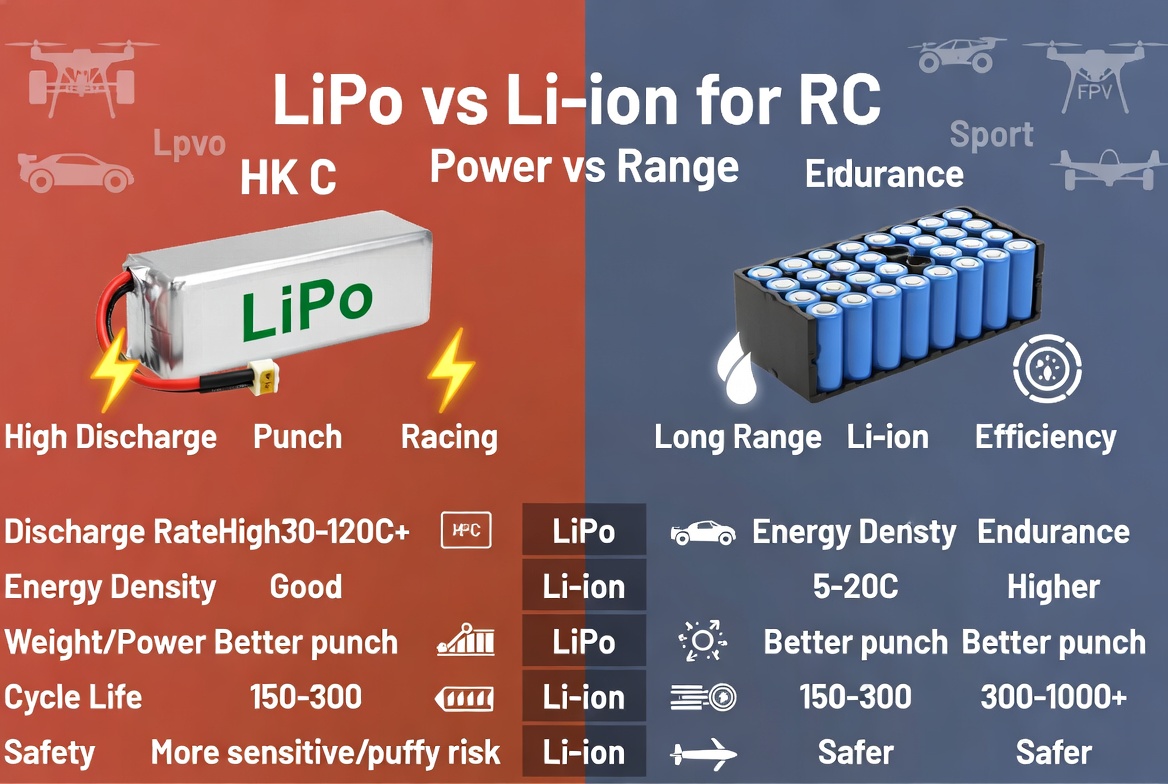
LiPo batteries discharge really fast. That means they can dump tons of energy in short bursts. This is perfect for racing or stunt flying. You want your RC car to accelerate hard? LiPo’s got your back.
What is a Li-ion Battery?
Li-ion stands for Lithium Ion. You know those batteries in your phone or laptop? Those are probably Li-ion batteries. These batteries are heavier and bulkier than LiPo, but they come with their own benefits.
Li-ion batteries use a cylindrical or rectangular design. They’re safer to handle during normal use because they’re built with more safety features. They also last longer before they need replacing.
Li-ion batteries discharge more slowly than LiPo. This means they’re better for endurance activities. You want your RC car to run for a long time without stopping? Li-ion is worth considering.
Power and Performance: Which One Goes Faster?
Let’s talk about what really matters to most RC fans: raw power.
LiPo batteries will always win in a straight power race. They deliver maximum current quickly, which means your RC car accelerates faster and hits higher speeds. The immediate burst of energy is something LiPo does better than anything else on the market.
You can discharge a LiPo battery hard and fast. Many RC cars can handle 20C to 100C discharge rates (that’s just a fancy way of saying how fast the battery empties). Some crazy performance LiPos even go higher. This constant barrage of energy keeps your RC car at peak performance throughout the run.
Li-ion batteries are slower to discharge. They typically max out at around 5C to 10C discharge rates. This means less peak power available at any given moment. Your RC car will still go fast, but it won’t have that explosive acceleration you get with LiPo.
Here’s the thing, though: for casual driving, you might not even notice the difference. If you’re not racing competitively, the LiPo advantage won’t blow you away.
Runtime: How Long Can They Run?
Now let’s flip the script. What if you care more about how long your RC car runs than how fast it goes?
Li-ion batteries win here. They hold their power better over time. You can take your RC car out and run it for hours without major performance drops. The battery will keep pushing energy steadily the whole time.
LiPo batteries lose their edge as they drain. You start with awesome power, but by the time the battery gets halfway empty, you’re not getting quite the same punch. The voltage drops more noticeably.
Real talk: if you’re doing casual cruising or long exploration runs, Li-ion is your friend. You’ll swap out batteries less often and enjoy more consistent performance throughout your session.
Weight: Does It Matter?
RC fans care about weight because it affects handling and speed.
LiPo batteries are super light. This is a huge advantage for RC cars and drones. A lighter vehicle handles better and goes faster. Less weight means less work for the motor.
Li-ion batteries are heavier. They use solid cylindrical cells that take up more space and weigh more than a LiPo pouch. For drone racing or lightweight RC cars, this extra weight is a real problem.
However, if you’re running an RC car on a track where weight isn’t critical, Li-ion won’t ruin your day. But side by side, LiPo wins on the weight front every single time.
Safety: The Serious Stuff
Here’s where things get real. Safety matters more than anyone likes to admit.
LiPo batteries can catch fire if you treat them wrong. Puncture one? It might catch fire. Overcharge one? Same problem. Drop it? You guessed it. This isn’t just theory either—RC forums are full of stories about LiPo fires that caused real damage.
You need to respect LiPo batteries. Always charge them properly with a good charger. Never leave them unattended while charging. Store them in a safe place, away from flammable stuff. One slip-up and you could have a dangerous situation.
Li-ion batteries are much safer in comparison. They have built-in protection circuits. You can’t easily overcharge them or overdischarge them. They’re engineered with safety in mind from the ground up.
This doesn’t mean Li-ion batteries are risk-free. They still need respect. But you won’t lose sleep worrying about a spontaneous fire like you might with LiPo.
Cost: What’s Your Budget?
Money talks, and batteries aren’t cheap.
LiPo batteries cost less upfront. You can grab a decent LiPo for an RC car without breaking the bank. A quality LiPo might run you anywhere from twenty to sixty dollars depending on capacity and discharge rating.
Li-ion batteries cost more per unit. The build quality and safety features add to the price. You might spend forty to one hundred dollars on a Li-ion battery of similar capacity to a LiPo.
Here’s the twist: Li-ion batteries last longer. You won’t need to replace them as often. LiPo batteries eventually lose their magic—they don’t hold charge like they used to. This means you’ll buy more LiPos over time.
Do the math on your situation. Buy cheap LiPos frequently, or invest in Li-ion batteries that stick around longer? Your wallet knows the answer.
Lifespan: How Long Before They’re Done?
LiPo batteries get tired. After a bunch of charge cycles, they start acting weird. They might not charge fully. They might swell up. They definitely won’t perform like they did when they were new.
A good LiPo battery gives you maybe three hundred to five hundred charge cycles before things get dicey. After that, performance drops noticeably.
Li-ion batteries laugh at this. They can handle one thousand or more charge cycles. That’s literally double what you’d get from a LiPo. If you’re using your RC car regularly, a Li-ion battery could outlast multiple LiPos.
This matters for your budget and for the environment. Less battery waste means you’re making a smarter choice.
Charging: How Quick and How Easy?
LiPo batteries charge fast. You can juice up a depleted LiPo in an hour or less with the right charger. Some batteries charge even faster with specialized equipment.
Li-ion batteries charge slower. You might need two to three hours to fully charge a Li-ion battery. This is actually a safety feature—slower charging means less heat and stress on the cells.
If you’re impatient and want to grab a quick charge between runs, LiPo is your battery. If you can wait and you prefer a safer charging experience, Li-ion works great.
Voltage: Does This Affect Your RC?
Both batteries work with different voltage systems, and this matters for compatibility.
LiPo batteries come in different configurations: single cell, two cell, three cell, and so on. A single cell delivers 3.7 volts nominal. A two cell (2S) gives you 7.4 volts. Add more cells, and the voltage stacks up.
Li-ion batteries typically run around 3.7 volts per cell, similar to LiPo. But most Li-ion setups come as integrated packs with specific voltage outputs.
Your RC car is built for a certain voltage range. You can’t just swap any battery into any car. You need to match the voltage or you’ll fry your motor or get weak performance. Check your RC manual before you buy a battery.
Discharge Rate: What’s a C Rating?
This term confuses lots of people, so let’s clear it up.
C rating tells you how fast a battery can discharge. A battery rated at 25C means it can safely deliver twenty five times its capacity per hour. A two thousand milliamp hour (mAh) battery at 25C can discharge at fifty amps.
LiPo batteries have high C ratings. This is one reason they’re great for RC cars. You get that constant flow of power to your motor.
Li-ion batteries have lower C ratings. Fifteen to twenty C is common. This limits how much current you can pull, which affects acceleration and top speed.
Your RC car’s motor and speed controller determine how much current you really need. Some motors are picky about it, while others are fine with moderate current.
Temperature: How Hot Do They Get?
LiPo batteries heat up during discharge. Push them hard, and they get toasty. This heat build-up can shorten their lifespan and reduce performance during long runs.
You need to let LiPo batteries cool down between runs. Racing events often have cool-down periods built in for this exact reason. Some serious racers even pack their batteries in ice between heats.
Li-ion batteries run cooler. They don’t heat up nearly as much during discharge. This means more consistent performance throughout your session and less risk of thermal damage.
If you’re running long races or pushing your RC car to the limit, Li-ion batteries keep their cool better.
Storage: Keeping Your Batteries Happy
Both battery types need proper storage to stay healthy.
LiPo batteries should be stored at partial charge. Find that sweet spot around fifty percent capacity. Store them in a cool, dry place away from sunlight. Never store a LiPo at full charge or completely dead. The cells degrade if you do.
Many people use fireproof bags or ammunition boxes for LiPo storage. This is smart. If something goes wrong, the damage stays contained.
Li-ion batteries are more forgiving. You can store them charged or partially charged without major damage. They’re happy in a cool environment, just like LiPo, but they don’t need the same babying.
Compatibility: Will It Fit Your RC?
This is crucial. You can’t just buy any battery and expect it to work.
Most RC cars come with a LiPo-specific connector and built for LiPo voltage. If you want to switch to Li-ion, you might need to buy a new connector or even a new speed controller.
Some modern RC cars and chargers have hybrid compatibility. They’ll work with both battery types without modification. Check your equipment before assuming anything.
When shopping for batteries, always verify compatibility with your specific RC model. One wrong move and you’ve got a battery that won’t fit.
Which One Is Right for You?
Okay, time to make a decision. Here’s my breakdown.
Go with LiPo if:
You want maximum performance and speed. You’re racing competitively. You’re willing to handle safety procedures properly. Weight matters for your application. You don’t mind replacing batteries more often. You want fast charging times.
LiPo is the choice for serious RC enthusiasts who know what they’re doing and who want their cars to absolutely scream.
Go with Li-ion if:
You prioritize safety and peace of mind. You want batteries that last longer. You prefer consistent performance throughout longer runs. You’re not obsessed with maximum speed. You want easier charging and storage. You’re new to RC and learning the ropes.
Li-ion is the choice for casual users and people who value reliability over raw power.
The Middle Ground: Hybrid Approach
Here’s a pro tip: you don’t have to choose just one. Many RC enthusiasts use both.
Keep a LiPo for race days when you want maximum performance. Use Li-ion batteries for casual driving and learning. This way you get the best of both worlds without compromise.
As you get more experienced, you’ll naturally gravitate toward whichever type suits your style. There’s no shame in using both.
Maintenance Tips for Maximum Life
Whatever battery you pick, treat it right.
For LiPo:
- Invest in a quality charger with LiPo balance charging.
- Never let a LiPo sit at zero charge for more than a few days.
- Store at fifty percent charge in a cool place.
- Use a fireproof bag during storage.
- Always supervise charging. Never charge overnight.
- Let batteries cool after hard use before charging.
For Li-ion:
- Use the charger that came with your battery or a compatible one.
- Don’t drain completely—charge when it hits around twenty percent.
- Store in a cool environment.
- Check batteries for swelling or damage regularly.
- Li-ion is more forgiving, but good practices still matter.
Common Mistakes to Avoid
People mess up battery management constantly. Learn from their mistakes.
Mistake One: Overcharging. Set your charger correctly. Don’t just guess at the settings. This kills batteries fast.
Mistake Two: Ignoring swollen batteries. If your LiPo puffs up, it’s done. Don’t use it. Safely dispose of it.
Mistake Three: Storing batteries wrong. Your battery shelf isn’t the right place for expensive batteries. Get proper storage.
Mistake Four: Mixing battery types. Don’t run multiple battery types in parallel. They discharge at different rates and cause problems.
Mistake Five: Forgetting to balance charge. Your charger should have balance charging. Use it.
The Future of RC Batteries
Battery technology keeps improving. Manufacturers are working on better energy density, faster charging, and improved safety.
Some newer RC cars are designed from the ground up for Li-ion batteries. This trend will probably continue. As Li-ion technology advances, we might see it dominate the RC world eventually.
For now, though, LiPo remains the performance king, and Li-ion is the practical choice for reliability.
Final Thoughts: Make Your Choice
You now know the real differences between these two battery types. You understand the trade-offs. You know what each one does best.
The choice comes down to your priorities. Do you want the absolute fastest RC car on the track? Go LiPo. Do you want batteries that last longer and are safer to handle? Choose Li-ion.
There’s no wrong answer here. Both batteries are legitimate choices for different reasons. The RC hobby is big enough for both types.
Start with whichever feels right for your situation. As you gain experience, you can always add the other type to your arsenal. Learn by doing, and you’ll quickly figure out what works best for you.
The best battery is the one you maintain properly and use safely. Master the basics, treat your batteries right, and you’ll have years of fun with your RC car. That’s what really matters.
Now get out there and start driving. Your RC car is waiting.
Quick Reference Table: LiPo vs Li-ion at a Glance
| Feature | LiPo | Li-ion |
|---|---|---|
| Power Output | Very High | Moderate |
| Weight | Very Light | Heavier |
| Safety | Requires Care | Built-in Protection |
| Cost | Lower | Higher |
| Lifespan | 300-500 cycles | 1000+ cycles |
| Charge Time | 1 hour or less | 2-3 hours |
| Runtime | Drops with discharge | Consistent |
| Heat Generation | High | Low |
| Storage Complexity | High | Low |
| Best For | Racing & Performance | Casual & Endurance |
Questions You Might Have
Q: Can I use a LiPo charger on a Li-ion battery?
A: No. Different chemistry requires different charging profiles. Using the wrong charger can damage your battery or start a fire. Always use the correct charger for your battery type.
Q: How do I know when a LiPo battery is dead?
A: A good battery monitoring system helps. When voltage drops below safe levels, stop using it. Most speed controllers have cutoffs to protect your battery.
Q: Is it okay to charge my batteries overnight?
A: With Li-ion, sometimes it’s okay. With LiPo, absolutely not. Unattended charging is dangerous. Always stay present during LiPo charging.
Q: Can LiPo batteries recover if they swell?
A: No. A swollen LiPo is essentially dead. The internal structure is compromised. Dispose of it safely. Don’t try to use it again.
Q: What’s the ideal storage temperature?
A: Cool and dry. Somewhere between fifty and seventy degrees Fahrenheit is perfect. Avoid extremes of heat and cold.
Q: How do I dispose of old batteries safely?
A: Many battery retailers and electronics stores have recycling programs. Some hobby shops take old batteries. Never throw them in regular trash.
Q: Can I run my LiPo-equipped car on Li-ion batteries?
A: Only if the voltage matches and your controller supports it. Many modern cars have hybrid support, but older ones might not work. Always verify before trying.
Q: What does “balance charging” mean?
A: It means the charger equalizes the voltage across all cells in a multi-cell battery. This is crucial for LiPo longevity. Always balance charge.
Q: Why do LiPo batteries puff up?
A: Gas builds up inside as the battery ages or gets damaged. It’s a sign of failure. Time to get a new battery.
Q: Are there other battery types for RC cars?
A: Yes, NiMh batteries still exist. But they’re outdated. LiPo and Li-ion are the modern choices. Stick with these two.
This guide should give you everything you need to make an informed decision. Remember, the RC hobby is supposed to be fun. Pick the battery that brings you joy and keeps you charging forward. Happy racing!