How RC Boat Cooling Systems Work?
If you’ve ever owned a radio-controlled boat, you know how hot those motors can get. One minute you’re racing across the water, having the time of your life. The next minute, your boat starts acting weird. The engine loses power. The throttle feels sluggish. You pull the boat out and touch the motor. It’s blazing hot!
That’s where the cooling system comes in. It’s one of the most important parts of your RC boat, and yet many people don’t understand how it works. In this guide, we’ll break down everything you need to know about RC boat cooling systems. By the end, you’ll know why these systems matter and how to keep yours running smoothly.
Why Does Your RC Boat Motor Get So Hot?
Before we talk about cooling, let’s understand the problem. Your RC boat’s motor generates a lot of heat. This happens because of friction and resistance inside the motor. When electricity flows through the motor’s coils, it creates friction. This friction turns into heat. It’s the same reason your phone gets warm when you use it a lot.
In a small motor running at high speeds, this heat builds up fast. Your boat motor can reach temperatures of 60 to 80 degrees Celsius when you’re pushing it hard. That’s over 140 degrees Fahrenheit! This heat damages the motor over time. It melts the insulation on the wires. It weakens the magnets. It wears out the bearings faster.
If the motor gets too hot, it can fail completely. Your boat will stop working. You might have to buy a new motor, which costs money. That’s why cooling matters so much.
The Purpose of a Cooling System
A cooling system does one simple job: it removes heat from the motor and moves it away. The faster it removes heat, the cooler your motor stays. A cool motor runs better. It lasts longer. It performs at its peak power.
Think of it like a fan in your room. When it’s hot, you turn on a fan to move the air around. The fan doesn’t make the room colder, but it moves the air around so you feel cooler. An RC boat cooling system works the same way. It moves water around the motor to carry heat away from it.
The Main Parts of an RC Boat Cooling System
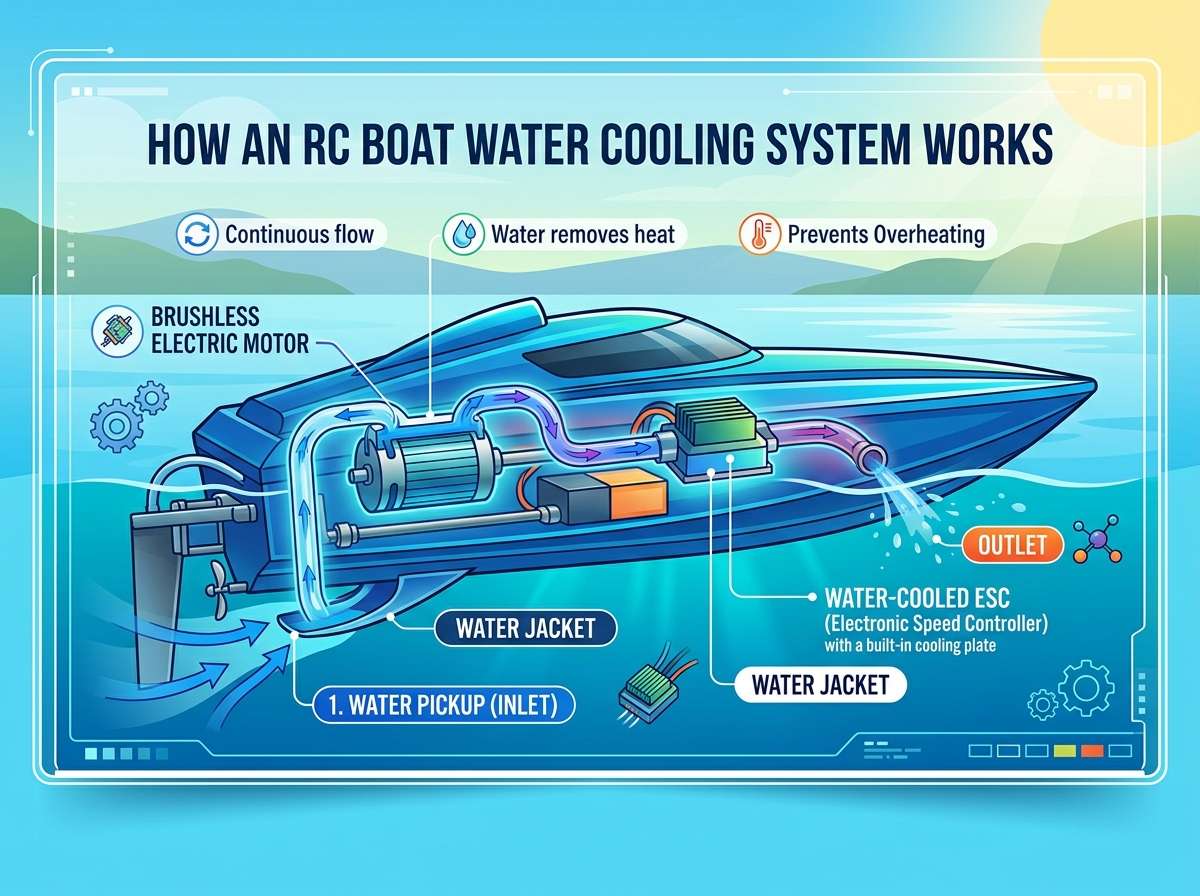
Most RC boats use a water cooling system. It’s not complicated. The system has just a few key parts:
The Jacket or Water Channels
The motor jacket is basically a hollow shell around the motor. Water flows through this jacket, right next to the hot motor. As water moves through the jacket, it absorbs heat from the motor. The hot water then leaves the jacket and moves to the next part of the system.
The jacket has tiny channels inside. These channels create a path for water to follow. Water enters at one point and exits at another. Some boats have jackets that cover the whole motor. Others have jackets that only cover the hottest parts.
The Water Pump
The pump is the heart of the cooling system. It takes in water and pushes it through the motor jacket at high speed. Without a pump, water would just sit in the jacket and do nothing.
Most RC boats use a simple impeller pump. An impeller is a wheel with blades. As it spins, the blades push water forward. The pump gets its power from the same battery as your motor. Some boats have electric pumps. Others use a direct-drive pump that connects straight to the motor shaft.
The Water Intake
This is where water enters the cooling system. On most boats, the intake is located at the bottom of the hull or on the side. As the boat moves through the water, the intake scoops up fresh water. This water is cold and full of oxygen, which helps it absorb heat better.
The intake has a screen or filter to keep out dirt, leaves, and other trash. If the intake gets clogged, no water flows to the motor. The motor overheats. That’s why keeping the intake clean is so important.
The Discharge or Output
After water flows through the motor jacket and absorbs all that heat, it has to go somewhere. The discharge outlet lets the hot water leave the cooling system. Usually, water exits through the back of the boat, near the propeller.
The discharge opening is often big enough so water can exit quickly. If the opening is too small, water backs up inside the jacket. The motor overheats because water moves too slowly.
How the Cooling System Works Step by Step
Let’s walk through what happens when you start your boat:
Step One: Water Intake
You launch your boat and hit the throttle. The boat starts moving forward through the water. The water intake at the bottom of the boat scoops up water from the lake or river. This fresh water is cold. It’s the key to keeping your motor cool.
Step Two: The Pump Activates
Your motor spins up. If you have an electric pump, it also spins up and starts pumping. If you have a direct-drive pump, it spins with the motor. Either way, the pump now starts pushing water through the system.
Step Three: Water Flows Through the Jacket
The pump forces water into the motor jacket. Water flows all around the hot motor. As water touches the hot motor, heat moves from the motor into the water. The water heats up. The motor cools down. This happens quickly because water is an excellent conductor of heat.
Step Four: Hot Water Leaves the System
The heated water flows out of the jacket and exits through the discharge outlet. Fresh, cold water enters the jacket at the same time. This constant cycle of fresh water coming in and hot water going out keeps the motor cool.
The whole cycle repeats hundreds of times per minute. Your motor stays at a safe temperature. It can run at full power without overheating.
Different Types of Cooling Systems
Not all RC boats have the same cooling system. Let’s look at the main types:
Open Loop Cooling
This is the most common type. Water comes from outside the boat and flows through the motor jacket once. Then it exits back into the lake or river.
Open loop cooling is simple and cheap. It works well for most boats. The only problem is that you need to be in water for it to work. If you run your boat out of water to clean it or test it, the motor will overheat in seconds.
Closed Loop Cooling
Some high-performance boats use closed loop systems. Water stays inside the boat in a tank. A pump circulates the same water over and over through the motor jacket. The water gets hot, but it stays in the system.
Closed loop systems are more complex. They need a water tank and a way to cool the water without leaving the boat. Some boats use a radiator or heat exchanger. Others use ice packs in the tank. These systems are expensive and heavy. Most beginners don’t need them.
Direct Cooling
Some tiny RC boats don’t have a jacket at all. Instead, water sprays directly on the motor from the intake. This is direct cooling. It’s even simpler than open loop cooling, but it’s less effective because water doesn’t stay in contact with the motor as long.
The Impeller Pump Explained
Since the pump is so important, let’s dive deeper into how it works.
An impeller pump looks simple. It’s just a plastic wheel with curved blades. But it does an amazing job pushing water.
Here’s how it works: The impeller spins fast. The blades of the impeller push against the water. As the blades move, they create a low-pressure area on one side and a high-pressure area on the other. Water flows from the low-pressure area to the high-pressure area. The faster the blades spin, the more water they push.
The pump sits in a chamber. Water enters from the intake side and exits on the discharge side. The impeller never stops spinning as long as the motor is on. The faster your motor runs, the faster the pump runs, and the more water flows through the jacket.
This is really smart. When your motor is working hard and gets hot, it spins faster. The pump then spins faster and pushes more water. Your motor needs more cooling, and it gets more cooling. The system adjusts itself automatically.
Water Cooling vs. Air Cooling
You might wonder why RC boats don’t use air cooling like some other electronics. Air cooling is simpler and lighter. So why use water?
The answer is performance. Water absorbs heat much better than air. Water is denser than air, so it can carry more heat away. This means the motor stays cooler with a water cooling system. A cooler motor performs better and lasts longer.
Also, RC boats are designed for water. They’re already wet. Using the water around the boat to cool the motor makes perfect sense. It’s efficient and it works.
Common Cooling System Problems and How to Fix Them
Even the best cooling systems run into problems sometimes. Let’s look at the most common issues:
Clogged Water Intake
This is the number one problem. Dirt, leaves, and algae can block the intake screen. When water can’t enter the system, the motor overheats.
How to fix it: Pull your boat out and look at the intake. Clean off any debris. Rinse the intake screen with fresh water. This takes two minutes and solves most cooling problems.
Low Water Flow
Sometimes water moves through the jacket, but not fast enough. The motor still gets too hot.
This can happen if the discharge opening is too small. It can also happen if the pump is worn out. A worn pump doesn’t push water as hard.
How to fix it: Check that the discharge opening is clear. Make sure nothing is blocking water flow. If the pump is old, consider replacing it. A new pump improves performance a lot.
Air in the System
Sometimes air gets trapped in the motor jacket. Air doesn’t conduct heat well, so hot spots develop. The motor overheats even though water is flowing.
How to fix it: Tilt the boat so the discharge is higher than the intake. Let water flow for a minute. This helps air escape. You can also squeeze the water line gently to release trapped air.
Pump Failure
Pumps can break. The impeller can crack. The shaft can bend. A broken pump means no water flow and an overheated motor.
How to fix it: Replace the pump. Most boat kits include a spare pump or sell them cheap. It’s an easy replacement that takes minutes.
Intake Drawing Air
If the intake is too high above the water or the boat goes too fast, the intake might draw air instead of water. No water flow means the motor overheats.
How to fix it: Make sure the intake is below the water surface. Slow down if the boat is drawing air. You can also raise the intake higher by tilting the boat slightly forward.
Maintenance Tips for Your Cooling System
Keeping your cooling system in good shape doesn’t take much time. Just follow these simple tips:
Flush Your System After Every Run
After you’re done boating, run fresh water through the cooling system. This washes out salt, sand, and dirt. Use a hose or bucket of fresh water and run the motor for a few seconds without the boat in the water. Never do this on land for more than a few seconds, because you need water flowing through the system.
Actually, here’s a better way: Get a hose with a fitting that matches your intake. Attach the hose to the intake. Run the motor at idle speed for a minute. Fresh water flows through the system and out the discharge. This cleans everything out.
Check for Leaks
Water should only exit where it’s supposed to exit. If you see water leaking from the motor jacket, something is wrong. Leaks mean less water reaches the hot parts of the motor.
Check your boat once a month. Look for water coming from unexpected places. If you find a leak, repair it or replace the damaged part.
Clean the Intake Screen
The intake screen does important work. It keeps trash out of your system. But it gets clogged easily.
Every few runs, take a look at the intake. If it’s covered in dirt or algae, clean it. Brush it with an old toothbrush. Rinse it with fresh water. This takes two minutes and prevents most problems.
Use Quality Water
If you use tap water, let it sit for a day so the chlorine evaporates. Chlorine can damage rubber seals. Better yet, use distilled water or water from the boat’s environment. If you race in saltwater, use fresh water for cooling. Salt clogs the system and eats away at metal parts.
Store Your Boat Properly
When you store your boat for a long time, leave some water in the cooling jacket. Dry jackets can develop cracks. A little water prevents this. But don’t leave the boat sitting in the sun filled with water, because the water heats up and can damage seals.
Temperature Monitoring
Some RC boat owners check the temperature of their cooling system water. They want to make sure it’s not getting too hot.
You can buy a simple thermometer to check the water. Just touch it to the discharge water while the boat runs. Most boats run at 35 to 45 degrees Celsius during normal use. If the water gets above 50 degrees Celsius, something is wrong. Check the intake, pump, and discharge.
For serious racers, there are thermometer sensors that send readings to a remote display. These let you watch the motor temperature in real time. It’s not necessary for casual boating, but it helps you tune your boat for best performance.
Upgrading Your Cooling System
If your boat keeps overheating, you can upgrade the cooling system. Here are some options:
Larger Motor Jacket
A bigger jacket means more surface area for water to contact the motor. More contact means better heat removal. Some boat owners modify their jackets or buy aftermarket jackets that are bigger than the original.
Better Pump
A more powerful pump moves more water faster. This removes heat better. Upgraded pumps are available from boat manufacturers and aftermarket suppliers.
Multiple Intakes
Instead of one intake, some boats use two. Two intakes bring in more water. More water means faster heat removal. This works best on fast boats that need serious cooling.
Radiator or Heat Exchanger
High-end boats sometimes use a radiator. The radiator is a metal part where hot water flows through fins. Air moves past the fins and carries heat away. This is a closed loop system. It’s expensive but very effective.
RC Boat Cooling in Different Environments
The environment where you boat affects cooling. Let’s look at different situations:
Fresh Water Boating
Fresh water is the best for cooling. It has no salt to corrode parts. It doesn’t leave deposits in the jacket. After each day on fresh water, just rinse your system with a hose. You’re good to go.
Saltwater Boating
Salt is the enemy of cooling systems. It deposits in the jacket and clogs the flow. It eats away at metal parts. If you boat in saltwater, flush your system thoroughly after every run. Flush with fresh water, not saltwater. This removes all the salt. Do this right after boating, before the salt dries.
Cold Water
In cold water, your motor might not get hot enough. This is rare, but it can happen in winter or in very cold environments. Cold water absorbs a lot of heat. Your motor might stay too cool, which actually hurts performance. If this happens, you might need to reduce water flow or insulate the motor jacket.
Murky or Dirty Water
If you boat in murky water full of dirt and algae, your intake clogs faster. Check the intake more often. Clean it after every few runs. Don’t wait until the motor overheats.
The Bottom Line
Your RC boat’s cooling system is simple but vital. It takes water from the environment, flows it through the motor jacket to absorb heat, and discharges the hot water back out. A pump keeps the water moving. As long as you keep the intake clean and water flowing, your motor stays cool.
Cooling system problems are easy to prevent with basic maintenance. Flush your system after each run. Clean the intake screen. Check for leaks. Do these simple things and your cooling system will work great for years.
If your boat keeps overheating even with a clean system, check the water flow. Make sure the discharge isn’t blocked. Make sure the pump is working. These simple checks solve almost every cooling problem.
A well-maintained cooling system means your RC boat runs better, performs at full power, and lasts much longer. It’s the difference between a boat that works great and one that disappoints you. Take care of your cooling system, and it will take care of your boat.
Final Thoughts
RC boat cooling systems might seem complicated, but they’re really quite simple. Water flows in, absorbs heat, and flows out. The pump keeps everything moving. That’s it. Understand these basics, maintain your system, and you’ll have a fast, reliable RC boat that you can enjoy for years to come.
The next time you take your boat out, pay attention to how the cooling system works. Watch the water flow out the back. Feel how hot it is. You’ll gain an appreciation for this simple but clever system that keeps your boat running strong.

Peterson is an RC hobby enthusiast and product reviewer with a passion for remote-controlled cars, trucks, boats, drones, and accessories. He enjoys testing the latest RC products, comparing features, and sharing practical buying guides to help beginners and experienced hobbyists make informed decisions. Through RCThing.com, Peterson provides honest reviews, maintenance tips, and expert advice to help readers get the most from their RC adventures.