5 Best RC Boat Battery In 2026
As an Amazon Associate we earn from qualifying purchases.
Picking the best RC boat battery can feel confusing at first. Many packs look alike, yet they differ in voltage, plug type, size and capacity. This guide helps beginners who want to replace a worn-out pack or power a new remote control boat for the first time.
The five products in this round-up are all rechargeable batteries made for small and mid-size RC boats. They range from compact lithium-ion packs to a larger lithium polymer pack with a different connector. The comparison rests on the listed features and typical use, not on personal testing.
Before you compare any listing, find the voltage, connector type and physical size printed on your current battery or in your boat’s manual. Matching these three details is the simplest way to avoid a wasted purchase. Capacity, shown in milliamp-hours (mAh), then tells you roughly how long a charge will last.
Many beginners focus only on capacity, but a larger pack that does not fit the battery bay or the plug is no use. Check the physical dimensions against the space in your boat, and confirm that the connector matches the one on your speed controller. A quick measurement with a ruler or caliper can save a return shipment.
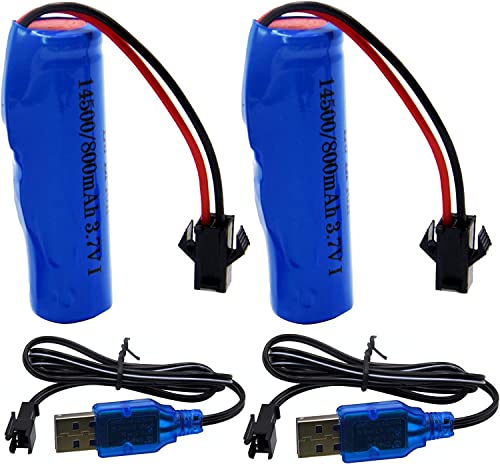


1. Blomiky 2 Pack 3.7V 800mAh Li-ion Rechargeable: best for small, budget-friendly replacements
This is a two-pack of small 3.7 volt lithium-ion batteries with an SM-2P plug. The listing describes a real capacity range of 500mAh to 800mAh, so the exact output depends on the cell. It is aimed at small RC cars, stunt vehicles and some small boats rather than large, fast models.
The plug and voltage are the first things to check. The listing says the battery is a single-cell pack with a black 2-pin SM-2P connector, and the plug end measures about 5.5 by 5.2mm. If your boat uses a different connector, this pack will not fit without an adapter. Adapters add resistance and can cause loose connections, so a matching plug is the safer choice.
Key features in simple terms
Each pack includes a built-in protection board. This board is meant to cut power when the battery is full and guard against overcharging. The listing notes that a red light may stay on for a while after charging, and it says a full charge usually takes about three to four hours.
The battery weighs about 19 grams and measures roughly 51 by 18 by 14mm. Its small size makes it easy to fit into tight battery bays. The listing also mentions an 8.5A over-current protection circuit, which limits the current the pack can deliver before the protection board steps in. Lower weight can help a small hull stay balanced and responsive.
What daily use usually feels like
Because the packs are light and small, they suit short sessions in a pool or pond. Buyers often keep a spare on hand so one can charge while the other runs. The charging wait of several hours means you will want to plan ahead, especially if you only have time to run the boat on weekends.
A practical habit is to label each pack once you know its real capacity. Packs in the same set can differ, so marking the stronger one helps you pick the best battery for longer sessions. Keeping a simple log of run times can also show you when a pack is losing capacity.
Performance and ease of use
Performance depends heavily on matching the pack to the model. The listing gives a wide range of compatible models, but it also says to confirm voltage, plug and size before buying. The included USB cable keeps charging simple, with no special charger needed.
Lithium-ion packs also need care during charging. Use the cable and charging method the listing describes, and never leave a charging battery unattended. Charge the pack on a hard, non-flammable surface away from anything that can catch fire. Let a pack cool after a hard run before you plug it in, because heat can shorten its life.
Value for money
At a low listed price, the two-pack is one of the lower-cost options in this round-up. For a small boat that uses a matching plug, it can be an economical way to get a spare. Buyers with larger or higher-power boats will likely need something else, because a small pack may not supply enough current for demanding motors.
Pros
- Low price for a two-pack
- Small, light size fits many compact models
- Built-in protection board and USB charging cable included
- Wide list of compatible small RC models
Cons
- Capacity varies between 500mAh and 800mAh, so run time is not fixed
- Charging takes around three to four hours
- Only suits models with the matching SM-2P plug and voltage
- Not designed for large or high-power boats
2. Blomiky 2 7.4V 600mAh 4.44Wh Lion Battery: best for TKKJ and Skytech style boats
This pack is a 7.4 volt lithium-ion battery rated at 600mAh and 4.44Wh. It uses an SM-2P plug and is sold for a group of remote control boats, including several TKKJ, Skytech and Gizmovine models. It is a good fit for owners who want a direct replacement for those specific boats.
The listing includes an extra adapter cable. This cable is meant for newer versions of certain boats that changed plug on newer models. Because the plug type can differ between versions, the adapter may be useful for owners of newer hulls. Check your boat’s connector before you order, so you know if you need it.
Key features in simple terms
The pack measures about 38 by 36.5 by 18.5mm, which keeps it compact. The listing describes it as a straightforward replacement for boats that use the same SM-2P connector. It also notes compatibility with a broad set of Skytech, Sharkool and related models. Compare the listed model names with the label on your own boat or its original packaging, and confirm that the model number matches before you buy.
The listing gives a nominal voltage of 7.4V and a 600mAh rating. A rating like this tells you how much charge the pack holds, which affects how long it runs between charges. Because the capacity is fixed in the listing, buyers can plan run time more easily than with a variable-capacity pack.
For example, a pack with a higher rating will generally run longer, all else being equal. The 4.44Wh figure is simply the 7.4V multiplied by the 0.6Ah, so the two ratings describe the same stored energy in different terms.
What daily use usually feels like
Most owners of these boats use them in calm water for short sessions. A 600mAh pack is generally suited to this kind of light use. Keeping a spare nearby is a practical habit, since the charge does not last indefinitely.
Charging the pack fully before each session and letting it cool after running will also help it perform consistently. Stop and recharge when the boat slows noticeably, rather than running the pack until it cuts out.
Performance and ease of use
The listing does not publish a discharge rating, so performance claims should stay general. What buyers usually notice is that the pack matches the original voltage and plug, which keeps setup simple. The adapter cable helps when a newer boat uses a slightly different connector.
Plugging the pack into the correct port and confirming the polarity before first use is a simple step that prevents problems. Reversing the connector can damage the boat’s electronics, so take a moment to check the orientation.
Value for money
At a mid-range listed price, this pack costs more than the small Blomiky two-pack. That is reasonable for a battery sized for a specific boat family. Owners who already know their model is covered will find it a sensible replacement.
If your boat uses a different plug or a different voltage, a battery of this type will not fit, so the price only makes sense when compatibility is confirmed. Check the current listing price, since it can change over time.
Pros
- Clearly listed 7.4V and 600mAh rating
- Includes an adapter cable for newer boat versions
- Compact size suits many small hulls
- Covers a wide list of TKKJ, Skytech and related models
Cons
- Costs more than the smallest budget packs
- Limited to boats that use the SM-2P plug or the adapter
- Run time is modest for a battery of this size
- No discharge rating is given in the listing
3. Zeee 3S Lipo Battery 2200mAh 11.1V 50C: best for larger, higher-power RC boats
This is a three-cell lithium polymer, or LiPo, pack rated at 11.1 volts and 2200mAh. It uses an XT60 connector and comes as a two-pack. Unlike the lithium-ion packs above, it is built for models that need more power and a different charger.
The listing states a 50C discharge rating. This figure describes how quickly the pack can release power, and a higher number generally means it can supply more current. For example, a pack with a higher C rating can deliver a stronger burst of current when a boat accelerates hard or pushes through rough water.
The listing is a sign that the pack suits faster or heavier boats, but it does not say how any specific boat will perform.
Key features in simple terms
Each pack measures about 75 by 34 by 26.5mm and weighs roughly 137 grams. The listing describes a 3S1P configuration, meaning three cells in series with one parallel group. That setup raises the voltage to 11.1 volts while keeping the capacity at 2200mAh. It is compatible with many RC categories, including cars, trucks, boats, planes and drones.
The safety notes are important. The listing says to use a LiPo balance charger only, keep the charge rate between 0.5C and 1C, and never charge unattended. It also says to keep the charging temperature between 41°F and 95°F. A balance charger monitors each cell separately, which helps keep the cells evenly charged and reduces the risk of overcharging one of them.
What daily use usually feels like
Because LiPo packs need careful handling, many beginners treat them with more caution than a simple lithium-ion pack. Owners usually charge them in a safe spot, such as on a non-flammable surface, and watch the process from start to finish.
A common habit is to place the pack in a fireproof bag or container while it charges, so any problem stays contained. Many also store the packs at a partial charge when they will not be used for a while, since leaving them fully charged or fully empty can shorten their life.
The two-pack suits people who run the boat often and want a spare ready. While one pack is in use, the other can charge, so there is less waiting between runs. This matters most at a lake or pond where a session may last an hour or more and the charging setup needs to keep pace with the boat.
Performance and ease of use
The listing recommends a charging current between 1.1A and 2.2A, and the charger must support balance charging for a 3S pack. Those requirements add cost and a learning step. A charger that supports 3S LiPo balance charging is a different device from a basic charger, so check compatibility before ordering. Read the charger manual for the correct settings, such as cell count and charge current, before the first charge.
Once the right charger is in place, the setup is clear and the pack is straightforward to use. Connect the XT60 plug to a matching connector on the boat, check that the polarity is correct, and follow the charging steps in the same order each time. A consistent routine makes it easier to spot anything unusual, such as a pack that feels warm or swells.
Value for money
At a higher listed price, this two-pack is the most expensive option here. Buyers should also budget for a proper LiPo balance charger, since the listing requires one. Once that cost is included, the total can feel high for a beginner. Compare the price with the cost of a lower-capacity or lower-discharge pack to see if the extra output is worth paying for.
For owners who need the higher output and already own a suitable charger, the two packs can still be a practical choice. In that case, the main cost is the packs themselves, and the spare pack adds convenience for regular use.
Pros
- Higher 50C discharge rating for more demanding use
- Two packs in one order allow for spares
- Compatible with many RC categories beyond boats
- Clear safety and charging guidance in the listing
Cons
- Needs a balance charger that supports 3S LiPo packs
- Highest listed price in this round-up
- Requires more careful handling than lithium-ion packs
- Larger and heavier than the small lithium-ion options
4. R608 Battery 11.1V 3000mAh RC Boat Battery: best for high-capacity runs
This URGENEX pack is a 3000mAh battery listed at 7.4 volts, with a Dean-style T plug and a discharge rating of 15C. The title mentions 11.1V, but the parameters list 7.4V, so buyers should check the label on their original pack before ordering. It is sold for the R608 and DEERC 2104 family of brushless boats, so confirm that your model is covered in the listing.
The pack is the largest and heaviest option in this group. It measures about 70 by 37 by 35mm and weighs roughly 158 grams. Its size means it needs a battery bay that can take it, so compare the dimensions with your boat’s compartment before you buy. A quick measurement with a ruler or tape can save a return, especially if your current pack is a slimmer design.
Key features in simple terms
The high capacity of 3000mAh is the main selling point. A higher capacity generally means a longer run between charges, all else being equal. Capacity is measured in milliamp-hours, so a 3000mAh pack can supply a given current for longer than a 1500mAh pack of the same design. The listing also says the pack includes a USB cable for charging.
The listing claims a cycle life of at least 300 charges. It also notes that lithium-ion packs have no memory effect, so you do not need to run them fully flat before charging. These are general listing claims, and real results will depend on how you use and store the pack. Storing the pack at a partial charge and avoiding deep discharges tend to help battery life across most lithium-based packs.
What daily use usually feels like
Owners of larger boats often want fewer stops to recharge. A pack like this suits longer sessions on open water, provided the boat’s motor and wiring can handle it. Because the pack is heavier, the boat’s balance may shift slightly compared with a smaller battery. Many hobbyists test trim in shallow water after a battery change to see how the boat handles before running it in deeper or faster conditions.
Performance and ease of use
The listed 15C discharge rating means the pack is built to deliver steady power. The Dean-style plug is a common connector among higher-power hobby gear, and it is designed to fit only one way, which helps prevent reversed connections. Charging is covered by the included USB cable, which keeps the process simple, though charging times will depend on the cable and power source used.
Value for money
The listed price is in the upper range, close to the two-pack of Zeee packs. For a single high-capacity battery, that can be a fair trade if the boat suits it.
Buyers who need a spare for backup may find a smaller pack more practical, since two lighter packs can be swapped in and out more easily. Buyers should confirm the voltage and plug first, as a mismatch could cause problems with the speed controller or motor.
Pros
- High 3000mAh capacity for longer runs
- Listed 15C discharge rating for steady power
- Includes a USB cable for simple charging
- Listing claims a cycle life of at least 300 charges
Cons
- Voltage in the title and in the parameters do not match, so checking is essential
- Heavier and larger than most options here
- Price is in the upper range for a single pack
- Only suits boats with the matching size and Dean-style plug
5. Blomiky 7.4V 600mAh Li-ion SM-5P Plug Battery: best for R108 and R308 Mini boats
This Blomiky pack is a 7.4 volt lithium-ion battery rated at a real 600mAh. It uses a five-pin SM-5P plug, which is different from the two-pin plugs on the earlier packs. It is aimed at R108, R308 Mini and several related small remote control boats.
The rating matters because it tells you how much energy the pack holds. A 600mAh pack stores less charge than a larger pack, so it suits short, casual sessions rather than long runs. Matching the voltage and capacity to your boat’s original battery keeps the electronics working as designed.
The listing describes the cable colors clearly. The red cable is positive and the black cable is negative. The middle pin is empty, so buyers should match the plug from the layout on their original pack rather than assuming it is a direct drop-in with other connectors. Comparing the pin count and pin spacing with the old battery before connecting takes only a minute and helps prevent damage to the boat’s electronics.
Polarity is worth checking twice. Reversing the red and black leads can damage the boat’s circuitry, so confirm the plug orientation before pressing the connector home. If the plug feels like it needs force, stop and recheck the alignment rather than pushing harder.
Key features in simple terms
The pack measures about 54.6 by 28.5 by 14.7mm and weighs roughly 40 grams. Its shape is slightly larger than the SM-2P packs, so check the battery bay before ordering. A quick measurement of the compartment with a ruler or caliper will confirm if the new pack will sit flat and close without force. The listing states a discharge rating of 10C.
A discharge rating describes how quickly the pack can safely deliver current. A 10C rating is a seller-stated figure, so compare it with the original battery’s specification if you have one. Packs with a higher rating are not automatically better for a small boat, because the motor and electronics set the actual demand.
The listing says the working time is the same as the original boat battery and that the pack comes from the same battery factory. Those are seller claims, so buyers should treat them as the seller’s statement rather than a guarantee. The pack is rated for a 7.4V nominal output, which is the voltage that the matching boat models are designed to use.
What daily use usually feels like
Owners of compact boats in this family usually run them for short, casual sessions. A 600mAh pack matches that style of use, and a spare helps with longer afternoons. Charging a spare while the first pack is in use lets you keep sailing with less waiting between runs.
Keeping the connector clean and firmly seated prevents loose contact during runs, and a quick check of the plug before each session is a simple habit that pays off.
Run time depends on water conditions, wind or throttle use, and how hard the boat is pushed. Expect the pack to deliver its best results on calm water with moderate throttle. Rough water and full throttle draw more power and shorten each session.
Performance and ease of use
The five-pin connector is the main setup point. Once the pack is matched to the correct plug, installation is simple. The listing describes the pack as a plug-in replacement for several models, which keeps the process straightforward. Owners who are new to lithium-ion packs should use the charger that came with the boat or one that is specified for 7.4V lithium-ion cells, and should never leave a charging pack unattended.
After each session, let the pack cool before recharging it. Storing a pack fully discharged for long periods can reduce its life, so charge it to a reasonable level if the boat will sit unused. Follow the maker’s charging guidance on the boat and charger.
Value for money
The listed price sits in the middle of the range, above the smallest Blomiky two-pack and below the larger packs. For owners of an R108 or R308 Mini boat, it is a sensible way to get a matched replacement. Buyers with other boat types should look elsewhere, because a pack that fits the plug but not the boat’s voltage or size can cause problems rather than save money.
Compare the cost of one pack against the cost of a spare. For many owners, a second pack gives more practical value than a single larger battery, since it allows back-to-back sessions without waiting for a charge.
Pros
- Clear 7.4V and 600mAh rating with a stated 10C discharge
- Five-pin plug suits a specific family of small boats
- Clearly labeled cable polarity helps avoid wiring mistakes
- Listed as a replacement for several named models
Cons
- Only fits boats that use the SM-5P connector
- Limited to a narrower group of models than the broader packs
- Heavier than the smallest SM-2P options
- Run time is modest for a 600mAh battery
Frequently Asked Questions
How do I know which RC boat battery fits my boat?
Check the voltage, the plug type and the physical size of your original pack. These three details decide if a replacement will fit and work safely. If any one of them differs, look for a different pack or an adapter.
What does mAh mean on a battery?
mAh stands for milliamp-hours. It describes how much charge a battery holds. A higher number usually means a longer run time, all else being equal.
Can I use a lithium-ion battery in place of a LiPo battery?
Not always. Lithium-ion and lithium polymer packs can use different chargers and have different voltage behavior. Check your boat’s manual and the battery listing before swapping chemistries.
Why does a battery charge take several hours?
Charging speed depends on the pack’s capacity and the current the charger supplies. Smaller packs with a low charging current take longer per cycle. Most listings give a typical charge time to help you plan.
How should I store RC boat batteries when I am not using them?
Keep them in a cool, dry place away from direct heat. Avoid leaving them fully charged or fully empty for long periods. Follow the storage guidance in the product listing or manual for your specific pack.
Frequently Asked Questions
How do I know which RC boat battery fits my boat?
Check the voltage, plug type and physical size of your original pack. These three details decide if a replacement fits and works safely. If any one differs, choose another pack or use a compatible adapter.

Peterson is an RC hobby enthusiast and product reviewer with a passion for remote-controlled cars, trucks, boats, drones, and accessories. He enjoys testing the latest RC products, comparing features, and sharing practical buying guides to help beginners and experienced hobbyists make informed decisions. Through RCThing.com, Peterson provides honest reviews, maintenance tips, and expert advice to help readers get the most from their RC adventures.