
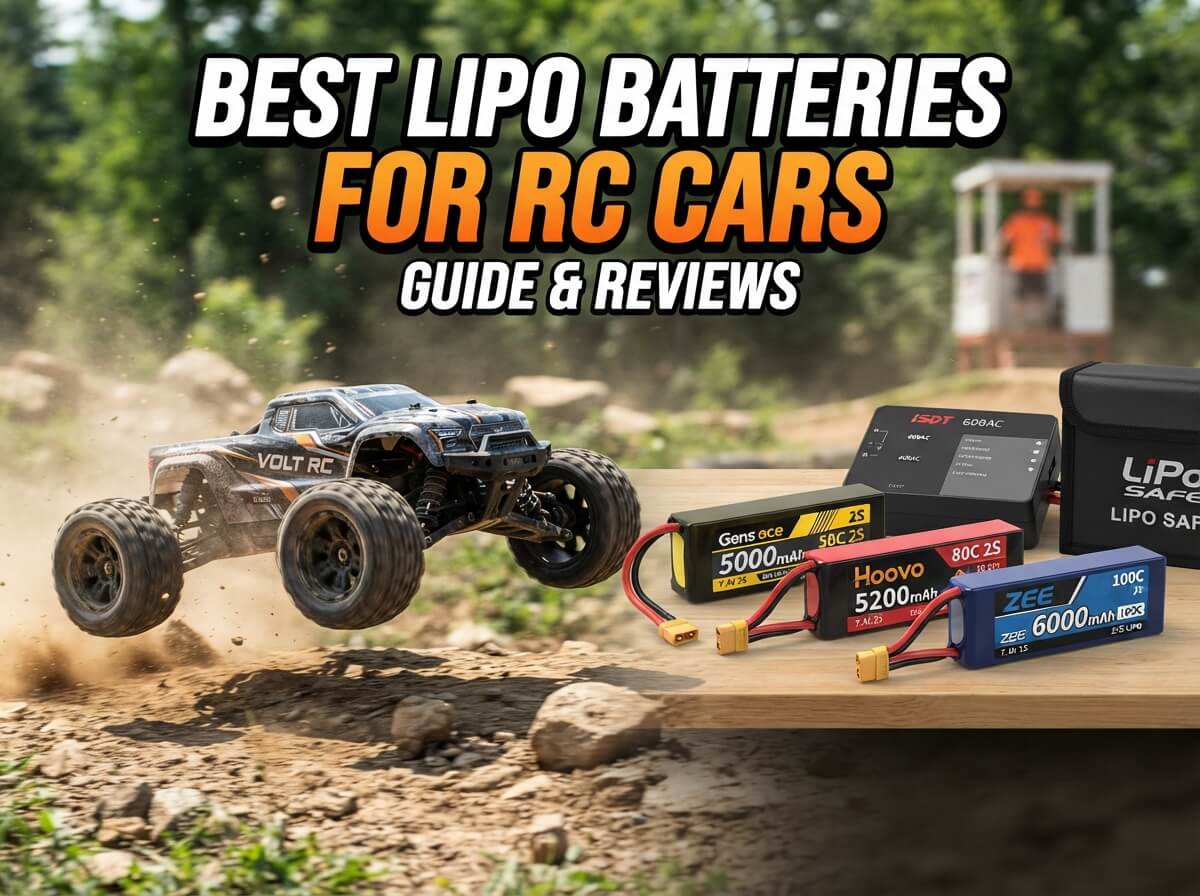
5 Best Lipo Batteries for RC Cars In 2026
If you race RC cars or just bash around your backyard on weekends, you already know one simple truth: your battery decides how much fun you have. A weak or mismatched lipo pack can turn a fast, punchy RC car into a sluggish brick. On the flip side, the right lipo battery gives you strong torque, long run time, and that instant throttle response every RC driver craves.
In this roundup, we are going to look closely at five popular lipo batteries that RC car owners keep coming back to. We will break down what each one does well, where it falls short, who it fits best, and how it stacks up against the others. By the end, you should have a clear idea of which pack matches your car, your driving style, and your budget.
Let’s get into it.
Why Your Lipo Battery Matters So Much
Before we jump into the reviews, it helps to know why lipo batteries get so much attention in the RC hobby. Unlike the old NiMH packs many of us grew up with, lithium polymer batteries pack more energy into a smaller size. They also discharge power faster, which is exactly what a high-speed RC car or a torque-hungry crawler needs.
A few numbers show up again and again on every lipo battery label, and they all matter:
- Voltage (S rating): This tells you how many cells are wired together. A 3S pack runs at 11.1V, a 6S pack runs at 22.2V, and so on. Higher voltage generally means more speed and power, but your motor and ESC (electronic speed control) need to support it.
- Capacity (mAh): This is basically the size of the fuel tank. A 5200mAh pack will run longer than a 3000mAh pack of the same voltage.
- Discharge rate (C rating): This number tells you how fast the battery can safely release its stored energy. A higher C rating means the battery can handle bigger power spikes without sagging or overheating.
- Connector type: EC5 and XT60 are the two most common connectors you’ll see on RC car batteries. They are not interchangeable without an adapter, so this detail matters when you’re shopping.
With that groundwork out of the way, let’s look at the actual batteries.
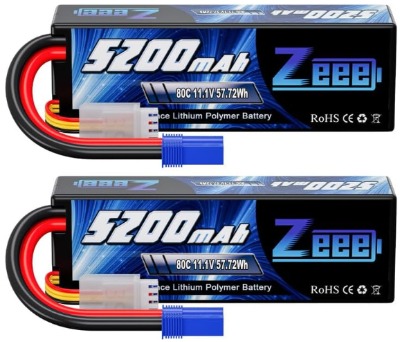
1. Zeee 3S Lipo Battery 5200mAh 11.1V 80C Hard Case (EC5 Connector, 2 Pack)
Product Description
This is a classic 3S hard case lipo battery, and it’s one of the most common configurations you’ll find in the RC world. Running at 11.1V with a 5200mAh capacity and an 80C discharge rating, this pack is built for RC cars, trucks, boats, and even smaller drones or heli setups. It ships in a two-pack, which is a nice touch since most RC drivers like to keep a spare charged and ready so downtime between runs stays short.
The hard plastic case adds a layer of physical protection that soft pack batteries don’t have. That matters a lot if your car takes hard hits or rolls over during a bash session.
Best Use Cases
This battery works well in 1/10 and 1/8 scale RC cars and trucks, especially models that already run a 3S setup out of the box. It’s also a solid pick for RC boats and mid-size drones, though most buyers will use it for ground vehicles.
Key Features Explained Simply
- 80C discharge rating: In plain terms, this means the battery can push out power quickly without losing performance. For an RC car, that translates to strong acceleration and steady power under load, even during hard cornering or when climbing over obstacles.
- Hard case design: The rigid outer shell protects the delicate battery cells inside from punctures and crush damage, which is common during rough driving or crashes.
- EC5 connector: A larger, higher-current connector that handles the power draw of bigger motors without heating up or wearing out quickly.
- 5200mAh capacity: Gives you a decent run time for casual bashing sessions, typically somewhere in the range of 10 to 20 minutes depending on your driving style and terrain.
Real-Life Usage Insight
For someone running a 1/10 scale monster truck or basher-style car, this battery type is a familiar sight. The 80C rating gives enough headroom for aggressive acceleration off the line, and the hard case holds up well against the occasional tumble down a hill or hard landing after a jump. Drivers who like to go full throttle right from the start tend to appreciate packs with a higher C rating like this one, since there’s less voltage sag under heavy load.
Pros
- Strong discharge rate handles hard acceleration well
- Hard case adds durability against crashes and rough handling
- Two-pack means less waiting around between runs
- EC5 connector supports higher current draw safely
- Good capacity for extended bash sessions
Cons
- Hard case adds a bit of extra weight compared to soft pack options
- EC5 connector may need an adapter if your car uses XT60 or Deans
- Not ideal for weight-sensitive race builds where every gram counts
Performance Discussion
In terms of raw output, an 80C 3S pack sits comfortably in the “strong but not extreme” range. It won’t out-punch a 100C+ race battery, but for everyday driving, bashing, and general fun, it delivers plenty of power without pushing your electronics too hard. The voltage stays steady even during quick bursts of throttle, which keeps your car feeling responsive from the first squeeze of the trigger to the last.
Ease of Use
Nothing complicated here. It uses a standard EC5 connector and balance lead, so it works with almost any smart charger on the market. The hard case also makes it easier to mount securely in a battery tray without extra padding.
Value for Money
Given the capacity, discharge rating, and the fact that you get two batteries, this pack offers strong value for anyone running a 3S RC car or truck. It’s a dependable, no-fuss option that suits most casual and intermediate drivers.
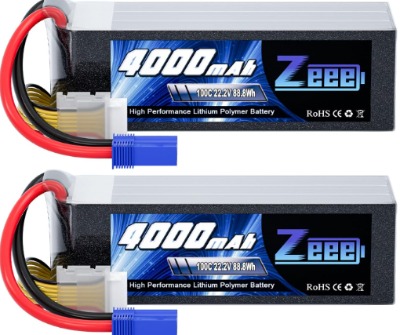
2. Zeee 6S Lipo Battery 4000mAh 22.2V 100C Soft Pack (EC5 Connector, 2 Pack)
Product Description
Stepping up in voltage, this 6S lipo battery runs at 22.2V with a 4000mAh capacity and a 100C discharge rating. It uses a soft pack design instead of a hard case, which keeps the weight down while still delivering serious power. This one is aimed at drivers who already run 6S-capable RC cars, trucks, or even larger drones and helicopters that need higher voltage input.
Best Use Cases
This battery shines in high-voltage RC trucks, bashers, and larger scale vehicles built to handle 6S power. It’s also a fitting choice for RC tanks and bigger hobby-grade drones that call for higher voltage and current output.
Key Features Explained Simply
- 22.2V (6S) output: Roughly double the voltage of a standard 3S pack, which means noticeably more top speed and pulling power, as long as your motor and ESC are rated for it.
- 100C discharge rating: This is a high number, meaning the battery can release energy very quickly without a major drop in voltage. That’s especially useful for big, torque-hungry motors that pull a lot of current at once.
- Soft pack construction: Lighter than a hard case, which helps keep the overall weight of your vehicle down. Lower weight often translates to quicker acceleration and better handling.
- EC5 connector: Rated for higher amperage, which fits naturally with the high-power nature of this battery.
Real-Life Usage Insight
Drivers running 6S trucks for extreme bashing or high-speed runs tend to notice the difference a 100C battery makes almost right away. Instead of feeling a slight lag during hard throttle application, the power comes on strong and steady. The soft pack shape is also flexible enough to fit into tighter battery trays that weren’t designed with a bulky hard case in mind.
Pros
- High voltage delivers strong speed and torque
- 100C rating supports big power draws without sagging
- Lighter soft pack design compared to hard case batteries
- Good fit for high-performance 6S vehicles
- EC5 connector handles high current safely
Cons
- Soft pack is more exposed to punctures and crash damage than a hard case
- Requires a 6S-compatible ESC and motor, so it won’t fit every car
- Higher voltage systems need extra care when charging and storing
Performance Discussion
This battery is built for drivers who want serious performance rather than casual cruising. The combination of 6S voltage and 100C discharge means your RC vehicle will have noticeably more punch off the line and better performance under load, especially on inclines or rough terrain where the motor works harder. That said, this kind of power isn’t meant for entry-level cars, so it’s worth double-checking your vehicle’s voltage rating before buying.
Ease of Use
Setup is straightforward if your car already supports 6S. The EC5 connector plugs in the same way as any other RC lipo, and the balance lead works with standard smart chargers. The main thing to keep in mind is charging time and safety practices, since higher voltage packs deserve a bit more caution during charging.
Value for Money
For the level of performance on offer, this battery is priced fairly. It’s a solid pick for hobbyists who have already invested in 6S-capable equipment and want a battery that can keep up with high-power motors.
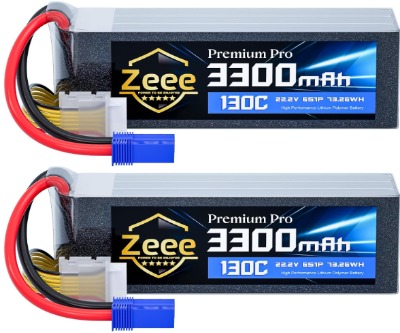
3. Zeee Premium Pro 6S Lipo Battery 3300mAh 22.2V 130C Ultra-Low IR (EC5 Plug, 2 Pack
Product Description
This is the performance-focused option in the lineup. The Premium Pro line steps up the discharge rating to 130C and uses an ultra-low internal resistance (IR) design, which is a fancy way of saying the battery loses less energy to heat and delivers power more efficiently. It runs at 22.2V (6S) with a 3300mAh capacity, trading some capacity for a much higher discharge rate compared to the previous pack.
Best Use Cases
This battery is best suited for racing-style RC cars and trucks where quick bursts of power matter more than long run time. It’s also a good match for drone racing setups and other applications where efficiency and low resistance make a noticeable difference in performance.
Key Features Explained Simply
- 130C discharge rating: A very high number in the RC world, meaning the battery can deliver an intense burst of current almost instantly, which is ideal for racing starts and sharp acceleration.
- Ultra-low internal resistance: Less energy gets wasted as heat inside the battery, so more of that stored power actually reaches your motor. This also tends to keep the battery running cooler during hard use.
- 3300mAh capacity: Smaller than the other packs on this list, which is a natural trade-off for the higher discharge rate and lighter weight.
- Soft pack, EC5 plug: Keeps weight low while supporting the high current draw that comes with a 130C rating.
Real-Life Usage Insight
For racers who care about lap times more than total run time, a battery like this makes a real difference. The lower internal resistance keeps voltage more stable throughout a run, so power delivery stays consistent even as the battery drains. Drivers switching from a standard 60C or 80C pack to this one often notice quicker throttle response and less of that “flat” feeling during hard acceleration.
Pros
- Very high discharge rate suited for competitive racing
- Low internal resistance improves efficiency and reduces heat buildup
- Lighter weight thanks to lower capacity and soft pack design
- Consistent power delivery even as the charge drops
- Two-pack keeps you race-ready with a backup on hand
Cons
- Lower capacity means shorter run time compared to bigger packs
- Higher price point due to the premium build and low-IR cells
- Best suited for performance driving rather than casual, long bashing sessions
Performance Discussion
This is where the battery really stands out. The 130C rating combined with ultra-low internal resistance means your car gets a burst of consistent, strong power right when you need it, particularly during starts, overtakes, or quick direction changes. The trade-off is capacity, so if you’re looking for long cruising sessions, this isn’t the pack for that job. It’s built for short, intense bursts of performance rather than all-day bashing.
Ease of Use
Just like the other Zeee packs, this one uses a standard EC5 plug and balance lead, so charging and setup stay simple. The main extra step is making sure your charger settings match the 6S configuration and capacity so charging stays safe and efficient.
Value for Money
The price sits higher than a standard 6S pack, but that’s expected given the low-IR cells and high discharge rating. For serious racers, the performance gain is worth the extra cost. For casual drivers who just want a reliable everyday battery, a standard 6S pack might make more financial sense.
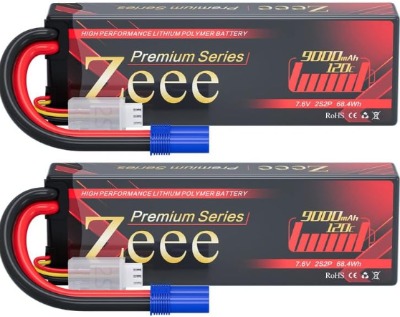
4. Zeee Premium Series 2S Lipo Battery 9000mAh 7.6V HV-Lipo 120C Hard Case (EC5 Connector, 2 Pack)
Product Description
This battery takes a different route. Instead of chasing high voltage, it focuses on capacity and high-voltage (HV) cell chemistry within a 2S setup. Running at 7.6V with a massive 9000mAh capacity and a 120C discharge rating, this hard case battery is designed for vehicles that use a 2S configuration but still demand strong performance and long run time.
Best Use Cases
This pack fits nicely into 1/10 scale RC cars and trucks that run a 2S system, especially short course trucks, buggies, and touring cars. It’s also a strong option for drivers who want longer run times without stepping up to a higher voltage setup.
Key Features Explained Simply
- HV-Lipo (High Voltage) cells: These cells are built to safely charge to a slightly higher voltage per cell than standard lipo cells, which squeezes out extra performance without changing the overall S rating.
- 9000mAh capacity: A very large fuel tank for a 2S pack, translating into noticeably longer run times between charges.
- 120C discharge rating: High enough to support quick, punchy acceleration even with the larger cell size.
- Hard case design: Adds protection against impacts, which pairs well with the more compact, high-torque nature of many 2S vehicles.
Real-Life Usage Insight
Owners of 2S short course trucks and touring cars often look for a pack that can go the distance without sacrificing punch, and this is exactly where a high-capacity 2S battery like this one earns its keep. Because of the HV cell technology, performance stays strong even as the charge starts to drop, so you don’t get that sudden power drop-off partway through a run that some standard 2S packs suffer from.
Pros
- Long run time thanks to the large 9000mAh capacity
- HV-Lipo cells add extra performance within the 2S voltage class
- 120C rating supports strong acceleration despite the larger cell size
- Hard case protects against impact damage
- Great fit for drivers who want fewer battery swaps during a session
Cons
- Heavier than most 2S packs due to the large capacity and hard case
- Only fits vehicles designed for 2S power, so it won’t work as a straight swap for 3S or 6S setups
- HV chargers are required to safely take advantage of the higher voltage cells
Performance Discussion
The standout trait here is endurance combined with steady power delivery. Most 2S batteries in this capacity range trade off discharge rate for size, but this pack keeps a strong 120C rating even with 9000mAh on board. That means longer bashing sessions or race heats without a major drop in performance as the battery discharges.
Ease of Use
The only extra step compared to a standard lipo is making sure your charger supports HV lipo charging profiles. Most modern smart chargers include this setting, so it’s usually just a matter of picking the right mode before you start charging.
Value for Money
Given the large capacity and strong discharge rating, this battery offers excellent value for 2S vehicle owners, especially those who hate stopping every few minutes to swap batteries. It’s a smart pick for endurance bashing and longer race formats.
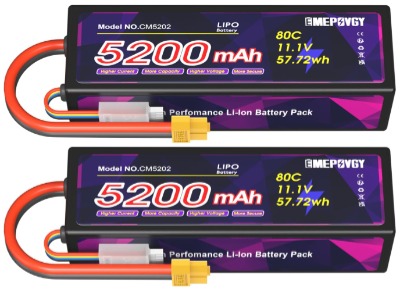
5. 11.1V Lipo Battery 3S 5200mAh 80C Hard Case with XT60 Connector (2 Packs)
Product Description
This battery closely mirrors the first pack on our list in terms of voltage, capacity, and discharge rating, running at 11.1V with 5200mAh capacity and an 80C rating in a hard case build. The main difference comes down to the connector, since this one uses an XT60 plug instead of EC5. That small detail can matter a lot depending on what your RC car came with from the factory.
Best Use Cases
This pack fits well in 1/8 and 1/10 scale RC cars and trucks that already use XT60 connectors, which is one of the most common connector types in the hobby. It works nicely as a direct replacement or upgrade battery for vehicles that came stock with a similar 3S setup.
Key Features Explained Simply
- XT60 connector: A widely used connector type known for a secure fit and reliable current handling, common across many RC car brands.
- 80C discharge rating: Delivers strong, consistent power for acceleration and cornering without major voltage sag.
- 5200mAh capacity: Provides a solid run time for typical driving sessions, striking a nice balance between size and endurance.
- Hard case protection: Shields the cells from impact, which is handy for bashers and off-road drivers who push their cars hard.
Real-Life Usage Insight
Since XT60 connectors show up on so many RC cars right out of the box, this battery tends to be an easy, drop-in option for a lot of drivers who don’t want to deal with connector adapters. The performance characteristics line up closely with other 80C 3S packs, so it delivers reliable, predictable power for everyday driving, bashing, and light racing.
Pros
- XT60 connector matches a huge range of stock RC car setups
- Strong, steady power thanks to the 80C discharge rating
- Hard case adds solid protection for rough driving conditions
- Good capacity for extended play sessions
- Two-pack keeps a backup ready to go
Cons
- XT60 connector isn’t compatible with EC5-equipped vehicles without an adapter
- Hard case adds some extra weight compared to soft pack alternatives
- Capacity and discharge rate are solid but not class-leading for serious racers
Performance Discussion
Performance-wise, this battery behaves very similarly to other 80C, 5200mAh 3S packs. It handles quick throttle input well, holds voltage steady during hard acceleration, and provides enough run time for a good chunk of driving before needing a recharge. It’s a dependable, middle-of-the-road performer that suits most driving styles.
Ease of Use
The XT60 connector is beginner friendly and widely supported by chargers and RC cars alike, which makes this one of the easier batteries to slot into an existing setup without extra parts or adapters.
Value for Money
Given the strong capacity, reliable discharge rating, and the popularity of the XT60 connector, this pack represents solid value, especially for drivers who already have XT60-equipped vehicles and don’t want the hassle of swapping connectors.
Comparison Insights: How These Five Batteries Stack Up
Looking at all five batteries side by side, a few clear patterns show up.
Voltage class: The 2S pack sits at the low end of the voltage scale, the two 3S packs sit in the middle, and the two 6S packs sit at the top. Your vehicle’s voltage rating decides which of these groups you should even be looking at, so this is really the first filter to apply before anything else.
Discharge rate: The Premium Pro 6S pack leads the group with its 130C rating, followed by the 2S HV pack at 120C, then the 6S soft pack at 100C, with both 3S hard case packs sitting at 80C. Higher discharge rates matter most for racing and hard acceleration, while more moderate ratings like 80C still handle regular bashing and driving just fine.
Capacity and run time: The 2S HV pack wins here by a wide margin with 9000mAh, giving it the longest run time on this list. The two 3S packs follow with 5200mAh each, then the 6S soft pack at 4000mAh, and finally the Premium Pro 6S pack at 3300mAh, which trades capacity for its high discharge rating.
Connector type: Four of the five batteries use EC5, while the last one uses XT60. This is purely about matching your existing setup rather than one connector being better than the other in terms of raw performance.
Weight and build: The hard case batteries (both 3S packs and the 2S HV pack) offer more physical protection but add weight. The soft pack batteries (both 6S packs) trim weight down, which can help with acceleration and handling but leaves the cells more exposed to impact.
Buying Guide: What to Check Before You Buy a Lipo Battery
Shopping for a lipo battery gets a lot easier once you know exactly what to look for. Here’s a simple checklist to run through:
Match the voltage to your car. Check your RC car’s manual or the sticker on your existing battery to confirm whether it runs 2S, 3S, or 6S. Running the wrong voltage can damage your motor, ESC, or the battery itself.
Check your connector type. Look at your current battery or ESC wiring to see if it uses EC5, XT60, Deans, or another connector style. Adapters exist, but a direct match is always simpler and safer.
Think about your driving style. If you race or push hard acceleration often, a higher C rating like 100C or 130C gives you an edge. If you mostly cruise or bash casually, an 80C pack is more than capable and often more affordable.
Balance capacity with weight. Bigger mAh numbers mean longer run times, but they also add weight, which can slow down acceleration and handling. Decide whether run time or agility matters more for how you drive.
Look at case type. Hard case batteries survive rough treatment better, which suits bashing and off-road driving. Soft pack batteries save weight, which suits racing and speed-focused builds.
Buy from a brand with clear safety ratings. Reputable lipo brands list accurate C ratings, use quality cells, and include proper balance connectors for safe charging.
Always use a lipo-safe charger. A charger built for lipo batteries includes balance charging and voltage cutoffs that protect both the battery and your RC car.
Who Should Buy These Batteries
Casual bashers and weekend drivers will likely be happiest with the standard 3S 80C packs (either the EC5 or XT60 version), since they offer a nice balance of power, run time, and durability without a big price jump.
Serious racers chasing quick lap times and sharp throttle response should lean toward the Premium Pro 6S 130C pack, since the low internal resistance and high discharge rate genuinely improve performance where it counts.
High-power truck and basher owners running 6S-capable rigs will get the most out of the 6S 100C soft pack, especially if their vehicle already calls for that voltage class.
Endurance drivers who hate constantly swapping batteries mid-session should look closely at the 2S 9000mAh HV pack, since the extended run time cuts down on downtime significantly.
Common Mistakes to Avoid With RC Lipo Batteries
Even experienced hobbyists slip up sometimes, so here are a few mistakes worth watching out for:
- Buying the wrong voltage. Always double check your car’s voltage rating before ordering a new pack. A 6S battery in a car built for 3S can fry your electronics fast.
- Ignoring connector compatibility. Ordering a battery with the wrong connector means either soldering a new one on or buying an adapter, both of which add hassle and cost.
- Charging without a balance lead. Skipping the balance connection during charging can lead to uneven cell voltages, which shortens battery life and creates safety risks.
- Storing batteries at full charge. Lipo batteries last longer when stored at a partial charge (commonly called storage voltage) rather than sitting fully charged for long periods.
- Letting the battery fully discharge. Running a lipo down to empty regularly damages the cells over time. Most ESCs include a low-voltage cutoff, so it helps to keep that setting active.
- Using a damaged battery. Puffed, punctured, or swollen lipo packs should be retired immediately rather than pushed for “just one more run.”
- Skipping a proper lipo bag or fireproof container during charging. This is a simple safety step that many beginners overlook until something goes wrong.
Final Verdict
All five of these batteries come from a trusted spot in the RC hobby world, and each one serves a slightly different purpose.
If you want an all-around dependable pack for a 3S RC car or truck, both the Zeee 3S 5200mAh 80C EC5 pack and the XT60 version are excellent, reliable choices. Pick whichever one matches your car’s existing connector.
If your rig runs 6S and you want strong everyday performance, the Zeee 6S 4000mAh 100C soft pack delivers solid power without breaking the bank.
If racing performance is your main goal, the Zeee Premium Pro 6S 3300mAh 130C pack stands out as the top performer on this list, thanks to its low internal resistance and high discharge rating.
And if long run time matters more than anything else, the Zeee Premium Series 2S 9000mAh HV pack is hard to beat, giving you extended playtime without a major performance drop-off.
At the end of the day, the best lipo battery for your RC car comes down to matching voltage, connector type, and performance needs to your specific vehicle and driving style. Any of these five packs will serve you well as long as you pick the one that actually fits your setup.

One Comment