How Long Does RC Car LiPo Battery Last?
If you’re new to the world of remote control cars, one of the first questions you’ll ask yourself is about battery life. How long will your RC car actually run before the power dies? If you’re thinking about using a LiPo battery—and you probably will be—then you need to know what to expect. Let me walk you through everything about RC car LiPo battery lifespan so you can keep your car running strong.
What Is a LiPo Battery Anyway?
Before we jump into how long a LiPo battery lasts, let’s talk about what it actually is. A LiPo battery is a lithium polymer battery. These batteries are super popular in the RC world because they pack a lot of power into a small, lightweight package. That means your RC car can move faster and run longer than it would with heavier battery types.
LiPo batteries work by storing energy through a chemical reaction. When you connect it to your RC car, electricity flows out and powers your motor. It’s that simple. The name “LiPo” comes from the materials inside—lithium and polymer. This combo makes them special because they can release energy really quickly, which is exactly what RC cars need.
You’ll find LiPo batteries in almost every high-performance RC car on the market. From small racing drones to bigger off-road trucks, people love these batteries. They’re reliable, they’re powerful, and when you take care of them properly, they last a decent amount of time.
How Long Does a Single Battery Charge Actually Last?
Here’s the real answer: a typical RC car LiPo battery charge will last between 10 to 20 minutes of active driving. But here’s the catch—that number changes based on several factors.
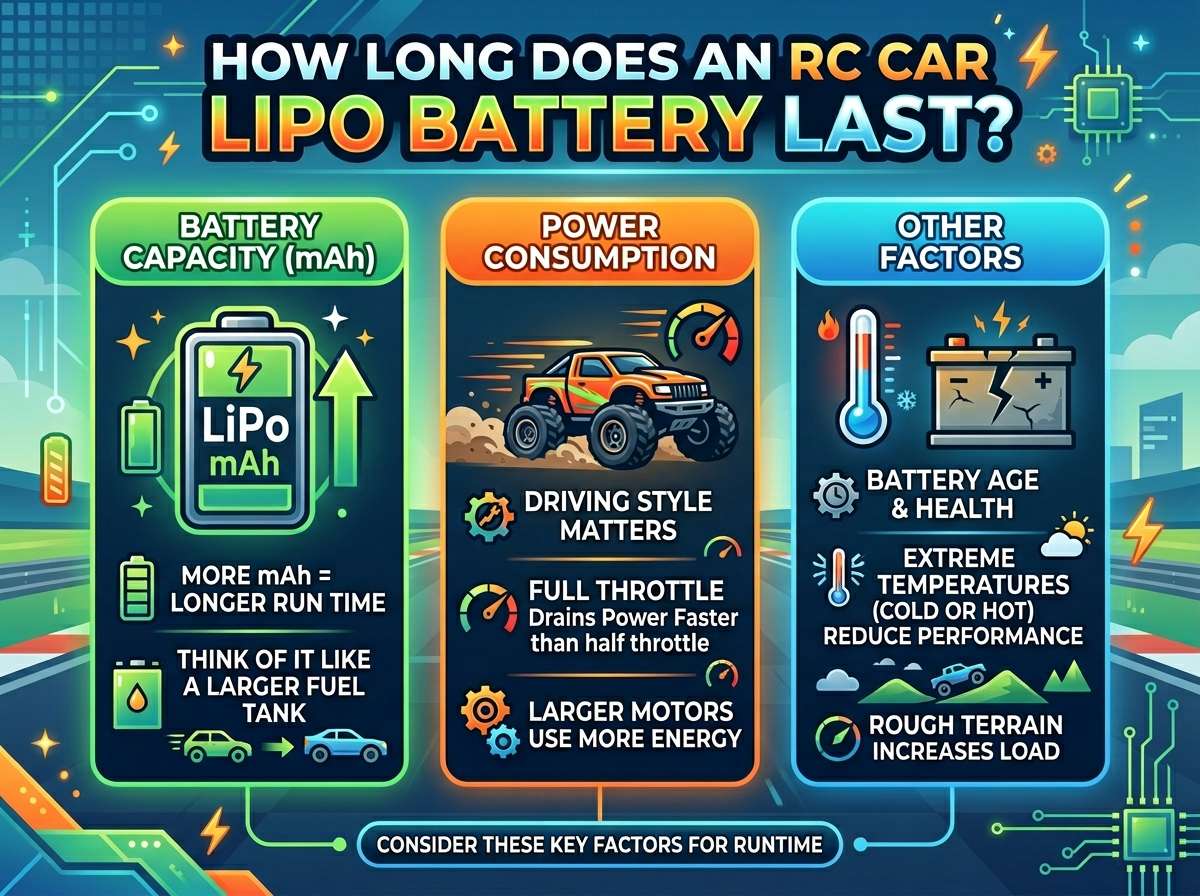
The size of your battery matters a lot. If you have a larger battery with more capacity, measured in milliamp-hours or mAh, you’ll get longer playtime. A small 1500mAh battery might only run for 10-15 minutes, while a bigger 5000mAh battery could push 25-30 minutes easily. Some people even use multiple batteries and swap them out to keep driving for hours.
The speed you’re driving at also impacts battery life. If you’re cruising slowly around your yard, the battery will last much longer. But if you’re pushing the throttle to the max and racing as fast as possible, you’ll burn through that charge much faster. High-speed driving drains batteries quickly because the motor has to work much harder.
The type of RC car you own plays a role too. A lightweight racing car will run longer on a single charge than a heavy truck doing tricks and stunts. Off-road driving, which involves going through rough terrain and climbing obstacles, eats battery power faster than smooth pavement driving.
Temperature affects battery performance as well. Cold weather makes batteries work less efficiently. Your LiPo battery will run for a shorter time on a cold day compared to a warm day. The battery cells just can’t push out energy as effectively when they’re cold.
How Many Charge Cycles Will Your LiPo Battery Handle?
Now we’re talking about the real lifespan—how many times you can charge and use a LiPo battery before it stops working properly. This is different from a single charge.
A good quality LiPo battery can handle between 200 to 1000 charge cycles. That’s a wide range, and it depends on how well you treat your battery. Some premium batteries might last even longer if you’re extremely careful with them.
What’s a charge cycle? It’s one full drain and recharge. So if you completely drain your battery and then fully charge it back up, that counts as one cycle. If you use half your battery and charge it back up, that’s only half a cycle.
Here’s something important: LiPo batteries don’t last forever, and they don’t last the same amount of time as regular alkaline batteries you might find in your TV remote. These are high-performance batteries, and they trade longevity for raw power.
The number of cycles your battery survives depends mostly on how you use it. If you store it badly, charge it wrong, or don’t maintain it, you’ll see that number drop quickly. If you treat it right, you might hit the higher end of that range.
Factors That Affect How Long Your LiPo Battery Lasts
Several things control whether your battery will last 200 cycles or 1000 cycles. Let’s go through them one by one.
Charging Practices
How you charge your battery makes a huge difference in its lifespan. Using a proper charger designed for LiPo batteries is step one. A real LiPo charger will charge each cell in your battery evenly, which keeps stress off the battery and helps it last longer.
Avoid fast charging if you want your battery to live a long life. Sure, you can charge quickly, but it creates heat and stress on the battery. Slower charging is gentler. Most people use the 1C charging rate, which means a 3000mAh battery would charge at 3 amps. This pace is safe and keeps your battery healthy.
Never overcharge your battery. Once it reaches full capacity, stop charging it. Leaving a LiPo battery on the charger for hours damages it. Most good chargers have an auto-shutoff, but don’t rely on that—stay present and remove the battery when it’s done.
Storage and Temperature Control
How you store your battery between sessions matters a lot. The best storage temperature is around room temperature, between 60 and 80 degrees Fahrenheit. Don’t leave your batteries in hot cars or cold sheds for extended periods.
Store your battery at partial charge, not fully charged. If you’re not using your battery for a few weeks, charge it to about 50 percent and keep it in a safe place. This state is easier on the battery than keeping it fully charged for long stretches.
Also, store your LiPo battery in a cool, dry spot. Moisture and heat are the enemies of battery lifespan. Some people even use special LiPo battery bags or storage boxes to keep their batteries safe and organized.
Discharge Rate and Driving Style
The harder you push your battery, the faster it wears out. Every time you drain your battery completely, it puts stress on the cells. Try to avoid running your battery all the way to zero if you can help it.
Many experienced RC drivers land their cars once the battery hits around 10-15 percent capacity. This practice extends battery life significantly. Your car will still be fun to drive, and you’re protecting your investment.
Driving style matters too. Smooth acceleration and steady speeds are easier on batteries than constant high-speed runs with quick stops and hard turns. If you’re doing tricks and stunts, you’re draining your battery faster.
Quality and Brand
Not all LiPo batteries are created equal. Cheap batteries from unknown brands might work at first, but they often fail quickly. Trusted brands that focus on RC batteries put more effort into quality control, which means longer lifespan.
When you buy a LiPo battery, you often get what you pay for. Spending a bit more on a reputable brand usually means the battery will last much longer and perform more reliably. Read reviews from other RC car enthusiasts to find the best options.
Age of the Battery
Even if you never use a LiPo battery, it gets older just sitting there. Chemical reactions happen inside the battery cells over time, even when idle. An old battery might have fewer cycles left than a new battery, regardless of how carefully you store it.
If you have an old battery that’s been sitting for years, it might not perform as well as it did when fresh. This is another reason to keep an eye on your battery’s condition and replace old ones before they fail during an important drive session.
Signs Your RC Car LiPo Battery Is Getting Old
Your battery will give you warning signs before it completely dies. Watch for these clues so you can retire the battery before it fails.
One clear sign is reduced playtime. If your battery used to run your car for 20 minutes and now it only lasts 10 minutes, the battery is losing capacity. This usually means you’re nearing the end of that battery’s life.
Another signal is slow charging speed. If your charger now takes much longer to charge your battery than it used to, the cells are probably wearing out. This is a natural part of the aging process.
Puffing is a serious warning sign you can’t ignore. If your battery pack starts to swell up or puff out, that’s a sign of internal chemical breakdown. Stop using that battery immediately. A puffed battery can catch fire or explode, so handle it carefully.
Check your voltage regularly. A healthy LiPo battery cell holds about 3.7 volts when full. If your battery voltage is dropping too low, it’s time to replace it. Many chargers show you the voltage, so check it.
How to Extend Your LiPo Battery Lifespan
You want to get the most out of your battery. Here are practical steps to make your LiPo battery last as long as possible.
Always use a quality LiPo charger, not a random charger you find. The right charger costs a little more, but it pays for itself by protecting your expensive batteries. A good charger will balance-charge your battery, which means it charges each cell evenly.
Let your battery cool down after a hard drive session. If you just finished driving your RC car fast, don’t immediately charge the battery. Give it 15-30 minutes to cool to room temperature. Hot batteries charge poorly and suffer damage from the heat.
Never drain your battery completely if you can avoid it. Land your car when the battery voltage drops to a safe level, around 2.8 to 3.0 volts per cell. This practice adds many cycles to your battery’s life.
Inspect your battery regularly for damage. Look for cracks, swelling, or any signs of physical damage. Replace damaged batteries immediately because they can fail suddenly during use.
Keep your battery away from water and moisture. Wet batteries can short out and fail instantly. Store them in dry containers and avoid driving in heavy rain if you want your battery to last.
Rotate between multiple batteries if you drive frequently. Having three or four batteries lets you spread out the cycling. Instead of running one battery to death, each battery gets lighter use, which extends the life of all of them.
Comparing LiPo Batteries to Other RC Battery Types
You might wonder if LiPo is the best choice, or if other battery types might last longer. Let’s compare.
Nickel-metal hydride batteries, called NiMH, used to be the standard for RC cars. They last more charge cycles—sometimes 500-1000 cycles—but they’re heavier and don’t pack as much power. They’re pretty much obsolete in the RC world now because LiPo batteries are so much better.
Lithium-ion batteries are another option. These are similar to LiPo batteries but have a metal casing instead of a polymer bag. They can last around 1000 cycles, which is impressive. However, they’re heavier and more expensive than LiPo batteries.
LiPo batteries sit in the sweet spot. They’re light, powerful, and reasonably priced. They don’t last as many cycles as some alternatives, but the performance advantage makes up for it. Most RC car owners choose LiPo because the trade-off is worth it.
Understanding Battery Capacity and Runtime
Battery capacity is measured in mAh, which stands for milliamp-hours. This number tells you how much energy the battery holds. A 2000mAh battery holds twice as much energy as a 1000mAh battery.
Higher capacity means longer runtime, all things being equal. If you want to drive your RC car for longer stretches without stopping to charge, get a higher capacity battery. A 5000mAh battery will keep your car running much longer than a 2000mAh battery.
You also need to consider the “C rating” of your battery. This number tells you how fast the battery can discharge energy safely. A battery with a 50C rating can release energy at a different rate than a battery with a 100C rating. High-performance RC cars need batteries with high C ratings.
The size of your battery also affects your car’s weight. A bigger battery adds weight, which affects acceleration and handling. Some people prefer smaller, lighter batteries even if it means shorter playtime. Others want maximum runtime and don’t mind the extra weight. There’s no perfect answer—it depends on what you care about most.
Real-World Battery Life Examples
Let’s look at some realistic scenarios so you understand what to expect.
A beginner with a small electric RC car might use a 3000mAh battery with a 20C rating. In normal recreational driving on smooth terrain, this battery will give about 15-20 minutes of playtime per charge. If the driver is gentle and not pushing the car too hard, they might extend it to 25 minutes. With proper care, this battery could last 300-500 charge cycles.
A serious hobbyist with a racing RC car might use a 5000mAh battery with a 50C rating. During actual racing runs lasting about 8 minutes, they could do multiple heats without the battery dying. But the high discharge rate wears the battery faster. These batteries might only last 200-300 cycles because racing is hard on them.
Someone who owns multiple RC cars and drives frequently might cycle through four different 3000mAh batteries. By spreading the load across four batteries, each one gets to rest and cool down between sessions. This approach could get 400-600 cycles out of each battery because no single battery is being overworked.
A casual driver who goes out once a month might use one battery slowly and carefully. They could stretch a battery to 600-800 cycles because the low-use rate and gentle driving style keep stress minimal.
When Should You Replace Your LiPo Battery?
The answer depends on what you’re seeing. If your battery still holds charge and performs okay, you can keep using it. But if any of these things are happening, it’s time to buy a new one.
Replace your battery if it’s puffing or swelling. This is not negotiable—a puffed battery is dangerous and should go to proper recycling immediately.
Replace your battery if it won’t hold a charge. If you charge it fully and five minutes later the voltage is already dropping, the battery cells are dead. It’s time to move on.
Replace your battery if it stops powering your car to acceptable speeds. If your RC car used to be fast but is now slow, a worn battery might be the issue. Swap in a fresh battery to see if that’s the problem. If the car runs better with a new battery, the old one should be retired.
Replace your battery if it gets physically damaged. Cracks, dents, or punctures mean the battery should be replaced before something worse happens.
Proper Disposal of Old LiPo Batteries
You can’t just throw old LiPo batteries in the trash. They contain chemicals that harm the environment, and they can catch fire in landfills.
Take your old batteries to a recycling center that handles electronics. Many places now accept LiPo batteries because they know they’re hazardous. Some RC hobby shops also take old batteries and recycle them properly.
If you can’t find a recycling center nearby, ask at your local electronics store. They often have battery recycling programs and can point you toward the right place.
Never burn a LiPo battery or try to dispose of it by throwing it in water. Both will cause fires or explosions. Be safe and responsible with battery disposal.
Tips for Getting the Most Runtime
You want to keep driving, not keep stopping to charge. Here are practical ways to maximize how long you can play with your RC car.
Buy multiple batteries in the same capacity. Rotate between them so each battery gets rest time. Your car runs longer overall, and each battery lasts longer too.
Choose a battery with higher capacity if you drive in a way that allows it. A 4000mAh battery will run longer than a 2000mAh battery, though it’s heavier. The extra weight might slow your car slightly, but you get more drive time.
Charge your batteries before they reach low voltage. Don’t wait until your car barely moves before charging—stop at 20 percent and charge then. This practice extends total battery lifespan.
Keep spare batteries charged and ready to go. Having three or four batteries means you can drive for hours by swapping them out. This spreads wear across multiple batteries and keeps the fun going.
Practice smooth driving habits. Easy acceleration and gentle turning use less battery power than hard driving. You’ll stay out longer and your battery will last longer too.
Building a Battery Management Routine
Treat battery care as part of your RC hobby, not an afterthought. A good routine keeps your batteries healthy.
Check your batteries before each drive session. Look for puffing, damage, or anything unusual. This takes 30 seconds but prevents problems.
After driving, let your battery cool to room temperature before charging. Set a timer—15 to 30 minutes is usually enough.
Charge your battery with a quality charger and stick around while it charges. Don’t walk away and forget about it. Modern chargers are safe, but attention is still the best safety measure.
Store charged batteries at 50 percent capacity if you’re not using them for more than a week. Top them up before you drive again.
Keep a battery journal or notes about each battery. Track when you bought it, how many cycles it has, and when you last charged it. This helps you know when a battery is getting old.
Organize your batteries in a cool, dry place. A plastic storage container in a closet or cabinet works great. Avoid basements that get damp or closets near heat sources.
Conclusion: Getting the Best from Your RC Car LiPo Battery
Your RC car LiPo battery will last between 10 to 20 minutes per charge, and a single battery will handle 200 to 1000 charge cycles in its lifetime. The exact numbers depend on how you drive, how you charge, and how well you maintain your battery.
The good news is that you control most of these factors. Use a proper charger, avoid overcharging, don’t let your battery get too hot or cold, and try not to drain it completely. These simple steps will keep your battery running strong for many sessions.
Invest in quality batteries from trusted brands, and get multiple batteries if you drive often. Rotating between batteries is one of the smartest moves you can make. You’ll drive longer, have more fun, and your batteries will last longer too.
Remember that battery care is just part of being a good RC car owner. Taking care of your battery takes care of your car, and it means more days out on the track or field doing what you love. So charge smartly, drive safely, and enjoy your RC car hobby to the fullest.
Peterson is an RC hobby enthusiast and product reviewer with a passion for remote-controlled cars, trucks, boats, drones, and accessories. He enjoys testing the latest RC products, comparing features, and sharing practical buying guides to help beginners and experienced hobbyists make informed decisions. Through RCThing.com, Peterson provides honest reviews, maintenance tips, and expert advice to help readers get the most from their RC adventures.