How Fast Do RC Cars Go?
If you’ve ever watched a tiny car zoom across the ground at lightning speed, you probably wondered: exactly how fast do these remote-controlled vehicles really go? The answer isn’t simple because RC cars come in so many different types and sizes. Some crawl along like a snail, while others race faster than you’d expect from something you can hold in your hand.
Let me break down everything you need to know about RC car speeds. Whether you’re thinking about buying your first RC car or you’re just curious, this guide will help you understand what to expect.
The Basic Answer: RC Cars Go Really Fast
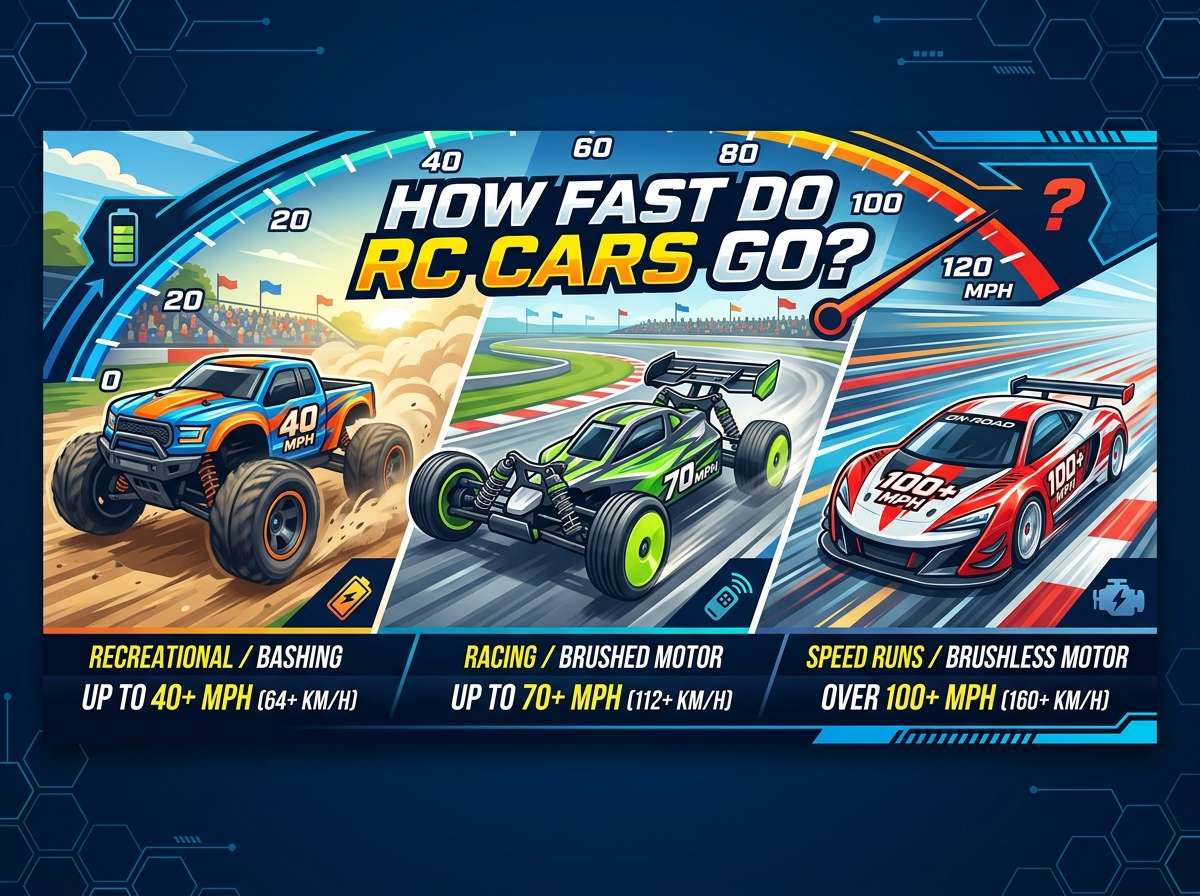
The simple truth is that RC cars can reach speeds ranging from 5 miles per hour all the way up to over 100 miles per hour. Yep, you read that right—some RC cars go faster than your neighborhood speed limit.
The speed depends on several things. The type of RC car matters a lot. The motor inside makes a huge difference. The battery strength plays a role too. Even the terrain where you drive affects how fast your car can go.
For most casual hobbyists who buy their first RC car, they’re looking at speeds between 15 and 40 miles per hour. That’s plenty fast to have tons of fun. Professional racing RC cars can hit speeds of 80 miles per hour or even faster on the right track.
The Different Types of RC Cars and Their Speeds
Not all RC cars are the same. They come in different categories, and each one has its own speed range. Let’s talk about the main types you’ll run into.
Electric Touring Cars
Electric touring cars look like real sports cars, just way smaller. These are the most common RC cars you see at hobby shops and in people’s garages. They’re designed to handle well on pavement and dirt tracks.
Most electric touring cars reach speeds between 25 and 50 miles per hour. Some high-end models can push past 60 miles per hour. These cars have a good balance between speed and control, which makes them great for learning. You won’t feel completely out of control when they hit top speed.
RC Trucks and Off-Road Vehicles
Trucks and off-road RC vehicles are built tough. They have big wheels, strong suspensions, and bodies that take a beating. You can drive them on grass, dirt, gravel, and rocky terrain.
Off-road trucks typically go about 15 to 45 miles per hour. They’re usually a bit slower than touring cars because they prioritize durability and handling rough ground. Some race trucks designed for competition can reach 60 miles per hour or more. But if you’re just having fun in your backyard, your truck probably hits around 30 miles per hour.
Drag Racing RC Cars
Drag racers are built for straight-line speed and nothing else. They’re lightweight, aerodynamic, and designed to accelerate hard for short distances. If you want pure speed, these are what you want.
Drag racing RC cars can hit 80 miles per hour or higher. Some top-tier drag racers approach 100 miles per hour. These speeds happen on flat, straight tracks. You wouldn’t want to take a drag racer on a twisty course because they don’t handle turns well.
Rock Crawlers and Scale Models
Rock crawlers are the opposite of drag racers. They prioritize climbing ability and control over raw speed. These cars move slowly and carefully through rocky terrain, mud, and obstacles. Scale models like tiny replicas of Jeeps or trucks focus on realism instead of speed.
Rock crawlers typically go 5 to 20 miles per hour. That might sound slow, but they can navigate terrain that other RC cars can’t even touch. For rock crawlers, the fun comes from the challenge, not the speed.
Nitro-Powered RC Cars
Nitro RC cars run on a special fuel mixture instead of batteries. These cars have real engines, not electric motors. Nitro cars make noise, smell like fuel, and deliver incredible raw power.
A typical nitro RC car hits speeds between 40 and 60 miles per hour. High-performance nitro competition cars can exceed 70 miles per hour. Some purpose-built nitro drag racers reach speeds comparable to electric drag racers.
What Determines How Fast Your RC Car Goes
Speed depends on many factors beyond just the type of car. Let’s look at what really controls how fast your remote-control vehicle can travel.
Motor Power
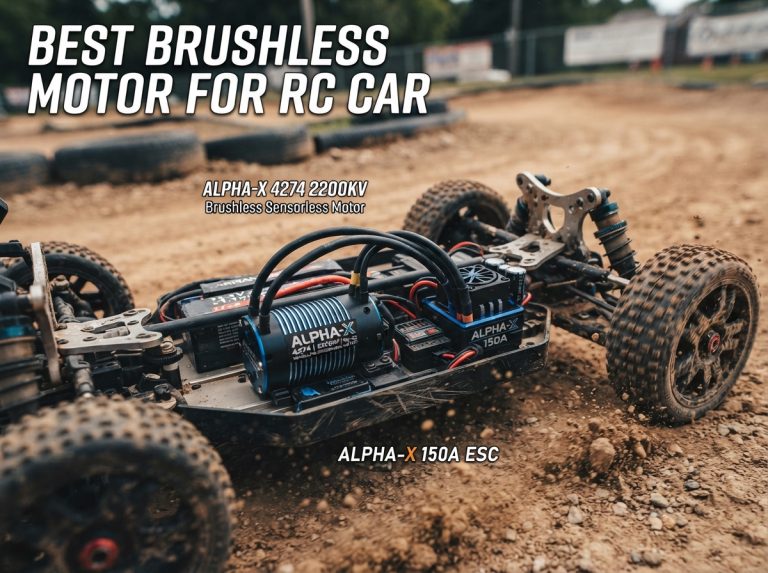
The motor is the heart of your RC car’s speed potential. More powerful motors spin faster and deliver more force to the wheels. A brushless motor typically delivers better speed and performance than a brushed motor. Brushless motors are more efficient and handle higher power better.
Most casual RC cars use brushless motors rated between 1000 and 3500 KV. That KV number tells you how many rotations per minute (RPM) the motor makes per volt of power. A higher KV number means a higher top speed. A lower KV number means more torque for climbing and accelerating.
For example, a 3000 KV brushless motor will spin faster than a 2000 KV motor. That means the 3000 KV motor car will have a higher top speed. But the 2000 KV motor might accelerate faster and handle better.
Battery and Power
Your battery gives the motor the electricity it needs. Battery voltage and capacity both affect speed. Most RC cars use 2S (7.4 volt) or 3S (11.1 volt) lithium polymer batteries.
A 3S battery gives your car more voltage, which means higher speed. A fresh, fully charged battery delivers more power than an old, tired battery. As your battery drains during driving, your RC car gets slower. This is why serious racers carry multiple batteries so they can swap them out.
Battery capacity is measured in milliamp hours (mAh). A bigger capacity battery lets you drive longer and maintain speed throughout your session. A smaller capacity battery might get you fast initial speed but fades quickly.
Gearing
Gearing is like the transmission in a real car. The gears in your RC car determine how much power goes to the wheels and how fast they turn. Different gear setups create different speed profiles.
“Locked” gearing means you maximize top speed. You sacrifice acceleration and handling. “Unlocked” gearing means better control and acceleration but lower top speed. Most beginner RC cars come with factory gearing that balances speed with drivability.
Terrain and Surface
Where you drive your RC car seriously impacts its speed. Smooth pavement lets RC cars reach their maximum speed. A well-groomed dirt track comes in second. Rough terrain, grass, and gravel slow things down because they create more friction and resistance.
Wind also plays a role on open tracks. A strong headwind slows your car down. A tailwind helps it go faster. This is why indoor tracks give more consistent speed measurements.
Weight and Build
A lighter car accelerates faster and reaches higher top speeds. Weight comes from the body, chassis, battery, and electronics. Some racers strip unnecessary parts to reduce weight. A heavier car built for durability will be slower than a lightweight racing version.
Aerodynamics
Aerodynamic design becomes important at higher speeds. Sports car bodies cut through air better than boxy truck bodies. Spoilers and aerodynamic kits reduce air resistance. This matters most for racing at 40 miles per hour and above.
Speed Comparisons You Can Understand
It helps to compare RC car speeds to things you know. A fast running person reaches about 20 miles per hour. A casual jogger goes 6 miles per hour. A bike rider averages 15 miles per hour.
Most entry-level RC cars go faster than a runner. A 30-mile-per-hour RC car is nearly as fast as a car driving through a residential neighborhood. A 50-mile-per-hour RC car matches highway traffic speed. An 80-mile-per-hour drag racer approaches highway speeds.
To put it in perspective, if you scaled an RC car up to real car size, a 40-mile-per-hour RC car would be like a 2000-mile-per-hour car in real life. It’s shocking how fast they actually are relative to their size.
Beginner RC Cars and What Speed You Can Expect
If you’re buying your first RC car, you’ll probably choose between a few popular options. Let’s talk about what speed you’ll actually get.
Budget-friendly RC cars in the $50 to $100 range typically reach 10 to 20 miles per hour. These are great for learning because they’re not too fast to control. Crashes don’t cause massive damage because the speed isn’t extreme.
Mid-range RC cars between $100 and $300 usually hit 25 to 40 miles per hour. These offer a good mix of speed and control. You still need some skill to drive them, but they’re not dangerously fast for a beginner.
High-performance RC cars over $300 can exceed 50 miles per hour. These require more experience and skill to drive well. They accelerate hard and need responsive handling to control properly.
RC Racing and Top Speeds
Professional RC racing has pushed speeds to their limits. In racing competitions, you’ll find seriously fast vehicles.
1:10 scale touring cars dominate RC racing. The fastest racing cars hit 70 miles per hour on road courses. Track records keep improving as motors, batteries, and technology advance.
1:8 scale nitro vehicles used in competitions regularly exceed 60 miles per hour. The most powerful ones push toward 80 miles per hour.
1:5 scale vehicles are the largest class and can reach incredible speeds. Some 1:5 scale RC cars have hit speeds over 100 miles per hour.
Drag racing RC cars represent the extreme. These purpose-built vehicles prioritize acceleration and top speed. The fastest drag racing RC cars approach 150 miles per hour in controlled conditions. These speeds only happen on flat, straight tracks with professional drivers.
Factors That Slow Down Your RC Car
You can also think about what makes your RC car slower than its maximum potential. Understanding these factors helps you keep your car running at its best.
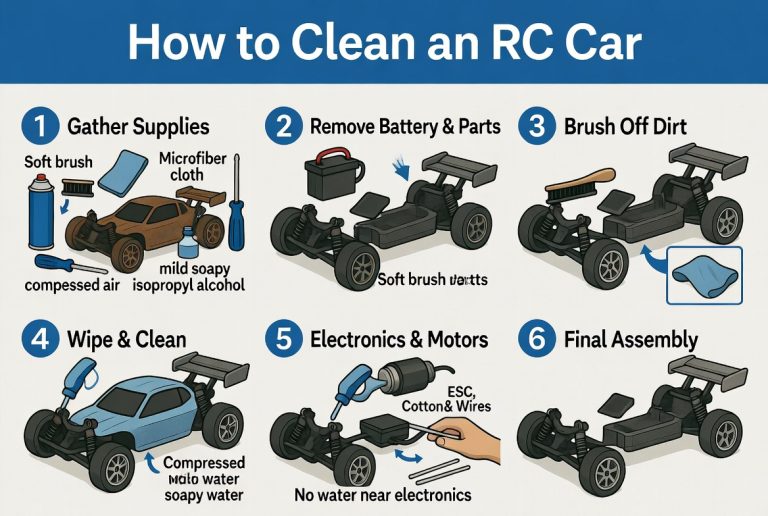
Dirty wheels lose traction and slow your car down. Clean wheels help your car maintain speed. Dust and mud building up in the motor reduces efficiency. Regular cleaning keeps your car faster.
Bent axles create drag and friction. Bent frames affect handling and top speed. Properly maintained cars run faster than neglected ones.
Low battery voltage kills speed fast. A second or third run through a battery saps the speed you had on the first run. Worn-out tires reduce traction and grip. Old rubber gets slippery and doesn’t hold the road like fresh tires.
Loose bearings reduce efficiency. Tight, smooth-running bearings let your car reach its true top speed. Dirty gears create friction. Clean gears spin faster.
How to Make Your RC Car Go Faster
If you already have an RC car and want to push its speed higher, you have options. Some upgrades are expensive, but others are cheap.
A new battery is the easiest upgrade. A fresh battery delivers more voltage and current. You’ll immediately notice your car is faster.
A higher-voltage battery adds speed. Upgrading from 2S to 3S gives a real speed boost. Just make sure your car’s electronics can handle the extra voltage.
A faster motor is the next step. Upgrading to a higher KV motor increases top speed. A 3500 KV motor is faster than a 2000 KV motor. Make sure your speed controller can handle the increased power.
Speed controllers manage motor power. An upgraded speed controller handles higher amps and delivers power more efficiently. This translates to more speed.
Aerodynamic modifications reduce drag at high speeds. A body with better aerodynamics helps your car reach higher speeds, especially on road courses.
Lighter wheels and tires reduce unsprung weight. Less weight spinning means less drag and faster acceleration. Carbon fiber parts replace heavy plastic parts.
Tighter gearing sacrifices acceleration for top speed. You change the gear ratio to prioritize maximum velocity. This is for experienced users who understand the trade-offs.
Safety Concerns with Fast RC Cars
Faster RC cars need more respect. A 50-mile-per-hour RC car can hurt you if it hits your skin or eyes. A 70-mile-per-hour RC car can cause real injury.
Always wear safety glasses when driving fast RC cars. Flying debris from crashes can cut or scratch your face. Gloves protect your hands if you catch the car or crash while holding it.
Keep your driving area clear of people. Never drive an RC car toward spectators or in crowded areas. Fast-moving RC cars are unpredictable, especially in a crash.
Drive fast RC cars on dedicated tracks when possible. Open fields or parking lots are better than crowded parks. Be aware of your surroundings.
Start slow even when you get a fast car. Don’t punch the throttle to maximum on your first drive. Get a feel for how the car handles at different speeds. Build your skill before pushing the limits.
The Fun Factor Beyond Just Speed
Speed matters, but it’s not everything. Some of the most fun RC car experiences come from things other than raw velocity.
Handling and control can be more fun than speed. A car that turns sharp and responds instantly is a joy to drive, even at modest speeds. A car that’s too fast to control feels frustrating instead of fun.
Durability matters for long-term enjoyment. A car that breaks constantly kills the fun. A tough car lets you drive hard without constant repairs.
The right track or terrain makes a difference. Racing on a challenging course with turns and elevation changes is more engaging than just going straight on pavement. Different surfaces create different challenges.
Your driving skill directly impacts how much fun you have. As your skill improves, you can tackle harder challenges and explore what your car can really do. The learning curve is part of the enjoyment.
Choosing the Right Speed for You
There’s no single “best” RC car speed. The right speed for you depends on your experience, your environment, and what you want from the hobby.
Beginners usually enjoy 15 to 30 miles per hour. That range offers thrills without overwhelming control challenges. You can still recover from mistakes at these speeds.
Experienced drivers often prefer 30 to 50 miles per hour. You need real skill to handle these speeds, but you get genuine racing experience. The challenge makes it rewarding.
Competitive racers push 50 miles per hour and beyond. These speeds require serious driving skills and quality equipment. But if you love racing and competition, the high speeds are what makes it exciting.
Casual backyard drivers might be happiest with something in the 20 to 35 miles per hour range. Fast enough to feel zippy, but forgiving if you make a mistake.
Common Questions About RC Car Speed
People ask me the same questions about RC car speed all the time. Let me address the big ones.
“Can RC cars go as fast as real cars?” At top speed, the fastest RC cars approach real car speeds. But they can’t sustain those speeds or accelerate like real cars can.
“Is a faster RC car always better?” No. A faster car is harder to control and breaks more easily. A slower car in skilled hands is more fun than a faster car you can’t handle.
“How do manufacturers measure top speed?” They typically measure top speed on a flat, smooth surface in ideal conditions with a fully charged battery. Real-world speeds are usually lower.
“Can I make any RC car go faster?” You can upgrade most electric RC cars. Nitro cars are different and require specific upgrades. Check your car’s manual to see what upgrades are compatible.
“Why is my RC car slower than the spec says?” Battery age, motor wear, friction in the drivetrain, and track conditions all reduce real-world speed compared to manufacturer specs. It’s completely normal.
The Future of RC Car Speed
RC car technology keeps improving. Motors are becoming more efficient. Batteries are getting better capacity and faster discharge rates. Controllers are smarter and more responsive.
These improvements mean tomorrow’s RC cars will be faster than today’s with the same power input. The speed ceiling keeps rising as technology advances.
Some companies experiment with hybrid powertrains combining electric motors with traditional engines. Autonomous driving features might eventually let RC cars reach their absolute maximum speed without driver limitations.
Final Thoughts on RC Car Speed
So how fast do RC cars go? The answer depends on the car, but most RC vehicles clock in between 15 and 60 miles per hour. Entry-level cars hit the lower end of that range. Racing and performance cars reach the upper end. Specialized drag racing vehicles exceed it entirely.
Speed is just one aspect of the RC car hobby. Control, durability, handling characteristics, and driving skill all matter equally or more. The best RC car for you isn’t necessarily the fastest one. It’s the one you enjoy driving most.
Start with something manageable if you’re new to the hobby. Learn the basics at modest speeds. Once you build confidence and skill, you can explore faster cars. The hobby grows with you as your interests evolve.
RC cars have been entertaining enthusiasts for decades. They’ll keep evolving and getting faster. Whether you want a leisurely cruise or high-speed thrills, there’s an RC car out there for you. The only question is which speed range fits your style best.
Now that you understand RC car speeds, you can make an informed choice about which vehicle suits your needs. Fast or slow, powerful or control-focused, RC cars deliver hours of outdoor fun and excitement. Pick your speed, hit the track, and enjoy the ride.
Peterson is an RC hobby enthusiast and product reviewer with a passion for remote-controlled cars, trucks, boats, drones, and accessories. He enjoys testing the latest RC products, comparing features, and sharing practical buying guides to help beginners and experienced hobbyists make informed decisions. Through RCThing.com, Peterson provides honest reviews, maintenance tips, and expert advice to help readers get the most from their RC adventures.