5 Best High End RC Plane Transmitter In 2026
If you fly RC planes, you already know your transmitter is the single most important tool in your hobby bag. It’s the bridge between your hands and your aircraft, and a shaky or laggy radio can turn a fun afternoon into a crash report. A great transmitter, on the other hand, feels like an extension of your arm. It responds fast, holds a strong signal, and gives you the confidence to push your flying skills further.
In this roundup, we’re digging into five radios that fliers talk about again and again: the Radiolink AT10II, the Radiolink T16D, the FLYSKY FS-i6X, the FLYSKY FS-i6, and the Spektrum iX14+. Some of these are budget-friendly workhorses that punch way above their price tag. Others sit at the high end and bring in features like voice broadcast, telemetry, and pro-level ergonomics. We’ll walk through each one in plain language, cover who they’re built for, and help you land on the right pick for your flying style and budget.
No fluff, no hype, just an honest look at what each radio does well and where it falls short. Let’s get into it.
Introduction: Why Your Transmitter Matters So Much
Think about everything your transmitter has to do. It reads every stick movement, every switch flip, every trim adjustment, and turns that into a signal your receiver understands in a split second. That signal has to travel cleanly through the air, resist interference from other pilots at the field, and stay locked on even when your plane is a tiny dot far away.
A cheap or outdated radio can introduce lag, drop signal at range, or simply feel clunky in your hands during a long flying session. That’s why RC pilots, especially those flying fixed-wing planes, gliders, and larger scale models, put real thought into their transmitter choice. Range, channel count, telemetry support, ergonomics, and build quality all come into play.
This guide covers a mix of entry-level and premium radios so you can see the full spectrum of what’s out there. We’ll compare channel counts, protocol support, screen quality, stick feel, telemetry options, and overall value. By the end, you’ll have a clear picture of which transmitter fits your flying goals, your budget, and your growth path as a pilot.
A quick note before we dive in: none of these radios are being reviewed based on personal ownership. This roundup is built from published specs, official documentation, and widely reported user experiences so you get a balanced, realistic picture rather than a sales pitch.
1.Radiolink AT10II 12CH Transmitter Review
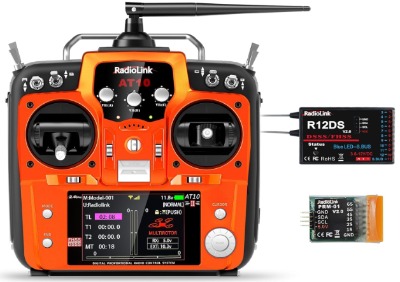
The Radiolink AT10II is one of those radios that keeps showing up in budget-conscious pilot recommendations, and for good reason. It’s a 12-channel 2.4GHz transmitter that pairs with the R12DS receiver, and it brings telemetry features that used to be reserved for much pricier gear.
Product Description
The AT10II has a boxy, no-nonsense design with a bright color screen, a set of programmable switches, and dual gimbals built for both airplane and multirotor use. It supports voltage telemetry out of the box, meaning your receiver can send back battery voltage data so you know exactly when it’s time to land instead of guessing.
It runs on Radiolink’s own protocol and works with a wide range of aircraft types, from fixed-wing trainers to quads, helicopters, cars, and boats. That flexibility makes it a solid pick if you fly more than one type of RC vehicle and don’t want a separate radio for each.
Best Use Cases
This transmitter shines for pilots flying trainer planes, sport aerobatic models, and small to mid-size FPV setups. It’s also a great match for hobbyists who fly a mix of aircraft and ground vehicles, since the mode switching and channel mixing are flexible enough to handle different vehicle types without much fuss.
Key Features Explained Simply
- 12 channels: gives you room to control flaps, retracts, lights, and other extras beyond the basic throttle, ailerons, elevator, and rudder.
- Voltage telemetry: the receiver reports battery voltage back to your screen, so you get a heads-up before your pack runs too low.
- Long range performance: the 2.4GHz signal is stable enough for typical park flying and even larger open-field sessions.
- Programmable mixes: lets you set up custom control mixes for tricky airframes like flying wings or V-tail planes.
- Model memory: stores multiple aircraft profiles so you can switch between planes without reprogramming everything each time.
Real-Life Usage Insight
Pilots flying basic trainers and mid-size sport planes tend to find the AT10II more than capable for everyday flying. The telemetry alert for low voltage is especially handy for newer pilots who sometimes lose track of flight time and end up landing on fumes. For FPV flyers, the range holds up well within typical line-of-sight flying distances, though very long-range cross-country flying might push some pilots toward a radio with a bigger antenna setup or diversity receiver options.
Pros
- Genuinely affordable for the feature set it offers
- Telemetry function adds real safety value
- Comfortable stick feel for the price point
- Works across multiple vehicle types, not just planes
- Simple menu structure that’s easy to learn
Cons
- Screen resolution feels basic compared to newer radios
- Firmware updates and support documentation can be harder to find
- Build materials feel a bit plasticky compared to premium options
- Limited third-party accessory ecosystem
Performance Discussion
In terms of raw signal performance, the AT10II holds a strong connection at typical flying distances most hobbyists will ever need. Latency is low enough that you won’t feel any noticeable delay between stick input and control surface movement. Where it starts to show its budget roots is in long-term durability and the overall polish of the software experience, which feels a generation behind more premium radios.
Ease of Use
New pilots tend to pick this radio up fast. The menu system isn’t overly complex, and the physical switches are labeled clearly enough that you’re not constantly digging through manuals. Binding to a receiver takes just a few steps, and setting up a new model profile is straightforward even if you’ve never configured a radio before.
Value for Money
This is where the AT10II really earns its spot on this list. You’re getting telemetry, 12 channels, and solid range for a price that undercuts a lot of the competition. If you’re building your first serious RC plane setup and don’t want to overspend, this radio delivers more than its price tag suggests.
2.Radiolink T16D 16 Channel Transmitter Review
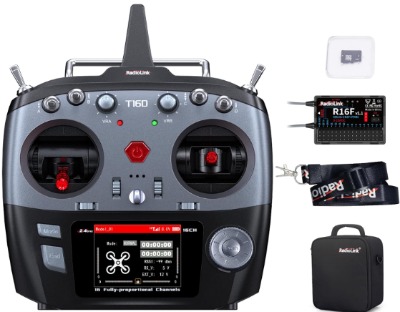
The T16D sits higher up in Radiolink’s lineup and brings in some genuinely advanced tech, including support for Nano ELRS, voice broadcast, and a bigger channel count. It’s built for pilots who want long-range performance without stepping into premium territory.
Product Description
The T16D pairs with the R16F telemetry receiver and supports up to 16 channels, giving you plenty of room for complex airframes with retracts, flaps, lights, and camera gimbal control. The standout feature here is ELRS support through a nano module, which is known in the FPV community for excellent long-range link quality and low latency.
Voice broadcast is another feature that sets it apart. The radio can literally speak out telemetry data like battery voltage or signal strength through a built-in speaker, so you don’t have to glance down at the screen mid-flight.
Best Use Cases
The T16D is a strong match for pilots flying long-range FPV planes, larger scale aircraft with multiple control surfaces, and anyone who wants ELRS-level range without buying a separate dedicated ELRS radio. It also works well for glider pilots who need lots of mixing options for flaperons, spoilers, and camber changes.
Key Features Explained Simply
- 16 channels: enough room for even complex scale planes with retractable gear, flaps, and auxiliary functions.
- Nano ELRS support: a long-range radio link protocol that FPV pilots trust for stability at extreme distances.
- Voice broadcast: spoken alerts for telemetry data so your eyes can stay on the aircraft instead of the screen.
- Telemetry receiver (R16F): sends back live flight data including voltage, signal strength, and more depending on your setup.
- Customizable mixing and logic switches: gives advanced pilots deep control over how each channel behaves.
Real-Life Usage Insight
Pilots who fly long-range FPV wings often gravitate toward the T16D because ELRS support genuinely extends usable range compared to standard 2.4GHz-only radios. The voice broadcast feature gets a lot of praise from pilots who fly in bright sunlight, since screen glare can make small telemetry text hard to read mid-flight. Having the radio announce battery percentage out loud solves that problem completely.
Pros
- ELRS support brings serious long-range capability
- Voice broadcast is a genuinely useful safety feature
- High channel count handles complex airframes with ease
- Strong value compared to similarly specced premium radios
- Good ergonomics for extended flying sessions
Cons
- Menu system has a steeper learning curve than simpler radios
- ELRS setup requires a bit of technical comfort, especially at first
- Firmware updates sometimes need extra research to get right
- Not as widely supported by third-party accessory makers as bigger brand names
Performance Discussion
Signal performance is where the T16D really stands out on this list. With ELRS engaged, latency stays low and the link holds firm even at distances that would cause standard protocols to start glitching. For pilots pushing long-range flights, this radio offers a noticeable step up from entry-level 2.4GHz-only transmitters.
Ease of Use
This isn’t the radio we’d hand to a total beginner. The sheer number of features and menu depth means there’s a real learning curve. That said, once you get past the initial setup, day-to-day use becomes second nature, and the payoff in range and feature depth is well worth the early learning investment for intermediate to advanced pilots.
Value for Money
Given that it offers ELRS-level performance, voice alerts, and a generous channel count, the T16D delivers features you’d normally expect from a much pricier radio. It sits in a sweet spot between budget and premium, making it a smart pick for pilots ready to level up without spending premium-tier money.
3.FLYSKY FS-i6X 6-10CH Transmitter Review
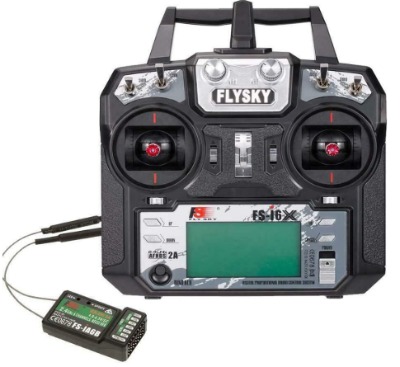
The FS-i6X is an upgraded version of FLYSKY’s hugely popular i6 line, and it’s become something of a go-to recommendation for pilots stepping up from a true beginner radio without jumping into premium pricing.
Product Description
The FS-i6X ships with default 6-channel support but can be expanded up to 10 channels, giving you room to grow as your flying skills and airframe complexity increase. It uses the AFHDS2A protocol and pairs with the FS-iA6B receiver, which supports telemetry feedback like voltage readings.
The transmitter itself has a clean, simple layout with a small LCD screen, physical switches, and dual gimbals suited for both fixed-wing and multirotor flying.
Best Use Cases
This radio fits pilots moving up from a very basic starter transmitter who want more channels and telemetry without overspending. It’s a great match for trainer planes, small aerobatic models, and simple FPV builds where 10 channels is plenty of room to work with.
Key Features Explained Simply
- Expandable channel count: starts at 6 but can be pushed to 10, so the radio grows with your needs.
- AFHDS2A protocol: a reliable, well-tested 2.4GHz protocol known for stable performance.
- Telemetry-ready receiver: the FS-iA6B can report back voltage data for basic flight safety monitoring.
- Lightweight, compact body: easy to hold for long flying sessions without wrist fatigue.
- Firmware flexibility: supports community firmware updates that add extra features for tech-savvy users.
Real-Life Usage Insight
Pilots flying basic to mid-level trainer planes and small sport aircraft tend to find the FS-i6X does everything they need without extra complexity getting in the way. It’s a common pick for people building their second or third plane after outgrowing an ultra-basic starter radio. Range and reliability at typical park-flying distances are consistently reported as solid.
Pros
- Very affordable for a telemetry-capable radio
- Simple, intuitive layout that’s easy to learn
- Reliable AFHDS2A signal performance
- Lightweight and comfortable for long sessions
- Active community support and firmware options
Cons
- Basic screen and interface feel dated next to newer radios
- Channel count tops out lower than mid or premium tier options
- Build quality is functional but not especially rugged
- Limited advanced mixing options for complex airframes
Performance Discussion
For everyday flying at normal field distances, the FS-i6X performs reliably without noticeable lag or dropouts. It’s not built for extreme long-range flying, but for the vast majority of park flyers and trainer pilots, it covers the bases well. Signal stability has earned it a strong reputation among budget-focused fliers.
Ease of Use
This is genuinely one of the easier radios on this list to pick up and start using right away. The menu is short, the switches are clearly labeled, and binding a new receiver takes just a couple of minutes. It’s a great confidence-builder for pilots who are still getting comfortable with radio setup in general.
Value for Money
At its price point, getting a working telemetry setup with an expandable channel count is a genuinely good deal. It won’t compete with premium radios on features, but for the money, it delivers reliable performance that covers most hobbyist needs.
4.FLYSKY FS-i6 6CH Transmitter Review
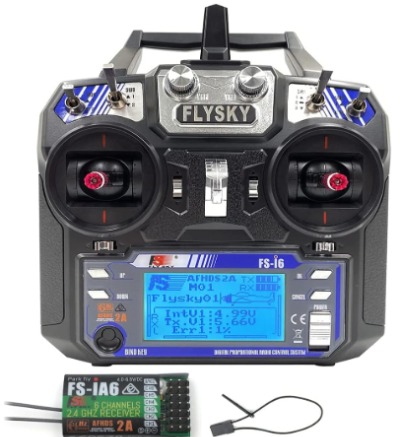
The original FS-i6 is the radio that introduced a lot of hobbyists to their first “real” transmitter after outgrowing toy-grade controllers. It’s simple, cheap, and still holds up as a dependable starter option.
Product Description
The FS-i6 is a straightforward 6-channel 2.4GHz transmitter paired with the FS-iA6 receiver. It doesn’t have telemetry support like its i6X sibling, and the channel count can’t be expanded the same way, but it keeps things simple for pilots who just want reliable basic control.
Best Use Cases
This radio is best suited for absolute beginners flying basic trainer planes, small foam gliders, or entry-level fixed-wing models that only need throttle, ailerons, elevator, rudder, and maybe one or two extra channels for flaps or landing gear.
Key Features Explained Simply
- 6 fixed channels: covers the essential flight controls without extra complexity.
- 2.4GHz AFHDS2A protocol: dependable signal performance for everyday flying.
- Simple LCD display: shows basic model info without overwhelming new users.
- Compact, lightweight design: comfortable for beginners still building hand strength and stick familiarity.
- Easy binding process: gets you flying within minutes of unboxing.
Real-Life Usage Insight
New pilots learning to fly trainer planes consistently point to the FS-i6 as an easy radio to start with because there’s simply less to think about. Fewer channels and no telemetry menu means less time spent in setup menus and more time actually flying, which is exactly what a beginner needs while building core stick skills.
Pros
- Extremely budget-friendly
- Simple enough for true beginners to learn fast
- Reliable signal for basic flying needs
- Lightweight and comfortable in hand
- Large community of users sharing setup tips
Cons
- No telemetry feedback at all
- Fixed 6-channel limit restricts future upgrades
- Basic screen with minimal information display
- Not suitable for complex or larger scale aircraft
Performance Discussion
For its intended purpose, which is teaching new pilots the basics, the FS-i6 performs exactly as expected. Signal reliability at short to mid-range distances is solid, and there’s rarely any noticeable lag during basic maneuvers. It’s just not built for pilots who need more channels or telemetry down the road.
Ease of Use
This might be the easiest radio on the entire list to learn. With only 6 channels and a simple menu, there’s very little to get confused about. It’s a genuinely great first radio for someone who has never touched a transmitter before.
Value for Money
Given how low the price point is, the FS-i6 delivers solid basic performance that’s hard to argue with for a first radio. Just know you’ll likely outgrow it once you start flying more complex aircraft or want telemetry feedback.
5.Spektrum iX14+ 14 Channel Transmitter Review
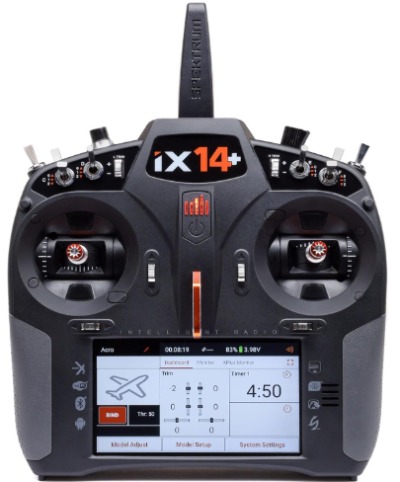
Now we get to the true premium option on this list. The Spektrum iX14+ is built for serious pilots who want pro-level ergonomics, a large touchscreen interface, and rock-solid signal performance across a huge range of aircraft types.
Product Description
The iX14+ is a 14-channel transmitter with a large full-color touchscreen display, a sleek aluminum-reinforced body, and support for Spektrum’s DSMX and AirWare telemetry systems. It’s sold as transmitter-only, meaning you’ll need a compatible receiver separately, which gives you flexibility to pair it with the exact receiver your aircraft needs.
This radio is designed with larger scale planes, complex sailplanes, and advanced multirotor setups in mind. It supports voice alerts, extensive programmable mixing, and a level of build quality that reflects its position at the top end of the Spektrum lineup.
Best Use Cases
This transmitter is built for experienced pilots flying large scale aircraft, competition sailplanes, advanced aerobatic planes, and complex multi-servo airframes. If you’re managing a hangar full of different aircraft types and want one radio that can handle all of them with dedicated profiles, this is the kind of transmitter built for exactly that.
Key Features Explained Simply
- 14 channels: plenty of room for even the most complex scale or competition airframes.
- Full-color touchscreen: makes navigating menus and model profiles fast and intuitive compared to button-only interfaces.
- DSMX protocol with AirWare telemetry: known in the hobby for excellent reliability and detailed flight data feedback.
- Voice alerts: spoken telemetry warnings so you can keep your eyes on the aircraft.
- Premium ergonomics: contoured grip, adjustable features, and a build quality meant for daily serious use.
Real-Life Usage Insight
Competition-level pilots and those flying expensive large scale aircraft tend to favor radios like the iX14+ because the reliability and telemetry depth reduce risk when flying pricier planes. The touchscreen interface makes managing dozens of model profiles far less tedious than scrolling through button menus, which matters a lot if you own several aircraft.
Pros
- Excellent build quality built to last
- Touchscreen interface is fast and genuinely pleasant to use
- Strong telemetry and voice alert features
- Reliable long-range signal performance
- Great for pilots managing many different aircraft profiles
Cons
- Premium price puts it out of reach for casual hobbyists
- Transmitter-only means extra cost for compatible receivers
- Learning curve is steeper due to the sheer depth of features
- Overkill for simple trainer planes or casual park flying
Performance Discussion
This is where the iX14+ separates itself from every other radio on this list. Signal reliability, telemetry depth, and overall responsiveness are all built to a standard that serious competition pilots expect. Latency is minimal, and the DSMX protocol has a long track record of dependable performance even in crowded RF environments at busy flying fields.
Ease of Use
The touchscreen genuinely helps here, making navigation faster than older button-and-scroll wheel radios. That said, the sheer depth of programmable features means new pilots will need time to fully learn the system. This radio rewards patience and is best suited for pilots who already have some experience under their belt.
Value for Money
You’re paying a premium price, and it’s worth acknowledging that upfront. But for pilots flying larger, pricier aircraft where reliability really matters, the build quality, telemetry depth, and long-term durability make a strong case for the investment. Casual flyers likely won’t need everything this radio offers, but serious hobbyists will get real, lasting value from it.
Comparison Insights
Here’s a simple side-by-side look at how these five transmitters stack up against each other on the things that matter most.
| Transmitter | Channels | Telemetry | Protocol | Best For | Price Tier |
|---|---|---|---|---|---|
| Radiolink AT10II | 12 | Yes (voltage) | Radiolink 2.4GHz | Trainer to sport planes, mixed vehicle types | Budget |
| Radiolink T16D | 16 | Yes (full telemetry) | Nano ELRS / 2.4GHz | Long-range FPV, complex airframes | Mid-range |
| FLYSKY FS-i6X | 6-10 | Yes (voltage) | AFHDS2A | Growing pilots, small sport planes | Budget |
| FLYSKY FS-i6 | 6 | No | AFHDS2A | Absolute beginners, basic trainers | Entry-level |
| Spektrum iX14+ | 14 | Yes (AirWare) | DSMX | Large scale planes, competition flying | Premium |
Looking at this table, a clear pattern shows up. As you move from the FS-i6 up through the AT10II, FS-i6X, T16D, and finally the iX14+, you’re basically paying for more channels, deeper telemetry, better build quality, and stronger signal range. Each step up the ladder brings real functional gains rather than just marketing fluff, which is refreshing in a hobby where spec sheets can sometimes be more hype than substance.
If range is your top priority, the T16D’s ELRS support puts it ahead of the pack for long-distance FPV flying. If build quality and pro-level polish matter most, the iX14+ is in a league of its own. For pilots on a tighter budget who still want telemetry, both Radiolink options and the FS-i6X give you strong value without the premium price tag.
Buying Guide: What to Actually Look For
Shopping for a transmitter can feel overwhelming with all the specs thrown around, so let’s break down the factors that actually matter in real-world flying.
Channel Count
Count how many functions your plane actually needs. A basic trainer only needs 4 to 6 channels. Add flaps, retracts, lights, or a camera gimbal, and you’ll want 8 or more. Buying extra headroom now saves you from needing a new radio later as your builds get more complex.
Telemetry Support
Telemetry sends flight data like battery voltage back to your transmitter in real time. This is genuinely useful for avoiding dead-stick landings and staying on top of how your aircraft is performing mid-flight. If you’re flying anything beyond basic park planes, telemetry is worth prioritizing.
Signal Protocol and Range
Different protocols perform differently at range. Standard 2.4GHz protocols like AFHDS2A work great for typical park and field flying. ELRS and other long-range protocols matter a lot more if you’re doing genuine long-distance FPV flights where standard range just isn’t enough.
Ergonomics and Build Quality
You’ll be holding this radio for hours over the lifetime of your hobby. Grip comfort, switch placement, and overall build sturdiness matter more than they might seem at first glance, especially during longer flying sessions or competition days.
Screen and Interface
A clear screen with an intuitive menu saves you real time and frustration during setup and mid-flight adjustments. Touchscreen interfaces like the one on the iX14+ tend to feel faster to navigate than older button-and-scroll systems, though they also come with a steeper price tag.
Model Memory and Mixing Options
If you own or plan to own multiple aircraft, look for a radio with generous model memory and flexible mixing options. This lets you store custom setups for each plane without reconfiguring everything every time you swap aircraft.
Battery Life and Charging
Long flying days demand solid battery performance. Check if the radio uses rechargeable internal batteries or standard AA cells, and factor that into your buying decision based on how often you fly and for how long.
Who Should Buy These Transmitters
Absolute beginners just starting out with their first RC plane should look at the FLYSKY FS-i6. It keeps things simple and affordable while you build core flying skills.
Growing hobbyists who’ve outgrown a basic radio but aren’t ready for premium pricing will find a great middle ground in the FLYSKY FS-i6X or the Radiolink AT10II, both of which add telemetry and more channels without a huge price jump.
Long-range FPV pilots chasing extended flight distances and rock-solid link quality should seriously consider the Radiolink T16D, since ELRS support genuinely changes what’s possible at range.
Serious competition pilots and large scale plane owners who need the absolute best in build quality, telemetry depth, and interface polish are the target audience for the Spektrum iX14+. It’s an investment, but one that pays off for pilots flying pricier, more complex aircraft on a regular basis.
Common Mistakes to Avoid When Buying a Transmitter
Buying based on channel count alone. More channels sound impressive, but if you’re flying a basic 4-channel trainer, paying extra for 16 channels you’ll never use just wastes money that could go toward a better plane or extra batteries.
Ignoring telemetry until it’s too late. A lot of new pilots skip telemetry to save money, then end up guessing battery levels and risking dead-stick landings. If your budget allows it, telemetry is worth the extra cost.
Overlooking receiver compatibility. Some transmitters, like the iX14+, are sold without a receiver included. Always double check what receiver you need and factor that cost into your total budget before buying.
Assuming more expensive always means better for your needs. A premium radio like the iX14+ is fantastic, but it’s genuinely overkill for someone flying a small foam trainer at the local park. Match the radio to your actual flying style, not just the spec sheet.
Skipping research on protocol compatibility. Not every receiver works with every transmitter. Before buying, confirm the protocol match so you’re not stuck with a radio that can’t talk to the receivers you already own.
Neglecting stick and switch feel. Specs on paper don’t tell you how a radio feels in your hands during a long flying session. If possible, read up on ergonomic feedback from other pilots or try a radio in person before committing, especially for premium purchases.
Final Verdict
There’s no single “best” transmitter here because the right pick genuinely depends on how you fly and what you fly. That said, here’s how we’d sum it up.
If you’re brand new to the hobby, start with the FLYSKY FS-i6. It’s cheap, simple, and gets you flying without overwhelming you. Once you outgrow it, the FS-i6X or Radiolink AT10II are natural next steps, both offering telemetry and more channels while staying budget-friendly.
For pilots chasing serious range on FPV wings or complex long-distance flights, the Radiolink T16D stands out as the smart mid-range pick thanks to its ELRS support and voice broadcast features.
And for pilots who’ve earned their stripes and want the best possible tool for flying large scale, competition-grade, or high-value aircraft, the Spektrum iX14+ is genuinely worth the premium price. Its build quality, telemetry depth, and touchscreen interface reflect real engineering, not just marketing.
Whatever you land on, remember that the best transmitter is the one that matches your current skill level and flying goals, not necessarily the one with the biggest spec sheet. Start where you’re comfortable, learn the fundamentals, and upgrade when your flying actually demands it. That approach will serve you far better than chasing the flashiest radio on the shelf right out of the gate.