How Many Channels for RC Car?
If you just bought your first remote control car or you’re thinking about getting one, you’ve probably seen the term “channels” thrown around a lot. Maybe you’re standing in a hobby shop looking at boxes that say “2-channel,” “4-channel,” or even “6-channel,” and you’re wondering what the heck that means. Don’t worry—this guide will break down everything you need to know about RC car channels in a way that actually makes sense.
What Does “Channel” Actually Mean?
Let’s start with the basics. A channel on an RC car controller is basically a separate control that sends a signal from your remote to your car. Think of it like this: if you have one channel, you can control one thing. If you have two channels, you can control two things at the same time.
The most common setup on any RC car remote is having channels for movement. The first channel usually controls your car going forward and backward, and the second channel controls it turning left and right. That’s why 2-channel cars are so popular for beginners—they give you the two basic movements you need.
When you hold that remote in your hands, every button, trigger, or dial you press sends a signal through the air to your car’s receiver. The receiver is a small piece of equipment inside your car that picks up this signal and tells the car what to do. The more channels your remote has, the more different commands you can send to your car at once.
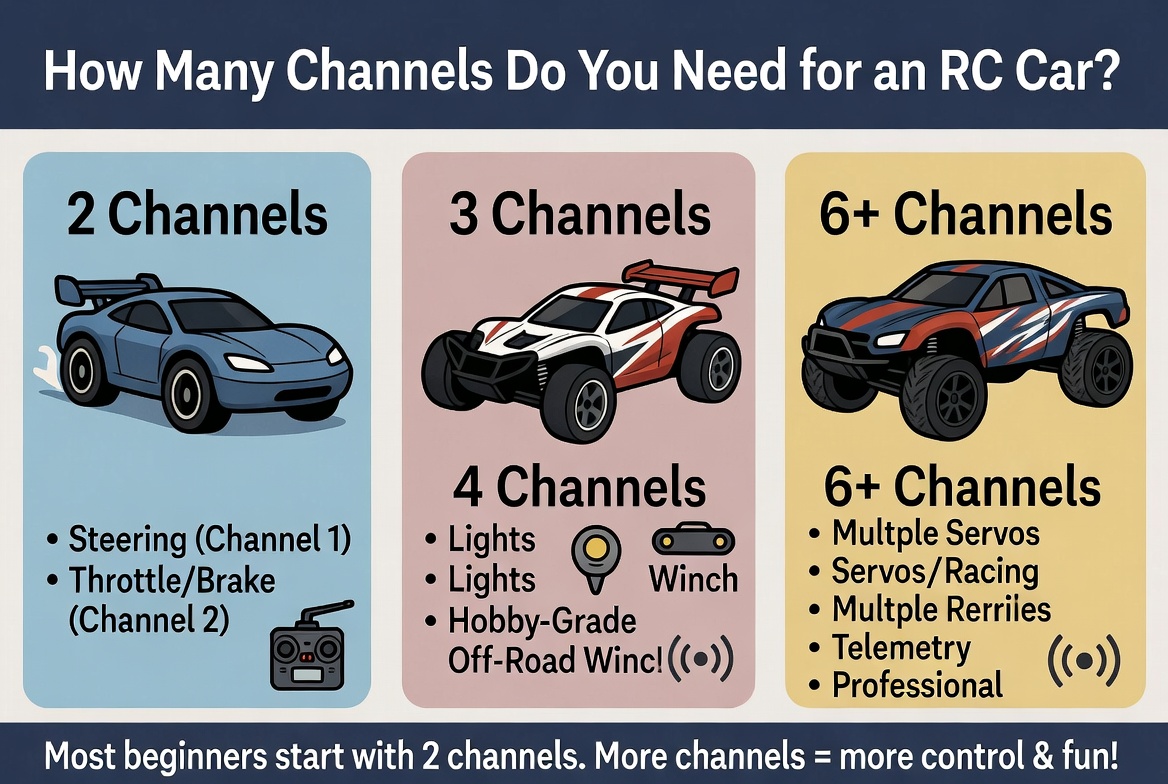
The Standard 2-Channel RC Car Setup
Most beginner remote control cars come with a 2-channel remote control system. This is the simplest setup and the most affordable option out there. With two channels, you get complete control over basic driving.
Channel 1 controls acceleration and braking. When you push forward on the throttle trigger, your car speeds up. When you pull back, it slows down or goes in reverse. Channel 2 handles your steering. Push the wheel left or the stick left, and your car turns that direction. Push right, and it goes right.
A 2-channel system is perfect if you just want to drive your RC car around for fun. You can race it, do tricks, and have a blast at a local RC track or in your backyard. The remote is simple to use, and most kids can pick it up within minutes. Adults love them too because they’re just straightforward fun without too much complexity.
The price point on 2-channel cars is also really nice. You’ll spend less money than you would on a more advanced system, which leaves more cash for spare parts, upgrades, or even buying another car to race with a buddy.
Moving Up to 4-Channel Remote Control Systems
When you start getting serious about RC cars, you’ll probably run into 4-channel systems. These are hugely popular among people who want more control and flexibility without going overboard with complexity.
With four channels, you get those basic two channels for acceleration and steering, but now you get two more channels to play with. What do these extra channels do? That depends on your car and your remote, but common uses include controlling things like on-off lights, gear shifting, power windows, or even special features like wheelie bars or hop-ups.
Many people use a 4-channel system when they want to drive more realistic models. If you’re running a scale model truck or a sports car with fancy details, those extra channels let you activate things that make your car feel more like the real deal. Some people even use the extra channels for special effects like smoke machines or electronic components.
The great thing about 4-channel remotes is that they usually use proportional controls. This means the more you push the throttle, the faster you go. The more you turn the steering wheel, the sharper you turn. This is more natural than simple on-off controls, and it gives you way more precision when driving.
A 4-channel radio system costs more than a basic 2-channel, but not tons more. If you’re going to be racing seriously or driving frequently, the extra control is worth the investment. Plus, most 4-channel remotes are compatible with a bunch of different car models, so you could use the same remote with multiple vehicles.
Stepping Into the World of 6-Channel RC Systems
Now we’re getting into more specialized territory. A 6-channel remote control system gives drivers serious control over their RC vehicles. These systems are popular with people who run crawlers, rock climbers, and more realistic scale models.
With six channels available, you can control so many different functions. Maybe channel 3 operates a winch for rock crawling. Channel 4 might control doors or a moving part on your model. Channel 5 could handle lights. Channel 6 might operate auxiliary functions. The possibilities really expand when you have this many channels to work with.
Rock crawlers and scale truck enthusiasts love 6-channel systems because those extra functions let them replicate realistic vehicle behavior. You can open doors, activate winches, turn on headlights, and control other moving parts while driving. It makes the whole experience way more immersive and fun.
The trade-off is that 6-channel remotes are more expensive and more complex. You need to program them properly, and it takes a bit more skill to set everything up correctly. But if you’re serious about the hobby, the extra control is absolutely worth it.
Beyond 6 Channels: Advanced Radio Systems
Some RC enthusiasts go even further and use systems with 8, 10, or even more channels. These high-channel remotes are typically found in the hands of serious racers, professional drivers, or people running extremely complicated models.
An 8-channel remote control system might be used for something like a big scale crawler with multiple motor controls, lighting systems, and moving parts. Some people use systems with this many channels for autonomous features or complex mechanical systems.
The reality is that most casual RC car drivers will never need more than 4 to 6 channels. If you’re just having fun cruising around, a 2-channel system is perfect. If you want more features and flexibility, go for 4 channels. Anything beyond that is for serious hobbyists who know exactly what they’re doing.
How Channels Work: The Technical Basics
Let’s talk a bit about how this whole system actually works. Your remote has a transmitter inside it. This transmitter sends out radio signals on a specific frequency. Your RC car has a receiver that picks up those signals.
Each channel uses a different part of the radio frequency to send its signal. Think of it like different lanes on a highway. Lane 1 carries your acceleration signal, lane 2 carries your steering signal, and so on. The receiver inside your car can read all these lanes at the same time and interpret what each one means.
Modern RC systems use something called frequency hopping, which means the signal jumps around different frequencies really fast. This helps prevent interference from other RC cars driving nearby. This is why you can have multiple RC cars racing at the same track without them interfering with each other.
The transmitter and receiver need to be on the same frequency, and they need to be paired together. Most modern systems come already paired, but some older systems required you to bind them yourself. This just means telling the receiver which transmitter to listen to.
The range on RC remotes varies depending on the system. A basic 2-channel remote might work up to 100 feet away. Nicer systems with better antennas can work from much farther away, sometimes even 300 feet or more. For most people driving in their backyard or at a local track, range isn’t really a concern.
Proportional vs. Digital Control: What’s the Difference?
You’ll hear people talk about proportional control and digital control. Let’s break this down because it matters when you’re choosing a remote control system.
Proportional control means that the amount you push the stick or trigger directly affects the level of the response. Push the accelerator halfway, and your car goes halfway fast. This gives you smooth, precise control over your vehicle. Most modern RC systems use proportional control, and that’s what you want.
Digital control is more basic. You either turn something on or off. The throttle is either full speed or no speed. There’s no in-between. These systems are cheaper but way less fun to drive. You can’t modulate your speed smoothly, and it’s harder to make fine adjustments.
Every decent RC car today uses proportional control. Don’t even consider digital control systems unless you’re buying the absolute cheapest toy-grade vehicle for a very small child.
Frequency Bands and Interference Issues
Different RC systems operate on different frequency bands. The most common bands are 27 MHz and 2.4 GHz. You might also see 49 MHz systems on some older cars.
The 2.4 GHz band is the modern standard. It offers better range, less interference, and more channels available than older frequency bands. If you’re buying a new RC car, it should definitely be 2.4 GHz. Don’t buy anything on the old frequency bands because you’ll run into problems if other people nearby are using RC cars.
The great thing about 2.4 GHz is that it automatically frequency hops. This means your remote constantly switches between different frequencies within the 2.4 GHz band, which prevents interference from other RC cars. You can have dozens of people racing with RC cars at the same track without any problems.
Some older systems on 27 MHz could interfere with each other if you didn’t assign them specific frequencies. This was annoying and limited how many people could race together. We’re glad that era is over.
If you’re buying a used RC car, check what frequency it runs on. Make sure it’s 2.4 GHz. Anything older might cause headaches and won’t perform as well.
Picking the Right Number of Channels for Your Needs
So how do you decide how many channels you actually need? It really depends on what you want to do with your RC car.
Go with 2 channels if you want simple fun. These cars are cheap, easy to operate, and perfect for running around your yard or a local park. Kids love them, and adults do too if they’re not interested in complex features. You get basic driving—forward, backward, left, right—and that’s it. Perfect for casual fun.
Get 4 channels if you want more flexibility. These cars let you add extra features and have more realistic driving characteristics. You get proportional control on both steering and acceleration, which feels great. If you’re going to race or drive regularly, 4 channels is the sweet spot. Not too expensive, but plenty of capability.
Consider 6 channels if you run scale models or crawlers. If you love realistic scale models or rock crawling, those extra channels give you the ability to control doors, lights, winches, and other features that make the experience more immersive. The setup is more complex, but it’s worth it if you care about realism.
Think beyond 6 channels only if you really know what you’re doing. Unless you’re running some seriously complex setup or you’re a professional driver, you probably don’t need more than 6 channels. The extra complexity isn’t worth it for most people.
Budget Considerations for Different Channel Systems
Budget matters when you’re buying an RC car, so let’s talk price. A basic 2-channel car might cost you $20 to $50. These are budget options perfect for kids or people testing the waters.
A decent quality 2-channel car might run $50 to $150. These perform better and last longer than the super cheap options.
A good 4-channel car typically costs between $100 and $300. For that price, you get better quality, more features, and a system that will last a long time if you take care of it.
High-quality 4-channel cars can run $300 to $800 or more. These are serious hobby-grade vehicles that perform great and hold up to heavy use.
Scale model crawlers and 6-channel systems start around $200 and can easily go into the thousands if you get something really nice.
The channel count doesn’t automatically determine the price, though. A cheap 4-channel car might actually cost less than a really nice 2-channel car. What matters is the quality of the components inside, the radio system, the motor, and the build quality.
The Difference Between Toy-Grade and Hobby-Grade RC Cars
This is really important to understand. Not all RC cars are created equal, and the channel count doesn’t tell the whole story.
Toy-grade RC cars are cheap vehicles meant for kids to play with. They’re made of plastic, they don’t perform great, and they break easily. Many come with basic radios that might only be 2 channels. The radio in a toy-grade car often can’t be used with other vehicles.
Hobby-grade RC cars are the real deal. They use quality motors, durable materials, and real suspension systems. They perform better, handle better, and last way longer than toy-grade cars. The radios on hobby-grade cars are usually compatible with multiple vehicles, and you can use them for years with different cars.
If you’re going to buy an RC car, skip the toy-grade stuff and go for hobby-grade. You’ll have so much more fun, and it will actually save you money in the long run because you won’t be replacing it every few months.
Most hobby-grade cars come with either 2-channel or 4-channel radios. The 4-channel systems are more popular because they offer better control and more realistic driving feel.
The Transmitter and Receiver Pairing Process
When you buy an RC car and remote together, they usually come already paired. But it’s good to know how this works in case something goes wrong or you want to pair a new receiver.
The pairing process is called binding. To bind a transmitter and receiver, you typically:
First, turn off the transmitter. Then, plug in the receiver to the car’s battery. The receiver will start flashing or beeping. Next, hold down a bind button on the receiver while turning on the transmitter. The transmitter will send out a signal asking if there’s a receiver ready to bind. Once the receiver hears that signal, it locks onto that transmitter’s frequency. The flashing light stops, and you’re good to go.
Different RC systems have slightly different binding procedures, so always check your manual. But the general process is the same across most systems.
Once bound, the receiver will only respond to commands from that specific transmitter. This is great for security and prevents interference from nearby cars.
Common Problems with RC Car Channels
Sometimes things go wrong with RC car systems. Let’s look at common issues people run into.
Intermittent signal loss happens when your car suddenly stops responding. This could be because the battery in the remote is dying, or maybe there’s interference from something nearby. Try moving away from WiFi routers or other electronic devices. Weak batteries are often the culprit, so try fresh batteries in the remote.
Slow response time means your car takes a moment to react to your commands. This could be a range issue—you’re too far away from the car. Try getting closer. It could also be a battery issue in the receiver. Make sure the battery in your car is fully charged.
The car won’t respond at all means something is wrong with the connection. Check that the receiver is getting power. Make sure the remote has fresh batteries. Try binding the remote and receiver again. If nothing works, the receiver might be broken and need replacement.
Turning or acceleration isn’t smooth could mean a broken stick or trigger on the remote. Try using the remote for another car if you have one. If it works fine with another car, your car’s receiver might need adjustment or replacement.
Most of these problems are easy to fix. Start with the simple stuff—fresh batteries, checking connections, and making sure everything is charged up.
Upgrading Your RC Car Radio System
Maybe you have a 2-channel car and you want to upgrade to 4-channel. Can you do that? Often, yes.
If you have a hobby-grade car with a removable receiver, you might be able to pull out the old receiver and install a new 4-channel receiver. You’d also need a new 4-channel transmitter. This upgrade might cost $100 to $200 depending on what you buy.
Some cars have receivers soldered directly to the main circuit board, which makes upgrades impossible. That’s another reason to buy hobby-grade cars with modular designs—you have more flexibility down the road.
When you upgrade, make sure the new receiver is compatible with your car. Check the voltage requirements and the physical size. The receiver needs to fit in your car’s chassis.
For most people, upgrading is more hassle than it’s worth. If you want more channels, just buy a new car with the setup you want. It’s often cheaper than trying to upgrade an existing vehicle.
The Future of RC Car Radio Technology
RC car technology keeps improving. We’re seeing better range, faster response times, and more reliable frequency hopping systems. The 2.4 GHz band is becoming standard everywhere, which is great for compatibility.
Some newer systems include telemetry. This means the receiver sends information back to the transmitter about things like battery voltage, motor speed, and temperature. Some advanced remotes even have small screens that display this data. It’s cool stuff, but it’s not essential for casual driving.
Lithium battery technology is also improving, which means smaller, lighter batteries in both remotes and cars. This translates to better performance and longer run times.
The fundamental concept of channels won’t change, though. Your car will always need to receive signals from your remote, and channels will always be how we organize those signals. The technology will just get better and more reliable.
Tips for Beginners Buying Their First RC Car
If you’re buying your first RC car, here are some tips to help you make the right choice.
Start with a 2-channel or 4-channel car. Don’t jump into 6 channels unless you have specific needs. Simpler is better when you’re learning.
Buy from a reputable hobby shop or established brand. Don’t get the cheapest thing at the discount store. Hobby-grade cars perform so much better than toy-grade junk.
Make sure you understand what’s included in the box. Do you get the remote? Do you get the battery? Do you need to buy these separately? Some cars need you to buy batteries and a charger separately, which can add to the cost.
Ask about spare parts. You’ll probably crash and break things when you’re learning. Make sure spare parts are available and affordable for your specific car.
Watch videos online of people driving the same model car. You can learn a lot by seeing how others use it and what they like or dislike about it.
Get extra batteries for your remote. Nothing is worse than your remote dying in the middle of having fun.
Charge your car’s battery fully before the first drive. New batteries often need to be broken in.
Start in an open area away from traffic and obstacles. Get comfortable with the controls before you try any tricks.
Summary: How Many Channels Do You Actually Need?
After reading through all this information, here’s the bottom line. For most people, a 2-channel RC car is plenty of fun. You get forward, backward, left, and right, and that’s all you need to have a blast.
If you’re more serious or you want features like lights and other extras, go for 4 channels. This is really the sweet spot for most RC car enthusiasts. You get good control, extra functionality, and the price is reasonable.
Anything beyond 4 channels is specialty territory. Unless you’re running scale models, rock crawlers, or you’re a professional driver, you don’t really need it.
The most important thing is to buy a quality hobby-grade car from a brand you trust. The channel count matters less than overall quality and your own interest in the hobby.
Get out there, buy your first RC car, and start having fun. You’ll figure out what works best for you as you drive more. The RC car community is friendly and helpful, so don’t hesitate to ask experienced drivers for advice.
Welcome to the hobby. You’re going to love it.
Peterson is an RC hobby enthusiast and product reviewer with a passion for remote-controlled cars, trucks, boats, drones, and accessories. He enjoys testing the latest RC products, comparing features, and sharing practical buying guides to help beginners and experienced hobbyists make informed decisions. Through RCThing.com, Peterson provides honest reviews, maintenance tips, and expert advice to help readers get the most from their RC adventures.