2WD vs 4WD RC Cars
If you’re new to the world of remote control cars, you’ve probably noticed that most RC vehicles fall into two main categories: 2WD (two-wheel drive) and 4WD (four-wheel drive) models. The decision between these two options might seem confusing at first, but we’re here to break it down for you in simple terms. By the end of this guide, you’ll know exactly which type of RC car works best for your needs and skill level.
What Are 2WD and 4WD RC Cars?
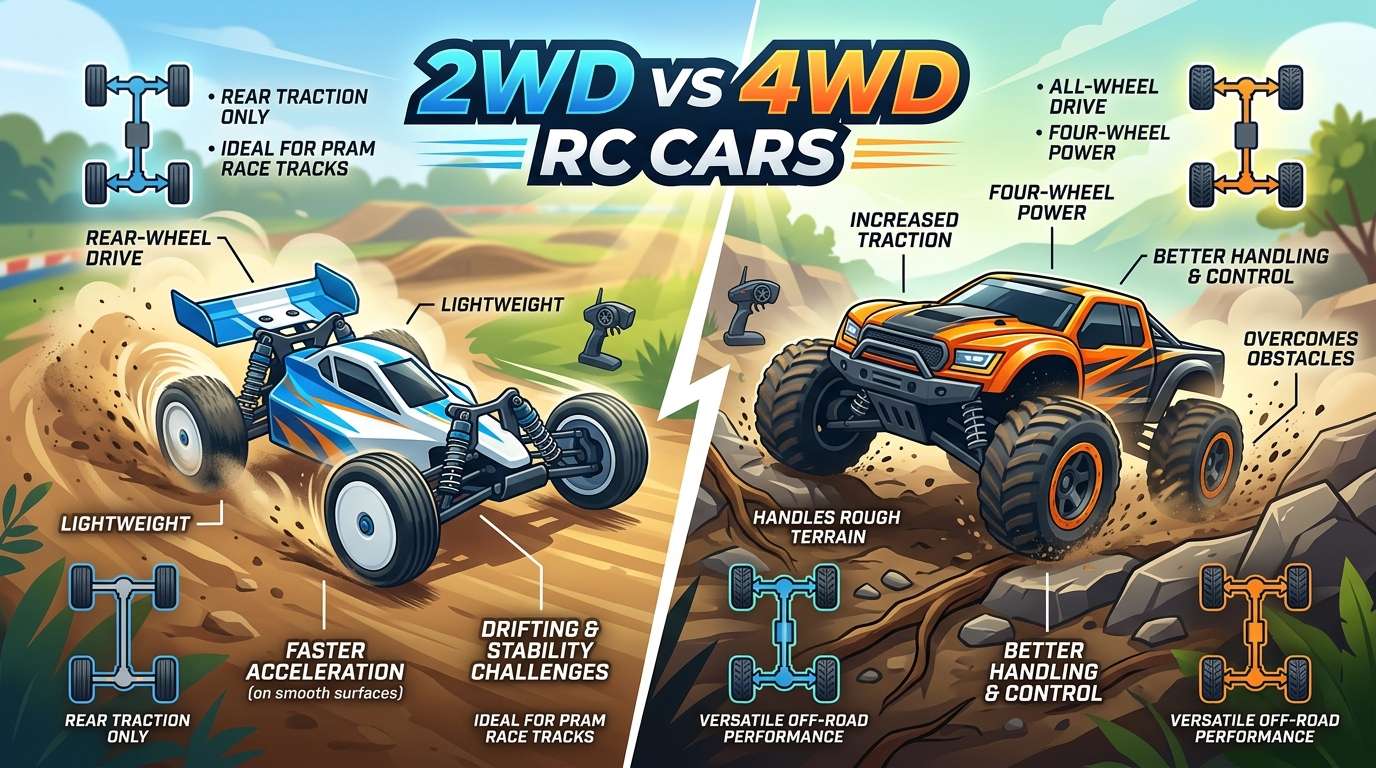
Let’s start with the basics. A 2WD RC car sends power to just two wheels—usually the rear wheels. A 4WD RC car, on the other hand, sends power to all four wheels at the same time. Think of it like the difference between a small scooter that only pushes with its back wheels and a truck that can push or pull with all four of its tires.
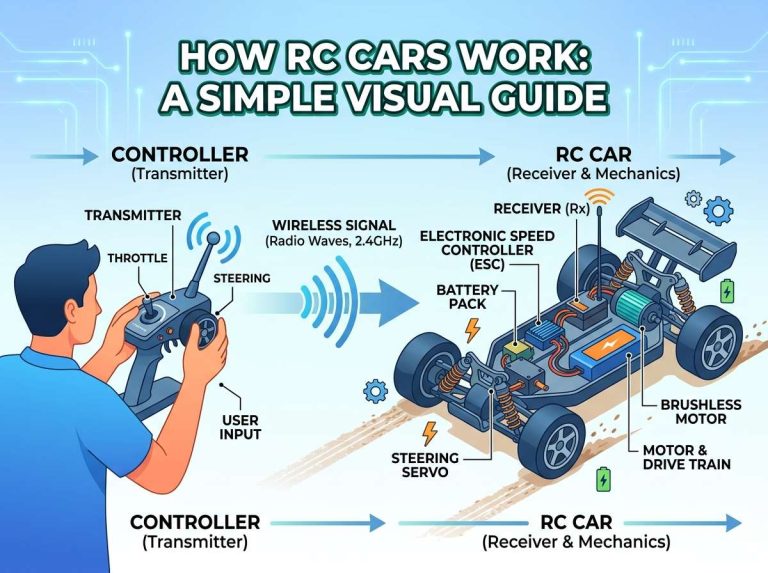
The power source in both cases is the same: an electric motor or engine running through a transmission system. The main difference is how that power gets distributed to your wheels.
In 2WD models, the front wheels only handle steering while the rear wheels do all the work pushing the car forward. In 4WD models, all four wheels work together to move the car and steer it at the same time. This fundamental difference affects how each car handles, performs, and feels when you’re driving it.
How 2WD RC Cars Work
A 2WD RC car has a simple and straightforward design. The motor connects to the rear axle through the transmission, giving those rear wheels all the power. The front wheels turn left and right for steering, but they don’t push or pull the car forward. This setup has been around for decades in the RC world, and it remains one of the most popular choices for beginners and casual racers.
The simplicity of 2WD cars makes them easier to manufacture, which means they cost less money than their 4WD cousins. With fewer moving parts and a less complex drivetrain, 2WD models are also cheaper to maintain and repair when something breaks. Parts are widely available because so many people have been using 2WD cars for so long.
One of the biggest advantages of 2WD cars is how they feel on the track or in an open space. They’re typically lighter than 4WD models, which means they accelerate faster from a standstill. Many drivers love the snappy feel of a quick 2WD buggy or truck zooming across the ground. The lighter weight also means you can take tighter turns at higher speeds compared to a heavier 4WD car.
How 4WD RC Cars Work
A 4WD RC car sends power to all four wheels simultaneously through a more complex transmission system. This means all four wheels are working to move the car forward, and all four can also help with steering and control. The front and rear differentials in a 4WD system split the power between the left and right sides, allowing the car to turn smoothly while maintaining power to all wheels.
The added complexity of 4WD systems means more parts, more opportunities for things to wear out, and higher initial costs. Parts for 4WD cars tend to cost more, and maintaining them requires a bit more mechanical knowledge. If you’re just starting out, the extra complexity might feel overwhelming at first.
However, that extra complexity comes with real benefits. The main advantage of 4WD is traction. When all four wheels are powered, your RC car can climb steeper hills, navigate rough terrain better, and maintain better control in tricky situations. If you’re planning to race off-road through dirt, mud, grass, or uneven ground, 4WD gives you a significant advantage.
Performance Differences: Speed and Acceleration
When it comes to pure speed on a flat, smooth surface, 2WD cars generally win. The lighter weight and less mechanical friction mean 2WD models accelerate faster and reach higher top speeds. If you care mostly about going fast in a straight line or racing on asphalt tracks, a 2WD car is your better choice.
2WD cars also feel more responsive in flat, smooth environments. The quicker acceleration lets you feel the immediate response when you move the throttle stick forward. This snappy feeling is one reason why many casual RC enthusiasts prefer 2WD cars for general driving.
4WD cars sacrifice some raw speed for better all-around traction and control. They accelerate a bit slower because the motor power is split between four wheels instead of two, and the extra weight of the 4WD drivetrain slows things down. However, this trade-off is worth it if you’re dealing with rough terrain, loose surfaces, or challenging driving conditions.
On off-road tracks with jumps, berms, and obstacles, a good 4WD car often outperforms a 2WD model because all four wheels maintain grip throughout a turn or over a jump. This extra traction means faster corner speeds even if the straight-line acceleration isn’t as dramatic.
Handling and Control
The way a car handles—how it responds to your inputs and how stable it feels—differs significantly between 2WD and 4WD models.
A 2WD car has a simple handling pattern. When you turn the steering wheel, only the front wheels move. This creates what drivers call “understeer” or “oversteer” depending on conditions. In loose conditions like dirt or sand, the rear of a 2WD car can slide out more easily because the rear wheels aren’t trying to follow the front wheels’ direction. For beginners, this sliding and drifting can feel fun and exciting, but it also means you need more practice to control the car smoothly.
A 4WD car handles quite differently. All four wheels work together to follow your steering input, which creates more balanced handling. A 4WD car feels more stable and predictable, especially on uneven terrain. This makes 4WD cars easier for beginners to control because there’s less sliding and less dramatic weight transfer happening.
If you want a car that forgives your mistakes and responds predictably to your inputs, 4WD is the way to go. If you love the challenge of managing a car that slides around and requires more precise control, you might prefer 2WD.
Terrain Performance: Where Each Shines
This is one of the most important factors to consider when picking between 2WD and 4WD.
2WD cars work best on smooth, hard surfaces. Asphalt parking lots, smooth dirt tracks, concrete surfaces, and carpet indoors—these environments are perfect for 2WD vehicles. The low weight and simplicity of 2WD cars make them ideal for racing on prepared tracks where the surface is consistent and relatively flat. If you plan to race on indoor carpet tracks or outdoor asphalt, 2WD is the logical choice.
However, put a 2WD car on soft, loose, or hilly terrain, and it starts to struggle. Sand, deep grass, mud, loose gravel, and steep hillsides all become challenges. The lack of traction from the front wheels and the lighter overall weight mean the car can bog down or get stuck more easily in these conditions.
4WD cars come alive in rough terrain. Mountains, rocky paths, deep grass, sand dunes, muddy areas, and rocky trails are where 4WD shines. All four wheels working together provide the traction needed to climb hills, navigate around rocks, and keep moving through soft ground. If your primary goal is to drive your RC car through nature or rough environments, 4WD is the clear winner.
For most beginners who want to drive on a mix of surfaces, 4WD is probably the safer choice because it handles more situations well. For those who know they’ll stick to smooth racing tracks, 2WD is perfectly fine and often better.
Maintenance and Repairs
The maintenance needs of 2WD and 4WD cars are noticeably different, and this affects how much time and money you’ll spend keeping your car in good shape.
2WD cars are maintenance-friendly. Fewer drivetrain components mean fewer things to clean, adjust, and fix. If something breaks, you probably have a simple repair ahead. The parts are cheaper, they’re readily available at hobby shops and online retailers, and most beginners can handle repairs with basic tools. Cleaning is straightforward too—just wash off the dirt and grime without worrying about complex components.
4WD cars need more attention. The front and rear differentials, the complex transmission, and multiple drive shafts mean more maintenance tasks after every hard-use session. Cleaning takes longer because you need to be more careful about water and dirt getting into sensitive areas. Parts are more expensive, and some repairs are harder to do yourself without advanced mechanical knowledge.
If you’re someone who loves tinkering and learning about mechanics, this extra maintenance is part of the fun. If you want to spend your time driving rather than fixing, a 2WD car requires less hassle.
Cost Considerations
Money matters, especially when you’re starting a new hobby. Let’s talk about the real costs.
2WD RC cars are less expensive to buy than comparable 4WD models. An entry-level 2WD buggy or truck typically costs less than a 4WD version. Parts are cheaper because the design is simpler and parts are made in higher quantities. If you break something, repairs won’t dig as deep into your wallet.
4WD cars cost more upfront, sometimes significantly more. The extra components, more complex manufacturing, and specialized parts drive up the price. Parts replacement is pricier, and if you need professional repairs, you might pay more for labor too.
However, the higher initial cost of a 4WD car doesn’t mean it’s a bad investment. If you plan to drive seriously and use the car frequently, the improved performance and durability might justify spending more. Plus, a good 4WD car holds its value well in the secondhand market if you ever decide to sell or upgrade.
Best For Beginners
If you’re completely new to RC cars and just want to have fun without a lot of stress, what should you buy?
For true beginners, a 2WD car is often the best starting point. It’s cheaper, easier to understand, simpler to maintain, and fun to drive. You’ll spend less money learning the ropes, and any repairs you need to make will be straightforward. The faster acceleration and snappier feel will give you an exciting first impression of RC driving.
However, if you know you want to drive off-road through grass, dirt, or other rough terrain right away, or if a friend or family member can help you with mechanical stuff, then starting with 4WD makes sense. A good 4WD kit teaches you more about mechanics and engineering, and you’ll get better overall performance in rough terrain.
The best beginner car is ultimately the one that matches where you’ll be driving it most often.
Racing: Which One Wins?
RC racing is a competitive hobby with different classes and categories, and the type of racing you want to do should influence your choice.
2WD racing is huge in the RC community. Many local clubs and competitions have dedicated 2WD racing classes for buggies and trucks. If you join a club, you’ll likely find active 2WD racing groups. The racing is tight, skill-based, and incredibly fun. 2WD cars are also cheaper to race because you spend less on the initial purchase and repairs.
4WD racing exists too, and it’s equally competitive in many areas. Some people prefer 4WD because the handling is more forgiving and you can focus on racing lines rather than managing slides and oversteer. 4WD races are often conducted on more technical terrain with obstacles, which rewards good vehicle control.
Check with local RC clubs or online communities in your area to see which racing classes are active near you. Your choice might be influenced by what’s available rather than what’s purely better.
Driving Experience and Fun
At the end of the day, RC cars are about having fun, so let’s talk about the actual driving experience.
2WD cars provide a thrilling, responsive driving experience. The quicker acceleration, lighter feel, and tendency to slide around all create an exciting sensation. If you enjoy a challenge and like the feeling of managing a car that’s eager to skid sideways, you’ll love driving a 2WD model. It feels like piloting something wild and hard to control.
4WD cars offer a more comfortable, stable driving experience. The predictable handling and better traction make you feel in control. Driving a 4WD car is less stressful because the car is less likely to surprise you with sudden spins or flips. This can be more fun if you prefer feeling completely in command of your vehicle.
Both types are genuinely fun to drive. Your preference depends on whether you want the challenge and excitement of managing a more reactive car or the confidence and control of a more predictable one.
Special Features and Modifications
Both 2WD and 4WD cars can be upgraded and modified to improve their performance. Parts like motors, transmissions, tires, and suspension components can be swapped out for better versions.
2WD cars typically have fewer upgrade options because the platform is simpler. However, you can still install a more powerful motor, lighter transmission gears, or better tires to improve performance. The upgrades tend to focus on making the car faster or easier to control.
4WD cars offer more upgrade possibilities because there are more systems to modify. You can upgrade differentials, suspension, motors, tires, and drivetrain components. The modular nature of 4WD cars means you can gradually improve your car over time by replacing one part at a time.
If you like the idea of gradually customizing and improving your RC car, a 4WD platform gives you more room to grow. If you want a simple car you can modify for speed, 2WD is easier to work with.
The Verdict: 2WD or 4WD?
So which one should you actually buy? Here’s how to decide:
Buy a 2WD RC car if: You’re on a tight budget, you plan to drive mostly on smooth surfaces like parking lots or indoor tracks, you want quick acceleration and impressive top speed, you prefer a simpler design that’s easy to maintain, and you want to get started with minimal fuss. 2WD cars are perfect for someone who wants a fun vehicle without a lot of commitment.
Buy a 4WD RC car if: You want to drive on rough terrain like grass, dirt, and hills, you prefer more stable and predictable handling, you don’t mind spending extra money for better all-around performance, you enjoy maintaining and modifying your car, and you want a vehicle that handles more real-world driving conditions. 4WD cars reward you with better traction and more forgiving control.
Tips for Your First RC Car
Once you’ve decided which type appeals to you more, keep these tips in mind:
First, buy from a reputable brand. Brands with long histories in RC racing like Traxxas, HPI Racing, and Team Associated make reliable cars that hold their value. Cheaper knockoff brands might seem tempting, but they often come with poor build quality and limited part availability.
Second, invest in good batteries and a quality charger. Your RC car is only as good as its power source. Cheap batteries perform poorly and wear out quickly. A good charger prevents overcharging and extends battery life.
Third, learn basic maintenance right away. Even if you buy a 2WD car for its simplicity, knowing how to clean, lubricate, and adjust your car will keep it running beautifully for years. Watch online tutorials and don’t be afraid to ask experienced RC drivers for help.
Fourth, take time to practice driving skills before you worry about racing or showing off. Getting comfortable with the steering sensitivity and throttle control will make your experience much more enjoyable.
Finally, join an RC club or community. You’ll meet other enthusiasts, learn from experienced drivers, discover good local places to drive, and have fun with people who share your interest.
Common Questions Answered
Are 2WD cars faster than 4WD cars? On smooth, flat surfaces, yes, 2WD cars are typically faster. On rough terrain, 4WD cars often perform better overall because they maintain traction better.
How long do RC cars last? With proper maintenance, both 2WD and 4WD cars can last for years. 4WD cars might have a longer lifespan because they’re often built to more robust standards, but 2WD cars last plenty long if you care for them.
Can I race a 2WD car against a 4WD car? Usually not in official competition—different classes separate them. But for fun driving, sure, you can race any cars against each other.
Is 4WD harder to drive? Not really. 4WD is actually easier for most people because it’s more stable and predictable. 2WD requires more finesse to control.
Which is more durable? This depends on the specific model, but 4WD cars are often built more robustly. However, a quality 2WD car from a good brand will be very durable too.
Final Thoughts
The choice between a 2WD and 4WD RC car doesn’t have to be stressful. Both types offer fun, excitement, and the joy of controlling a fast-moving machine. Your decision should come down to where you’ll drive, how much you want to spend, and what kind of driving experience appeals to you.
Start with what fits your situation right now. If you’re just curious about RC cars and don’t want to spend much, grab a 2WD car and see if you love the hobby. If you want the best all-around performance and plan to drive seriously, a 4WD car is worth the extra money.
Either way, you’re in for a treat. The RC car hobby is welcoming, fun, and full of friendly people who love to help newcomers. Your first RC car—whether it’s 2WD or 4WD—is the beginning of an exciting journey. Get out there, enjoy the ride, and don’t take the decision too seriously. You really can’t go wrong.
Peterson is an RC hobby enthusiast and product reviewer with a passion for remote-controlled cars, trucks, boats, drones, and accessories. He enjoys testing the latest RC products, comparing features, and sharing practical buying guides to help beginners and experienced hobbyists make informed decisions. Through RCThing.com, Peterson provides honest reviews, maintenance tips, and expert advice to help readers get the most from their RC adventures.