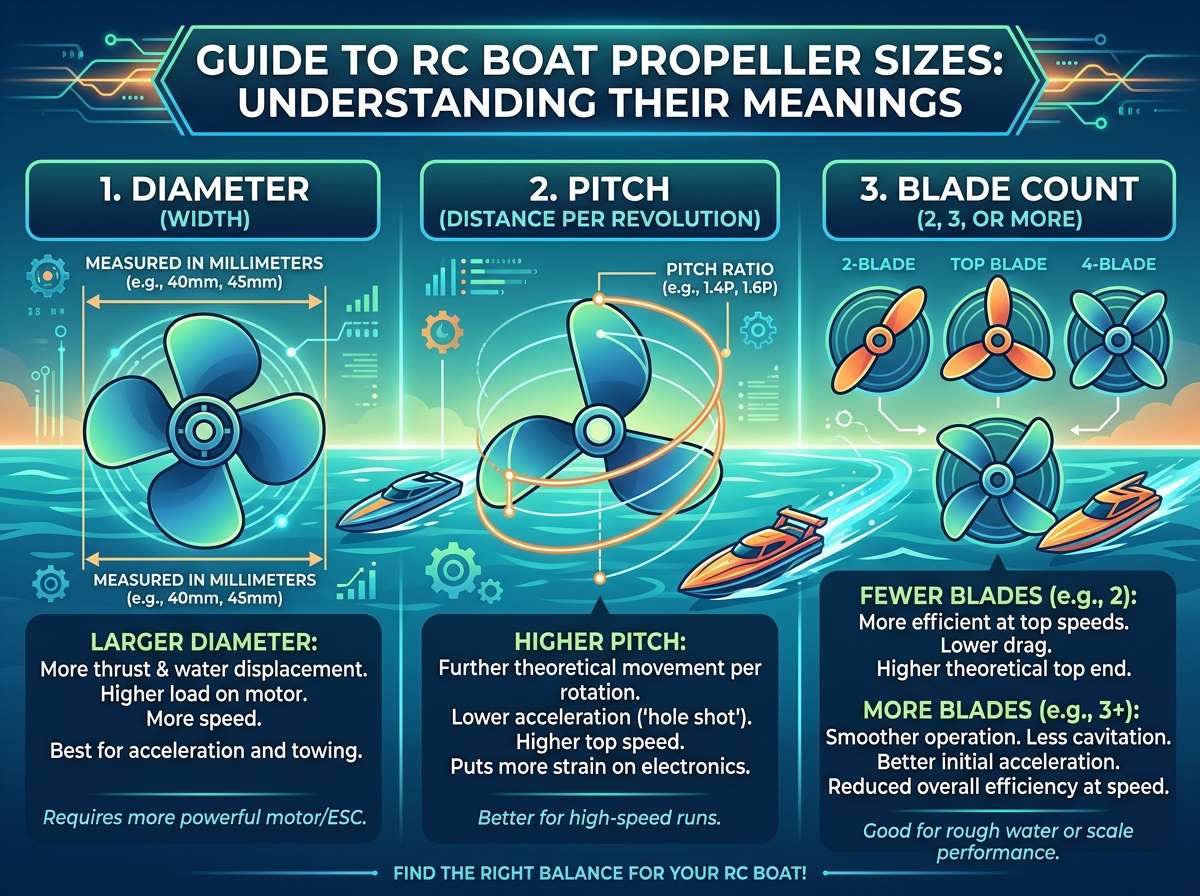
What Propeller Size Means in RC Boats?
RC boats are incredibly fun. There’s something magical about controlling a tiny vessel across water. But here’s the thing—if you want your boat to run smoothly and perform the way you expect, you need to understand propellers. Specifically, you need to know what propeller size actually means and why it matters so much for your boat’s speed, power, and handling.
This guide breaks down everything about RC boat propellers in simple terms. By the end, you’ll know exactly how propeller sizes work and why picking the right one can transform your boating experience.
The Basics: What Does Propeller Size Actually Mean?
Propeller size in RC boats gets described using two numbers. You might see something like “5 x 3” or “4 x 2.5” printed on your propeller or listed in your boat’s specifications. These numbers tell you crucial information about how your propeller will perform.
The first number is the diameter. This measures how wide the propeller is from one blade tip to the other blade tip. Think of it as how far the blades stretch out when they spin. A bigger diameter means the blades travel a longer distance with each rotation.
The second number is the pitch. This one confuses a lot of new boat owners. Pitch isn’t about the sound. Instead, it measures how far forward your propeller would move through water in one complete rotation if it didn’t slip at all. A propeller with 3-inch pitch wants to move 3 inches forward per spin. A 4-inch pitch propeller wants to move 4 inches forward per spin.
Think about it this way: if you have a gear with different teeth sizes, bigger teeth grab more. Similarly, a higher pitch propeller “grabs” more water and pushes the boat further with each turn. But grabbing more water also takes more energy from your motor.
Why Diameter Matters for Your RC Boat
Diameter affects several important things about how your boat performs. Let’s break down what a bigger or smaller diameter actually does.
More Surface Area Means More Grip
When your propeller diameter gets larger, the spinning blades cover more water. This gives your propeller more surface area to push against. Think of it like trying to move something with a small stick versus a big stick—the bigger stick can move more stuff because it’s bigger.
A larger diameter propeller grips the water harder. It moves more water with each rotation. This creates more thrust, which means more power to push your boat forward. Your boat will accelerate quicker and might reach higher top speeds.
But Bigger Isn’t Always Better
Here’s where things get interesting. Larger propellers need more energy to spin. If your motor has limited power, a huge propeller might slow down too much when it tries to spin. Your motor works harder and harder until it can’t keep up. This actually reduces your boat’s top speed instead of increasing it.
It’s like running uphill versus running on flat ground. Run uphill and you use way more energy. Your motor is the same way. Give it too much load and it slows down.
Small Propellers Spin Faster
Smaller propellers need less energy to turn. Your motor can spin them very quickly. This means your boat zooms ahead fast. But here’s the trade-off: each rotation moves less water because the blades are smaller. You might get great speed, but your boat could lose some pushing power.
Many racing boats use smaller propellers for this reason. Speed matters more than raw power. But if you’re towing something or need serious acceleration, a smaller propeller might leave you disappointed.
How Pitch Changes Everything
Pitch works differently than diameter, and understanding pitch is really important for getting your boat to run right.
High Pitch Means More Distance Per Spin
A propeller with high pitch tries to move further with each rotation. A 4-inch pitch propeller wants to go 4 inches per rotation. A 2-inch pitch propeller wants to go only 2 inches per rotation. More pitch means your boat moves faster when the propeller can actually turn.
Here’s why: high pitch propellers are like a mountain bike gear that’s meant for flat ground and speed. They want to cover distance. Your boat shoots forward with each spin.
The Pitch Problem: Your Motor Might Struggle
But here’s the catch. High pitch propellers resist spinning more than low pitch propellers. Your motor has to work harder to turn them. If your motor isn’t powerful enough, it can’t spin the propeller fast enough. Your boat crawls along instead of zooming.
This happens because the propeller is fighting your motor. It’s like your motor is trying to carry too much weight uphill. It just can’t do it fast enough.
Low Pitch Lets Your Motor Spin Freely
Low pitch propellers don’t resist spinning as much. Your motor can spin them quickly and easily. Your motor doesn’t have to work as hard. This means faster RPMs—that’s rotations per minute.
But here’s the trade-off again: lower pitch means each rotation doesn’t move your boat as far. So even though the propeller spins faster, your boat might not go as fast overall. It’s the classic speed versus power question.
Putting Diameter and Pitch Together
Now that you know how diameter and pitch work separately, let’s talk about how they work together. This is where the magic happens.
Large Diameter + High Pitch = Maximum Power
This combination gives you the most thrust and the most pushing power. Both parts are working together to move water and create force. Your boat will accelerate hard and have serious pulling power.
The downside? Your motor needs to be powerful. A weak motor can’t handle this combination. It’ll struggle like a person trying to push a car uphill. You might get disappointing speed even though the propeller is big.
Small Diameter + Low Pitch = Maximum Speed
This combination lets your motor spin the propeller as fast as possible. Each rotation happens quicker. Your motor isn’t fighting resistance. Your boat reaches top speed faster than with any other combination.
The trade-off is less thrust. If your boat needs to accelerate hard or fight waves, this setup might feel sluggish during those moments. You get speed at the cost of raw pushing power.
Medium Diameter + Medium Pitch = Balanced Performance
This is the goldilocks zone. You get decent speed and decent power. Your motor spins the propeller at a good pace without struggling too much. Your boat feels responsive and capable for most situations.
Most recreational boats use this middle ground. You’re not sacrificing too much in any direction. You get a well-rounded boat that handles lots of different water conditions.
Understanding Slip and Real-World Performance
Here’s something important that trips up a lot of people: your propeller doesn’t actually move your boat as far as the pitch suggests. Scientists call this “slip.”
Slip happens because water isn’t solid. It’s a liquid. As the propeller spins, it doesn’t push against something totally solid. Some water gets pushed but doesn’t contribute to forward movement. It’s like trying to walk on ice—your feet spin but you don’t move forward as much as you’d expect.
Real propellers typically achieve between 50% and 80% efficiency. A 4-inch pitch propeller might only move your boat 2 to 3.2 inches forward per rotation instead of the full 4 inches.
This is totally normal. It doesn’t mean something is wrong with your propeller. It just means water is a liquid and physics is complicated. High-quality propellers minimize slip through better design. That’s one reason expensive propellers sometimes cost more than cheap ones.
How Motor Power Affects Propeller Choice
Your motor is the engine that spins your propeller. If your motor is weak, it limits what propeller you can use effectively. If your motor is powerful, you have more choices.
Weak Motors Need Smaller Propellers
A weak motor can’t handle large, high-pitch propellers. The motor can’t spin them fast enough. You’ll get better performance with a smaller, lower-pitch propeller. Your motor can spin it quickly and get your boat moving.
It’s like having a bicycle motor versus a car engine. The bicycle motor works great with a light load but struggles with a heavy load. Give it something light and it zooms along.
Powerful Motors Can Handle Large Propellers
A beefy motor can turn large, high-pitch propellers without trouble. It has the muscle to spin them at good RPMs. You get the benefit of more water being pushed with each rotation. Your boat gets serious acceleration and speed.
A powerful motor is like a truck engine. It can handle heavy loads and still perform well. Give it a powerful propeller and it shines.
Balancing Speed and Thrust for Different Boat Types
Different boats need different things. A racing boat has totally different needs than a cruising boat or a towing boat.
Racing Boats Want Speed
Racing boats go all-in on speed. They use smaller diameter propellers with lower pitch. The motor can spin these propellers incredibly fast. Speed is everything in racing. Thrust matters less because racing boats are light and built for going fast, not for pushing heavy loads.
Racers will sacrifice power for pure speed. They want to hit maximum RPMs quickly and maintain that speed around the water.
Cruising Boats Want Balance
Cruising boats aren’t in a hurry. Comfort and stability matter more than top speed. These boats usually run medium-sized propellers with medium pitch. You get decent speed for tooling around the water without sacrificing too much thrust for handling waves and wakes.
Cruising boats are built for enjoyment, not for setting records. The propeller reflects that priority.
Towing and Heavy Boats Need Power
Boats that tow skiers or carry heavy payloads need maximum thrust. These boats use larger diameter propellers with higher pitch. The propeller moves more water with each rotation. The motor might not spin it as fast, but it doesn’t need to. The goal is pushing power, not pure speed.
Towing boats are all about that pulling power. The propeller is built for force, not for RPM.
What Numbers Are Normal for RC Boats?
Different types of RC boats use different propeller sizes. Let’s look at what’s typical.
Small RC Boats
Tiny RC boats—the ones you can hold in your hand—typically use very small propellers. You might see something like “2 x 1.5” or “2.5 x 2.” These small propellers let tiny motors spin them very fast. The boats zip around quickly despite their weak motors.
These boats are fun toys. They’re not built for performance. They’re built for play.
Medium RC Boats
Medium-sized RC boats are the sweet spot for most hobbyists. You’ll see propeller sizes like “4 x 3” or “5 x 3.5” on these boats. They’re big enough to feel substantial but small enough to handle easily.
Medium boats give you good speed and decent power. They handle in different water conditions. They’re the daily drivers of the RC boat world.
Large RC Boats
Big RC boats use larger propellers. You might see “6 x 4” or “7 x 5” propellers. These boats have powerful motors that can handle the resistance. The big propellers create serious thrust and speed.
Large boats impress people. They feel more realistic. They handle waves better because they’re heavier and have more pushing power.
Why Your Propeller Might Be Wrong
If your boat doesn’t feel right, the propeller might be the problem. Here are the signs that you’re running the wrong size.
Your Boat Is Too Slow
If your boat feels sluggish even though the motor sounds healthy, you probably have a propeller that’s too large or has pitch that’s too high. The motor is working hard to spin it but can’t turn it fast enough. Your boat doesn’t reach the speed it should.
Try a smaller diameter or lower pitch. Give your motor an easier job and watch your speed improve.
Your Boat Won’t Accelerate
Acceleration problems usually mean low pitch. The propeller spins quickly but doesn’t push hard. Your boat has speed but no punch. It feels weak when you try to accelerate or climb waves.
Try higher pitch. Give your propeller more bite. Your boat should feel more responsive.
Your Motor Gets Too Hot
An overheating motor is crying for help. Usually it means the propeller load is too high. Your motor is working way too hard. It’s burning up from the effort.
Switch to a smaller propeller or lower pitch. Let your motor breathe. An overheated motor will fail if you don’t fix this.
Your Motor Won’t Spin the Propeller Fast Enough
Sometimes a motor just won’t get the propeller to decent RPMs no matter what you do. The propeller load is too much. Your motor lacks the power.
Again, try smaller diameter or lower pitch. You need to reduce the load on your motor.
How to Find the Right Propeller for Your Boat
Finding the right propeller takes a little work, but it’s not complicated. Here’s how to do it.
Start with Your Boat’s Manual
Your boat’s manual should list recommended propeller sizes. Start there. Manufacturers test boats and include the propeller sizes that work best. They’re a good starting point.
Check Your Motor’s Specifications
Your motor has a designed RPM range. This is how fast it wants to spin. Most motors run best between 8,000 and 12,000 RPM, but this varies. Check your motor’s specs.
Your propeller should let your motor reach this RPM range at full throttle. If your motor maxes out at 6,000 RPM with your current propeller, it’s too heavy. If it screams up to 20,000 RPM, the propeller is too light.
The Trial and Error Method
You can test different propellers. Keep notes about how your boat performs with each one. Write down top speed, acceleration feel, and whether the motor sounds healthy.
After testing a few options, you’ll find the sweet spot. This is your ideal propeller.
Online Communities Are Gold
RC boat forums and communities are full of experienced people who use the same boats as you. They’ve tested propellers extensively. Ask them what they recommend. Most people love sharing their knowledge about what propellers work best.
Advanced Propeller Considerations
Once you nail the basics, you can get into more advanced territory. These details matter once you’re ready for them.
Material Matters
Propellers get made from different materials. Plastic is cheap and tough but doesn’t perform as well. Aluminum is stronger and more efficient. Composite materials offer the best of both worlds in many cases.
Better materials mean better performance. They cost more but last longer and work better.
Blade Design and Shape
Propeller blades aren’t all shaped the same. Some are more curved. Some are flatter. Shape affects how water flows around the blade. Better-designed blades push water more efficiently.
Premium propellers have better blade design. They perform better than cheap knockoffs.
Cupping and Raking
Advanced propellers feature cupping—a slight curve in the blade—and raking—an angle to the blade. These features reduce slip and improve performance.
You don’t need to understand these deeply as a beginner. Just know that better propellers have these features.
Common Propeller Mistakes Beginners Make
Learning from others’ mistakes helps you avoid problems. Here are the most common errors.
Buying the Cheapest Propeller
Cheap propellers cut corners. They don’t perform as well. They break more easily. You’ll pay for the savings in poor performance. Spend a little more and get a quality propeller.
Not Checking Motor Temperature
A hot motor is a dying motor. If your motor gets too hot, something is wrong. Usually the propeller is the culprit. Pay attention to motor temperature.
Assuming Bigger Is Always Better
Bigger propellers don’t always mean better performance. Bigger propellers just mean more load. If your motor can’t handle it, you’ll have worse performance. Bigger is only better if your motor can handle it.
Not Testing Different Options
Every boat is slightly different. Every motor is slightly different. What works for someone else might not work for you. Test different propellers. Find what works for your specific setup.
Ignoring the Manual
Your boat’s manual isn’t boring reading material. It’s the manufacturer’s knowledge about your boat. They’ve tested it. They know what works. Pay attention to their recommendations.
Propeller Maintenance Keeps Performance Alive
Your propeller needs care to keep performing well.
Keep It Clean
Salt water and debris stick to propellers. Clean yours after every use. Corrosion builds up and damages propellers. Prevent it by keeping your propeller clean and dry when not in use.
Check for Damage
Propellers get banged up. Hitting rocks, debris, or the bottom damages propeller blades. Even small damage affects performance. Inspect your propeller regularly. Replace it if you see cracks or bent blades.
Balance Is Important
Imbalanced propellers create vibration and poor performance. If your propeller feels unbalanced, replace it. Vibration means something is wrong.
Store Properly
Don’t just throw your propeller in a box. Store it where it won’t get bent or dented. A bent propeller performs terribly.
What to Remember About RC Boat Propeller Size
Let’s recap the big ideas so you’re not confused after reading this long article.
Propeller size gets described with two numbers. The first is diameter—how wide the propeller is. The second is pitch—how far it wants to move forward per rotation. Diameter affects how much water the propeller moves. Pitch affects how much resistance the propeller creates.
Bigger diameter propellers move more water but resist spinning more. Smaller diameter propellers spin easier but move less water. Higher pitch propellers push harder per rotation. Lower pitch propellers spin faster.
Your motor determines what propeller works for you. A weak motor needs a small, low-pitch propeller. A powerful motor can handle large, high-pitch propellers.
Different boats need different propellers. Racing boats want speed. Cruising boats want balance. Towing boats want power. Pick a propeller that matches what your boat should do.
If your boat doesn’t perform right, the propeller might be the problem. Too much propeller makes boats slow. Too little propeller makes boats weak during acceleration. Finding the right size transforms how your boat performs.
Getting Started with Your Next Propeller
You’re ready to pick a propeller now. Start with what your manual recommends. Test it. If something feels wrong, adjust. Try different sizes and keep notes.
The right propeller isn’t a mystery. It’s a match between your motor’s power and the propeller load. Get this match right and your boat will run beautifully.
RC boating becomes way more fun when your boat performs the way you expect. Propeller size is the secret that makes this happen. Now you know the secret.
Get out there and find your perfect propeller. Your boat will thank you.
Peterson is an RC hobby enthusiast and product reviewer with a passion for remote-controlled cars, trucks, boats, drones, and accessories. He enjoys testing the latest RC products, comparing features, and sharing practical buying guides to help beginners and experienced hobbyists make informed decisions. Through RCThing.com, Peterson provides honest reviews, maintenance tips, and expert advice to help readers get the most from their RC adventures.