3S vs 4S Lipo Battery for RC
If you’re new to the RC hobby, you’ve probably stumbled across those weird battery names like “3S” and “4S” and wondered what the heck they mean. Don’t worry—you’re not alone. Most beginners find battery talk confusing, but once you break it down, it’s actually pretty simple. This guide will help you understand the difference between 3S and 4S lipo batteries so you can pick the right one for your RC drone, car, or truck.
Let’s Talk About Lipo Batteries Basics
Before we jump into the 3S vs 4S debate, let’s cover the basics. Lipo stands for Lithium Polymer. These batteries power most modern RC toys because they pack a ton of power into a tiny package. They’re way better than old nickel-cadmium or nickel-metal hydride batteries that your parents’ RC toys used to run on.
A lipo battery contains cells. Each cell puts out about 3.7 volts when fully charged. That’s the magic number you need to remember: one cell equals roughly 3.7 volts of power.
Now here’s where the “S” comes in. The “S” stands for “series,” which just means cells linked together. When you stack cells in series, their voltages add up. This is where 3S and 4S come from.
What Does 3S Mean?
A 3S lipo battery has three cells stacked together in series. Here’s the math:
- One cell = 3.7 volts
- Three cells = 3.7 + 3.7 + 3.7 = 11.1 volts
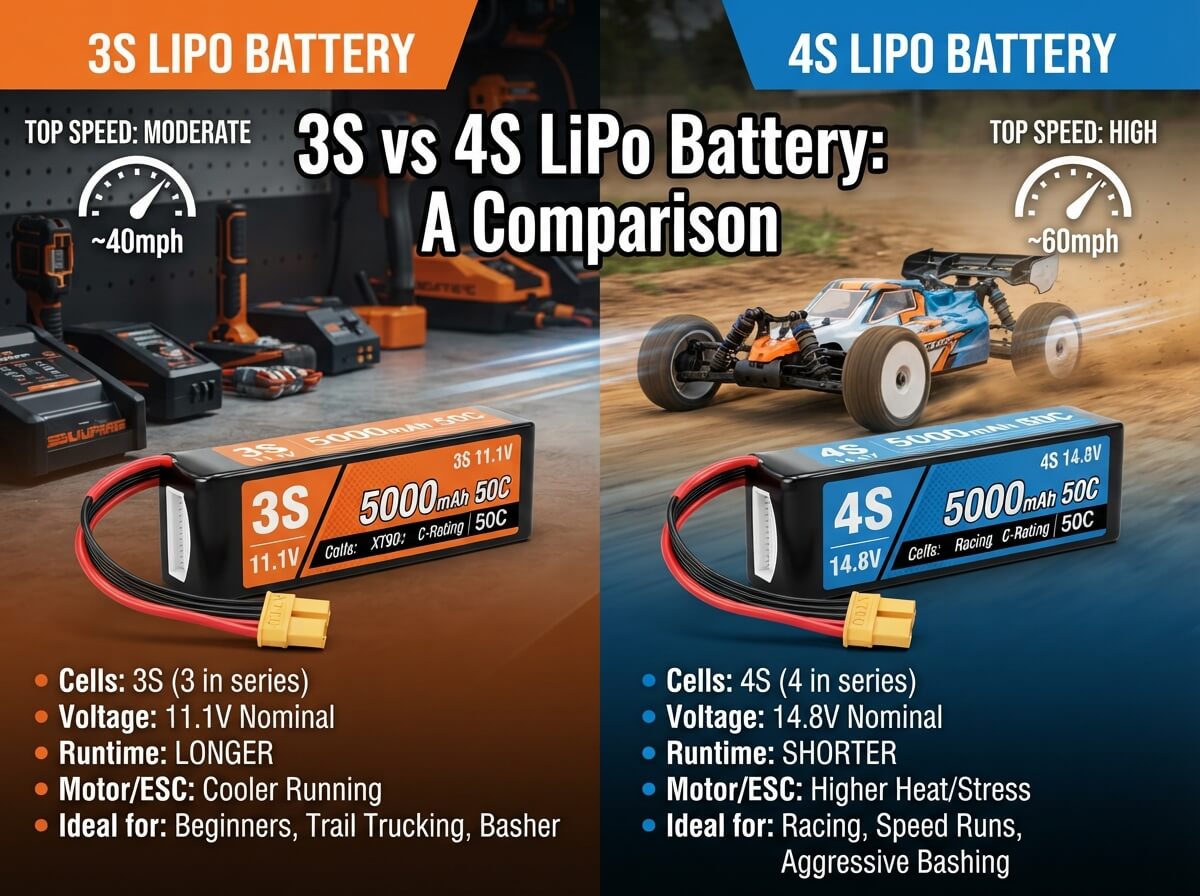
So a 3S lipo battery gives you around 11.1 volts of power. When the battery is fully charged, it actually hits about 12.6 volts because each cell charges up to about 4.2 volts per cell. As you use it and drain the battery, the voltage drops.
The 3S is the most common battery setup you’ll find in the RC world. Tons of beginner drones, RC cars, and other electric RC toys run on 3S batteries. Why? They’re balanced. They give enough power without being crazy expensive or too hard to handle.
What Does 4S Mean?
A 4S lipo battery has four cells stacked in series. Let’s do the math:
- One cell = 3.7 volts
- Four cells = 3.7 + 3.7 + 3.7 + 3.7 = 14.8 volts
A 4S battery puts out about 14.8 volts when it’s fully charged, hitting roughly 16.8 volts at full charge. That’s about 33% more voltage than a 3S battery. That extra voltage makes a real difference in how your RC toy performs.
Direct Comparison: 3S vs 4S
Now that you know what these terms mean, let’s compare them head-to-head across several important areas.
Voltage Output
This is the most obvious difference. A 4S battery outputs about 33% more voltage than a 3S. For the motors in your RC device, more voltage means more raw electrical power available. The motors can spin faster and work harder.
The 3S delivers about 11.1 volts normally, while the 4S delivers about 14.8 volts normally. That 3.7-volt jump sounds small, but it makes a huge impact on actual performance.
Speed Performance
Here’s where things get exciting. If you’re flying a drone or driving an RC car, you care about speed. The 4S battery will make your RC toy significantly faster than a 3S battery would. We’re talking noticeably faster—not just a tiny bit quicker.
With a 3S battery, you get smooth, controlled flight or driving. It’s perfect for learning because everything feels manageable. With a 4S battery, things get intense. Your RC drone will accelerate harder and reach higher top speeds. Your RC car will zoom across the ground with serious punch.
If you’re still learning to fly or drive, this speed boost can actually be a problem. It’s harder to control something that’s zipping around like crazy. Most beginners start with 3S for this exact reason.
Acceleration
Not only will a 4S battery make your RC device faster in general, it will also accelerate faster. Think of it like the difference between a regular car and a sports car. The sports car doesn’t just have a higher top speed—it gets to that speed quicker.
A drone with a 4S battery will launch into the air with more force. An RC car with a 4S battery will jump off the line faster. This snappy acceleration is fun, but it demands better control skills from the pilot.
Weight Differences
Here’s a catch: a 4S battery pack usually weighs more than a 3S pack of the same capacity. This matters because your RC device has to carry that weight around.
For drones, extra weight means you need more powerful motors and bigger propellers to stay airborne. The total effect is that your drone might feel heavier and less responsive, even though it has more power available.
For RC cars and trucks, a heavier battery lowers the center of gravity, which can actually help with handling. The extra weight can make the car feel more stable.
Flight Time and Runtime
Here’s something that surprises people: a 4S battery doesn’t automatically give you longer flight time or run time. In fact, it often reduces flight time compared to a 3S battery.
Why? Because the motors work harder with a 4S battery. Your drone accelerates faster, climbs quicker, and generally works harder. All that extra work burns through the battery faster. You might get 20-25% less flight time with a 4S battery than you would with a 3S battery of the same capacity.
For RC cars, the same principle applies. Racing hard with a 4S battery will drain it quicker than cruising around with a 3S battery.
If you want longer flight times, a 3S battery is actually your friend. You’ll fly longer with a 3S than you would with a 4S on the same charge.
Battery Capacity and Milliamp-Hours (mAh)
The battery capacity is measured in milliamp-hours, or mAh. A higher mAh number means the battery stores more energy and lasts longer.
You can buy 3S batteries in various capacities. Common sizes include 1300mAh, 2200mAh, 2500mAh, and larger. The same goes for 4S batteries.
If you want longer flight times or run times, you can often solve this with a higher mAh rating rather than sticking with a 3S battery. A 3S 2200mAh battery will outlast a 3S 1300mAh battery.
Cost and Price
Here’s a practical concern: 4S batteries cost more than 3S batteries. A 4S battery pack typically runs 20-40% more expensive than a comparable 3S pack.
Why? They have more cells, more power capacity, and they’re more complex. The markup isn’t huge, but it adds up. If you’re on a tight budget, 3S batteries make more sense.
If you’re building an entire RC setup, you also need to think about chargers. A basic charger might work fine for a 3S battery, but 4S batteries need more powerful charging equipment. A charger that handles 4S batteries costs more than a basic 3S charger.
Discharge Rate (C Rating)
The C rating tells you how fast a battery can safely discharge its power. It’s written as a number followed by a “C.” For example, “50C” or “100C.”
A 50C battery can safely discharge 50 times its capacity per hour. A 1000mAh battery with a 50C rating can safely discharge 50,000mAh (or 50 amps) continuously.
Here’s the thing: many 4S batteries come with higher C ratings than 3S batteries. That means they can deliver power faster and more aggressively. This is great for high-performance flying or racing, but it’s overkill for casual flying or driving.
A 3S battery with a decent C rating (like 50C or higher) works fine for most beginner setups. You don’t need a super high C rating unless you’re doing aggressive flying or competitive racing.
Charging Time
A 4S battery takes slightly longer to charge than a 3S battery because it has more cells and more energy to store. The difference isn’t huge—maybe an extra 10-20 minutes—but it’s worth considering if you’re the impatient type.
If you want to fly or drive multiple batteries in a session, you’ll appreciate that 3S batteries charge a bit faster.
When Should You Use a 3S Battery?
A 3S battery is your best bet if you fall into any of these categories:
You’re a beginner. The 3S gives you enough power to have fun while keeping things manageable. Speed is reasonable, prices are low, and everything feels controllable.
You want longer flight time. If you care about maximum flight duration, the 3S wins. Pair it with a decent mAh rating, and you’ll fly longer than with a 4S.
You’re on a budget. 3S batteries and the equipment to charge them cost less. Your initial investment is lower, and replacement batteries are cheaper.
You’re flying in tight spaces. If your flight area is small—like indoors or in a small yard—the lower speed of a 3S is actually an advantage. It’s easier to control.
You like smooth, relaxed flying. Some people just want to chill out and fly casually. A 3S battery gives you that smooth, easy feeling.
When Should You Use a 4S Battery?
Step up to a 4S battery if you match these situations:
You want speed and power. If you’re chasing thrills and want your RC device to move fast and accelerate aggressively, 4S is calling your name.
You’ve got decent flying or driving skills. You need the control experience to handle a 4S. If you’re still learning, this isn’t the move yet.
You have enough space. Racing or speed flying demands room. You need space to go fast safely.
You’re willing to spend more. 4S batteries and compatible chargers cost more. You need budget for this upgrade.
You want that competitive edge. If you’re racing or flying competitively, the 4S gives you an advantage in speed and acceleration.
Important Safety Stuff You Need to Know
Lipo batteries are powerful and need respect. Here are the critical safety rules:
Never charge a lipo battery unattended. Always stay close and watch it the entire time it’s charging.
Use a lipo charger, not a regular charger. Lipo chargers have special settings for lipo batteries. Using the wrong charger can damage the battery or cause it to catch fire.
Never drain a lipo battery completely. Stop using it when the voltage drops to 3.0 volts per cell. For a 3S battery, that’s 9.0 volts total. For a 4S, that’s 12.0 volts total. Over-discharging kills the battery.
Store lipo batteries in a safe place. A lipo bag or a metal container works well. If a battery puffs up or swells, stop using it immediately.
Always follow the manual that comes with your RC device. Different devices have different battery requirements.
Common Questions About 3S and 4S Batteries
Can I use a 4S battery in a device made for 3S?
No. It’s a bad idea. The extra voltage can fry the electronics in your RC device. Always use the battery your device recommends.
Can I use a 3S battery in a device made for 4S?
Also no. The device won’t work properly. It needs that 4S voltage to function correctly.
How do I know if my RC device uses 3S or 4S?
Check the manual or look at the package. It will clearly state the battery type. If you’re unsure, ask the manufacturer or a hobby shop.
Can I damage a battery by charging it wrong?
Yes. Charge lipo batteries with a real lipo charger. These chargers have balance charging, which keeps all cells at the same voltage. This extends battery life and keeps it safe.
How long do lipo batteries last?
A good lipo battery lasts hundreds of charging cycles if you take care of it. Charge it properly, store it right, and avoid over-discharging, and you’ll get a long life out of it.
What does “balancing” mean?
When you charge a lipo battery, each cell should charge to exactly the same voltage. Balancing makes sure this happens. Most modern chargers do this automatically.
Real Talk: Which One Should You Buy?
If you’re standing in a hobby shop trying to pick between 3S and 4S, here’s the honest answer:
Start with 3S. Even if you’re tempted by the speed of a 4S, begin with 3S. You’ll learn better, crash less, and spend less money. Speed is fun, but control is more important.
Get spare 3S batteries. Buy two or three 3S batteries so you can fly or drive longer. Swap out a dead battery and keep going. This is more fun than owning one 4S battery.
Upgrade to 4S later. Once you’ve got real control skills and you want more speed, upgrade to 4S. By then you’ll appreciate what it offers.
This approach works for drones, RC cars, RC trucks, and basically every electric RC hobby.
The Bottom Line
The difference between 3S and 4S lipo batteries comes down to voltage. A 3S battery runs at about 11.1 volts, while a 4S runs at about 14.8 volts. That extra voltage makes a 4S faster and more powerful, but it also drains faster, costs more, and demands better control skills.
For beginners, 3S is the smart choice. You get great performance, good prices, and longer flight times. Once you’ve got skills and you want more speed, 4S is waiting for you.
Whatever you pick, treat your lipo batteries with respect. Charge them right, store them safely, and never ignore their limits. A well-cared-for lipo battery will give you years of fun hobby flying or driving.
Now get out there and start flying or driving! The RC hobby is incredibly rewarding, and picking the right battery is just your first step toward amazing adventures.