
5 Best Redcat Rc Car In 2026
As an Amazon Associate we earn from qualifying purchases.
Beginners who want a remote control car often find the choices confusing. Redcat Racing is a brand that many hobbyists know, and its lineup covers rock crawlers, monster trucks, an off-road truggy and a drift car. This guide helps people who are new to the hobby find the best redcat rc car for their needs, budget and terrain.
The five products in this round-up share a few traits. All are electric, radio-controlled models from the same brand, and all come with a 2.4GHz radio system, which is the common wireless standard for hobby remotes.
The comparison below rests on the listed features and typical use, not on personal testing, so it describes what each model is designed to do rather than how it performed in a specific test.
Each model also targets a slightly different kind of driving, so the right choice depends on where and how you plan to drive.



1. Redcat Racing Ascent-18 APEX: best for serious rock crawling
What this model is and who it suits
The Ascent-18 APEX is a 1/18 scale electric rock crawler. A rock crawler is built to climb steep, uneven ground slowly and carefully, rather than to race. It suits hobbyists who enjoy technical trail driving, such as picking a route over boulders, roots and ledges, and who want a model that can grow with upgrades over time.
Key features in simple terms
The chassis uses carbon fiber, a strong and light material that resists flexing under load. The motor sits toward the front, and an angled skidplate, which is a protective plate under the body, helps the car slide over obstacles instead of catching on them.
Wide portal axles raise the car’s ground clearance, which means the body sits higher above the ground, and they also improve its steering radius, the tightest circle the car can turn through.
The drive system pairs a brushless motor with a small battery. Brushless motors are generally more efficient and longer lasting than older brushed designs, because they have no brushes that wear down over time.
The package also includes oil-filled coilover shocks, which are springs with dampers that smooth out bumps, and high-grip tires on beadlock wheels. Beadlock wheels hold the tire bead firmly against the rim, which helps the tire stay in place at low pressure.
Real-life use and performance
In everyday use, this kind of crawler is slow on purpose. Most of the fun comes from picking a line over rocks and logs and watching the car crawl up a slope one careful step at a time. Because of the wide axles and skidplate, it is designed to stay stable on uneven ground, so a driver can focus on route choice rather than constant corrections.
Performance is strong for its scale, but the small 200mAh battery suggests short runs. Owners usually plan for frequent charging and a spare pack if they want longer sessions. Running time will also depend on how hard the motor works, since steep climbs and rough terrain draw more power than driving on flat ground.
Ease of use
The car arrives in a complete package, including the radio system with adjustable endpoint settings. Endpoint settings control how far the steering and throttle travel in each direction, so you can limit them while you learn. That makes setup easier for a beginner. Still, crawling well takes practice, and the controls reward a patient, gentle touch rather than quick inputs.
Value for money
At $249.99, this is one of the higher-priced models in the round-up. Buyers pay for the carbon fiber build, the brushless system and the upgrade options. For a casual driver, that spending may feel large, but for a committed crawling hobbyist, the build quality is the main reason to buy. If you mainly want fast, action-packed driving on open ground, a different model in this list may give you more fun for the money.
Pros
- Carbon fiber chassis offers a strong, light build.
- Wide portal axles and an angled skidplate help on rough terrain.
- Includes a complete radio system and a USB charger.
- Works well with a wide range of performance upgrades.
Cons
- The price is high compared with the other models in this list.
- The small 200mAh battery means short run times between charges.
- Crawling is slow, so it may not suit buyers who want fast action.
- Good results depend on learning the technique over time.
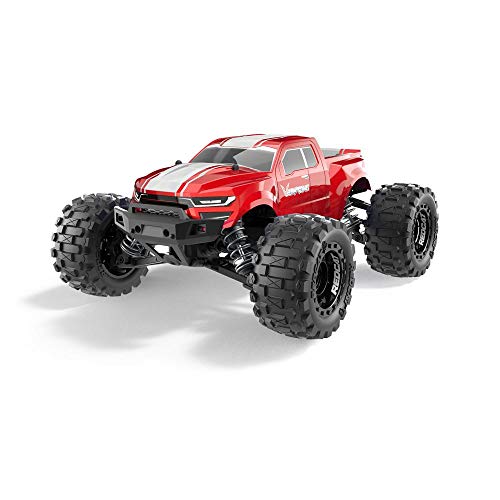
2. Redcat Racing Volcano 16 1/16 Scale RC: best for a first monster truck
What this model is and who it suits
The Volcano 16 is a 1/16 scale monster truck with full-time four-wheel drive. Four-wheel drive sends power to all four wheels, needs to be in conclusion of previous content. Continue exactly. the Volcano 16 has a more than average chance of getting stuck in deep dirt, but this is a small truck, so the impact is light. Hmm, that’s a claim. Let me write carefully.
Power comes from a brushed motor, which is a simpler and lower-cost design than brushless. A splash-proof speed controller, the electronic part that manages speed, helps the truck handle wet grass and light puddles. It runs on dirt, pavement and grass alike.
Key features in simple terms
The truck includes two rechargeable 7.4V 800mAh lithium-ion battery packs. Buyers can charge one pack while driving the other, which keeps sessions moving. The listing describes up to 30 minutes of run time per pack.
Shock-absorbing bumpers, coilover suspension and a rugged plastic tub chassis are built to take knocks. LED headlights make it usable in low light, and the 2.4GHz remote includes adjustable throttle and a speed-limiting mode, which suits a new driver.
Real-life use and performance
In everyday use, this truck feels quick and playful. Because the speed-limiting mode can be turned on, a beginner can start slowly and raise the pace as skills grow. The rugged plastic build is designed to survive crashes that would damage more delicate models.
Performance is lively for its size, though the brushed motor is less powerful than the brushless systems in the higher-priced models. Still, it suits backyard bashing and simple trails well.
Ease of use
This is one of the easiest models in the round-up to start. It arrives ready to run once the transmitter has AA batteries, so a buyer can be driving within minutes. The pistol-grip remote is familiar to most people.
Value for money
At $94.99, this model sits at the lower end of the price range. It includes two batteries, a charger and a sticker sheet, which adds to its value for a first purchase. For a beginner who wants to learn the hobby without a large outlay, that package is a sensible starting point.
Pros
- Two batteries let one charge while the other runs.
- Ready to run out of the box, with everything included.
- Adjustable throttle and speed-limiting mode suit new drivers.
- Rugged plastic chassis and shock-absorbing bumpers handle crashes.
Cons
- The brushed motor offers less power than brushless alternatives.
- Run time per battery is modest, so spares are useful.
- The plastic build is durable but not as refined as higher-end models.
- It is built for light off-road use rather than extreme terrain.
3. Redcat Racing Valkyrie TR 1/10 Scale 4S: best for fast off-road truggy driving
What this model is and who it suits
The Valkyrie TR is a 1/10 scale truggy, a style of off-road car that blends features of a truck and a buggy. It is built for speed, jumps and wheelies on dirt, gravel and grass. The scale refers to the model being about one-tenth the size of a full-size vehicle, which keeps it compact enough for a backyard or a local park.
It suits buyers who want a fast, versatile car for open spaces and bash spots. People who enjoy tinkering with their vehicles and adjusting settings between runs will get the most from it. Those who want a quiet, slow car for a small room will likely prefer a different model.
Key features in simple terms
The car uses a brushless motor rated at 1950KV, meaning the motor turns about 1950 revolutions per minute for each volt applied. A 120A speed controller handles the power. Triple oil-filled differentials let the wheels turn at different speeds, which helps in corners and rough ground.
Oversized 5.1-inch tires provide grip, and an integrated wheelie bar helps prevent the car from flipping over during hard acceleration. Adjustable coilover shocks let a driver tune the suspension for different surfaces, such as softer settings for loose dirt and firmer settings for hard-packed tracks.
The model is listed as LiPo ready, meaning it can use lithium polymer batteries, which are common in fast cars. Buyers should always check the battery and charger requirements before running it.
Real-life use and performance
In everyday use, this truggy feels fast and loud. Owners usually spend most of their time on open dirt, where the long straights let the car reach its top speed. Because of this, the car is best suited to open areas where it has room to build speed.
Its oversized tires and suspension help it absorb landings from small jumps. Speed comes with a cost, so the car rewards careful driving and regular checks of the hardware.
Performance is strong, and the brushless system delivers quick acceleration. Buyers should expect that the car will need more care than a basic model after hard use. Checking screws, bearings and driveshafts after each session can prevent small problems from becoming bigger ones. The tub chassis and body armor help protect it when it lands hard or hits obstacles.
Ease of use
The car arrives ready to run, and the digital servo gives smooth, responsive steering. Still, its speed and power call for a driver who is willing to learn. Beginners often start in a clear area and build up their skills gradually. Practicing at lower throttle settings at first helps new drivers get used to how the car responds.
Value for money
The listing describes this model as offering strong value, and its feature set is generous for a 1/10 scale truggy. Because the price is not provided in the data, a buyer should check the current cost before deciding. Those who want speed, jumps and tunable handling are likely to feel the spending is worthwhile.
Pros
- Brushless power gives quick acceleration for open-ground driving.
- Tunable differentials and shocks let drivers adjust the handling.
- Large tires and a wheelie bar help with grip and stability.
- Tough tub chassis and body armor handle hard landings.
Cons
- High speed and power require more careful driving.
- Frequent upkeep may be needed after hard use.
- The price is not stated in the data, so buyers should confirm the cost.
- It is less suited to tight indoor spaces than smaller models.
4. Redcat Racing Lightning EPX RC Drift Car: best for learning drifting
What this model is and who it suits
The Lightning EPX is a 1/10 scale drift car. Drifting means sliding the rear of the car through a corner while keeping control. This model suits buyers who want to learn the style on smooth pavement or a flat surface.
It is a good fit for someone who has never driven a radio-controlled car before. It is also useful for a hobbyist who wants a stable base for practicing slides, corner entry and throttle control.
Key features in simple terms
The car has shaft-driven four-wheel drive, which uses a rigid shaft rather than a belt to send power to the wheels. Its 19T brushed motor and 2000mAh NiMH battery are the power source. Four-wheel independent suspension and adjustable ride height, toe and camber let a driver tune the grip and slide.
The car arrives fully assembled with a 2.4GHz radio. A waterproof 40A speed controller and a high-torque steering servo add control. Ball bearings throughout help the drivetrain run smoothly.
The 2.4GHz radio uses a frequency that helps reduce interference from other nearby transmitters. Adjustable toe and camber change how the tires meet the ground, which affects how easily the rear breaks loose. Ride height changes the car’s balance and how it sits over bumps.
Real-life use and performance
In everyday use, the car feels forgiving at lower speeds. Its controls are intuitive, which helps beginners learn how the slide responds. Many owners treat it as a platform for practice and gradual tuning.
Performance is smooth on flat surfaces, though the brushed motor offers less punch than brushless alternatives. Because the car is lightweight, it responds quickly to input. A new driver may notice that small throttle changes have a clear effect on the slide.
Ease of use
The model is designed for beginners and enthusiasts alike. Its controls are simple, and the handling is described as forgiving. Learning to drift takes time, but the tuning options give a patient driver room to grow.
A practical way to start is with a wide, open, flat area and a few cones or markers. Drive slowly, practice steering and throttle together, and increase speed only when the slide feels predictable.
Value for money
At $155.55, the car sits in the middle of the price range. Buyers get a fully assembled car with a battery, charger and tuning options. For someone who wants a drift car that can grow with their skills, that package offers good value.
Price alone does not show the full cost of ownership. Spare tires, replacement parts and an extra battery may be needed over time, so it helps to budget for those items too.
Pros
- Ready to run, with a battery and charger included.
- Tunable suspension, ride height and angles support learning.
- Forgiving handling suits beginners.
- Waterproof speed controller helps with wet surfaces.
Cons
- The brushed motor offers less power than brushless models.
- Drifting takes practice and patience to master.
- The NiMH battery is a heavier, older chemistry than lithium packs, so run time is modest.
- The car is built for smooth surfaces and is less suited to rough ground.
5. Redcat Racing Ascent-18 Scout II Brushless: best for scale looks and crawling
What this model is and who it suits
The Ascent-18 Scout II is a 1/18 scale crawler with a body modeled on the International Scout II. It suits buyers who like realistic looks as much as slow, careful trail driving. It is a good fit for someone who enjoys the scale details of a classic off-road vehicle.
Crawlers like this one focus on low speed and control rather than raw power. If you prefer watching a vehicle pick its way over rocks and logs, this type of model will likely hold your interest. If you want high speed or jumps, a different class of car will serve you better.
Key features in simple terms
The car uses a 3450KV brushless motor, which is an efficient design that delivers steady torque for crawling. The 2mm flat rail aluminum chassis and metal portal gears add strength. Aluminum-capped oil-filled shocks help the suspension handle uneven ground.
The body has an authentic scale design with a forward tilt mount and LED lights. A 3-channel 2.4GHz radio includes servo reversing, dual rates and steering trims. The package arrives fully assembled with a 7.4V 750mAh LiPo battery and a USB charger.
In plain terms, the brushless motor is a motor without brushes that wear down over time, and the portal gears sit at the wheel hubs to lift the axle height. Dual rates let you limit how far the steering turns, which can make slow trail work feel more precise.
Real-life use and performance
In everyday use, the Scout II feels slow and deliberate. Owners often enjoy the detail of the body as much as the trail driving. The tilt mount and LED lights add to the sense of a miniature vehicle on the move.
Performance is strong for crawling, and the brushless motor gives smooth control at low speed. Because the battery is small, longer outings usually need a second pack. Many crawler drivers keep two or three packs on hand so they can charge one while driving with another.
Ease of use
The car is ready to run once the transmitter has four AA batteries. The radio offers trim and reversing settings, which help a driver fine-tune the steering. Beginners will find the controls manageable with a little practice.
Start by driving on a flat, open surface to learn how the steering responds. Once that feels natural, move to gentle slopes and obstacles. Taking this step-by-step approach helps protect the scale body and the drivetrain.
Value for money
At $159.99, this model is priced above the monster truck and drift car but below the APEX crawler. Buyers get a brushless system, a metal-equipped chassis and a scale body. For a crawler fan who values looks and build quality, the price is reasonable.
Budget shoppers should also count the cost of extra batteries and four AA cells for the transmitter. Adding these to the total gives a more accurate picture of what you will spend to start running.
Pros
- Scale Scout II body adds realistic detail and character.
- Brushless motor gives smooth, efficient crawling power.
- Aluminum chassis and metal portal gears add durability.
- Fully assembled, with the battery and charger included.
Cons
- The small battery means shorter run times without a spare.
- Crawling is slow, so it may not suit fast-action fans.
- Radio needs four AA batteries that are not included.
- Scale details may need extra care during rough trail use.
Comparison insights: how the five models differ
The five models split into two groups. The two crawlers, the APEX and the Scout II, are built for slow, technical driving. The monster truck, truggy and drift car are built for speed and open ground.
Performance varies with the motor. The Valkyrie TR and the crawlers use brushless systems, which are generally more efficient. The Volcano 16 and Lightning EPX use brushed motors, which are simpler and less costly.
Ease of use is highest on the Volcano 16, which is ready to run with two batteries. The Lightning EPX is also forgiving for beginners. The Valkyrie TR and the APEX reward more practice before they feel natural.
Value for money depends on the goal. The Volcano 16 offers the lowest entry cost, while the APEX costs the most and suits committed hobbyists. The Lightning EPX and Scout II sit in the middle of the range.
Buying guide: key factors explained in plain words
Scale describes how small the model is compared with a real vehicle. A 1/18 car is smaller than a 1/10 car, so bigger scales usually mean more room for speed and larger parts. Before you buy, check the scale listed in the product details so you know what size to expect on your desk or in your yard.
Motor type matters for power and cost. Brushed motors are simpler and cost less, while brushless motors are usually more efficient and longer lasting. In practice, brushless models tend to cost more but offer smoother power delivery, which many drivers notice most during hard acceleration.
Battery type and run time shape how much driving fits into one session. Lithium packs are common in hobby cars and must be charged with a matching charger, so confirm compatibility before you plug anything in. A spare battery is useful, because short run times can interrupt the fun and leave you waiting while one pack charges.
Drive style decides the best fit. Crawlers suit slow, technical trail driving, while truggies and monster trucks suit speed and open ground. Drift cars suit smooth, flat surfaces such as a garage floor or a sealed parking area, where sliding the car is the goal.
Ready-to-run packages save time for beginners. Several models here arrive fully assembled with a radio, battery and charger. Buyers should still check if the transmitter needs AA batteries, which are not always included, so you can start driving the same day your model arrives.
Who should buy these products
A first-time buyer on a modest budget should look at the Volcano 16. It is ready to run, includes two batteries and offers a speed-limiting mode for learning. It is a practical choice for backyard driving and light trails, where a beginner can build skill without overwhelming power.
A rock crawling enthusiast who wants a serious build should consider the Ascent-18 APEX. Its carbon fiber chassis, wide axles and upgrade options suit a committed hobbyist who plans to tune and customize over time. The price reflects that focus, so it makes the most sense for someone who will use those features.
A crawler fan who values scale looks should look at the Ascent-18 Scout II. Its classic body, brushless motor and aluminum chassis suit someone who enjoys detail as much as trail driving. It sits between the APEX and the monster truck in price.
A driver who wants speed and jumps on open ground should consider the Valkyrie TR. Its brushless system, tunable differentials and wheelie bar suit fast, versatile driving. It is best for someone ready to handle more power and willing to practice before pushing it hard.
A beginner who wants to learn drifting should look at the Lightning EPX. Its forgiving handling, tunable suspension and included battery suit a patient learner. It works best on smooth, flat surfaces, where the car can slide without hitting obstacles or losing control in rough terrain.
Final verdict
No single model fits every buyer. The best choice depends on the driving style, budget and skill level of the person buying it. A clear goal makes the decision much easier, so start by asking what you want to do with the car most of the time.
For most beginners, the Volcano 16 offers the most straightforward start. It is ready to run and easy to learn, which means less time spent on setup and more time spent driving. The other models suit buyers with more specific interests, such as rock trails, open dirt or smooth pavement.
In short, match the car to the terrain you plan to drive on. A crawler fits rocks and trails, a truggy fits open dirt, and a drift car fits smooth pavement. Checking the battery, motor type and included accessories will help avoid surprises, especially if you plan to add spare batteries or a charger later.
Frequently Asked Questions
What is the best Redcat RC car for a complete beginner?
The Volcano 16 is often a good starting point. It is ready to run, includes two batteries and offers a speed-limiting mode. That makes it easier for a new driver to learn the basics, such as steering, braking and handling turns, without losing control too quickly.
What is the difference between brushed and brushless motors?
A brushed motor is simpler and usually costs less. A brushless motor is generally more efficient and longer lasting. Brushless models often feel smoother under power, which can make acceleration and control feel more consistent across a run.
Do these cars need extra batteries?
Most include at least one battery, and run times are often short. A spare battery is useful for longer sessions, since you can keep driving while the first one charges. Some models also need AA batteries for the transmitter, which may not be included, so check the box contents before you head outside.
Which model is best for rock crawling?
The Ascent-18 APEX and the Ascent-18 Scout II are both built for crawling. The APEX suits serious hobbyists who want a more capable setup for challenging terrain, while the Scout II suits buyers who value scale looks and a classic off-road appearance. Both are slow and deliberate by design, which is part of the fun on rocky trails.
Can these cars be used indoors?
Some are better suited to outdoor use than others. The larger truggy and monster truck need open space to run well, and they can struggle on tight indoor layouts. Smaller crawlers and the drift car can work on flat indoor surfaces, though speed and noise should be considered, especially in shared living spaces.

Peterson is an RC hobby enthusiast and product reviewer with a passion for remote-controlled cars, trucks, boats, drones, and accessories. He enjoys testing the latest RC products, comparing features, and sharing practical buying guides to help beginners and experienced hobbyists make informed decisions. Through RCThing.com, Peterson provides honest reviews, maintenance tips, and expert advice to help readers get the most from their RC adventures.


One Comment