
5 Best RC Differential Oil In 2026
If you’ve ever felt your RC car push wide through a corner, spin one wheel while the other sits still, or just feel “off” compared to how it drove last week, the diff oil inside your differential is probably the reason. RC differential oil is one of those cheap, small parts that make a huge difference in how your car handles, yet a lot of hobbyists skip past it and just run whatever came in the diff from the factory.
That’s a mistake, honestly. The right differential fluid can turn a twitchy, hard-to-drive buggy into something that carves corners smoothly. It can also help a basher truck put power down without wheelspin, or help a touring car hold a tight line on smooth pavement. The wrong fluid, on the other hand, can make your car feel sluggish, cause premature diff wear, or lead to that annoying “one wheel peel” where all the power goes to a single tire.
In this roundup, we’re going to look at five popular RC diff oil products that cover the full range of viscosities most hobbyists need: a multi-bottle starter kit, three single-viscosity bottles from Team Associated’s Factory Team line, and a well-known Traxxas kit. We’ll break down what each one is good for, how easy it is to use, what real drivers tend to say about it, and where it sits on value for money. Then we’ll wrap up with a comparison, a buying guide, some common mistakes to dodge, and a final verdict so you can walk away knowing exactly which bottle to add to your cart.
Let’s get into it.
A Quick Word on What Diff Oil Actually Does
Before we jump into the reviews, it helps to know what you’re actually shopping for. RC differential oil is a silicone-based fluid that fills either a gear differential or a sealed diff housing. It controls how much resistance there is between the internal gears as your car turns. Thin oil (low cSt number) lets the gears spin more freely against each other, so power moves easily between the left and right wheels. Thick oil (high cSt number) locks the gears together more, so the wheels tend to spin at closer to the same speed, almost like a mild locked axle.
The “cSt” you see in every product name stands for centistokes, which is just the unit used to measure viscosity. Lower numbers mean thinner, more fluid oil. Higher numbers mean thicker, almost honey-like oil. Diff oils for RC cars usually range from around 3,000 cSt on the thin end all the way up to 1,000,000 cSt on the thick end, though most drivers only ever need something in the 5,000 to 300,000 range depending on where the fluid goes (front, center, or rear diff) and what kind of car they’re running.
With that out of the way, let’s look at the products.
1. 3 Bottles RC Differential Oil Kit (10K, 30K, 50K cSt) — 2oz Silicone RC Diff Fluid Set
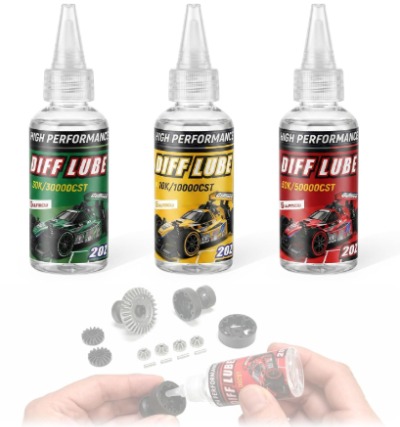
This kit is built for people who don’t want to buy three separate bottles or guess which viscosity they need. It comes with three bottles at 10,000, 30,000, and 50,000 cSt, each holding about 20ml (roughly 60ml total across the set), and it’s marketed as a general-purpose set for sealed differentials in 1/10 and 1/8 scale cars, trucks, and buggies.
Product Description
This is a starter-friendly bundle. Instead of committing to one viscosity and hoping it’s right, you get a small spread that covers a lot of common tuning needs right out of the box. The 10K oil is on the thinner side and works well for a diff that needs to move freely, the 30K sits in a middle zone that suits a lot of stock and mildly modified setups, and the 50K is thick enough to tighten things up for higher-traction surfaces or more aggressive driving styles.
Best Use Cases
This kit shines for anyone running a sealed gear differential, which covers most budget-to-mid-range 1/10 buggies, short course trucks, and monster trucks. It’s also a smart pickup for anyone who just built their first RC car and doesn’t yet know which viscosity fits their driving style or local track surface.
Key Features Explained Simply
- Three viscosities in one pack: You’re not stuck guessing. You can try thin, medium, and thick oil and feel the difference yourself.
- 2oz size fits most sealed diffs: A single sealed diff usually only needs a small amount of oil to fill, so this bottle size avoids waste.
- Silicone base: Silicone oil resists temperature changes better than basic oils, so the diff feels more consistent as it heats up during a run.
- Made for 1/10 and 1/8 scale: It covers the two most common scale categories among hobby-grade RC cars.
Real-Life Usage Insight
Drivers who pick up a set like this tend to use it as a tuning tool rather than a one-and-done fill. A common approach is to run the 30K in the rear diff first as a baseline, then swap to the 10K if the car feels too tight in corners, or bump up to the 50K if it’s spinning out on acceleration. Having all three on hand means you can make these changes in minutes instead of waiting on another order to ship.
Honest Pros and Cons
Pros:
- Great value since you get three tuning options instead of one
- Good starting point for beginners who don’t know their ideal viscosity yet
- Compact bottles are easy to store in a pit box
- Silicone formula holds up well across a range of temperatures
Cons:
- Bottle sizes are on the smaller side, so heavy tuners may run out faster than expected
- Not every buyer finds label clarity as sharp as name-brand bottles, so double check the cSt markings before pouring
- Doesn’t cover ultra-thick viscosities needed for some center diff setups
Performance Discussion
For sealed diffs in typical bash and casual race use, this trio does what it says. The 30K especially tends to be a crowd-pleaser as an all-around rear diff fluid for short course trucks and buggies. The thinner 10K helps loosen up a diff that feels bound up after a rebuild, and the 50K adds noticeable resistance for drivers who want more forward bite out of corners.
Ease of Use
Filling a sealed diff is simple: pop the case open, clean out the old oil, add the new fluid to the fill line, and reassemble with fresh o-rings if needed. The narrow bottle tips on kits like this one usually make pouring cleaner than trying to use a large single bottle.
Value for Money
This is where the kit earns its keep. Buying three viscosities separately from a single brand almost always costs more than a bundled set like this, so if you’re still figuring out your ideal setup, this is a budget-smart way to experiment.
2. Team Associated FT Silicone Diff Fluid, 30,000 cSt (ASC5457)
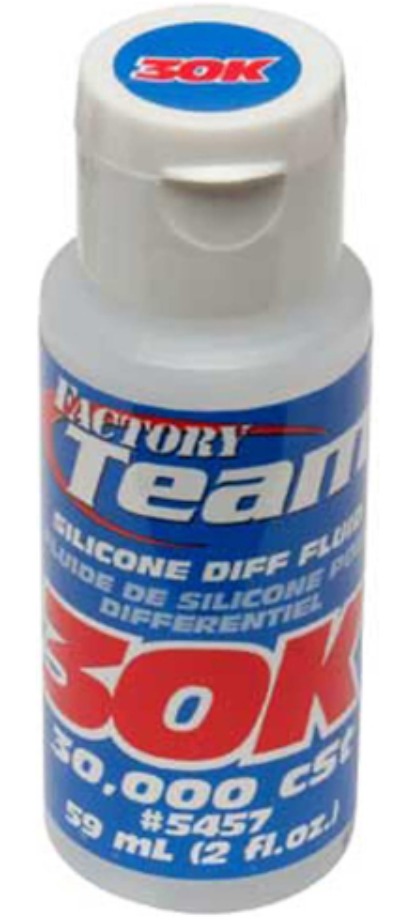
Team Associated’s Factory Team line is a name most RC racers already know. The 30,000 cSt bottle sits right in the middle of their viscosity range and tends to be one of the more commonly stocked bottles among racers who run Associated buggies and trucks.
Product Description
This is a single-viscosity, 2oz bottle of Factory Team silicone diff fluid rated at 30,000 cSt. It’s a clear liquid designed as a precision tuning fluid rather than a generic all-purpose oil, and it’s built to work in any application that calls for diff fluid, not just Associated-branded cars.
Best Use Cases
The 30K viscosity is a strong pick for rear or center diffs in 1/10 buggies and short course trucks running on medium to high traction surfaces like carpet or well-prepped dirt. It’s also a solid choice for drivers who want a touch more forward drive than a thinner oil provides, without locking the diff up too much.
Key Features Explained Simply
- Custom silicone blend: Formulated specifically for diff tuning rather than repurposed general lubricant.
- Clear, easy-to-check fluid: You can see the level and condition of the oil easily when filling.
- Standard 2oz bottle: A familiar size that fits neatly into most pit boxes and tool bags.
- Precision viscosity rating: The 30,000 cSt number is consistent bottle to bottle, so your tuning notes stay accurate over time.
Real-Life Usage Insight
Racers who run gear diffs in competitive settings tend to like this fluid because it holds its viscosity rating reliably, which matters a lot when you’re trying to dial in small changes between practice runs. It’s common to see this bottle paired with a thinner front diff fluid and a thicker center diff fluid to build a full three-diff tuning setup.
Honest Pros and Cons
Pros:
- Trusted, well-known brand with a long track record in RC racing
- Reliable, consistent viscosity from bottle to bottle
- Works across many vehicle brands, not just Associated cars
- Good middle-ground viscosity that suits a wide range of surfaces
Cons:
- Single viscosity only, so you’ll need to buy more bottles to build a full tuning range
- Slightly pricier per ounce than generic multi-packs
- Not the best fit if your car needs a very thin or very thick setup right away
Performance Discussion
In gear diffs, this fluid gives a noticeable, predictable amount of resistance that helps power transfer evenly between wheels without feeling locked. Drivers moving up from stock diff oil often notice smoother corner exit and less wheel hop on rough surfaces.
Ease of Use
The bottle’s flip-top style cap keeps things mess-free, and the fluid pours cleanly without much mixing or shaking required before use.
Value for Money
It costs a bit more than a bundled multi-viscosity kit, but for racers who already know 30K is their sweet spot, buying it as a standalone bottle from a trusted brand is worth the extra cost for the consistency alone.
3. Team Associated FT Silicone Diff Fluid, 100,000 cSt (ASC5459)
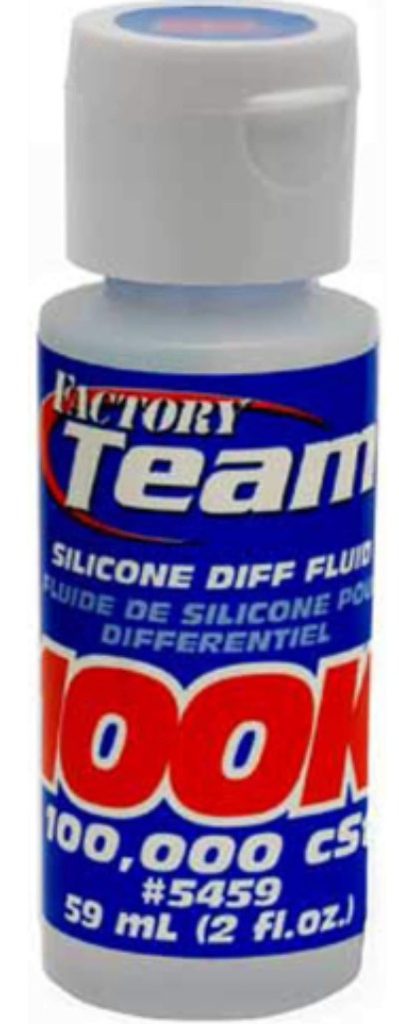
Moving up the thickness scale, this 100,000 cSt bottle is built for situations where you want much more resistance between the diff gears, which usually means center diffs or high-traction rear diff setups.
Product Description
This is a high-viscosity silicone diff fluid meant for precision tuning of gear differentials, particularly where the goal is to reduce diff action and push more power straight ahead instead of letting it slip between wheels.
Best Use Cases
This viscosity works well in center diffs on 4WD buggies and trucks running in high-power or high-traction conditions. It’s also useful in a rear diff when a driver wants a much more locked feel for straight-line stability on loose, sandy, or low-grip surfaces where wheelspin is the main issue.
Key Features Explained Simply
- 100,000 cSt rating: A big jump up from mid-range oils, giving noticeably more resistance.
- Reduces diff slip: Helps limit how much one wheel can outspin the other.
- Good for center diffs: A common spot for thicker fluid in 4WD setups.
- Consistent temperature performance: Factory Team fluids are built to hold their viscosity even as the diff heats up during a run.
Real-Life Usage Insight
Drivers who add this fluid usually do it after noticing their car spins a wheel or loses drive on acceleration out of corners. Swapping the center diff to something in the 100K range often tightens the whole drivetrain up, giving a much more direct and predictable feel when you hit the throttle.
Honest Pros and Cons
Pros:
- Strong option for reducing power loss through diff slip
- Great for 4WD center diffs that need extra lockup
- Reliable Factory Team quality and consistency
- Helps with straight-line stability on loose surfaces
Cons:
- Too thick for most 2WD rear diffs on higher-grip surfaces, where it can make the car feel harsh
- Small learning curve if you’ve never tuned with such a thick oil before
- Only comes in one viscosity, so you’ll need other bottles for front or rear diffs
Performance Discussion
At this viscosity, the diff behaves much closer to a locked axle. That’s a big plus for straight-line traction and acceleration, but it does come with a trade-off: cornering can feel a bit stiffer since the wheels resist turning at different speeds. It’s a fluid best used with intention rather than as a default fill.
Ease of Use
Because it’s thicker, it takes a bit more patience to pour and fill compared to thinner oils. A few gentle squeezes on the bottle and a little extra time helps avoid air bubbles in the diff housing.
Value for Money
For the specific job it does, this bottle earns its price. It’s not an everyday fluid for every diff, but for center diffs on high-power 4WD platforms, it solves a real problem that thinner oils can’t.
4. Team Associated FT Silicone Diff Fluid, 200,000 cSt (ASC5461)
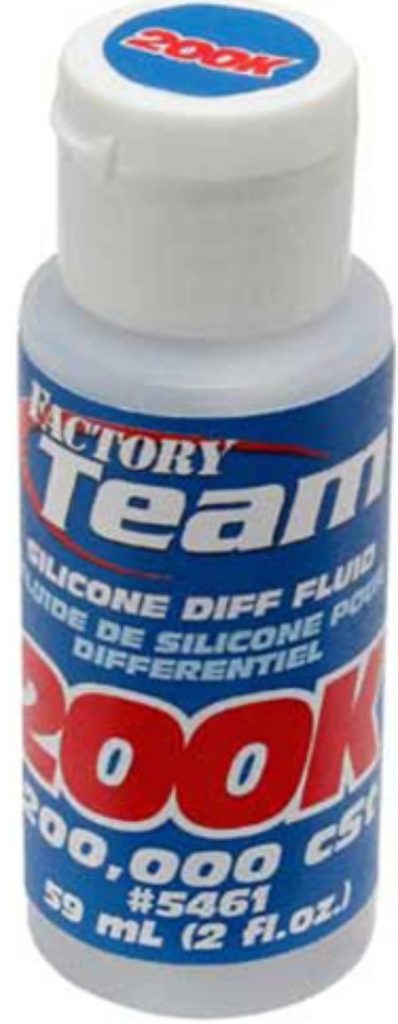
This is the thickest bottle in our roundup from the Factory Team lineup, built for drivers who need serious lockup, usually in a center diff on powerful 4WD setups or in specialty tuning situations.
Product Description
At 200,000 cSt, this fluid sits well into the “very thick” end of the diff oil spectrum. It’s designed for the same precision tuning goals as the rest of the FT line but aimed at applications where near-maximum resistance is the target.
Best Use Cases
This viscosity is best suited to center diffs in high-power 4WD buggies and trucks, especially those running on brushless power systems where torque can easily overpower a thinner diff setup. It also works for drivers experimenting with a heavily locked front diff for extra steering bite on loose surfaces.
Key Features Explained Simply
- 200,000 cSt rating: Among the thickest common tuning viscosities available.
- Maximum practical resistance for most street and race applications: Gives a very tight, connected feel between wheels.
- Same Factory Team consistency: Reliable viscosity that matches what’s printed on the label.
- Flip-top cap design: Keeps the thicker fluid contained and easier to store without leaks.
Real-Life Usage Insight
Drivers running high-torque brushless setups sometimes find that even 100K oil isn’t enough to stop wheelspin under hard acceleration. Stepping up to 200K in the center diff is a common fix in that situation, giving the car a much more planted, straight-line-focused feel.
Honest Pros and Cons
Pros:
- Excellent for taming wheelspin in high-torque 4WD setups
- Reliable brand consistency across the FT lineup
- Useful for advanced tuning setups that need extreme lockup
- Long-lasting since a little goes a long way in most diff housings
Cons:
- Overkill for beginners or lower-power setups
- Can make handling feel unnatural if used in the wrong diff position
- Thicker pour means a little more mess risk if you’re not careful
- Not a fluid most casual bashers will ever need
Performance Discussion
This is a specialty tool more than a general-purpose fluid. Used correctly, it solves specific traction and power-delivery problems in high-power setups. Used incorrectly, like in a front diff on a car that needs to turn sharply, it can make the car feel like it’s fighting itself in corners.
Ease of Use
Filling with this thickness takes a bit more care and patience than the thinner bottles in this roundup, mostly due to how slowly it pours. It’s not difficult, just slower.
Value for Money
For the narrow but important job it does, in taming wheelspin on powerful 4WD platforms, it’s worth having in your toolbox even if you don’t use it in every car.
5. Traxxas 5136X Differential Oil Kit (10,000, 30,000, 50,000 Weights)
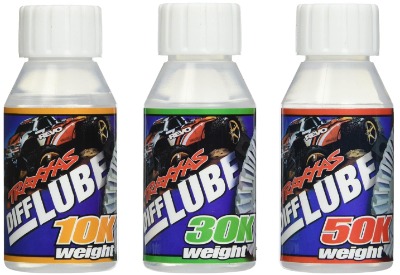
Traxxas is one of the most recognized names in RC, and this kit brings together three of their most commonly used diff oil weights in one package, aimed squarely at Traxxas vehicle owners though usable in other sealed diff setups too.
Product Description
This kit bundles three bottles at 10,000, 30,000, and 50,000 weight, giving Traxxas owners a straightforward way to tune their sealed differentials without hunting down separate purchases. It’s built around the viscosities that fit most stock and mildly upgraded Traxxas platforms.
Best Use Cases
This kit is the go-to option for owners of Traxxas trucks and buggies like the Slash, Rustler, Stampede, and similar platforms, especially those looking to fine-tune diff feel after upgrading motors, gearing, or tires. It’s also handy for anyone doing routine diff maintenance who wants fresh oil on hand.
Key Features Explained Simply
- Three commonly needed weights: Covers a practical tuning range without going into rarely-used extremes.
- Traxxas-branded consistency: Matches the fluid recommendations found in many Traxxas manuals and support guides.
- Sealed diff focus: Built with Traxxas-style sealed differentials in mind, which are common across their truck and buggy lineup.
- Simple bottle design: Easy to pour and store alongside other maintenance supplies.
Real-Life Usage Insight
A lot of Traxxas owners keep this kit in their toolbox simply for routine maintenance, since diff oil does break down and thin out a bit over time with heavy use. Beyond maintenance, it’s also a popular pick for drivers who want to firm up their rear diff after adding a more powerful motor, since stock oil weight sometimes isn’t quite enough to handle the extra torque without excess wheelspin.
Honest Pros and Cons
Pros:
- Trusted brand match for Traxxas vehicles specifically
- Three practical weights cover most common tuning needs
- Reliable option for routine diff maintenance, not just upgrades
- Easy to find replacement bottles later since it’s a well-known brand
Cons:
- Primarily useful for sealed diffs, less relevant for open gear diff setups
- Doesn’t include thicker options for high-torque 4WD center diff tuning
- Price per ounce can run higher compared to generic multi-packs
Performance Discussion
For Traxxas platforms specifically, this kit tends to deliver exactly what’s expected since the weights are chosen to match how these vehicles are typically set up from the factory. The 30K weight often works well as a direct stock oil replacement, while the 10K and 50K give room to fine-tune from there.
Ease of Use
Since Traxxas diffs are designed around these exact weight ranges, filling and maintaining them with this kit tends to be a smooth, familiar process for most Traxxas owners, especially if you’ve already opened up the diff housing before.
Value for Money
For Traxxas-specific owners, this kit is a smart, low-fuss purchase. You’re paying a small premium for brand match confidence, but it saves the guesswork of figuring out if a generic oil weight will behave the same way inside a Traxxas-style sealed diff.
Comparison Insights: How These Five Stack Up
Looking at all five products side by side, a clear pattern shows up. The two multi-bottle kits, the generic 3-bottle set and the Traxxas 5136X kit, are built for flexibility and everyday tuning across the low-to-mid viscosity range. They’re both smart picks if you’re still learning how diff oil changes affect handling, since you get room to experiment without buying extra bottles.
The three Team Associated bottles cover a different need entirely. They’re single-viscosity, precision-focused fluids that make more sense once you already know roughly what your car needs. The 30K bottle overlaps nicely with the mid-range oils found in both kits, so it works as a great “next step up” once you’ve used a starter kit and want a name-brand refill. The 100K and 200K bottles serve a narrower purpose, mostly aimed at center diffs in 4WD setups or drivers chasing very specific traction control goals.
If you only buy one thing, a starter kit like the generic 3-bottle set or the Traxxas kit gives the broadest coverage for the money. If you already race competitively or run a high-power 4WD platform, the thicker Team Associated bottles fill gaps those starter kits simply don’t reach.
Buying Guide: How to Pick the Right RC Diff Oil
Here’s a simple, no-jargon way to think through your purchase.
Start with your diff type. Sealed diffs, common in Traxxas and many budget-to-mid trucks, generally use a narrower viscosity range (often between 5,000 and 50,000 cSt). Gear diffs on racing buggies and trucks tend to use a wider spread, sometimes reaching into the 100,000+ range for center diffs.
Think about your surface. Loose, low-traction surfaces like sand or loose dirt usually call for thinner oil so the car can rotate through corners without binding. Smooth, high-traction surfaces like carpet or clean asphalt often do better with thicker oil to reduce wheel spin and keep power going down cleanly.
Match viscosity to diff position. As a rough rule of thumb, front diffs run thinner than rear diffs, and center diffs on 4WD cars usually run the thickest of the three. This isn’t a hard rule, since driving style and track conditions shift things around, but it’s a solid starting point for beginners.
Buy a range if you’re new. If you don’t already know your ideal setup, a multi-bottle kit saves money compared to buying single bottles one at a time while you experiment.
Check bottle size against your diff volume. Small 2oz bottles are plenty for most single-diff fills but can run low fast if you’re topping off multiple diffs regularly or running several cars.
Who Should Buy These Products
Total beginners just getting into RC cars will likely get the most value from one of the multi-bottle kits, either the generic 3-bottle set or the Traxxas kit if they already own a Traxxas vehicle. Both give room to learn how viscosity changes feel without overspending.
Casual bashers who mostly drive for fun on mixed surfaces will also do well with a mid-range kit, since it covers most everyday driving conditions without needing anything extreme.
Club racers and more serious hobbyists who already understand their car’s handling tendencies will benefit more from the single-viscosity Team Associated bottles, especially if they’re dialing in a specific front, rear, or center diff setup for a particular track.
4WD and high-power brushless setup owners dealing with wheelspin problems are the main audience for the thicker 100,000 and 200,000 cSt bottles, since those viscosities solve a very specific power-delivery issue that thinner oils can’t touch.
Common Mistakes to Avoid
Using the same viscosity everywhere. A lot of new hobbyists fill every diff with the same oil out of convenience. Front, center, and rear diffs usually benefit from different viscosities, so treating them all the same leaves performance on the table.
Overfilling or underfilling the diff. Too much oil can build pressure and cause leaks, while too little leaves air pockets that affect how the diff feels. Fill to the manufacturer’s recommended line, not just “until it looks full.”
Skipping fresh o-rings during a rebuild. New oil poured into a diff with worn seals often leaks out quickly, wasting your fresh fluid and making a mess inside the car.
Guessing viscosity based on price alone. A more expensive bottle isn’t automatically the “better” choice for your setup. The right viscosity for your surface and diff type matters far more than the price tag.
Not testing changes one diff at a time. Changing multiple diffs at once makes it hard to tell which change actually improved or hurt handling. Adjust one, test drive, then move to the next.
Ignoring surface and weather. A viscosity that felt great on a dry indoor track can feel completely different outdoors on loose dirt or after rain. Keep a couple of viscosities on hand so you can adjust to conditions.
Final Verdict
There isn’t one single “best” bottle here, because the right diff oil really does depend on your car, your diff type, and how you like to drive. That said, here’s how we’d sum it up.
If you want the most flexible, beginner-friendly option, the 3 Bottles RC Differential Oil Kit (10K, 30K, 50K cSt) or the Traxxas 5136X kit are both smart starting points. They give you room to experiment without committing to a single viscosity blind, and either one covers the bulk of what most sealed-diff RC cars need.
If you already know you want a reliable mid-range fluid from a trusted racing brand, the Team Associated FT 30,000 cSt bottle is a dependable pick that works across many vehicle types, not just Associated cars.
For drivers dealing with wheelspin on powerful 4WD setups, the Team Associated FT 100,000 cSt and 200,000 cSt bottles fill a gap that thinner oils simply can’t, especially in center diffs under high torque.
At the end of the day, the smartest move for most hobbyists is to start with one of the multi-viscosity kits, learn how your car reacts to thinner and thicker oil, and then pick up single-viscosity bottles from a trusted brand once you know exactly what your setup needs. That approach saves money early on and sets you up to fine-tune like a more experienced racer down the road.

Peterson is an RC hobby enthusiast and product reviewer with a passion for remote-controlled cars, trucks, boats, drones, and accessories. He enjoys testing the latest RC products, comparing features, and sharing practical buying guides to help beginners and experienced hobbyists make informed decisions. Through RCThing.com, Peterson provides honest reviews, maintenance tips, and expert advice to help readers get the most from their RC adventures.