5 Best RC Truck For Beginners In 2026
As an Amazon Associate we earn from qualifying purchases.
Picking a first remote control truck can feel confusing. Many models look alike online, and terms like brushed motor, RTR and 2.4GHz are not always explained. This guide helps beginners find the best RC truck for beginners by comparing five popular options in plain language.
The five trucks in this round-up share a few traits. All are ready-to-run, meaning they arrive mostly assembled, and all use a handheld remote with a rechargeable battery in the truck. The comparison rests on the listed features and typical use, not on personal testing, so each review explains what the product is designed to do and who it usually suits.
It also helps to know a few basic terms before you compare. A brushed motor is a simpler, lower-cost motor that is common in beginner toys. A brushless motor is usually more efficient and powerful, but it costs more. Ready-to-run trucks need no assembly, while kits require you to build the vehicle yourself. Keep these ideas in mind as you read each section below.


1. Barlisam Remote Control Car Sturdy All-terrain: best for young kids on a budget
What it is and who it suits
This is a low-cost, all-terrain monster-style truck with two motors and wide tires. It is aimed at children and younger beginners who want a simple, ready-to-drive toy. The listed price is $19.99, which places it among the lowest-cost options here.
Parents often look at this kind of truck for a first gift. It asks very little of the buyer, which is part of its appeal. A child can open the box, charge the truck and start driving within a short time.
Key features in simple words
The truck uses two independent motors, so each side of the drivetrain gets its own power. The listed design includes wide tires with a deep tread pattern, which usually helps grip on grass, dirt and gravel. It also has an independent suspension and front and rear bumpers.
The remote uses 2.4GHz technology. This radio frequency lets several trucks run nearby without interfering with each other, and it reduces the chance of signal drop-outs compared with older frequencies. The truck is listed at a top speed of about 10 km/h, which is a calm, controllable pace.
Everyday use and drift
In practice, this truck suits a backyard, a park or a smooth living-room floor. Its listed features mention drifting by braking hard and changing direction quickly. Beginners may find the drift effect easier to repeat once they get used to the steering. Start on open ground with plenty of space to practice.
Battery use is listed at about 25 minutes per rechargeable battery, with two batteries included. The remote needs two AA batteries, which are not included in the rechargeable pack. Plan for a full charge before the first run, and keep spare AA batteries on hand for the remote.
Performance and ease of use
For a budget model, performance is steady and predictable. The speed is modest, which helps younger drivers keep control. Climbing and jumping are listed as good, though results depend on the terrain and the driver’s skill. A small dirt mound or a gentle slope is a reasonable place to test these features.
Setup is simple because the truck is ready to run. The controls are basic, and most children can learn them quickly. A short practice session on a flat surface usually builds confidence before moving to rougher ground.
Value for money
At $19.99, value is strong for a first toy truck. Buyers should expect a toy-grade build rather than a hobby-grade one. For a gift to a young child, that trade-off is often reasonable, since the main goal is fun and easy learning rather than long-term durability or high speed.
Pros
- Low listed price suits a first purchase or a small budget.
- Two motors and wide tires offer good grip on mixed ground.
- 2.4GHz remote reduces interference when several trucks run together.
- Ready to run with no assembly needed.
Cons
- Top speed is modest, which some older beginners may find slow.
- The remote needs AA batteries that are not included in the rechargeable pack.
- Toy-grade construction is less durable than hobby-grade trucks for heavy bashing.
- Battery run time is short, so spare batteries may be useful.
2. UDIRC 22mph Fast RC Car: best for beginners who want a hobby-grade truck
What it is and who it suits
This is a 1:16 scale, four wheel-drive monster truck with a metal drivetrain and hobby-style controls. It suits teens and adults who want a real RC experience without starting with a complex kit. Its listed price is $99.99, which places it well above the toy-grade options.
The word “hobby-grade” means the truck is built for repeated use and repair, not just occasional play. A typical toy truck is sealed, cheap and hard to fix. A hobby-grade model uses replaceable parts and can be tuned or upgraded over time. That difference matters most to buyers who expect to drive often.
Buyers who want more than a plaything often look at this category. The truck is built to handle hard use, and its upgrade path adds room to grow. For example, a driver who starts on a flat backyard can later move to rougher trails without buying a new vehicle.
Key features in simple words
The truck has full proportional throttle and steering. In plain terms, the more you move the trigger or wheel, the more the truck responds, which gives finer control than simple on-off buttons. Oil-filled shocks help soften landings and bumps.
The drivetrain uses metal gears and reinforced parts. Spare suspension arms and CVDs (the shafts that carry power to the wheels) are included, which helps when parts wear or break. The listed top speed is 22 mph, with upgrade options to higher speeds.
Everyday use and upgrades
In practice, this truck works well on dirt, gravel, short grass and pavement. The four-wheel-drive system and independent suspension help it stay balanced over rough ground. Drifting and wheelies are possible, though they take practice and a bit of patience.
The adjustable speed switch lets a beginner start at a lower setting and raise it as confidence grows. Because of this, the truck can serve a young teen and an adult at the same time. Upgrades to brushless systems are listed as available later, so the truck can keep pace with a growing skill level.
Performance and ease of use
Performance is strong for a beginner model. The truck feels responsive, and the suspension keeps it stable at speed. Learning the throttle and steering takes some time, but the adjustable speed makes that learning curve gentler.
Setup is listed as ready to run with two rechargeable batteries. Most drivers will still need to learn basic maintenance, such as checking screws after hard runs and keeping debris out of the drivetrain. A short routine after each session helps the truck last longer.
Value for money
At $99.99, the price reflects its hobby-grade parts and upgrade path. Buyers who would otherwise buy a toy and then replace it may find the value sensible. Those who only want a casual toy may see it as more than they need.
Pros
- Metal gears and reinforced parts suit rough, repeated use.
- Adjustable speed helps beginners learn at a safer pace.
- Upgrade options allow growth without buying a whole new truck.
- Spare parts are included, which helps during early learning.
Cons
- The price is much higher than basic toy trucks.
- Hobby-style controls take longer to learn than simple remotes.
- Higher speeds call for a safe, open space and careful driving.
- Routine checks and maintenance are part of owning a hobby-grade truck.
3. Hielse All-terrain Remote Control Car: best for a mid-range all-terrain truck for kids
What it is and who it suits
This truck is a monster-style model with two motors, wide tires and an LED light. It is designed for children around ages six and up who want an all-terrain toy with a friendly speed. The listed price is $21.99, close to the first option in this round-up.
Its features overlap with the Barlisam model, so the choice often comes down to small differences in design and listing details. Parents should compare the photos, dimensions and included parts on each product page before deciding. A close look at those details often reveals which model fits a child’s age and play area best.
Key features in simple words
Like the Barlisam truck, it uses two independent motors for stable power. Each motor drives its own side, so the truck can keep moving when one wheel meets resistance. The tires have a tread pattern meant to grip grass, sand and gravel. Strong front and rear bumpers help the body survive minor knocks.
The remote is a pistol-style 2.4GHz design. Many beginners find this shape comfortable to hold, because the trigger sits under the index finger and the steering wheel stays within easy reach. The listed top speed is 10 km/h, and the truck can perform a drift by braking and reversing direction. Beginners often find that gentle trigger pressure gives better control than full throttle.
Everyday use and battery life
In everyday use, the truck suits open outdoor spaces and smooth indoor floors. Its independent suspension helps keep it steady on bumpy ground, such as a garden lawn or a gravel path. The LED lights add visibility during play at dusk, which can extend a play session on short winter evenings.
Two rechargeable batteries are included, the listed run time is about 25 minutes per battery, and each charges in about 1.5 hours. The remote needs two AA batteries. A full charge before the first run is a sensible habit, and it helps to keep one charged battery ready so play is not interrupted.
Performance and ease of use
Performance is similar to the Barlisam truck, with steady grip and a calm top speed. The pistol grip makes the controls easy to reach for younger hands. Beginners can learn the basics, such as starting, turning and stopping, in a short session.
Setup is listed as ready to run, so there is no assembly. Most of the work is charging the batteries and checking that the remote is powered. Keeping the remote and truck within a clear line of sight helps the signal stay strong during play.
Value for money
At $21.99, the value is close to the lowest-cost option, with a slightly higher listed price. Buyers who want a similar toy with a different design may find this a fair choice. Those who want the lowest possible price may prefer the Barlisam model, especially if the child mainly plays on smooth floors and does not need the extra tire tread.
Pros
- Two motors and wide tires offer solid grip on mixed ground.
- Pistol-style remote is comfortable for many young beginners.
- Ready to run, with no assembly needed.
- LED lights add visibility during play in low light.
Cons
- Top speed is modest, which may feel slow to older drivers.
- The remote needs AA batteries that are not included in the rechargeable pack.
- Toy-grade parts are less durable than hobby-grade trucks.
- Run time per battery is limited, so a spare set helps during long sessions.
4. BIFYTON Remote Control Car: best for a rear-wheel-drive truck with LED lights
What it is and who it suits
This is a 1:18 scale, rear-wheel-drive truck with a sturdy plastic body and LED lights. It suits children and younger beginners who want an outdoor toy with a little more speed. The listed price is $27.99, the highest of the toy-grade options in this round-up.
Its two-wheel-drive layout is different from the four-wheel-drive designs in this round-up, and that difference changes how the truck handles. Parents should keep this in mind when comparing it with other models. A child who mainly drives on pavement or hard-packed dirt will notice the difference less than one who drives on loose ground.
Key features in simple words
The truck uses a brushed motor and two-wheel drive, which means only the rear wheels deliver power. Brushed motors are simple and common in beginner trucks. They are generally easy to understand and repair, which suits a first remote car. The listed design includes anti-skid tires and independent shock absorbers.
The 2.4GHz remote has a listed range of up to 164 feet. It offers forward, reverse, left, right and LED controls with a few buttons. The listed run time is up to 30 minutes per rechargeable battery, and two batteries are included. Battery life in real use will depend on terrain, speed and how often the truck is driven hard.
Everyday use and terrain
In everyday use, the truck suits grass, mud, sand and smooth roads, according to its listing. Rear-wheel drive can feel less planted than four-wheel drive on loose ground. For example, a rear-drive truck may spin its back wheels on wet grass when a four-wheel-drive model would grip and climb. Because of this, many beginners will do best on firm, fairly flat surfaces.
The sturdy front bumper helps with minor bumps into walls or furniture. It will not protect the truck from a hard crash at speed, so gentle driving indoors is still wise. The bright LED lights make night play more visible and add a playful touch to evening use.
Performance and ease of use
Performance is good for everyday play, with a listed top speed of about 20 km/h. That is faster than the other toy-grade options in this round-up, which may suit older children better. Faster speeds call for more careful steering, especially around people, pets and fences. A younger child may find the truck quick to react and prefer a slower model.
The controls are simple and the remote feels comfortable to hold. Setup is quick, and the truck is listed as ready to drive out of the box once its batteries are charged and installed. Adults should still check the battery compartment and charging steps before handing it over.
Value for money
At $27.99, the price sits above the other toy-grade options. The extra cost buys a faster top speed, LED lights and a longer listed run time per battery. Buyers who want those features may see the value. Those on a tight budget may prefer a lower-priced model that still covers the basics of driving and steering.
Pros
- Listed top speed is higher than the other toy-grade models in this round-up.
- LED lights add fun for night play and visibility.
- Longer listed run time per battery than most of the others.
- Remote range of up to 164 feet is listed, which is useful in open spaces.
Cons
- Rear-wheel drive can feel less stable than four-wheel drive on loose ground.
- The price is the highest among the toy-grade trucks in this round-up.
- The remote needs AA batteries that are not included in the rechargeable pack.
- Faster speeds call for more careful driving and a wider safe area.
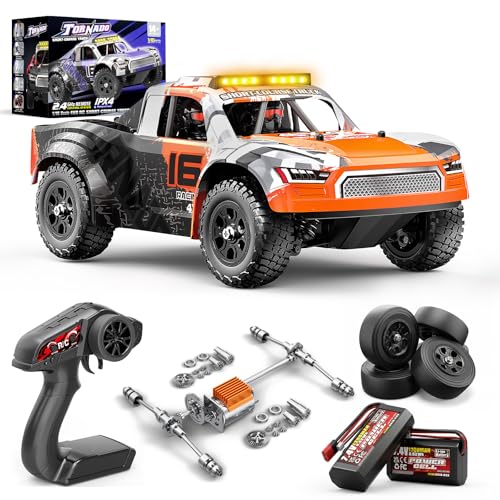
5. 1:16 Beginner RC Cars: best for teens and adults who want speed
What it is and who it suits
This is a 1:16 scale, four-wheel-drive short course truck with a metal drivetrain and two tire sets. It suits older children, teens and adults who want fast, controllable fun. The listed price is $75.99, which places it in the middle of this round-up.
Its listing describes it as a beginner model. However, its speed and parts put it closer to a hobby-style truck, so new drivers should expect a faster ride than a basic toy car.
Key features in simple words
The truck uses a proportional 2.4GHz remote, which gives smoother control than simple on-off buttons. The throttle responds to how far you press it, so gentle inputs produce gentle movement. A speed dial lets the driver set the top speed from 50 to 100 percent, which helps a beginner start slowly. The listed top speed is up to 22 mph.
The drivetrain is metal, including steel CVD shafts and a metal differential. Two 7.4V batteries are included, and each is listed at about 15 minutes of run time, depending on terrain and throttle use. Two tire sets, one for grip and one for drifting, are included, so the same truck can handle different surfaces and driving styles.
Everyday use and terrain
In everyday use, the truck suits gravel, hard-packed dirt, short grass and sand. Its low body and wide stance make it easier to slide on loose surfaces. A roll cage and a sturdy body help protect it during bumps, such as jumps off curbs or collisions with fences and rocks.
Because the batteries swap quickly, one pack can charge while the other runs. This keeps play going longer than a single-battery setup. The listed multi-driver range is about 230 feet, so friends can race together in a shared open space without tangling their signals.
Performance and ease of use
Performance is strong, with fast acceleration and stable handling at speed. The speed dial and steering trim help beginners adjust the truck to their skill. Learning to drift and control speed takes practice, so start on a flat, open area before trying tighter courses.
Setup is ready to run, so the truck is driving soon after charging the batteries. Owners should check the screws and parts after hard runs, as with other fast trucks. A quick look at fasteners and wheels after each session helps catch loose parts early.
Value for money
At $75.99, the truck offers a lot for its price. It combines a metal drivetrain, two battery packs and two tire sets. Buyers who want speed and durability without a large investment may find it a good balance, especially if they plan to use it often.
Pros
- Proportional control and a speed dial help beginners learn safely.
- Metal drivetrain and reinforced parts suit rough, repeated use.
- Two battery packs and two tire sets extend play and grip options.
- Ready to run, with the battery and remote the only items to set up.
Cons
- Listed battery run time is short, so extra packs may be useful.
- Higher speeds call for a safe, open area and careful driving.
- The truck is aimed at older users and may be too fast for younger children.
- Regular checks and maintenance are part of owning a fast hobby-style truck.
Comparison insights: how these RC trucks differ
The five trucks fall into two groups. Three are low-cost toy-grade models, while two are hobby-style trucks with metal parts and higher speeds. The price gap is clear, and it shapes what each truck is built to do. Toy-grade trucks focus on simple, affordable fun, while hobby-style trucks aim at longer use and more room to grow.
In performance, the UDIRC and the 1:16 Beginner truck lead on speed and control. The BIFYTON truck sits in the middle, with a faster top speed than the toy-grade models. The Barlisam and Hielse trucks offer steady, gentle performance that suits younger drivers who are still learning to steer. Gentle performance also means fewer surprises on hard floors and crowded play areas.
In ease of use, the simpler toy-grade trucks are the quickest to learn. They respond in predictable ways, so a new driver can focus on steering rather than managing speed. The UDIRC and the 1:16 Beginner truck reward patience with a more rewarding feel once the basics are clear. Both offer adjustable speed, which helps beginners ease into faster driving without jumping straight to full power.
For value, the three toy-grade trucks sit at the lower end of the price range. They are a sensible choice for a first try or for a child who may lose interest quickly.
The UDIRC and the 1:16 Beginner truck cost more, but their metal parts and upgrade or accessory options add to what they can do over time. The right choice depends on if the buyer wants a casual toy or a longer-lasting hobby truck that can handle more wear.
Buying guide: key factors for a first RC truck
Start with the rider’s age and experience. Younger children usually do best with a slower, simpler truck that is easy to steer and hard to break. Older teens and adults often want more speed, better handling and a sturdier build that can handle repeated runs on rougher ground.
Next, look at the drive system. Four-wheel drive sends power to all wheels and usually gives better grip on loose dirt, grass and sand. Two-wheel drive is simpler and often cheaper, but it can feel less stable on rough surfaces, especially when the truck climbs a slope or turns quickly.
Check the remote and radio. A 2.4GHz remote is common in modern trucks because it reduces interference when several trucks run together in the same area. Pistol-style remotes suit many hands and feel natural to hold, while proportional controls give finer control than simple buttons, which helps with smooth turns and gentle throttle changes.
Consider the batteries. Most trucks use rechargeable packs, and listed run times usually range from about 15 to 30 minutes per battery. Actual run time depends on speed, terrain and battery condition, so heavy use on rough ground will shorten each session. Extra packs extend play time and let a family take turns, and many remotes still need separate AA batteries, so check what is included before buying.
Finally, think about build quality. Toy-grade trucks use plastic parts and suit gentle play on smooth surfaces. Hobby-style trucks use metal parts and suit repeated, rougher use. Spare parts, such as suspension arms, tires and drive shafts, can also matter over time, because replacing a single worn part is usually cheaper than replacing the whole truck. Check if replacement parts are easy to find before you buy.
Who should buy these RC trucks: matching buyers to a model
A parent buying a first truck for a young child may prefer the Barlisam or Hielse model. Both are low-priced, ready to run and easy to learn. Simple steering and a short learning curve make them a practical first choice for small hands.
The Hielse model may suit a buyer who prefers its pistol-style remote. Many children find a grip-style controller more comfortable to hold for longer sessions. Trying the controller shape in a store or reading reviews from other parents can help confirm the fit.
A buyer who wants a faster toy with LED lights may look at the BIFYTON truck. Its rear-wheel drive and higher listed speed suit older children with some driving confidence. The lights also make evening play more fun.
A teen or adult who wants real speed and durability may consider the UDIRC or the 1:16 Beginner truck. The UDIRC suits a buyer who wants upgrade options later, such as replacement parts or added accessories. The 1:16 model suits a buyer who wants proportional control, two battery packs and two tire sets from the start. Proportional control lets the driver steer and throttle more smoothly, which helps when learning to handle speed.
Final verdict
For the youngest beginners and tight budgets, the Barlisam and Hielse trucks offer the simplest entry point. Both are easy to set up and use, though their speeds are modest. The BIFYTON truck adds speed and LED lights for a slightly higher price.
For buyers who want a more durable, hobby-style experience, the UDIRC and the 1:16 Beginner truck are the stronger choices. Both cost more, but they offer metal parts, faster speeds and more room to grow. Ask yourself how old the driver is, how much you want to spend and how much speed and durability you need. The best RC truck for beginners depends on those three answers.
Frequently Asked Questions
What is the best RC truck for beginners?
The best choice depends on age and budget. Younger children often do well with a simple toy-grade truck, while teens and adults may prefer a hobby-style model.
Do RC trucks need assembly?
All five trucks in this round-up are listed as ready to run. You mainly need to charge the batteries and power on the remote. Always check the product listing for any included items before you start.
What does 2.4GHz mean on an RC truck?
It is a radio frequency used by modern remotes. It reduces interference between trucks and usually gives a steadier connection than older frequencies. This helps when several trucks are running in the same area.
How long does an RC truck battery last?
Listed run times range from about 15 to 30 minutes per battery, depending on the model and how hard the truck is driven. Aggressive driving at full speed uses more power than gentle driving. Extra batteries help extend play.
Are hobby-grade RC trucks worth the extra cost?
They can be, for buyers who want metal parts, higher speeds and upgrade options. Casual users who only want a simple toy may find the toy-grade models enough. Think about how often the truck will be driven and how rough the terrain will be before deciding.

Peterson is an RC hobby enthusiast and product reviewer with a passion for remote-controlled cars, trucks, boats, drones, and accessories. He enjoys testing the latest RC products, comparing features, and sharing practical buying guides to help beginners and experienced hobbyists make informed decisions. Through RCThing.com, Peterson provides honest reviews, maintenance tips, and expert advice to help readers get the most from their RC adventures.