5 Best Foam RC Airplane In 2026
As an Amazon Associate we earn from qualifying purchases.
Picking a foam RC airplane can feel confusing at first. Many models look alike online, and product pages use similar words like flip, LED and headless mode. This guide helps beginners, parents and gift buyers understand what each option offers. It covers five popular foam RC airplanes, the features they share and how they differ in daily use.
Every product here is a lightweight, remote-controlled plane made from foam, usually sold for kids and adults aged six and up. All five include LED lights, stunt flips and easy takeoff and landing buttons. The comparison rests on the listed features, typical use and general knowledge of this product type, not on personal testing. Use it as a starting point, then check the current listing details before you buy.
Five Foam RC Airplanes Compared for Beginners
The table below lists the key details side by side. Use it to spot the differences before reading each review.


1. FUNPX Foam RC Airplane: best for night flying and party fun
The FUNPX Foam RC Airplane is a small, colorful foam plane aimed at kids and casual flyers. It stands out for its multi-color LED lights, which make it easy to follow after dark. It suits families who want a plane for evening play or a simple party display.
Best use cases
This plane fits best in open backyards, parks and large indoor spaces with plenty of room. Night flights are a clear strength, since the lights help you see where it is. It also works as a birthday or holiday gift that is ready to fly out of the box.
Key features in plain words
The plane has a high and low speed setting, so a new pilot can start slow and move up. One-touch stunt buttons perform 360-degree rolls. A dual-joystick remote lets you adjust height and turns with both thumbs.
The foam body is light, which helps it bounce off walls and the ground without much damage. One-key takeoff and landing and a headless mode are included to make early flights simpler. The package includes three modular batteries, which the listing says offer up to 45 minutes of flight in total, plus remote batteries.
Everyday use and performance
In everyday use, the controls are easy to grasp, but expect some practice before smooth stunts feel natural. The listing notes that the plane hovers best in calm weather, so wind will make it harder to hold steady. Indoor flying is possible, though outdoor use in still air gives more stable results.
Ease of use and value for money
Because it is ready to fly, setup takes very little time. The dual joysticks are a step up from one-stick toys, which helps beginners who want more control. At its listed price, it offers a good mix of lights, stunts and spare batteries for a gift.
Pros
- Bright multi-color LEDs make night flying easy to follow.
- Three modular batteries are included, giving longer total flight time.
- Foam body is light and handles bumps well.
- Two speed settings let beginners start slowly.
Cons
- Stable hovering depends on calm weather, so wind is a limit.
- Stunts take practice before they feel smooth.
- Battery swaps are needed for longer play sessions.
2. 4DRC V32 Foam RC Airplane: best for beginners who want many flight modes
The 4DRC V32 is a fighter-jet style foam plane with a wide list of flight modes. It suits buyers who want a plane that grows with a child’s skills. Its shape and LED lights give it a bold look for both kids and adults.
Best use cases
This model works well in school gyms, parks and open yards. The listing describes flights over sand and performing spins in larger spaces. It in a family setting, the plane suits a camping trip or a quiet suburban backyard. Its LED lights make evening flights more visible.
Key features in plain words
The V32 offers gravity sensing, which means the plane can respond to how the remote is tilted. It also has aerobatic rolls, 360-degree circling and altitude hold, which keeps the plane at a set height. Three speed options let the pilot move from careful flying to faster play.
The body uses EPP foam, a soft and flexible material that springs back after a tumble. Four built-in propellers sit inside a protective structure to help keep fingers away from the blades. No assembly is needed, so the plane is ready soon after unboxing.
Everyday use and performance
In daily use, the altitude hold feature makes it easier to keep the plane in the air while you focus on steering. Gravity sensing takes a little getting used to, since small hand movements can change the direction. Most buyers will find that practice in an open space pays off quickly.
Ease of use and value for money
The one-key takeoff and landing buttons are a clear help for beginners. Many features for the price make the V32 a solid option for a child who wants more than basic flying. Adults with some flying experience may also enjoy the range of modes.
Pros
- Many flight modes, including altitude hold and three speed options.
- Protective propeller design helps keep little hands safer.
- EPP foam body springs back after tumbles.
- No assembly needed, so flying starts quickly.
Cons
- Gravity sensing needs practice before it feels natural.
- The wide feature list can overwhelm very young beginners.
- Battery life details are not clearly given in the listing data.
3. RC Plane Remote Control Airplane: best for safety-focused families
The RC Plane Remote Control Airplane is a foam fighter-style plane built with safety and simple control in mind. It suits parents who want a plane that is easy to start and includes protective features. Its rechargeable batteries also make it a practical choice for regular play.
Best use cases
This plane fits backyards, parks and open play areas. Its racing features make it a good pick for siblings or friends flying together. It can also work for a birthday party where several planes fly at once.
Key features in plain words
Three speed modes let kids move up as their confidence grows. Altitude hold keeps the plane at a steady height, and headless mode makes direction easier to follow. One-key takeoff and landing keep the controls simple.
The plane uses a 2.4GHz remote system, a radio type that helps avoid signal clashes. Full-side propeller guards cover the blades to help protect hands. Two rechargeable batteries are included, and the listing mentions low-battery and out-of-range alerts.
Everyday use and performance
Because of its alerts and guards, daily use tends to feel calm and controlled. The low-battery warning gives a clear signal to land before the battery runs out. Keep the plane within range so it does not drift away.
Ease of use and value for money
No assembly means a child can start flying soon after opening the box. The included spare battery adds value for longer play sessions. For a plane in this price range, the feature set is well suited to families.
Pros
- Full-side propeller guards offer added protection for hands.
- Low-battery and out-of-range alerts help prevent losses.
- Two rechargeable batteries are included.
- Multiple planes can fly together thanks to the 2.4GHz system.
Cons
- The listing gives a flight time of up to 16 minutes, which may feel short for some players.
- Out-of-range alerts mean flying must stay within a set area.
- Stunts require practice to perform smoothly.
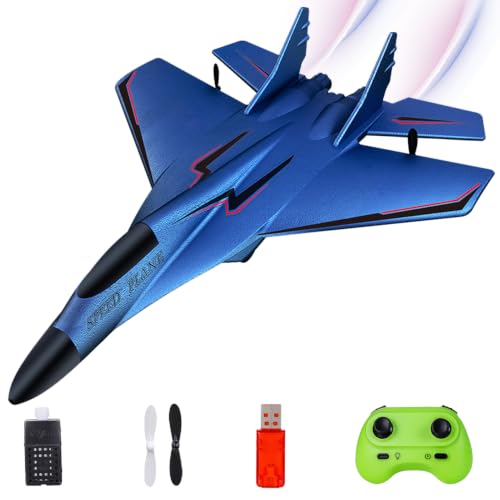
4. Lovovia Foam Remote Control Airplanes: best for ages 8 to 16 and outdoor play
The Lovovia Foam Remote Control Airplane is a blue foam fighter-jet style plane. It is aimed at children aged roughly 8 to 16, along with adults who are new to flying. It suits buyers who want a simple plane for outdoor play and evening fun.
Best use cases
This plane works well in backyards, parks and open outdoor spaces. The listing also mentions indoor flying, which suits calm days. It can be a good pick for weekend outings or a holiday gift.
Key features in plain words
One-key takeoff and landing and altitude hold make the basic controls easier to manage. Adjustable speed settings let the pilot choose how fast the plane flies. The plane can perform 360-degree rolls and spins with a press of a button.
Multi-color LED lights help the plane stand out at night. The 2.4GHz remote system is designed to reduce interference, which helps keep control steady. The shock-resistant foam body is light and built to take knocks.
Everyday use and performance
In regular use, the altitude hold feature helps the plane stay at a steady height while you practice turns. The foam body means minor crashes are less likely to cause damage. Expect the plane to respond best in calm air, as with most foam models.
Ease of use and value for money
The controls are straightforward, which suits a first-time pilot. Adjustable speeds let the plane grow with a child’s skills. At its listed price, it offers a useful set of features for outdoor fun.
Pros
- Simple one-key takeoff and landing suits beginners.
- Adjustable speed settings allow gradual progress.
- Shock-resistant foam body handles bumps well.
- Bright LED lights support evening play.
Cons
- Performance depends on calm weather, as with most foam planes.
- Flight time details are not clearly stated in the listing data.
- Stunts still need practice before they feel smooth.
5. MAXBECK Remote Control Wireless Airplane Toy: best for hybrid flying and outdoor fun
The MAXBECK Remote Control Wireless Airplane Toy is a Su-35 style foam plane with a hybrid design. It combines a rigid wing with features that suggest a glider and a quadcopter. It suits buyers who want a plane that can handle different kinds of outdoor play.
Best use cases
This plane fits open outdoor spaces, including areas near water, since the listing says it floats after landing in water. Night flying is also an option thanks to its LED lights. Groups can fly several planes together without mixing up their signals.
Key features in plain words
The plane uses 2-channel control, which lets the remote steer the plane in four directions: up, down, left and right. It is described as automatically balanced, which can help a beginner keep it level. Its 2.4GHz signal is said to be stable and works with multiple planes at once.
The plane needs open ground to take off. The listing says it should taxi and accelerate over 65 to 100 feet before lifting off, or it can be thrown to launch. The light foam build is meant to help it stay flexible and easy to handle.
Everyday use and performance
In daily use, the launch method is the main thing to plan around. A smooth, flat area gives the plane room to build speed. Thrown launches may suit those with some practice, while beginners may prefer taxiing on the ground.
Ease of use and value for money
The listing says a beginner can learn to fly it after a few hours of practice. Two-channel control is simpler than the multi-function remotes on some models. For the listed price, it gives a unique design with night lights and water-float features.
Pros
- Hybrid design suits varied outdoor play.
-
Because of its light build, the plane is also easy to pick up after a short landing. Groups who want to fly together will find the multi-plane signal useful. The design gives a different feel from standard fighter-jet models.
Pros
- Hybrid design suits varied outdoor play.
- Floats on water after falling in, according to the listing.
- Stable 2.4GHz signal works with several planes at once.
- LED lights support night flying.
Cons
- Needs a long, open area to take off by taxiing.
- Two-channel control offers fewer stunts than some rivals.
- Learning to fly may take several practice sessions.
Comparison Insights: Performance, Ease of Use and Value
All five planes share a foam body, LED lights and a 2.4GHz remote. The main differences lie in the number of flight modes and how each plane launches. Some models focus on stunts, while others focus on safety or outdoor flying.
For performance, the 4DRC V32 and the Lovovia offer many aerial moves with altitude hold. The FUNPX stands out for its dual joysticks and night display. The MAXBECK is built more for steady, long outdoor glides than tight tricks.
For ease of use, the RC Plane Remote Control Airplane and the Lovovia are easy to start, thanks to one-key takeoff and landing. The MAXBECK asks for a larger space and may need more practice. Beginners who want the simplest start should weigh this trade-off carefully.
For value for money, the FUNPX includes three batteries, which helps longer sessions. The RC Plane Remote Control Airplane adds two rechargeable batteries and safety guards. Prices are close across the group, so the features matter more than the price gap.
Buying Guide: Key Factors Explained in Plain Words
Start with the pilot’s age and skill level. Simpler controls suit young children, while more modes suit older kids and adults. Read the feature list to see if the plane offers speed settings and altitude hold.
Next, think about where you will fly. Open parks and backyards suit larger planes with a stable hover. Indoor flying works better with lighter planes and calm air, and wind is a limit for all foam models.
Battery setup matters too. Some packages include spare batteries, while others include rechargeable ones. Check how many batteries come in the box, since extra packs help you fly for longer.
Safety features are worth a look. Propeller guards and a protective foam body help reduce the risk of injury and damage. Always supervise young children during flight and keep the plane away from people, pets and power lines.
Finally, consider the gift factor. Ready-to-fly planes with lights work well for birthdays and holidays. A plane with clear alerts and simple controls can help a first-time owner get started quickly.
Who Should Buy These Products
Parents of young children may find the RC Plane Remote Control Airplane a good fit. Its guards, alerts and simple controls suit a first plane. The FUNPX is another option for families who want evening play.
Older kids who want more flight modes may prefer the 4DRC V32. Its altitude hold and three speed options give room to grow. The Lovovia suits children aged about 8 to 16 who want outdoor play with easy controls.
Buyers who want a plane for group flying or water-side fun may like the MAXBECK. Its hybrid design and float feature suit open spaces. It fits adults and older teens who are willing to practice launches.
Final Verdict
No single plane is right for everyone. The best choice depends on the pilot’s age, the flying space and how much practice the buyer expects to do. Each model covers a different set of needs.
For a simple first plane with safety features, the RC Plane Remote Control Airplane is a sensible pick. For night fun, the FUNPX stands out. For more modes and growth, the 4DRC V32 and the Lovovia are worth comparing.
Before buying, check the current listing for the latest details on price, batteries and included parts. Matching the plane to the pilot’s sk ill with the plane’s features will help you get the most value from your purchase.
Frequently Asked Questions
Are foam RC airplanes safe for young children?
Foam planes are generally light and soft, which helps reduce the risk of injury and damage. Propeller guards add further protection on some models. Adult supervision is still important, especially for younger children.
Can foam RC airplanes fly indoors?
Some models can fly indoors in a large, open room. Calm air gives the best results, since wind makes stable flight harder. Always check the space for ceiling fans, furniture and other obstacles first.
Do these planes need assembly?
All five planes are described as ready to fly or needing no assembly. Charge or install batteries as directed, then start flying. Check the listing for the exact package contents before you buy.
What does headless mode mean?
Headless mode lets the plane respond to the remote based on the pilot’s position, not the plane’s direction. This makes it easier for beginners to avoid losing track of which way the plane is facing. It is a helpful feature for first-time flyers.
Are these planes suitable for adults?
Several models suit adults as well as children, especially those with stunt modes and multiple speed settings. Adults who want a relaxed outdoor hobby may enjoy the MAXBECK or the 4DRC V32. Check the age guidance on each listing before buying.

Peterson is an RC hobby enthusiast and product reviewer with a passion for remote-controlled cars, trucks, boats, drones, and accessories. He enjoys testing the latest RC products, comparing features, and sharing practical buying guides to help beginners and experienced hobbyists make informed decisions. Through RCThing.com, Peterson provides honest reviews, maintenance tips, and expert advice to help readers get the most from their RC adventures.