How to Stop Your RC Car from Flipping Over?
If you’ve just started playing with remote control cars, you’ve probably experienced that frustrating moment when your new hobby literally flips upside down on you. One second you’re cruising along, feeling like a pro, and the next second your RC car is doing an unintended somersault. Don’t worry—this happens to almost everyone who drives RC vehicles, especially when they’re learning.
The good news? You can fix this problem. Flipping doesn’t need to ruin your fun. In this guide, we’ll walk you through practical tips that actually work to keep your RC car upright and stable. These solutions range from simple tweaks you can make right now to longer-term changes that make a big difference over time.
Why Do RC Cars Flip in the First Place?
Before we dive into solutions, let’s talk about why your remote control car keeps flipping. When you know the reason, fixing the problem becomes way easier.
Most RC car flips happen because the vehicle becomes unbalanced or unstable during certain moves. Your RC car has a center of gravity—basically, the point where all its weight seems to balance. When this center of gravity moves too far forward, backward, or to the side, your car loses stability and tips over.
The most common flipping situations include accelerating too hard, hitting bumps or jumps at the wrong angle, or taking sharp turns at high speed. Your RC car’s suspension can’t keep up with the forces you’re creating, so the vehicle tips.
Sometimes your car flips because you’re driving on terrain that’s too rough or uneven. Other times, the problem comes from inside the car itself—maybe the weight isn’t distributed right, or your suspension settings need adjustment. The wheels might not have enough grip on the ground, or your driving technique needs work.
Adjust Your Suspension System
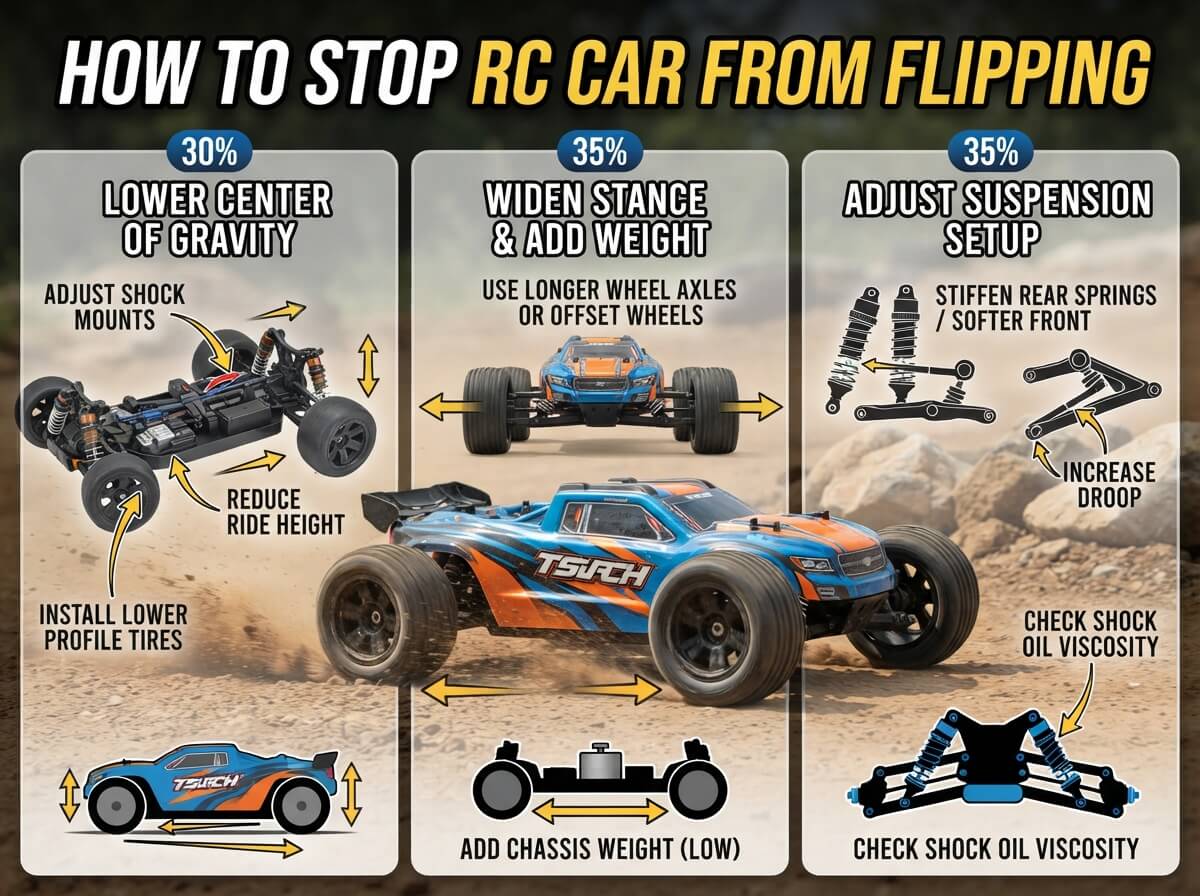
Your RC car’s suspension works like the shock absorbers on a real car. It keeps the wheels on the ground and absorbs bumps and impacts. When your suspension isn’t set up correctly, your car becomes bouncy and unstable, which leads to flips.
Start by looking at your shocks. These are the tubes that let your car bounce up and down smoothly. Check if they’re too soft or too stiff. Soft shocks let your car bounce around too much, while stiff shocks don’t absorb impacts well and make your car rigid.
For beginners, you want suspension that’s in the middle ground. Not too soft, not too hard. If your RC vehicle feels like it’s bouncing all over the place, your shocks are probably too soft. Try tightening them up a bit or replacing the spring inside with a stiffer one.
The ride height also matters a lot. Ride height is how close your RC car’s body sits to the ground. If your car is too low, the body can scrape and cause handling problems. If it’s too high, you lose stability. Adjust your suspension arms to find the sweet spot where your car sits level and balanced.
Don’t forget about anti-roll bars, if your remote control vehicle has them. These bars help your car lean less when it turns, which stops it from tipping during cornering. Stiffer anti-roll bars give you more stability when turning.
Get Your Weight Distribution Right
An RC car that feels heavy or unbalanced flips much easier than one that’s balanced properly. Weight distribution determines whether your vehicle stays planted or becomes unstable.
Start with the battery. The battery is usually one of the heaviest parts of your remote control car. Make sure it’s mounted low and centered in your vehicle. Never stick the battery way up high or way to the back. Both of these positions raise your center of gravity and make flipping more likely.
Check what other parts you’re carrying. Some people add upgrades like better motors, extra armor, or cameras. Each addition changes how your RC car feels. Keep heavy upgrades low and in the middle of the car.
Look at the front of your car too. If your motor, transmission, or front bumper adds too much weight up front, your vehicle will be nose-heavy. This causes the back to lift up easily during acceleration or when you hit a jump. Add weight to the rear if needed to balance things out.
A balanced RC car feels better to drive and flips way less often. Spend time getting this right, and you’ll see huge improvements immediately.
Lower Your RC Car’s Center of Gravity
The lower your RC car’s center of gravity sits, the harder it is to flip. Physics works in your favor here. A lower center of gravity means your car needs to tilt more before it tips over.
One easy way to lower your center of gravity is to use a lower-profile battery. Some batteries are flat and thin, while others are tall and bulky. Flat batteries sit lower in your car and help stabilize the whole vehicle.
You can also lower your car by reducing the height of the suspension. Adjust your suspension arms down a bit. This brings everything closer to the ground. Just make sure your car can still move without the body scraping on obstacles.
Some RC car bodies are taller or heavier than others. If your car keeps flipping, think about switching to a different body style. Lower, sleeker bodies help with stability.
Keep your car’s body as compact as possible. Remove or secure any loose parts that might move around and throw off the balance while you’re driving.
Master Your Driving Technique
Sometimes the problem isn’t your car—it’s how you’re driving it. Your technique and habits make a huge difference in whether your RC car flips.
Acceleration is key. When you slam on the throttle, the sudden force shifts the weight toward the back of your car, lifting the front wheels. This is a recipe for flipping. Instead, accelerate smoothly and gradually. Build up speed gently rather than jerking the remote control.
When you’re coming down from a jump or going over a bump, land flat and level. Try to hit jumps straight on, not at an angle. If your car lands tilted, it’ll flip. Use smooth, controlled motions on your controller to keep your remote control car stable.
Turning at high speed is super risky. Slow down before you turn, make your turn smoothly, and then speed up after. Never jerk your steering hard to the side while going fast. This throws your weight sideways and causes flips.
Practice your throttle control. Get comfortable with how your remote control car responds to different amounts of throttle. Learn the difference between gentle acceleration and full power. Most flips happen because people punch the throttle too hard.
Choose the Right Terrain for Your Skill Level
Not all terrain is created equal when it comes to RC car stability. Some surfaces make flipping much more likely than others.
Smooth, flat ground is perfect for beginners. Grass fields and smooth dirt work great. These surfaces don’t create sudden shocks or uneven spots that throw your car off balance.
Avoid loose gravel, sand, and rocky terrain when you’re learning. These surfaces create unpredictable traction, which makes your car slide and flip. They also hide holes and obstacles that catch your wheels at weird angles.
Bumpy ground is a common flip zone. Rocks, roots, and sudden dips can catch your wheels and make your car vault over. Start with smoother areas and work up to rougher terrain as you get better.
Water crossings and wet dirt reduce traction and stability. Stay away from these when you’re first starting out.
Slopes and hills are trickier than flat ground. Going uphill is usually okay, but coming downhill at speed easily leads to flips. Practice on slight slopes before trying steep hills.
Increase Traction With Better Tires
Your tires are the only part of your RC car that touches the ground. Good traction keeps your vehicle planted and stable. Bad traction leads to sliding and flipping.
Check your current tires. Are they bald and worn smooth? Replace them. Worn tires slip and slide, which causes loss of control and flips.
Different tire types work better for different surfaces. Off-road tires have big treads and knobs that dig into dirt and grass. Street tires are slick and work best on pavement. Pick the tire type that matches where you drive most.
Make sure your tires are the right size for your RC vehicle. Too-small tires lower your ground clearance and make bottoming out more likely. Too-large tires can rub on your car’s body and cause handling problems.
Check your tire pressure if your tires are the pumped kind. Slightly higher pressure gives you more stability, while lower pressure provides more grip. Start in the middle and adjust based on how your car handles.
Tire compound matters too. Softer compounds grip better but wear out faster. Harder compounds last longer but don’t grip as well. For beginners, a medium compound works fine.
Upgrade Your Suspension Components
If you’ve tried the basics and your RC car still flips, it might be time to upgrade some parts. Better suspension components make a real difference.
Replace your shocks with higher-quality ones. Premium shocks have better internals that absorb impacts more smoothly. They keep your wheels on the ground better during rough driving.
Try adjustable suspension arms if your car has them. These let you fine-tune your ride height and anti-roll bar settings. More options mean you can dial in the perfect setup for where you drive.
Add or improve your anti-roll bars. Some budget RC cars don’t have them, but adding one creates massive stability improvements. If your car already has them, stiffer bars reduce body roll during turns.
Check your ball joints and pivot points. Loose connections create slop that makes your car feel unstable and unpredictable. Tighten everything up or replace worn parts.
Slow Down Your Steering Response
Sometimes your remote control car flips because it reacts too quickly to steering inputs. If your car whips its wheels around too fast, it causes the body to lean hard and flip.
Many RC car controllers let you adjust steering speed or sensitivity. This setting controls how quickly the wheels respond to your steering input. Try reducing this setting to make steering slower and more gradual.
Slower steering response gives you more time to control your car and prevents sudden shifts in weight. Your vehicle will feel more stable and less twitchy.
Start with moderate steering response and only increase it once you’re confident and skilled. Racing pros use fast steering, but beginners need something gentler.
Replace or Modify Your Body
Your RC car’s body isn’t just for looks—it affects how your car handles and whether it flips.
Heavy or tall bodies raise your center of gravity and make flipping easier. If your current body is bulky, try switching to a lighter, lower-profile one. You might be surprised at how much this helps.
Some bodies have poor aerodynamics or catch wind at speed. This creates instability, especially at high speeds. Choose a streamlined body design.
Make sure your body is securely mounted and balanced. A body that shifts around mid-drive throws off your weight distribution and causes flips.
If your body has tall sides or a high roof, consider removing unnecessary body parts if your car allows it. Less mass and surface area means more stability.
Use Linkages and Adjustable Settings
Most RC cars have adjustment points that let you fine-tune how they handle. Take advantage of these.
Camber angle affects how your tires sit and how much they grip. Adjust camber for better tire contact with the ground.
Toe-in adjustments change how your wheels point relative to the direction you’re going. Small toe-in adjustments improve tracking and stability.
Downforce holes or wings add stability at high speeds by creating aerodynamic effects. If your car supports these, try them out.
Sway bar connections and pivot points can be adjusted on many RC vehicles. Experiment with different settings and pay attention to how your car feels.
Keep a notebook or use your phone to record which settings feel best. Once you find good settings, you’ll know what to aim for on future adjustments.
Practice Makes Perfect
Here’s the honest truth: the more you drive your RC car, the better you’ll get at not flipping it. Practice teaches you how your specific car handles and how to avoid situations that cause flips.
Start in wide-open spaces where you won’t damage anything if you flip. Practice smooth acceleration, gentle turning, and controlled braking. Build muscle memory for good driving habits.
Try different speed ranges. Learn exactly how fast you can go in turns before your car becomes unstable. Everyone’s car is different, so you need to find your car’s limits.
Practice jumping and landing smoothly. Land flat, not tilted, and always land with your wheels together for stability.
Watch experienced RC car drivers and learn from their techniques. Notice how they accelerate smoothly, take turns gradually, and avoid jerky movements.
Don’t get discouraged by flips. They’re part of learning. Each flip teaches you something about how your car behaves.
Keep Your RC Car in Good Shape
A well-maintained remote control car flips less often than one with wear and tear.
Check your bearings. Worn bearings create play and slop in your suspension. Replace them if they feel loose or grinding.
Inspect your tie rods and steering linkages. These connect your steering servo to your wheels. Bent or loose linkages cause handling problems.
Make sure your motor has enough power for your car’s weight. A weak motor can’t accelerate smoothly and causes traction loss, which leads to flips.
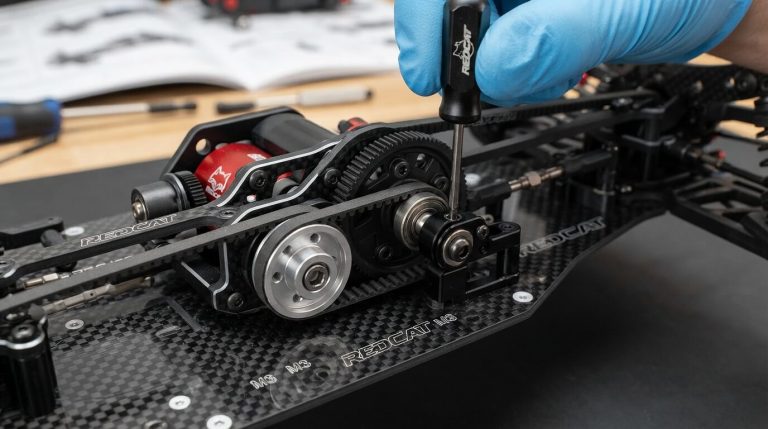
Check all bolts and screws regularly. Loose hardware shifts around and throws off your balance.
Keep your gears clean and properly meshed. Worn gears create inefficient power transfer and handling problems.
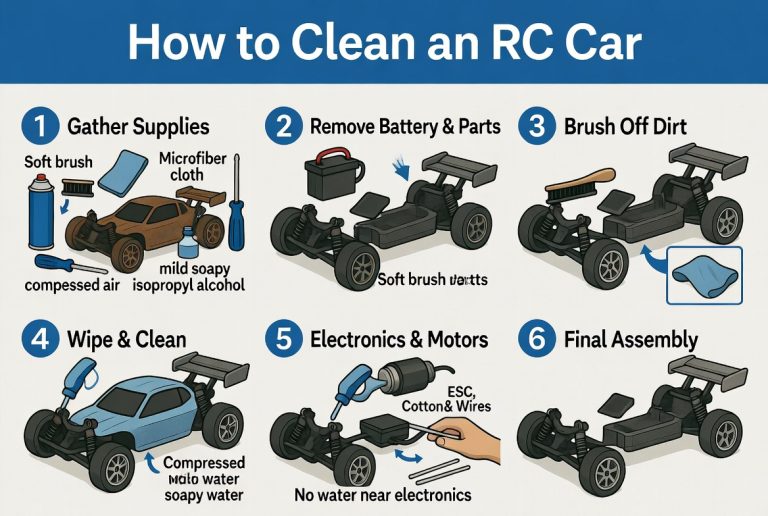
Clean your car after each driving session, especially if you drove in mud or sand. Dirt clogs moving parts and affects performance.
Conclusion: Your RC Car Can Stay Upright
RC cars flipping is frustrating, but you have plenty of tools to fix it. Start with the easiest changes—smooth driving technique and better suspension settings. Move on to weight distribution and tire upgrades. Gradually make bigger changes as you need them.
Remember that most flips come from either poor driving technique or an unbalanced, unstable car setup. Focus on both of these areas, and you’ll see massive improvements.
Take your time learning. There’s no rush to go super fast or tackle crazy terrain. Build your skills gradually, and your RC car will stay upright more and more.
Get out there, practice these tips, and enjoy your remote control car without the frustration of constant flipping. You’ve got this!