
Rc Truck Vs Rc Car
Many beginners wonder about RC truck vs RC car when they first look at remote control vehicles. The names often sound interchangeable, and many shops use them loosely. Still, these models differ in build, handling and where they perform best.
This article explains each type, compares their construction and performance, and lists what to consider before buying. By the end, you should feel ready to pick the right model.
Key Takeaways
- The terms RC truck and RC car overlap, and many sellers use them loosely.
- RC trucks usually have taller bodies, more ground clearance and tougher suspension for rough terrain.
- RC cars are often lower and faster on smooth surfaces such as pavement or indoor floors.
- Decide where you will drive first, then choose the body style that suits that place.
- Check battery type, run time, charging needs and your budget before you buy.
What Is an RC Truck and What Is an RC Car?
Both terms describe a model vehicle steered with a handheld transmitter. Each has a motor, a battery, a receiver and drive parts. The main difference lies in body design and intended use.
Defining a Remote Control Car
A remote control car sits low to the ground and has a road-vehicle shape. Its low center of gravity and smaller wheels suit smooth surfaces. Many RC cars are built for quick driving on pavement or hard indoor floors.
Racing-style on-road cars focus on grip, cornering and speed. Their low stance can make them struggle on bumps, grass or loose dirt.
Defining a Remote Control Truck
A remote control truck looks and acts more like a pickup or off-road vehicle. It has a taller body, larger wheels and more space between the chassis and the ground. This clearance helps it cross rocks, roots and uneven terrain.
Many RC trucks use longer-travel suspension to keep the wheels in contact with rough ground. Trucks are often the choice for outdoor driving in yards, parks and trails.
Why Beginners Often Mix Up the Two Terms
Manufacturers, retailers and hobbyists use the words loosely. A model sold as a car may have a truck-like body, and a model called a truck may simply be a small off-road buggy. Listings do not always follow strict rules.
Look at body shape, ride height and tire size rather than the name alone. These features show how the model will actually behave.
How RC Trucks and RC Cars Are Built Differently
The build of a model shapes how it feels to drive. Small differences in the chassis, suspension and drive system add up to very different handling.
Chassis, Body Shape and Ride Height
The chassis is the base frame that holds the motor, battery and electronics. On an RC car, it is usually low and flat, which keeps the center of gravity near the ground and aids stability in turns.
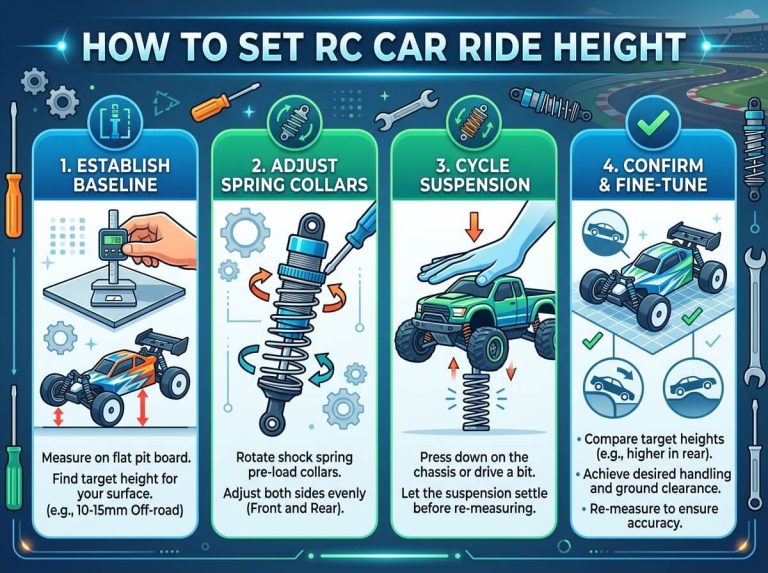
An RC truck has a higher chassis and taller body. The greater ride height helps it pass over obstacles more easily.
Suspension, Tires and Ground Clearance
Suspension parts such as shock absorbers and springs help the wheels follow the ground. Trucks often have longer suspension travel to absorb bumps. Cars usually have shorter, firmer suspension for tight control on smooth ground.
Tires also differ. RC cars often use smaller, smoother tires for grip on pavement or indoor floors. RC trucks usually have larger, knobby tires that bite into dirt, grass and gravel.
Ground clearance is the distance between the lowest part of the model and the ground. Trucks generally have more, while cars can scrape on bumps or tall grass.
Drivetrain and Power Options
The drivetrain sends power from the motor to the wheels. Some models drive only the rear wheels, while others drive all four. Four-wheel drive, often shortened to 4WD, helps a model climb and pull through loose ground.
RC cars are often rear-wheel drive, which suits smooth surfaces and sharp handling. Many RC trucks use 4WD for better traction on rough terrain. Electric motors are the most common power choice for beginners. Always check the drive layout listed for any model you consider.
How RC Trucks and RC Cars Perform on Different Surfaces
Where you drive matters as much as the model itself. A design that works well on a smooth floor may struggle outside. Matching the surface to the model keeps the fun going and reduces damage.
Pavement and Smooth Indoor Floors
RC cars shine on pavement, concrete and smooth indoor floors. Their low profile and grippy tires help them corner quickly and stay controlled.
RC trucks can drive on smooth surfaces too, but their tall bodies can feel tippy at high speed. For these places, a car is usually the simpler choice.
Dirt, Grass, Gravel and Rough Terrain
Trucks are built for outdoor ground. Their extra clearance and longer suspension help them handle dirt paths, grass, gravel and small rocks.
RC cars can struggle on loose or uneven ground. Their low body may catch on bumps, and their smaller tires can lose grip in dirt. Rough terrain suits a truck better.
Speed, Handling and Stability
Speed depends on the motor, gearing and battery as well as the body style, so no single rule applies to every model. In general, low, light cars feel quick and precise on flat surfaces.
Trucks feel more stable over bumps but less agile in tight turns. Their higher center of gravity means they may lean more in fast corners. A truck rewards careful driving, while a car rewards smooth, confident inputs.
Common Types of RC Trucks and RC Cars
Both categories include many sub-types, and each suits a different style of driving. Looking at the main types helps you narrow your search quickly.
Monster Trucks, Crawlers and Off-Road Trucks
Monster trucks have oversized tires and high ground clearance, built for jumps and rough outdoor play. Crawlers are slower trucks designed to climb steep, rocky terrain with precise control.
Off-road trucks balance speed and clearance, making them a common choice for general outdoor driving. Many beginners start with this type because it handles varied ground well.
Buggies, Touring Cars and On-Road Racers
Buggies are off-road cars with a low, wedge-like shape and knobby tires. They handle dirt tracks and light trails better than most road-style cars.
Touring cars and on-road racers are built for smooth, paved surfaces. They emphasize grip, cornering and precise steering, and they are common in organized racing.
Drift Cars and Specialty Models
Drift cars are designed to slide through corners on purpose. They usually use rear-wheel drive and a setup that lets the rear tires lose grip in a controlled way.
Specialty models include scale replicas, detailed rock crawlers and tiny indoor cars. These suit collectors and people with specific interests, while beginners can still find a good match among the common types above.
Comparing RC Trucks and RC Cars for Beginners
Once you know the basic differences, compare the practical side. Cost, repairs, learning curve and storage all affect daily enjoyment, often more than looks.
Cost, Parts and Repair
Prices vary widely between brands, sizes and features. Trucks with larger tires and stronger suspension can cost more than basic cars. Check replacement part prices before you buy, since repairs add up over time.
Cars sit low, so they can break bumpers or suspension arms after hard landings. Trucks often absorb impacts better, though they may still need repairs after rough use.
Learning Curve and Ease of Driving
Many beginners find trucks easier to drive outdoors. The taller body and softer suspension forgive small mistakes on bumps. Their slower feel can make steering and throttle control simpler to learn.
Cars reward careful driving but can feel twitchy at speed. Either type gets easier with time and smooth habits.
Space, Storage and Where You Can Drive
Cars usually fit well in smaller spaces, such as hallways or a flat driveway. Trucks are often larger, so measure your storage space before buying.
Think about where you will drive most often. A park, yard or trail suits a truck, while a smooth lot or indoor room suits a car. Check local rules for public areas.
Maintenance and Durability
Both types need regular care, such as cleaning dirt from bearings and checking screws. Trucks with more suspension parts may need more frequent checks, while cars with simpler setups can be quicker to maintain.
Durability depends more on build quality and how the model is driven than on body style alone. Gentle use and routine checks extend the life of either type. In short, care matters more than category.
Tips for Picking Between an RC Truck and an RC Car
A clear plan makes the choice easier. Start with your driving location, then consider power, setup and budget. These steps help you avoid buying a model that does not fit your needs.
Matching the Model to Your Driving Location
List the places where you expect to drive most. For grass, dirt or gravel, a truck is usually the better fit. For pavement or indoor floors, a car will likely suit you more.
An off-road truck or buggy can offer a useful middle ground. Still, be honest about your main use.
Checking Battery Type, Run Time and Charging
Most modern RC models use rechargeable batteries. Check the battery type, listed capacity and included charger. Run time varies with driving style, terrain and battery condition, so treat any listed figure as a general guide.
A spare battery can keep you driving while another charges.
Deciding Between Ready-to-Run and Kit Models
Ready-to-run models come mostly assembled, with electronics installed. They suit beginners who want to start driving quickly. Kits teach you how the vehicle works, but they take more time and patience.
If you are new, a ready-to-run model is usually the simpler starting point. You can try a kit later.
Setting a Realistic Budget
Decide how much you want to spend before you shop. Include the model, a charger, spare batteries and basic tools. Extra costs add up quickly.
Keep a small reserve for replacement parts, since even careful drivers may need repairs.
Safety and Basic Care Tips for New Owners
Good habits protect you, your model and the people around you. Simple care also helps the model last longer. These tips apply to both trucks and cars.
Charging and Handling Batteries Safely
Always use the charger recommended for your battery. Never leave batteries charging unattended, and keep them away from heat and flammable materials. Stop using any battery that is swollen, hot or damaged.
Read the manufacturer’s instructions for charging and storage, since many batteries should not be fully discharged before storage.
Cleaning, Storage and Routine Checks
After each session, brush off dirt, grass and dust. Check screws, wheels and suspension parts for looseness or wear. Small checks prevent bigger problems later.
Store the model in a dry place with the battery removed or stored safely. Keeping it clean and dry protects the electronics and bearings.
Frequently Asked Questions
Is an RC truck the same thing as an RC car?
Both are remote control vehicles, so the terms overlap. A truck usually has a taller body, more ground clearance and longer suspension. A car is typically lower and built for smoother surfaces.
Which is better for a complete beginner, an RC truck or an RC car?
It depends on where you plan to drive. Trucks suit outdoor ground such as grass, dirt and gravel. Cars suit smooth pavement or indoor floors.
Can an RC truck go on the same tracks as an RC car?
Many RC trucks can drive on smooth tracks, but their tall bodies may feel less stable at high speed. Cars are usually better for dedicated on-road tracks. Check the track rules and the model’s design first.
Are RC trucks more expensive than RC cars?
Prices vary widely by brand, size and features, so there is no fixed answer. Compare specific models rather than the category alone.
Do RC trucks and RC cars need special batteries?
Most use rechargeable batteries, but the type and size depend on the model. Use only the battery and charger the manufacturer lists for that vehicle.
Conclusion
The difference between an RC truck and an RC car comes down to body design, ride height and intended terrain. Trucks suit rough outdoor driving, while cars suit smooth surfaces and quick handling. Because the names overlap, the features matter more than the label.
Before buying, consider where you will drive, what battery and charging setup you need, and what budget you can manage. If you are new, start with a ready-to-run model. With steady practice and basic care, either type can be a rewarding hobby.
Peterson is an RC hobby enthusiast and product reviewer with a passion for remote-controlled cars, trucks, boats, drones, and accessories. He enjoys testing the latest RC products, comparing features, and sharing practical buying guides to help beginners and experienced hobbyists make informed decisions. Through RCThing.com, Peterson provides honest reviews, maintenance tips, and expert advice to help readers get the most from their RC adventures.

2 Comments