How To Make An Rc Car Faster
Many people want to know how to make an RC car faster, but the answer is not one single part. Speed comes from how the power, grip, gearing and weight work together. This article explains each of these ideas in plain words so a beginner can understand what matters most.
You will learn what makes a remote control car quick, which parts affect speed, and which changes are worth trying first. You will also see common mistakes that slow cars down and some basic safety points. The goal is to help you make smart, careful improvements.
Key Takeaways
- Speed depends on power, grip and weight working together, not on one part alone.
- Gearing, battery voltage and motor type have the biggest effect on how fast a car goes.
- Good tires and a clean drivetrain help the car use its power on the ground.
- Overgearing and worn batteries can slow a car down or cause overheating.
- Small, careful changes are a safer way to learn than large upgrades all at once.
What Makes an RC Car Fast?
An RC car is fast when it can reach a high speed and build that speed quickly. Both matter. Some cars launch hard but stop climbing early, while others take longer to start but run longer at high speed.
Speed, Acceleration and Top Speed Explained
Acceleration is how quickly a car gains speed. Top speed is the highest speed the car can hold. A car with strong acceleration feels punchy off the line, which is useful for short tracks and bashing.
Top speed depends more on gearing and motor power. Acceleration depends on grip and how well the car puts its power to the ground. Knowing the difference helps you decide which change to make first.
How Power, Grip and Weight Work Together
Power is the energy the motor sends to the wheels. Grip is how well the tires hold the surface. If the car has lots of power but poor grip, the wheels spin and the car does not move forward well.
Weight also plays a role. A lighter car usually speeds up faster because it has less mass to move. A heavy car needs more force to reach the same speed, so balance matters.
The Main Parts That Affect RC Car Speed
Several parts work as a system. Each one can limit the others. Learning what each part does makes it easier to plan upgrades without wasting money.
Motor Type and Motor Size
The motor turns electrical energy into rotation. Brushed motors are simpler and cheaper. Brushless motors are generally more efficient and can deliver more power for their size.
Motor size is often shown as a number, such as a turn rating. A lower turn number usually means more power but less top speed in the same gearing. This is a general pattern, so check the product details for the exact meaning on each motor.
Battery Voltage and Battery Capacity
Voltage is the electrical push that drives the motor. Higher voltage usually means higher speed, as long as the other parts can handle it. Capacity, measured in milliamp hours, shows how much energy the battery stores.
Capacity mainly affects run time, not peak speed. A bigger capacity battery does not make the car faster by itself. Always confirm that the car, motor and speed controller support the voltage you plan to use.
Electronic Speed Controller (ESC) Basics
The electronic speed controller, often called the ESC, manages power from the battery to the motor. It decides how much current reaches the motor when you press the throttle. It also protects the system from certain problems.
An ESC must match the motor and battery type. Using a controller rated too low can cause overheating or failure. Many beginners upgrade the ESC along with the motor so the parts work well together.
Gearing and Pinion-to-Spur Ratio
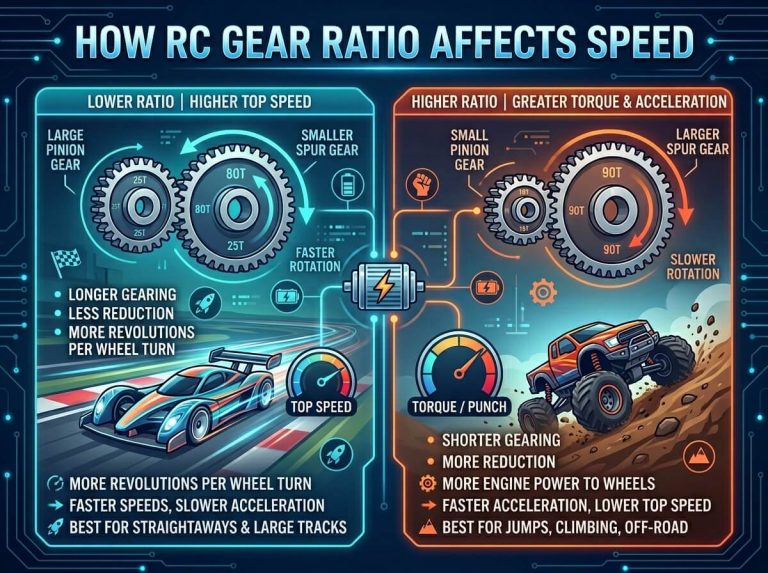
Gearing controls how the motor turn is passed to the wheels. The pinion is the small gear on the motor, and the spur is the larger gear that turns the spur is the larger gear that turns the driveshaft. The ratio between these two gears changes how the car feels.
A smaller pinion or a larger spur usually gives more top speed but slower acceleration. A larger pinion or smaller spur gives quicker launches but a lower top speed.
Gearing is one of the most useful tuning tools. Changing it is often cheap and easy.
It is also easy to overdo, which is covered later in this article.
Tires, Wheels and Traction
Tires are the only part of the car that touches the ground. Their grip decides how much power can actually move the car forward. Softer rubber usually grips better on smooth surfaces, while harder compounds often last longer.
Wheel design also matters. Wheels that are light and stiff help the tires respond quickly. Tire choice should suit the surface, if it is dirt, carpet, asphalt or a mix.
Suspension Setup and Ride Height
Suspension controls how the wheels follow the ground and how weight shifts during acceleration and braking. A stable setup keeps tires in contact with the surface. Poor setup can make the car bounce or lose grip at speed.
Ride height is the distance between the chassis and the ground. A lower ride height often lowers the center of gravity, which can improve stability. Too low, however, can cause parts to scrape and slow the car down.
Step-by-Step Ways to Make an RC Car Faster
The steps below follow a sensible order. Start with the simplest checks and move toward bigger changes only when needed.
Start With a Full Charge and Good Batteries
Before changing any part, check the battery. A fully charged, healthy battery delivers the most power. A low or aging battery can make the car feel slow even when the setup is good.
Charge batteries with a charger made for their type. Let them cool before and after use. Good battery care is one of the cheapest ways to keep speed steady.
Adjust the Gearing for More Top Speed
Gearing is often the first tuning step for top speed. Change the pinion gear one tooth at a time. Test the car after each change and watch motor temperature.
In practice, a small increase in pinion size can raise top speed while keeping temperatures in check. Large jumps can overheat the motor and drain the battery quickly. Make changes slowly.
Upgrade the Motor and Speed Controller
A stronger motor can add power, especially when paired with a matching ESC. Brushless systems are a common upgrade for drivers who want more speed. Choose a motor and controller that suit the battery voltage and the car’s design.
Always check the manufacturer’s guidance for compatibility. A powerful motor on a weak chassis can lead to broken parts. Upgrades work best as a complete set rather than one part at a time.
Reduce Weight and Drag
Lighter parts help the car accelerate faster. Some drivers replace heavy plastic or metal parts with lighter options where the car’s strength allows. Removing unneeded accessories can also help.
Drag is the air resistance that slows the car at high speed. A low, streamlined body shape can reduce drag. Keep the body secure and undamaged, since loose or cracked shells can change airflow.
Improve Tire Grip and Traction
Good traction lets the car use its power. Choose tires suited to the driving surface. Clean the tires regularly, since dust and debris reduce grip.
Foam inserts and tire glue are options some drivers use on certain surfaces. These can change grip and handling, so test carefully. Keep the tire pressure consistent on each side of the car.
Keep Bearings, Drivetrain and Parts Clean
Dirt and grit can slow the drivetrain, which carries power from the motor to the wheels. Clean and lightly oil moving parts as the manufacturer suggests. Check bearings for roughness.
Loose screws and worn gears waste power. A quick check after each run helps catch these problems early. A well-kept car usually feels smoother and faster.
Upgrades for Beginners: What to Change First
<
Upgrades for Beginners: What to Change First
New drivers often wonder where to spend money first. The best starting point is usually the cheapest change that gives a clear result. Bigger upgrades can wait until you understand how the car behaves.
Low-Cost Changes That Make a Difference
Gearing and tire care are among the simplest changes. Both cost little and can be undone easily. They also teach you how each part affects the car.
Keeping the battery healthy is another low-cost step. A good battery often gives more real-world speed than a new part with a tired pack. Tightening loose hardware and cleaning the drivetrain also help at no cost.
Bigger Upgrades for Experienced Drivers
Motor and speed controller upgrades bring more power, but they also raise the stress on the rest of the car. Stronger drivetrain parts, better bearings and a tougher chassis may be needed. These changes suit drivers who already know how to read temperatures and spot wear.
Some drivers also move to higher voltage batteries. This can add speed, but it demands careful matching of every component. Plan the whole system before spending money.
Common Mistakes That Slow an RC Car Down
Many speed problems come from avoidable mistakes. Knowing them early can save parts and frustration. Most issues are easy to fix once they are noticed.
Overgearing and Overheating
Overgearing means the gears are set too tall for the motor and battery. The car may reach a higher top speed on paper but never get there, because the motor struggles and heats up. Heat can damage the motor and the ESC.
Signs of overheating include a hot motor, a slow response and a sudden drop in speed. Stop and let the parts cool if this happens. Then reduce the gearing a step.
Using Worn or Damaged Batteries
Worn batteries lose their ability to deliver steady power. The car may feel weak, sluggish or inconsistent from run to run. Swollen, cracked or hot batteries should not be used at all.
Replace batteries when they no longer hold a charge well. Store them as the manufacturer advises, and avoid running them fully flat.
Ignoring Maintenance and Loose Parts
Dirt, worn gears and loose screws slow the car and can cause more damage. A car that is not maintained often feels slower each week. Small problems grow into expensive repairs.
A short checklist after each session helps. Look at the wheels, screws, gears and body. Fix small issues before they become large ones.
Speed Safety, Legal Limits and Responsible Driving
Faster cars need more care. Safe driving protects you, other people and your equipment. Following local rules is also part of responsible use.
Protecting Your Electronics and Your Car
Do not run the car at high speed with a weak or damaged battery. Keep electronics dry and away from heat. Avoid crashing repeatedly into hard objects, since this can break the chassis and wiring.
Always confirm that every part is rated for the voltage and power you use. Mismatched parts are a common cause of failure.
Driving Safely at Higher Speeds
Choose an open, clear area for fast runs. Keep a safe distance from people, pets and breakable objects. Higher speeds leave less time to react, so start slowly on a new setup.
Some clubs and tracks set their own speed or class rules. Check these before racing. Following them keeps the hobby fun for everyone.
Frequently Asked Questions
Can I make any RC car faster?
Most RC cars can be made somewhat faster through gearing, battery care and maintenance. How much faster depends on the design and the parts available. Some budget models have limits that are hard to exceed.
Is a brushless motor always faster than a brushed motor?
Brushless motors are generally more efficient and can deliver more power. However, they only perform well when paired with a matching ESC and battery. A properly set up brushed motor can still be quick in some cars.
Does a bigger battery make an RC car faster?
A bigger capacity battery mainly gives longer run time, not higher speed. Speed depends more on voltage and the power the system can handle. Always check that the battery voltage suits the motor and ESC.
Will changing the gearing damage my motor?
Gearing changes can cause overheating if the ratio is too tall for the motor and battery. Making small, gradual changes and checking motor temperature helps prevent damage. If the motor runs very hot, reduce the gearing.
How much faster can an RC car get with upgrades?
The gain depends on the car, the parts and how well they match. Small tuning steps often bring modest improvements, while larger upgrades can add more but cost more. No exact figure applies to every car, so results vary.
Conclusion
Making an RC car faster means balancing power, grip, gearing and weight. Start with a healthy battery, sensible gearing and clean, well-maintained parts. Move to bigger upgrades only when you understand how the car responds. Careful, step-by-step changes are the most reliable way to build speed safely.
Peterson is an RC hobby enthusiast and product reviewer with a passion for remote-controlled cars, trucks, boats, drones, and accessories. He enjoys testing the latest RC products, comparing features, and sharing practical buying guides to help beginners and experienced hobbyists make informed decisions. Through RCThing.com, Peterson provides honest reviews, maintenance tips, and expert advice to help readers get the most from their RC adventures.