2WD vs 4WD RC Car
So you want to get into RC cars. Great choice. But then you hit that first big question — do you go with a 2WD or a 4WD RC car?
It feels like a small thing. It’s not. This one decision changes how your car handles, where you can drive it, how much you spend, and how much fun you actually have. Let’s break it all down in plain language so you can walk away with a clear answer.
What Does 2WD and 4WD Even Mean?
Let’s start from the basics.
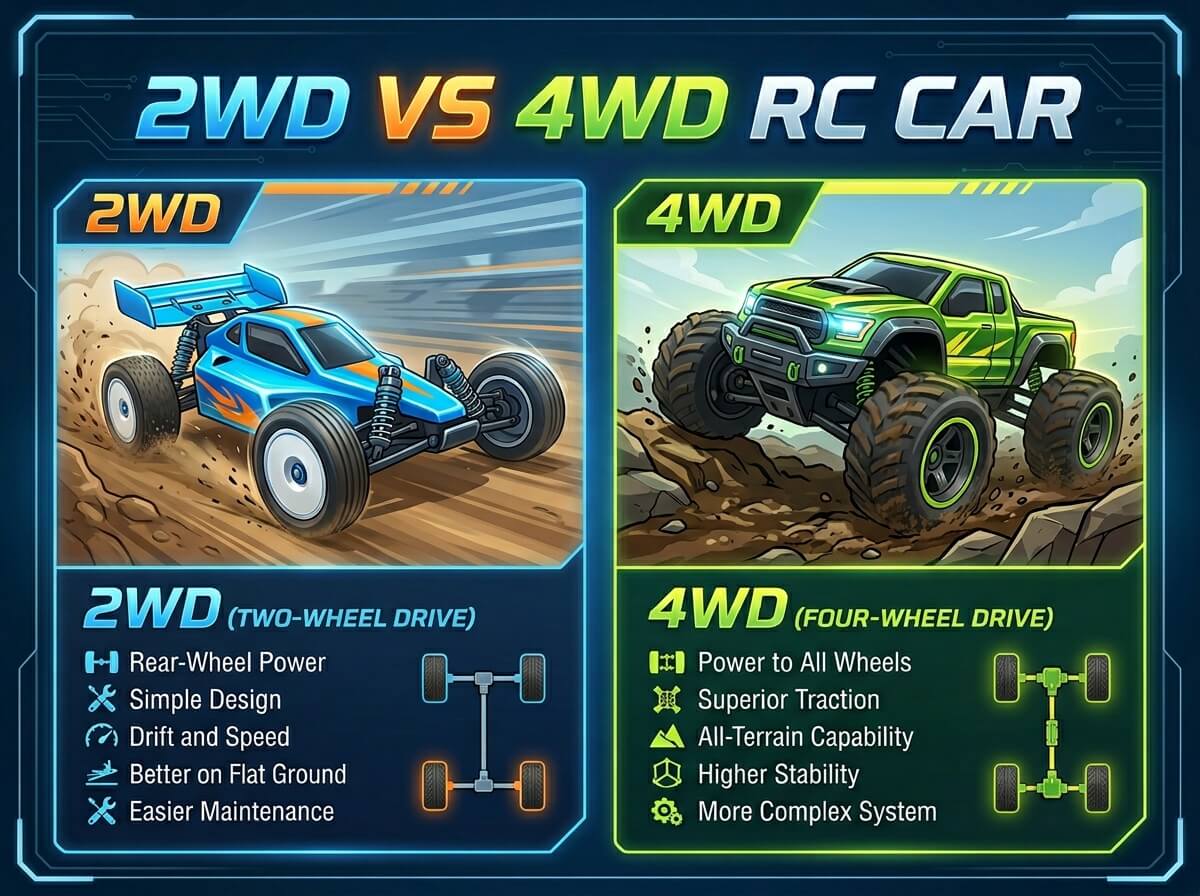
2WD means two-wheel drive. Power from the motor goes to only two wheels — usually the rear ones. The front wheels just roll along for the ride. They steer, but they don’t push or pull the car forward.
4WD means four-wheel drive. Power goes to all four wheels at the same time. Every wheel is working together to move the car. This gives you more grip, more control, and more ability to handle tough surfaces.
That’s the core difference. Simple enough, right?
Now let’s dig into what that actually means for you on the track or in the backyard.
The Case for 2WD RC Cars
A lot of RC hobbyists start with 2WD. There’s a good reason for that.
They’re Cheaper
2WD RC cars cost less. Sometimes a lot less. You get fewer parts, a simpler drivetrain, and a lower price tag. If you’re just getting started and don’t want to drop a ton of money right away, 2WD is the smart move.
You can find solid 2WD bashers, buggies, and stadium trucks at a fraction of what a comparable 4WD setup would cost. That leaves more budget for spare parts, upgrades, or fuel if you’re running nitro.
They’re Easier to Fix
Fewer moving parts means fewer things that break. And when something does break, it’s easier to find the problem and fix it.
A 2WD RC car has no front driveshafts, no front differential, no front axle to worry about. The front end is mostly steering components. The drivetrain is simple — motor, gearbox, rear differential, rear axles. Done.
For beginners, this is huge. You spend less time wrenching and more time driving.
They’re Lighter
Less drivetrain hardware means less weight. A lighter RC car can accelerate faster and feels more nimble. On flat, smooth surfaces, a 2WD car can feel incredibly fast and snappy.
Rear-wheel drive gives you that classic “tail out” feel when you push it hard. You can slide around corners in a controlled drift and really feel the car working under you. Many experienced drivers actually prefer this because it’s more engaging to drive.
They’re Great for Specific Tracks
On flat, groomed surfaces like indoor carpet tracks or well-prepped dirt ovals, 2WD RC cars are completely at home. Competitive RC racing at the 1/10 scale 2WD buggy class is one of the most popular classes in the hobby worldwide. These cars are finely tuned, incredibly fast, and highly competitive.
If you want to race at a proper RC club, chances are good they have a strong 2WD buggy class. You won’t be at a disadvantage.
The Downsides of 2WD
Okay, now the honest part.
They Struggle Off-Road
Take your 2WD buggy off the groomed track and things get harder. Loose gravel, deep mud, wet grass, sand — the rear wheels spin and the front wheels just go wherever they want. You lose traction fast.
On rough terrain, 2WD cars require a lot more driver skill to keep going straight. You need to be smooth on the throttle, or you’ll be spinning out constantly.
The Learning Curve Is Real
2WD rear-wheel drive cars are more “twitchy.” The back end can step out quickly if you’re not careful with throttle and steering inputs. New drivers often find this frustrating at first.
You’ll spin out. You’ll flip. You’ll overcorrect. That’s just part of learning. But if you want something that feels more planted and forgiving right out of the box, 2WD isn’t always the easiest teacher.
The Case for 4WD RC Cars
Now let’s talk about 4WD.
More Traction, More Control
All four wheels pulling the car forward means your RC car grips the surface much better. Loose dirt, gravel, wet surfaces, grass — 4WD handles all of it with far more confidence than 2WD.
If you want to bash in the park, race on ungroomed trails, or rip through your backyard after it’s rained, 4WD is the better tool for the job. You spend less time fighting the car and more time driving it.
Easier for New Drivers
4WD RC cars are more forgiving. The grip from all four wheels helps stabilize the car. You can be a little rough on the throttle and the car will mostly keep going straight. This makes the learning process a lot less frustrating.
Many parents buying an RC car for a kid go with 4WD for exactly this reason. The car doesn’t spin out as easily, doesn’t flip as often, and responds more predictably to driver input.
Better on Mixed Terrain
Life isn’t always a perfectly groomed race track. If you want to drive on driveways, sidewalks, grass, gravel, and dirt all in the same session, 4WD handles the variety much better.
You hit a sandy patch? No problem. Rocky section? 4WD claws through it. You don’t have to think twice about the terrain. Just point and go.
More Consistent Performance
In wet or slippery conditions, 2WD cars can become almost undriveable for a beginner. 4WD stays usable in more conditions. If you live somewhere with variable weather and you drive outdoors, 4WD gives you more days where driving is actually fun instead of a struggle.
The Downsides of 4WD
No setup is perfect. Here’s where 4WD falls short.
Higher Cost
A 4WD RC car has more parts — front and rear diffs, front driveshafts, front axles, front CVDs or universal joints, and a central drivetrain that connects everything. All of that adds cost.
The car itself costs more upfront. Spare parts cost more too. When you break a front driveshaft, you’re buying parts that don’t even exist on a 2WD car.
More Complex Maintenance
More parts means more to check, more to clean, and more to replace. Differentials need fluid changes. CVDs need grease. The front drivetrain takes dirt and debris just like the rear does.
This isn’t a dealbreaker, but it does mean more time maintaining the car between runs.
Heavier Weight
4WD drivetrains are heavier. That extra weight affects acceleration. A 4WD car with the same motor as a 2WD car will feel slightly slower off the line because it has more mass to move.
On smooth, flat tracks, this can actually put 4WD at a disadvantage against a well-tuned 2WD setup.
Less “Feel” in Some Cases
Some experienced RC drivers find 4WD a little less satisfying to drive on a smooth track. The car is very planted and predictable, which is great for beginners — but experienced drivers sometimes want more challenge and feedback from the car. 2WD provides that.
Comparing Head to Head
Let’s lay it out simply so you can see both options side by side.
| Feature | 2WD | 4WD |
|---|---|---|
| Price | Lower | Higher |
| Maintenance | Simpler | More complex |
| Weight | Lighter | Heavier |
| Traction | Less | More |
| Off-road ability | Limited | Strong |
| Ease for beginners | Harder | Easier |
| Track racing | Excellent | Good |
| Bashing outdoors | Fair | Great |
| Drift/slide feel | Yes | Less |
What Kind of Driver Are You?
This is the real question. Let’s match your situation to the right choice.
You’re a Complete Beginner
Go with 4WD. Seriously. The extra traction and stability will make your first few weeks much more enjoyable. You’ll crash less. You’ll have more successful runs. You’ll learn faster because you’re focused on driving, not fighting the car.
A 4WD RC buggy, short course truck, or monster truck is a fantastic starting point. You can drive it almost anywhere without worrying too much about surface conditions.
You Want to Race on a Track
Look at what class the local RC club runs. Many tracks have competitive 2WD buggy classes that are well-populated and a blast to race. If you want to get into club racing, 2WD might be the smarter move because the competition is usually stiff and the cars are well-developed.
That said, many clubs also run 4WD classes. Check your local track before you buy.
You Want to Bash in the Backyard
4WD. Every time. Backyards are uneven, the grass is soft, there are sticks and rocks, and conditions change. 4WD handles all of that. You’ll spend way more time driving than recovering from spin-outs.
You’re Into Drifting
RC drifting usually uses rear-wheel drive setups — which are 2WD. Drift cars are specifically built for this. The rear-heavy power delivery lets you break traction intentionally and slide the car around. 4WD in a drift setup is less common and harder to control in the traditional drift style.
You’re on a Budget
2WD wins here. You get more car for your money. The initial purchase is cheaper, parts are cheaper, and if you break something, the repairs cost less.
Common RC Car Types and Their Drive Systems
Different types of RC vehicles usually come in one or both drive configurations. Here’s a quick guide.
RC Buggies — Available in both 2WD and 4WD. 2WD buggies are race-focused and very popular on indoor dirt tracks. 4WD buggies offer better traction in rougher conditions.
Short Course Trucks — Usually available in both. 4WD short course trucks are very popular for bashing and casual backyard racing.
Monster Trucks — Almost always 4WD. The big tires and high center of gravity benefit massively from all-wheel drive. You wouldn’t want a monster truck in 2WD.
Stadium Trucks — Often 2WD. Very common in competitive racing.
Crawlers — Always 4WD. Rock crawlers need all four wheels gripping and clawing at the terrain at all times. 4WD isn’t optional here — it’s essential.
Drift Cars — Usually 2WD rear-wheel drive. Built specifically to break rear traction and slide.
Touring Cars — Often 4WD for on-road racing. The smooth tracks and high speeds benefit from predictable, planted grip.
Terrain Matters a Lot
Where you plan to drive should heavily influence your pick.
Smooth indoor carpet — 2WD is perfectly at home here. You don’t need extra traction when the surface is consistent and grippy.
Outdoor dirt track — Both work. A well-prepped dirt track can be dominated by a 2WD buggy in the hands of a skilled driver.
Rough outdoor terrain — 4WD. Sand, gravel, uncut grass, packed dirt with ruts — 4WD handles all of it with more confidence.
Pavement and driveways — Both work, but 4WD is more fun because you don’t have to baby the throttle as much.
Wet surfaces — 4WD is much better. Moisture kills traction fast on a 2WD car.
Rock crawling — 4WD only. No debate.
Speed: Does Drive Type Affect It?
Yes, but not always in the way you’d expect.
On a straight line, a lighter 2WD car can sometimes keep up with or beat a heavier 4WD car even if both have the same motor. Less weight = faster acceleration.
On a loose or rough surface, 4WD is faster because it hooks up and puts power down more efficiently. The wheels aren’t spinning and searching for grip.
In competitive racing, 2WD cars at the top level are incredibly fast — so don’t think 4WD is automatically faster. It’s more about the surface and conditions.
Upgrades and Tuning
Both 2WD and 4WD RC cars can be upgraded heavily. You can swap motors, ESCs, servos, shocks, tires, and more on almost any platform.
However, upgrading a 2WD car is simpler because there are fewer systems to deal with. You upgrade the rear drivetrain and you’re largely done. On a 4WD, you need to think about front and rear differential fluids, front drivetrain components, and how changes affect all four wheels.
If you love wrenching and upgrading, 4WD gives you more to play with. If you want to drive more and wrench less, 2WD is simpler to keep dialed in.
Brand and Model Recommendations by Drive Type
You don’t need to spend a fortune to get a great RC car in either configuration.
For 2WD, look at platforms like the Traxxas Slash 2WD, Team Associated RC10B6, or the Arrma Granite 2WD. These are well-supported, have tons of spare parts available, and are great for beginners and experienced drivers alike.
For 4WD, the Traxxas Slash 4×4, Arrma Granite 4×4, Losi Tenacity, and Redcat Racing options are all solid starting points. They’re tough, well-supported, and handle all kinds of terrain.
The Final Verdict
Here’s the simple takeaway.
Get 2WD if:
- You’re on a tight budget
- You want to race on a proper RC track
- You’re interested in RC drifting
- You want a simpler car to maintain
- You enjoy the challenge of rear-wheel drive handling
Get 4WD if:
- You’re a beginner who wants a forgiving car
- You plan to bash outdoors on varied terrain
- You drive in wet or loose conditions often
- You want a car that’s easier to drive fast right away
- You’re buying it for a younger driver
There’s no wrong answer here. Both setups are fun. Both have real strengths. The best RC car is the one that fits how and where you drive.
Start with the one that matches your situation. As you get more into the hobby, you’ll probably end up owning both anyway — because that’s just how this hobby goes.
Wrapping It Up
The 2WD vs 4WD debate in RC cars comes down to three things — your budget, your terrain, and your experience level.
2WD is light, affordable, and rewarding to master. It teaches you real car control and punishes sloppy driving, which makes you better over time.
4WD is forgiving, capable, and versatile. It lets you drive more places with less frustration, especially when you’re still learning.
Both types have passionate fans. Both types win races. Both types can be bashed hard and put away happy.
Pick the one that fits your life right now. Get out there and drive. The rest will figure itself out.
A Few Tips Before You Buy
No matter which drive type you pick, keep these tips in mind.
Buy from a reputable brand. Cheap no-name RC cars from random online listings often use poor-quality parts that break quickly and are impossible to find replacements for. Stick with brands that have a solid community and parts availability — like Traxxas, Arrma, Losi, Team Associated, or Redcat.
Check the parts availability. Before you commit to any RC car, search online for spare parts. If you can find bearings, driveshafts, differentials, and body panels easily, you’re in good shape. If the parts don’t exist, you’ll be stuck when something breaks — and something always breaks eventually.
Join a community. There are massive RC car communities online — forums, Facebook groups, Reddit threads, and YouTube channels dedicated entirely to this hobby. These communities are incredibly helpful. Before you even buy, post your question and get real feedback from people who’ve owned the exact car you’re looking at.
Don’t skip a good battery. Your RC car is only as good as the power source feeding it. A quality LiPo battery makes a huge difference in run time and performance. Don’t cheap out on batteries.
Get a battery charger that fits your needs. If you’re running LiPo packs, a proper balance charger is important for safety and battery life. It’s not exciting gear, but it matters.
Is One Better for Kids?
If you’re buying for a child, lean toward 4WD.
Kids are not gentle on RC cars. They hit curbs. They drive into walls. They run it full throttle on every surface they can find. 4WD handles all of that abuse better because it’s more stable at high speed and recovers from rough inputs more naturally.
A 4WD monster truck or short course truck is an especially good pick for younger drivers. The big tires absorb bumps, the 4WD keeps it going straight, and the tough body shells take hits without crumbling.
Stick to a simple brushed motor setup for very young drivers — they’re easier to control, slower, and less likely to result in a crash that destroys the car in the first five minutes.
Is One Better for Indoor vs Outdoor Use?
Indoor driving tends to favor 2WD. Indoor RC tracks usually have carpet or a well-groomed clay surface. Traction is consistent. You don’t need all four wheels driving the car — two is plenty. Lighter 2WD cars also work better in tight indoor spaces where acceleration and agility matter more than raw grip.
Outdoor driving almost always favors 4WD. Outdoors means variable surfaces, changing conditions, and terrain that no indoor track ever throws at you. 4WD is the right tool for outdoor bashing and casual outdoor driving.
If you plan to do both, 4WD is the safer all-rounder. You can drive it indoors fine — it just won’t be the absolute fastest option on a tight indoor carpet track.
Final Thoughts on the 2WD vs 4WD Question
The RC hobby is all about having fun. Both drive configurations deliver that in different ways.
2WD teaches you how to really drive a car. It’s demanding, rewarding, and produces better, more skilled RC drivers over time. It’s also the cheaper path into the hobby.
4WD removes barriers. It lets you focus on enjoying the experience rather than fighting physics. It opens up more terrain and makes the hobby accessible to more people.
Neither is wrong. Neither is the “best.” They serve different purposes for different drivers.
The most important thing is to get out there, run the car, and have fun. The rest — the upgrades, the tuning, the debate over 2WD vs 4WD — that’s all just part of the ride.
Happy bashing!