How to Dispose of RC Car LiPo Batteries?
If you race or drive RC cars, you already know that LiPo batteries are the heart of your hobby. They give you fast speed, long run time, and strong power. But every battery has a life span. At some point, your pack will puff up, lose its punch, or just stop holding a charge. When that day comes, you cannot just toss it in the trash can. LiPo batteries are not like regular AA batteries. They hold stored energy inside, and if you handle them the wrong way, they can catch fire or even explode.
This guide will walk you through every step of safe LiPo battery disposal. We will cover why these batteries are risky, how to tell when a pack is dead, how to fully discharge it, and where to take it once it is ready for disposal. By the end, you will know exactly what to do with that old, swollen, or damaged pack sitting in your garage.
Why You Can’t Just Throw LiPo Batteries in the Trash
Lithium polymer batteries, often called LiPo batteries, store a huge amount of energy in a small package. That is exactly why RC car hobbyists love them. But this same trait makes them dangerous once they are damaged or worn out.
Here is the main problem: a LiPo cell has a thin pouch made of foil and plastic layers. Inside, there are chemicals that react with air and moisture. As long as the pouch stays sealed and undamaged, the battery is stable. But if the pouch gets punctured, crushed, or bent, air can reach the internal layers. This can cause a chemical reaction that leads to heat, smoke, or fire.
Regular trash trucks compress garbage as they collect it. If a LiPo battery ends up in that truck, the crushing force can puncture the pouch and start a fire right inside the truck. This has happened many times across many cities, and it is one of the top causes of garbage truck and recycling center fires. So tossing a battery in your kitchen trash bin is never a safe option.
Landfills carry the same risk. Batteries buried in landfills can get damaged by other trash pressing down on them, or by heavy machines driving over the pile. Once a fire starts underground in a landfill, it is extremely hard to put out and can burn for weeks.
On top of the fire risk, LiPo batteries also contain metals and chemicals that can leak into soil and water if left in a landfill. This is bad for the environment and can affect nearby communities. That is why proper recycling is not just about safety, it is also about protecting the planet.
Signs Your RC Car LiPo Battery Is Ready for Disposal
Before you jump to disposal, it helps to know when a battery has truly reached the end of its useful life. Not every weak-feeling pack needs to be thrown away right off the bat. Some signs of a dead or unsafe pack include:
- Puffing or swelling – The pack looks fatter than normal, or the pouch looks like a balloon. This means gas has built up inside from a chemical breakdown.
- Physical damage – Any tear, dent, cut, or crush mark on the outer wrap is a red flag.
- Burnt smell – A sharp, chemical, almost fishy smell means something has already started to break down inside.
- Voltage drop below safe limits – If a cell reads under 3 volts and won’t come back up after a slow charge, the cell is likely damaged for good.
- Poor performance – The pack drains fast, gets hot quickly, or just cannot push your car like it used to, even after a full charge.
- Age and cycle count – Most LiPo packs are good for a few hundred charge cycles. After that, capacity drops and the risk of failure climbs.
If your battery shows any of these signs, especially puffing or damage, stop using it right away. Do not attempt one more race or one more test run. Set it aside for safe disposal instead.
Step 1: Handle a Damaged Pack With Extra Care
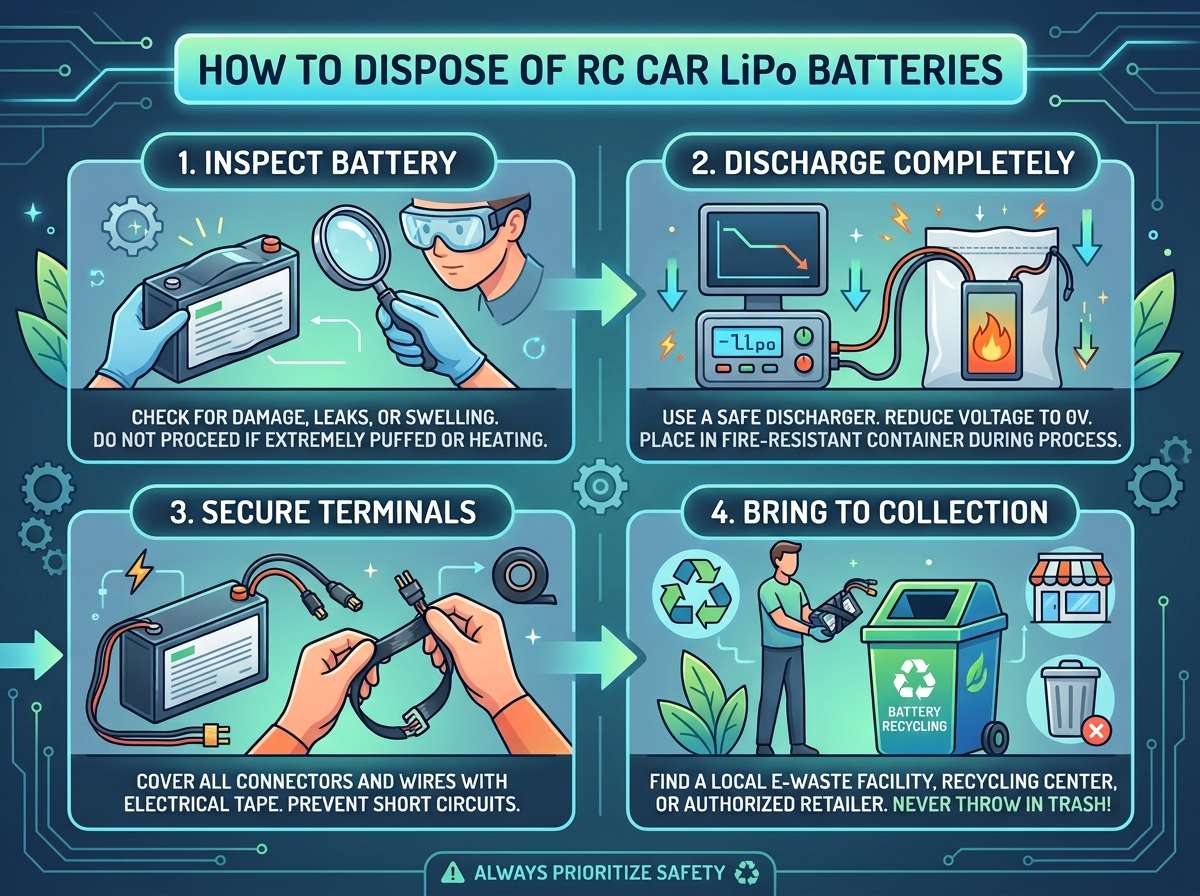
If your battery is swollen, punctured, or smells strange, treat it like it could catch fire at any moment, because it truly could. Follow these steps right away:
- Move the battery to a safe outdoor spot, away from anything that can burn, like paper, wood, or fabric.
- Place it on a fireproof surface such as concrete, brick, or dirt. Never place it on grass, carpet, or a wooden deck.
- If you have a metal or ceramic container (like an old ammo box or a fireproof LiPo safety bag), place the battery inside.
- Keep a fire extinguisher or a bucket of sand nearby, just in case.
- Do not attempt to charge, discharge, or plug in a swollen or damaged pack. Any spark could trigger a reaction.
Once the battery is in a safe spot, you can move forward with the discharge process, but only if the pack does not look badly damaged. If it is heavily swollen or already leaking, skip the discharge step and go straight to storage until you can drop it off for recycling.
Step 2: Fully Discharge the Battery Before Disposal
This is one of the most important steps in the whole process. A LiPo battery that still holds a charge is far more likely to spark or catch fire during transport or storage. So before you get rid of it, you need to bring the voltage down to a safe, storage-level state.
Using a Smart Charger with Discharge Mode
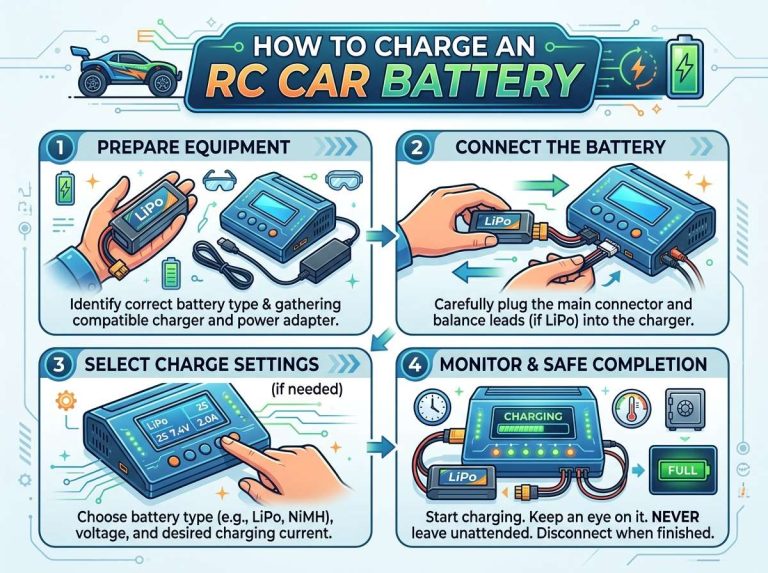
Most modern RC chargers come with a discharge setting built in. This is the easiest and safest method if your pack is still in decent shape.
- Connect the battery to your charger like you normally would.
- Select the discharge mode on your charger’s menu.
- Set the discharge rate low, usually around 0.5C to 1C, so the process stays gentle and slow.
- Let the charger bring the voltage down to about 3.0 volts per cell, or follow your charger’s storage voltage guide.
- Once finished, unplug the pack and let it sit for a bit to cool down.
This method is slow but steady, and it gives you full control over the process.
Using a Discharge Resistor or Bulb Method
If you do not own a smart charger, you can use a simple trick with a light bulb or a resistor. Here’s how it works:
- Grab a 12-volt car bulb or a power resistor rated for the job.
- Connect the battery leads to the bulb using proper connectors, never bare wires touching each other.
- Let the bulb light up and slowly drain the pack’s energy.
- Check the voltage every so often with a multimeter.
- Stop once the voltage reaches around 3.0 volts per cell.
This method takes patience, but it works well for hobbyists who do not have fancy gear.
The Saltwater Method (Only for Truly Dead or Damaged Packs)
Some RC hobbyists use a saltwater bath to fully drain and neutralize a battery that is too far gone for a normal discharge. This method is mostly used for packs that are already swollen or clearly dying, not for healthy batteries.
- Mix a strong saltwater solution in a plastic bucket, about one cup of salt per gallon of water.
- Submerge the battery fully in the water, using something to weigh it down if needed.
- Leave it soaking for about two weeks in a spot away from anything flammable.
- Check the voltage after this period. It should read close to zero.
- Let the battery dry out completely before moving it to a disposal or recycling location.
Keep in mind, saltwater can be messy and takes a lot of patience. It is best used as a last resort for badly damaged packs that cannot go through a normal discharge safely.
Step 3: Tape the Battery Terminals
Once your battery voltage is low, the next step is simple but important: cover the connector terminals with electrical tape. This stops the metal contacts from touching any other metal object during storage or transport, which could cause a short circuit and spark a fire.
Just wrap a few layers of tape around the connector plug and any exposed wire ends. This tiny step adds a solid layer of safety before you move the battery anywhere.
Step 4: Store the Battery Safely Until Drop-Off
Even after discharge, you should not leave a dead LiPo pack sitting loose in your house. Store it properly until you can take it to a recycling drop-off point.
- Use a fireproof LiPo bag, ammo can, or metal storage box.
- Keep it away from heat sources, direct sun, and anything flammable.
- Do not stack it under other batteries or heavy objects.
- Label the container so family members know what is inside.
This short-term storage step keeps everyone safe while you plan your next move toward proper recycling.
Step 5: Find a Real Battery Recycling Location
Now comes the final and most important part: getting the battery to a place built to recycle it safely. LiPo batteries fall under the category of lithium-ion battery waste, and many places accept them for free.
Where to Take Your Old RC LiPo Batteries
- Local hardware stores – Many home improvement chains run battery take-back programs at the front desk.
- Electronics retailers – Big electronics shops often have collection bins near the entrance for old batteries and small electronics.
- Hobby shops – Some RC hobby stores collect used LiPo packs from customers since they understand the risk firsthand.
- Municipal hazardous waste centers – Most cities run a household hazardous waste drop-off site that takes lithium batteries along with paint, chemicals, and other tricky waste.
- Call2Recycle and similar programs – These battery recycling networks have public drop-off locations across many regions, and you can search their site by zip code to find the closest spot.
Before you head out, call ahead or check the store’s website to confirm they accept lithium polymer packs specifically, since some locations only take small household batteries like AA or AAA cells.
Mailing Batteries for Recycling
If there is no drop-off point near you, some recycling companies offer mail-in programs. These usually require special fireproof shipping materials since postal services have strict rules about shipping lithium batteries. Always follow the recycler’s packaging instructions closely, since improper shipping can lead to fines or rejected packages.
What Happens to the Battery After Recycling
Once your old RC pack reaches a real recycling facility, workers separate the different materials inside. The metals, like cobalt, lithium, nickel, and copper, get pulled out and reused to make new batteries or other products. The plastic and foil layers get processed separately. This closed-loop system reduces the need to mine new raw materials, which is better for the earth and cuts down on pollution linked to mining.
Recycling also keeps dangerous chemicals out of soil and water supplies. Instead of leaking through cracked landfill liners over time, the materials go back into a controlled industrial process built to handle them safely.
Common Mistakes to Avoid
Even careful hobbyists sometimes slip up during disposal. Here are a few things to steer clear of:
- Never puncture a swollen pack to try to release the gas. This can cause an immediate fire.
- Never throw a LiPo battery in a regular recycling bin meant for plastic, glass, or paper.
- Never store batteries loose in a bag with metal tools or keys, since contact can cause a short.
- Never leave a charging pack unattended, especially during the discharge process.
- Never ship a battery without proper packaging, since shipping rules exist for good reason.
Avoiding these small mistakes keeps you, your home, and the people around you safe.
Tips to Make Your LiPo Batteries Last Longer
Good disposal habits start with good battery care from day one. Here are a few simple habits that stretch out the life of your RC car packs:
- Store batteries at storage voltage, not full charge, when you are not using them for a while.
- Keep packs at room temperature, away from cold garages or hot car trunks.
- Avoid fully draining a battery during a race or run; try to land it before it drops too low.
- Check for puffing or damage after every hard crash.
- Use a proper LiPo bag during charging, even if your charger has safety features built in.
These habits reduce the chance of early battery failure and cut down on how often you need to deal with disposal in the first place.
Final Thoughts
Getting rid of an old RC car LiPo battery does not have to be stressful once you know the right steps. Discharge it fully, tape the terminals, store it safely, and take it to a proper recycling center instead of the trash can. This small effort protects your home from fire risk and keeps harmful chemicals out of landfills and waterways.
The next time you notice a pack losing its punch or puffing up a little, do not wait around. Follow this guide, drop it off at a proper location, and keep your hobby running safe for years to come.

Peterson is an RC hobby enthusiast and product reviewer with a passion for remote-controlled cars, trucks, boats, drones, and accessories. He enjoys testing the latest RC products, comparing features, and sharing practical buying guides to help beginners and experienced hobbyists make informed decisions. Through RCThing.com, Peterson provides honest reviews, maintenance tips, and expert advice to help readers get the most from their RC adventures.