

5 Best RC Airplane for Beginners In 2026
If you type “best RC airplane for beginners” into any search bar, you already know the problem. You get a flood of listings, a pile of jargon, and zero real answers. Channels, headless mode, gyro stabilization, brushed motors, LiPo batteries — it can feel like you need an engineering degree just to buy a toy plane.
You don’t. Flying a remote control airplane is one of the most fun hobbies you can pick up, and it doesn’t have to drain your wallet or your patience. The trick is starting with the right plane. A beginner-friendly RC airplane should be tough, easy to fly, and forgiving when you crash it (and you will crash it, at least a few times — everyone does).
This guide walks through five popular beginner RC planes on the market right now. We’ll break down what each one does well, where it falls short, how it flies in real conditions, and who it actually fits. No hype, no fluff, just straight talk so you can make a smart call before you spend your money.
By the end of this article, you’ll know exactly which RC plane suits your skill level, your budget, and your flying style, plus a full buying guide so you never get stuck wondering what all the specs actually mean.
Why RC Airplanes Make Such a Great Hobby
Before we jump into the reviews, let’s talk about why this hobby is worth your time in the first place.
Flying an RC plane teaches you patience and hand-eye coordination fast. It gets you outside, away from screens, and into open fields or parks where you can actually focus on something with your hands. It’s also a hobby that scales with you. You can start with a small foam plane that costs less than a nice dinner out, then work your way up to bigger, faster, more advanced models once you’ve built real skill.
The best part is that beginner RC planes today are built tough. Most are made from a special foam that flexes on impact instead of snapping, so those first-week crashes won’t end the hobby before it even starts.
Quick Comparison Table
| Product | Channels | Best For | Skill Level | Approx. Price Range |
|---|---|---|---|---|
| LEAMBE P51 Mustang RC Plane | 4 CH | Realistic flying, adults and teens | Beginner to intermediate | Mid-range |
| HAWK’S WORK 2 CH RC Plane | 2 CH | Kids, first-time flyers | True beginner | Budget |
| 3CH P-51D Mustang RC Warbird | 3 CH | Stabilized, warbird look | Beginner | Budget to mid-range |
| FUNPX Foam RC Plane | Multi-channel with headless mode | Stunt flying, night flying, kids 6+ | Beginner | Budget |
| LEAMBE F4U Corsair RC Plane | 4 CH | Aerobatics, gift buyers | Beginner to intermediate | Mid-range |
Now let’s get into the details of each plane.
1. LEAMBE 4 Channel RC Plane – P51 Mustang (Ready to Fly)
Product Overview
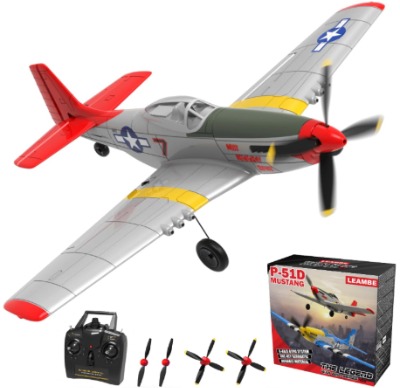
This is a scale replica of the classic P51 Mustang warbird, built for people who want their RC plane to actually look like a real airplane and not just a toy. It comes ready to fly out of the box, meaning you get the plane, the transmitter, and the battery all in one package, with little to no assembly required.
With 4 channels of control, this plane gives you throttle, elevator, rudder, and aileron control. That’s the same setup used in more advanced RC aircraft, so learning on this plane actually teaches you skills that transfer to bigger, faster models down the road.
Best Use Cases
This plane shines in open fields, parks, and other wide outdoor spaces with light wind. It’s not built for indoor flying since it needs room to bank, climb, and turn. It’s a solid pick for a weekend hobbyist who wants something more advanced than a toy-grade glider but doesn’t want to jump straight into a hardcore hobbyist-grade aircraft.
It also makes a great gift for an adult who loved model airplanes as a kid and wants to get back into the hobby, or for a teenager who has already tried a simpler 2-channel plane and wants to step up.
Key Features Explained Simply
- 4-channel control: You get full directional control, not just left-right steering. This means smoother turns, real banking, and more realistic flight paths.
- Aerobatic capability: The plane is built to handle loops, rolls, and other tricks once you get comfortable with the controls.
- Ready to fly design: No gluing wings on or fiddling with tiny screws for hours. Charge the battery, bind the transmitter, and you’re airborne.
- Scale P51 Mustang look: The body design mimics the real historic aircraft, which adds a cool factor that plain foam gliders don’t have.
Real-Life Usage Insight
New flyers usually notice the learning curve is a bit steeper than a basic 2-channel toy plane, simply because there’s more to control at once. That said, most people get comfortable within a handful of flight sessions, especially if they start in calm wind and keep the first few flights short and low.
Because the plane responds to four different inputs, over-correcting is the most common early mistake. New pilots often push the stick too hard on turns, which can lead to a stall. Slow, small stick movements work far better than sharp jerky ones.
Pros
- Realistic scale design that looks great in the air
- Full 4-channel control for a more authentic flying experience
- Good build quality with foam that holds up to normal beginner crashes
- Ready to fly setup saves time and hassle
- Works as a stepping stone toward more advanced RC planes later
Cons
- Steeper learning curve compared to simple 2-channel planes
- Needs decent open space and calm weather to fly well
- Not ideal for very young kids without adult supervision
Performance Discussion
In light to moderate wind, this plane holds a stable flight path and responds cleanly to stick input. It handles banking turns smoothly once you get a feel for the throttle balance. In windier conditions, like most lightweight foam planes, it can get pushed around, so early flights are best saved for calm mornings or evenings.
Ease of Use
It’s beginner-friendly, but it does ask a little more of you than the most basic toy-grade planes. If this is your very first RC plane ever, expect a short adjustment period. If you’ve flown any 2-channel or 3-channel model before, this one will feel like a natural next step.
Value for Money
Given the scale design, 4-channel control, and ready-to-fly setup, this plane offers solid value. It sits in the mid-range price bracket, which makes sense since it does more than basic toy planes while still staying accessible for someone new to the hobby.
2. HAWK’S WORK 2 CH RC Airplane – Red RC Glider
Product Overview
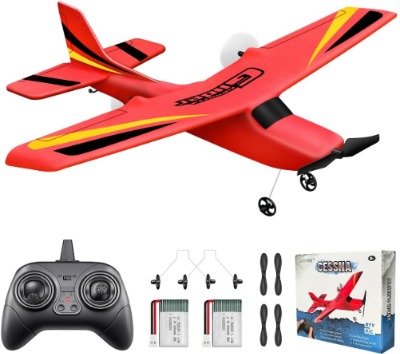
This is about as beginner-friendly as RC planes get. With just 2 channels of control, this glider strips flying down to the basics: throttle and turning. It runs on 2.4GHz frequency, which means less interference from other remote control devices nearby, so your plane won’t suddenly go rogue because someone else is flying close by.
This model is aimed squarely at kids and first-time flyers who want to learn the fundamentals of RC flight without getting overwhelmed by too many controls at once.
Best Use Cases
This plane is perfect for a parent introducing their child to the hobby, or an adult who has never touched an RC controller before and wants to build confidence before moving to something more complex. It also works well for casual, low-pressure flying sessions at a local park or backyard, since the flight style is more relaxed and glider-like.
Key Features Explained Simply
- 2-channel control: Only two inputs to worry about, throttle and steering. This drastically cuts down the learning curve.
- 2.4GHz remote system: Reduces signal interference, giving a more stable connection between the controller and plane.
- Lightweight glider-style build: Easier to launch by hand and more forgiving in flight.
- Simple, sturdy design: Built to survive rookie mistakes like nose-diving into the grass.
Real-Life Usage Insight
Kids tend to pick this plane up fast because there’s less to think about. Most beginners get a feel for the throttle and turning within their first session. Parents flying alongside their kids often mention that this plane makes a great “teaching tool” since it’s simple enough to hand over the controls without worrying about a complicated crash.
Wind is the main factor that trips people up here. Since it’s light, it can drift more in breezy conditions, so calm days give the best results, especially for younger pilots still learning stick control.
Pros
- Extremely easy to learn, ideal for absolute beginners and kids
- Reliable 2.4GHz connection with minimal interference
- Lightweight and simple to hand-launch
- Budget-friendly price point
- Great confidence-builder before moving to more advanced planes
Cons
- Limited maneuverability due to only 2 channels
- Struggles a bit in windy conditions since it’s so light
- Not built for tricks or aerobatic flying
Performance Discussion
Flight is smooth and predictable in calm weather, which is exactly what a beginner needs. It glides well and holds altitude nicely once trimmed. Because it lacks the rudder and elevator control of higher-channel planes, sharp turns and precise maneuvers aren’t really part of the deal here, but for learning the ropes, that’s a fair tradeoff.
Ease of Use
This is hands-down one of the easier RC planes to fly on this list. If your goal is to hand a plane to a child or a nervous first-timer and have them flying within minutes, this is the one to grab.
Value for Money
At a budget-friendly price, this plane delivers exactly what it promises: an easy entry point into RC flying. It’s not going to wow anyone with tricks, but for the price and the purpose, it’s a smart buy.
3. 3CH P-51D Mustang RC Plane – Stabilized RC Warbird
Product Overview
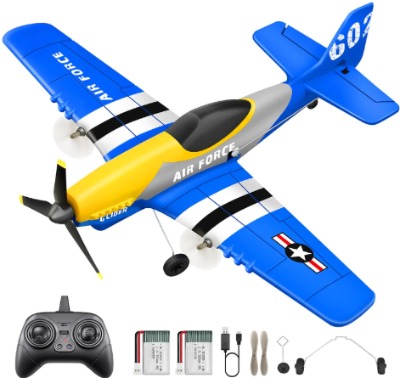
This plane splits the difference between the simplicity of a 2-channel glider and the complexity of a full 4-channel aerobatic plane. With 3 channels, you get throttle, steering, and elevator control, plus the huge bonus of built-in stabilization technology.
That stabilization system is the real headline feature here. It uses a gyro sensor to automatically correct small wobbles and drift, which means the plane basically helps fly itself while you’re still learning.
Best Use Cases
This plane is a great fit for someone who has already tried a 2-channel toy plane and wants a bit more control without diving straight into a fully manual 4-channel aircraft. It also works well for slightly older kids or teens who want a more realistic warbird-style plane but still need some training wheels built in.
Key Features Explained Simply
- 3-channel control: Adds elevator control on top of throttle and steering, giving you more say over altitude and flight path.
- Gyro stabilization: Automatically smooths out small flight corrections, reducing the chance of an unexpected nosedive.
- P-51D Mustang warbird design: Another nod to classic aviation styling, giving it visual appeal beyond just being a toy.
- Beginner-tuned setup: Flight response is calibrated to be forgiving rather than twitchy.
Real-Life Usage Insight
New pilots often say the stabilization system is the standout feature. It catches small mistakes before they turn into crashes, which builds confidence fast. That said, some flyers note the stabilization can feel a bit “sticky” at first, meaning the plane resists sharp turns until you get used to how it responds.
This plane tends to be a favorite for people who want that middle ground: more control than a basic glider, but less risk than a fully manual aerobatic plane.
Pros
- Gyro stabilization makes learning far less stressful
- 3-channel setup adds real elevator control without overwhelming complexity
- Attractive warbird design
- Good stepping stone between beginner and intermediate skill levels
- Reasonably tough build for repeated beginner crashes
Cons
- Stabilization can feel restrictive if you want sharper, faster maneuvers
- Slightly pricier than basic 2-channel planes
- Still needs decent open space to fly comfortably
Performance Discussion
Flight is smooth and confidence-inspiring, especially in the first few sessions. The stabilization system actively works to keep the plane level, correcting for small wind gusts and shaky stick input. As your skills grow, you may start to notice the assist holding you back from sharper turns, but by that point you’ll likely be ready to graduate to a fully manual 4-channel plane anyway.
Ease of Use
This is one of the friendliest planes for someone past the total beginner stage but not ready for full manual control. The gyro stabilization takes a lot of the stress out of early flights, making it a smart pick for nervous first-timers who still want more than a basic glider.
Value for Money
Given the stabilization tech and 3-channel control, this plane offers strong value for its price bracket. It bridges a real gap in the market between ultra-basic toy planes and full aerobatic models.
4. FUNPX Foam RC Plane with Drone Batteries – Headless Mode Stunt Plane
Product Overview
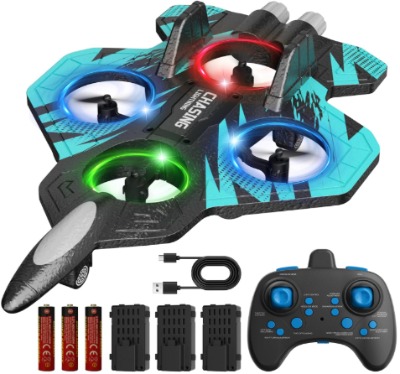
This plane takes a different approach entirely. Instead of chasing realistic scale looks, it leans into pure fun. It’s built for stunts, flips, and even night flying thanks to built-in LED lights. It also includes headless mode, a beginner-friendly feature that keeps the plane’s controls consistent no matter which direction it’s facing relative to you.
It comes with three drone batteries and three AAA batteries, which means you get more total flight time in one package compared to planes that ship with just one battery.
Best Use Cases
This is a great pick for younger kids (the packaging notes it’s suitable for ages 6 and up), casual backyard flyers, and anyone who wants a fun, low-stakes plane that can handle rough landings without complaint. The LED lights also make it a fun option for evening flying sessions when other planes would be grounded due to low visibility.
Key Features Explained Simply
- Headless mode: Normally, if the plane turns around and faces you, left and right on your controller can feel flipped and confusing. Headless mode fixes that by keeping the controls oriented the same way no matter which direction the plane is facing.
- 360-degree flips and stunts: Built to handle tricks that would stress out a scale-style warbird plane.
- LED night flying lights: Lets you keep flying after the sun goes down, which extends your playtime.
- Durable foam build: Designed to survive the kind of hard landings that come with stunt flying and young beginners.
- Multiple batteries included: Three drone batteries mean less downtime waiting for a recharge.
Real-Life Usage Insight
Parents and casual flyers tend to like this plane because it takes the pressure off. Since it’s built to survive crashes and stunts, there’s less worry about “ruining” the plane during the learning process. Headless mode gets a lot of praise from true beginners since it removes one of the most confusing parts of early RC flying: figuring out which way is which once the plane turns around.
The night flying feature also gets used more than you’d expect, since it opens up flying time on hot days when waiting for the evening cool-down makes sense anyway.
Pros
- Headless mode makes early flights far less confusing
- Extremely durable foam build meant for stunts and rough landings
- Multiple batteries included for extended play sessions
- LED lights allow for night flying
- Budget-friendly and fun for younger kids
Cons
- Less realistic in appearance compared to scale warbird models
- Stunt-focused design means less emphasis on smooth, realistic flight paths
- May feel too “toy-like” for older teens or adults looking for a more serious hobby plane
Performance Discussion
This plane is snappy and responsive, built more for quick tricks than long, graceful glides. It handles flips and rolls well, and the headless mode genuinely helps reduce the disorientation that trips up a lot of new pilots. It’s not aiming to be a scale-accurate flying machine, and it doesn’t need to be, since fun and ease of use are clearly the priority here.
Ease of Use
Between headless mode and the tough foam build, this is one of the more forgiving planes on this list, especially for kids. Mistakes don’t feel as costly since the plane is built to bounce back from hard landings.
Value for Money
With three batteries included, this package offers strong value for the price. More batteries mean more total flying time without needing to buy extras right away, which is a nice bonus for anyone shopping on a budget.
5. LEAMBE 4 Channel RC Plane – F4U Corsair (Ready to Fly)
Product Overview
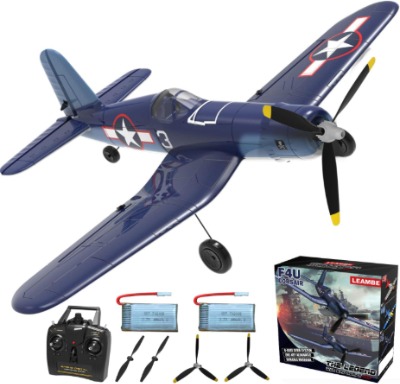
This is the sibling model to the LEAMBE P51 Mustang reviewed earlier, but styled after the F4U Corsair, another iconic warbird design known for its bent-wing shape. Like its Mustang counterpart, it comes ready to fly with full 4-channel control and an aerobatic-capable frame.
Best Use Cases
This plane fits the same general audience as the P51 Mustang model: hobbyists who want a scale-style plane with real aerobatic potential, gift buyers shopping for an adult or teen with a passion for aviation, and pilots who have already built some basic skill and are ready for a plane with more nuance and control.
Key Features Explained Simply
- 4-channel control: Same full control setup as the Mustang model, offering throttle, elevator, rudder, and aileron control.
- F4U Corsair scale design: The bent-wing look sets it apart visually from more common straight-wing warbird replicas.
- Aerobatic capability: Built to handle loops and rolls once you’re comfortable with the stick inputs.
- Ready to fly package: Comes prepared for flight with minimal setup needed.
Real-Life Usage Insight
Flyers who already own or have tried the LEAMBE Mustang often pick this Corsair model as a second plane, since the flight characteristics feel familiar but the look and feel is fresh. New pilots who start directly with this plane report a similar learning curve to the Mustang: manageable, but not instant, especially with the 4-channel control scheme.
The bent-wing Corsair design does add a small visual charm factor that some pilots say makes flying feel more rewarding, purely because it looks distinct in the sky compared to more generic RC plane shapes.
Pros
- Distinctive F4U Corsair scale design
- Full 4-channel control for realistic, responsive flying
- Ready to fly setup with minimal assembly
- Sturdy foam build that handles beginner crashes reasonably well
- Great gift option for aviation fans
Cons
- Same learning curve challenges as any 4-channel plane
- Needs open space and calm wind for the best flying experience
- Not the best first plane ever for a total beginner with zero RC experience
Performance Discussion
Flight performance mirrors the Mustang model closely, since both share the same core 4-channel platform. It holds a stable line in calm wind, banks smoothly, and rewards small, controlled stick inputs. Like most lightweight foam planes, gusty conditions will test your control, so early sessions are best kept to calm weather.
Ease of Use
If you already have some RC experience, even from a 2 or 3-channel plane, this one will feel approachable. If it’s your very first plane, expect a short adjustment period as you learn to manage all four channels together.
Value for Money
Similar to its Mustang sibling, this plane sits in the mid-range price bracket and earns that price through its scale design, 4-channel control, and ready-to-fly convenience. For hobbyists who want more than a toy-grade glider, it’s a solid investment.
Comparison Insights: How These Planes Stack Up Against Each Other
Now that we’ve gone through each plane individually, let’s line them up side by side.
For total beginners with zero experience, the HAWK’S WORK 2 CH plane is the easiest starting point. Two channels means less to think about, and the lightweight glider-style build is forgiving for shaky first attempts.
For beginners who want a bit more control without full complexity, the 3CH P-51D Mustang with gyro stabilization hits a sweet spot. It adds elevator control and a stabilization system that catches mistakes, making it a natural next step up from a basic glider.
For kids and stunt-focused fun, the FUNPX foam plane wins on pure practicality. Headless mode removes a lot of early confusion, the foam build survives hard crashes, and the included batteries mean more time in the air. It’s also the only plane here built specifically for night flying.
For hobbyists ready for full manual control and scale realism, both LEAMBE planes (the P51 Mustang and the F4U Corsair) offer a more advanced, authentic flying experience. They’re best suited for someone who already has some basic RC background, or a highly motivated beginner willing to push through a slightly steeper learning curve.
In terms of price, the HAWK’S WORK glider and the FUNPX foam plane sit at the more budget-friendly end, while the two LEAMBE models and the stabilized P-51D Mustang land in the mid-range bracket, reflecting their added control channels and features.
Buying Guide: What to Look for in a Beginner RC Airplane
Here’s a breakdown of the main things to think through before you buy your first RC plane.
Number of Channels
This is the single biggest factor for beginners. Fewer channels mean simpler controls, which is great for your very first plane. More channels mean more realistic, responsive flying, but also a steeper learning curve. As a general rule:
- 2 channels: Best for absolute beginners and young kids
- 3 channels: A solid middle ground, especially with stabilization tech
- 4 channels: Best once you have some basic flying confidence
Build Material and Durability
Nearly all beginner RC planes use some form of foam construction. Look for planes that specifically mention crash-resistant or durable foam, since your first flights are almost guaranteed to include a few rough landings. A tougher build means fewer repairs and more time actually flying.
Stabilization Technology
Gyro stabilization is a genuine game-changer for new pilots. It automatically smooths out small mistakes, which lowers the frustration factor early on. If you’re nervous about flying for the first time, a plane with stabilization tech is worth prioritizing.
Headless Mode
This feature solves one of the most confusing parts of RC flying: figuring out which direction is “left” and “right” once your plane turns to face you. If you’re buying for a young child or someone brand new to the hobby, headless mode is a genuinely useful feature to look for.
Battery Life and Included Extras
Check how many batteries come in the box. A plane that ships with just one battery might leave you sitting around waiting to recharge after only a few minutes of flying. Planes that include multiple batteries, like the FUNPX model, let you fly longer without interruption.
Flying Environment
Think honestly about where you’ll actually fly. Small gliders can work in larger backyards, but most beginner planes fly best in open parks or fields away from trees, power lines, and other obstacles. If your outdoor space is limited, factor that into which plane makes sense for you.
Weight and Wind Sensitivity
Lighter planes are easier to hand-launch and control at low speeds, but they also get pushed around more by wind. If you live somewhere breezy, a slightly heavier, more stable plane will likely serve you better than an ultra-light glider.
Who Should Buy These Planes
Parents introducing kids to the hobby should lean toward the HAWK’S WORK 2 CH plane or the FUNPX foam plane, since both prioritize simplicity, durability, and forgiveness over speed or realism.
Total beginners with no RC experience at all, regardless of age, will likely have the smoothest start with a 2-channel plane before working up to more channels.
Hobbyists who already have some basic flying background, even from a cheap toy-grade plane, are well suited to the 3CH stabilized P-51D Mustang or either of the 4-channel LEAMBE planes.
Gift buyers shopping for an adult aviation enthusiast will likely get the best reaction from the LEAMBE P51 Mustang or F4U Corsair, since both combine authentic warbird styling with real aerobatic capability.
Anyone wanting flexible flying hours, including evenings after work or school, should strongly consider the FUNPX plane thanks to its built-in LED lights for night flying.
Common Mistakes to Avoid When Buying and Flying Your First RC Plane
Jumping straight to a 4-channel aerobatic plane as your very first RC plane ever. It’s tempting to want the most advanced-looking model right away, but starting with too many channels at once often leads to frustration and more crashes early on. Build basic skill first if you’re truly starting from zero.
Flying in windy conditions during your first few sessions. Even a well-built plane can get tossed around by strong gusts. Save your early flights for calm mornings or evenings when the air is still.
Skipping the trim adjustment step. Most RC planes need small trim adjustments on the transmitter to fly straight and level. Skipping this step can make a perfectly good plane feel unstable or hard to control.
Flying too close to trees, power lines, or crowds. Beginners need extra buffer space since your control precision is still developing. Always fly in a wide-open area away from obstacles and people.
Not charging the battery fully before your first flight. A partially charged battery can cut your flying session short right when you’re starting to get the hang of things, which is a frustrating way to end an otherwise good learning session.
Ignoring the manual’s binding instructions. Every RC plane needs the transmitter and receiver to be properly bound together before flight. Skipping or rushing this step is a common reason a brand-new plane won’t respond correctly right out of the box.
Buying based on looks alone. A plane might look amazing in photos, but if the channel count and skill level don’t match your experience, you’ll end up frustrated. Always match the plane to your actual skill level, not just your taste in design.
Final Verdict
All five of these planes serve a real purpose, and none of them is a bad choice, as long as it matches your skill level and goals.
If you want the absolute easiest entry point into the hobby, especially for a young child or a nervous first-timer, go with the HAWK’S WORK 2 CH RC Plane. It strips flying down to the basics and builds confidence fast.
If you want a bit more control without diving into full complexity, the 3CH P-51D Mustang with gyro stabilization is a smart middle-ground pick. The stabilization tech genuinely helps smooth out those early rocky flights.
If your priority is rugged, kid-friendly fun with tricks, flips, and even night flying, the FUNPX Foam RC Plane delivers strong value, especially with three batteries included in the box.
If you already have a bit of flying confidence, or you’re buying a gift for an adult aviation fan, either of the LEAMBE 4 Channel planes, the P51 Mustang or the F4U Corsair, offer a more realistic, rewarding flying experience with genuine aerobatic potential.
There’s no single “best” answer here, only the best fit for your situation. Match the plane to your experience level, your flying space, and your patience for a learning curve, and you’ll set yourself up for a fun, lasting hobby instead of a frustrating one-and-done experience.
Fly safe, start slow, and enjoy the ride.





One Comment