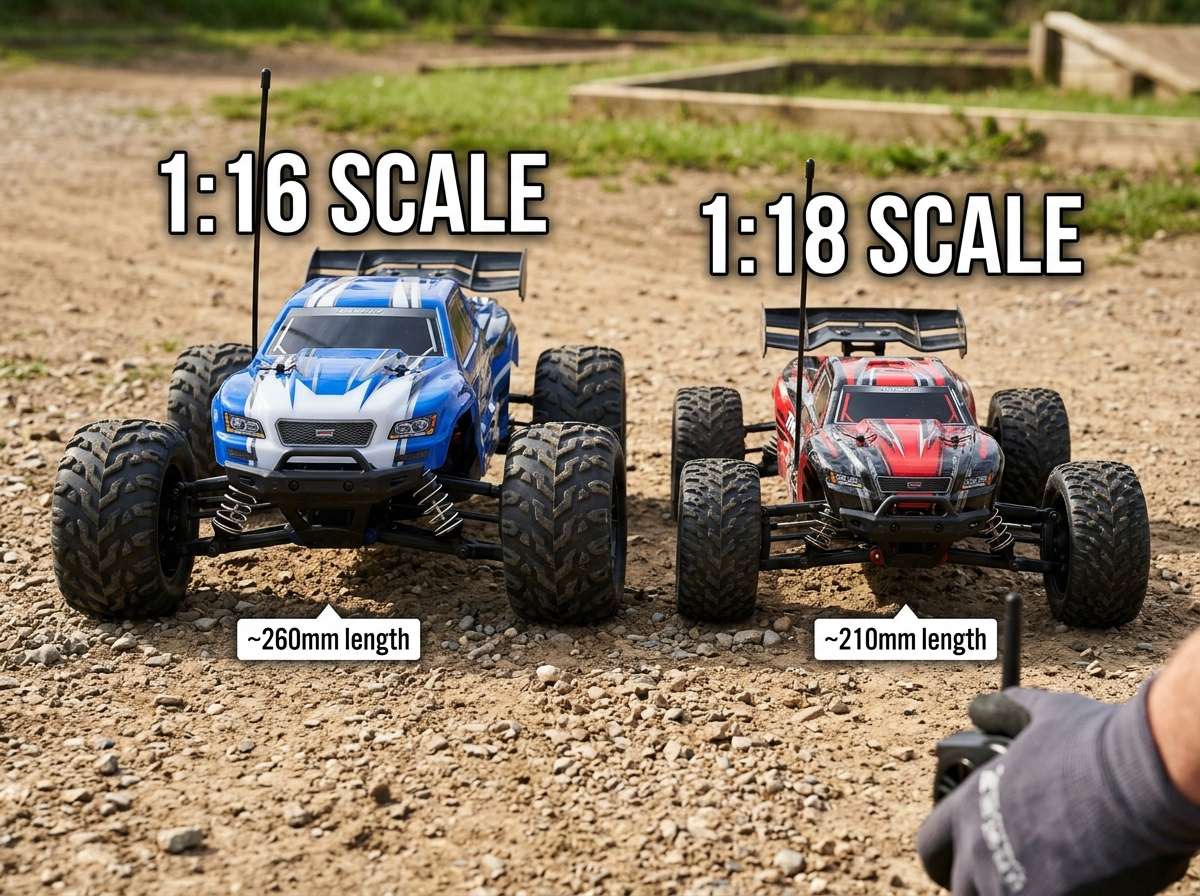
1/16 vs 1/18 Scale RC Car
If you’re new to the world of remote control cars, you’ve probably noticed that they come in many different sizes. Two of the most common sizes you’ll see are 1/16 and 1/18 scale models. But what do these numbers really mean, and how do you know which one is right for you?
This guide breaks down everything you need to know about both scale options. By the end, you’ll understand the key differences and be able to pick the perfect RC car for your needs.
What Do Scale Numbers Mean?
The numbers 1/16 and 1/18 tell you how much smaller the RC car is compared to a real, full-size car. Think of it like a comparison ratio.
A 1/16 scale car is 16 times smaller than a real car. A 1/18 scale car is 18 times smaller than a real car. This means a 1/18 model is a bit smaller overall than a 1/16 model.
Let me give you some real numbers. A typical 1/16 scale car is about 7 to 8 inches long. A 1/18 scale car usually measures around 6 to 7 inches long. The difference isn’t huge, but it’s noticeable.
The scale affects many things about your RC car experience. The bigger size brings some benefits. The smaller size brings others. We’ll cover all of this in depth.
Size and Dimensions: The Main Difference
The most obvious difference between these two scales is their physical size. Let’s look at what this means in practical terms.
1/16 Scale RC Cars
A 1/16 model is noticeably larger. Most 1/16 scale cars measure between 7 to 9 inches in length. Some off-road models can be even bigger.
This larger size has real advantages. The car is easier to see when you’re driving it, especially outdoors in bright sunlight. You won’t lose sight of it as easily. The bigger body also means more room for bigger motors and batteries inside.
The larger size feels more substantial in your hands. Many people like how a bigger RC car feels when they’re holding it before and after drives. It seems more like a “real” model of a car.
The downside is storage and portability. A 1/16 car takes up more space in your room or garage. If you want to carry it around, you’ll need a bigger bag or case.
1/18 Scale RC Cars
A 1/18 model is more compact. These cars usually range from 6 to 7 inches long. Some models can be slightly smaller.
The smaller size makes these cars super convenient for storage. You can keep several 1/18 models in a small box. They’re also easier to transport. If you want to take your RC car to a friend’s house or to a park, a 1/18 is less bulky.
The compact size is also great if you live in an apartment or have limited space. You can enjoy RC car driving without needing a huge area.
The tradeoff is that some people find them harder to control because they’re smaller and lighter. Wind can affect them more easily. They can also be trickier to modify or repair due to less interior space.
Speed and Performance
Speed is a big reason people buy RC cars. Let’s see how these two scales compare when it comes to how fast they go.
1/16 Scale Speed
A 1/16 scale RC car typically reaches speeds between 20 to 35 miles per hour. Some high-performance models can go even faster.
The larger size and weight of a 1/16 model helps it maintain speed and stability. The bigger tires grip the ground better. The car doesn’t get blown around as much by wind or bumps.
You get a more stable driving experience at higher speeds. The car feels planted and controlled. This makes 1/16 models great for people who want to feel real performance.
1/18 Scale Speed
A 1/18 scale car usually tops out at 15 to 25 miles per hour. Some powerful models can reach 30 miles per hour.
These cars are lighter, so they accelerate quickly. But they can’t quite match the top speeds of 1/16 models. The lighter weight also means they get pushed around more easily by wind and rough terrain.
For beginners, this slower speed can actually be good. You have more time to react and make corrections. The car is easier to control if you’re just starting out.
Power and Battery Life
How long your RC car runs before needing a charge is important. So is how much power it has.
1/16 Scale Power and Battery
Because 1/16 cars are bigger and heavier, they need more powerful motors and larger batteries to run well.
These models typically come with bigger battery packs. You can drive them for longer periods before they run out of power. A typical session might last 20 to 30 minutes depending on the model and how hard you drive.
The bigger motor gives you more acceleration and pulling power. This is great if you like climbing hills or driving on challenging terrain.
The downside is charging time. Larger batteries take longer to charge. You might wait an hour or more for a full charge.
1/18 Scale Power and Battery
These cars use smaller motors and batteries. They’re lighter on power overall.
Battery life is shorter. You might get 12 to 20 minutes of driving time before needing to recharge. This is perfect if you plan quick drives or testing sessions.
Charging is faster though. You can get a full charge in 30 to 45 minutes on many models. This means less downtime between driving sessions.
The smaller motor is still plenty powerful for fun driving. You won’t feel like you’re missing out on performance for basic driving and tricks.
Cost and Budget
Money matters when you’re buying a hobby. Let’s talk about how these scales stack up price-wise.
1/16 Scale Pricing
1/16 scale RC cars are generally more expensive. A basic model can cost anywhere from 50 to 150 dollars. High-quality or specialty models can cost much more.
The bigger size and better components drive up the cost. You’re getting more materials and more complex parts.
Parts and upgrades are also pricier. If you break something, replacement pieces for 1/16 models cost more than 1/18 parts.
1/18 Scale Pricing
These models are usually cheaper. You can find solid 1/18 RC cars for 30 to 100 dollars. Entry-level models are often in this category.
The smaller size means less material and simpler construction. This keeps costs down.
Parts are less expensive too. Replacement tires, motors, and other pieces cost less for 1/18 models.
If you’re on a tight budget or want to test if RC cars are for you, 1/18 is the smart choice.
Durability and Build Quality
How well your RC car holds up matters a lot. You don’t want something that breaks after a few drives.
1/16 Scale Durability
The bigger size naturally means more durable construction in many cases. Larger parts are often stronger and less likely to snap from minor impacts.
1/16 models are built to handle more abuse. Stronger suspension systems, thicker plastics, and reinforced frames are common.
This doesn’t mean they never break. RC cars still need care. But 1/16 models tend to take bumps and crashes better than 1/18 cars.
The bigger size also means more space between delicate parts. Parts don’t get jammed together as tightly.
1/18 Scale Durability
These cars are more fragile due to their smaller size. Thinner plastics and lighter materials are used throughout.
This doesn’t make them bad. It just means you need to be more careful with them. Crashes are more likely to cause damage.
The upside is that repairs are often simpler. Smaller, lighter damage is easier to fix yourself.
Many 1/18 models are designed for hobbyists who enjoy tinkering and fixing things. If you like hands-on work, the lighter construction can actually be fun.
Handling and Control
How easy is the RC car to drive? That’s a crucial question for any buyer.
1/16 Scale Handling
The weight and size of a 1/16 model give you better traction and grip. The car feels more stable in your hands and on the ground.
Larger wheels and tires mean better contact with the ground. You get more predictable handling.
Steering feels responsive but not twitchy. You can make smooth, controlled turns. The car responds well to your inputs.
Wind and terrain don’t push the car around as much. This is great for outdoor driving.
For beginners, 1/16 models are forgiving. They’re harder to flip or lose control of.
1/18 Scale Handling
These cars are more twitchy and sensitive. Slight movements on the controller cause bigger responses.
The smaller tires have less contact with the ground. This means less grip and traction.
Wind affects 1/18 cars more easily. They can get pushed around on breezy days.
On smooth surfaces like pavement, they’re fine. On rough terrain, they’re more challenging to control.
For someone just starting, a 1/18 might feel harder to handle. But once you get used to it, many people enjoy the nimble, quick response.
Terrain and Driving Surfaces
Where you drive your RC car makes a difference in which scale you should choose.
1/16 Scale Off-Road Performance
The bigger wheels and sturdier frame make 1/16 models great for off-road driving. They handle dirt, grass, gravel, and rocks well.
The extra ground clearance means less chance of getting stuck on obstacles. The car can climb steeper angles.
If you want to drive in parks, beaches, or your backyard on unpaved ground, a 1/16 is the way to go.
1/18 Scale On-Road Performance
These cars really shine on smooth, flat surfaces. Pavement, concrete, and smooth indoor floors are perfect for 1/18 models.
The lightweight design and small tires work great on hard surfaces. They’re quick and nimble on roads.
For indoor driving or smooth outdoor pavement, 1/18 cars are excellent. They perform well and are fun to drive.
Off-road is possible but more challenging. Rough terrain can slow them down or cause them to flip.
Customization and Upgrades
Do you like tweaking and improving your toys? This matters a lot.
1/16 Scale Customization
The larger size means more room inside the car for upgrades. You have space to add better motors, batteries, and electronics.
Parts are easier to install due to the bigger work area. Modifying a 1/16 is less cramped and frustrating.
The aftermarket is strong for 1/16 models. Many companies make upgrade parts, replacement components, and accessories.
If you plan to invest in improvements over time, a 1/16 is the better choice.
1/18 Scale Customization
Limited space inside makes upgrades tricky. You can still modify 1/18 cars, but it takes more patience.
Parts are harder to fit. Everything is cramped and tight.
The aftermarket is smaller. Fewer companies make 1/18-specific upgrades.
That said, many basic upgrades are still available. You can improve performance, but it takes more work.
Maintenance and Repairs
Keeping your RC car in good shape requires basic maintenance.
1/16 Scale Maintenance
The bigger size means easier access to parts that need cleaning or adjustment. You can see and reach components without a magnifying glass.
Repairs take less time due to the larger workspace. Swapping out broken parts is straightforward.
Regular cleaning is easy. Dirt and debris are easier to wipe away from bigger parts.
1/18 Scale Maintenance
Everything is smaller and tighter, which makes maintenance more challenging.
You might need tweezers or small tools to work on internal parts. Patience is essential.
Repairs take longer because the workspace is cramped. You need a steady hand and good eyesight.
Cleaning requires more care. Small crevices trap dust and dirt.
If you don’t enjoy detailed mechanical work, maintenance on a 1/18 can feel tedious.
Driving Experience and Fun Factor
At the end of the day, you want to have fun. How do these scales compare?
1/16 Scale Fun
Driving a bigger RC car feels more immersive. The larger model takes up more of your visual attention.
The stability and grip make driving smooth and predictable. You can focus on having fun rather than fighting with control.
The speed and power are satisfying. You feel like you’re really driving something.
Group driving sessions are fun with 1/16 models. The size makes them easy for others to spot and follow.
1/18 Scale Fun
The nimble, twitchy handling appeals to people who like a challenge. The quick response is exciting.
Racing on smooth surfaces is a blast. The speed feels fast for the small size.
They’re fun to collect. The smaller size means you can own several without taking up much space.
Indoor driving on a smooth floor or table is entertaining. They’re perfect for quick play sessions.
Which One Should You Choose?
Now that you know the differences, how do you decide?
Choose 1/16 If You:
Want a more stable, forgiving car for learning. The bigger size and weight make control easier.
Plan to drive mainly off-road. Bigger wheels and more ground clearance handle rough terrain better.
Like driving for long sessions. Larger batteries last longer.
Want to modify and upgrade over time. The bigger size makes customization easier.
Have space to store a bigger model. You won’t be cramped for room.
Want a car that feels more substantial and real. The size feels more like driving a real vehicle.
Plan to drive with friends. The bigger size is easier for others to see.
Choose 1/18 If You:
Have a tight budget. These cars cost less.
Live in a small space. They don’t need much storage room.
Like quick, nimble handling. The twitchy response is fun if you’re skilled.
Plan to drive mainly on smooth surfaces indoors or on pavement. They perform best in these conditions.
Want fast charging times. You can get back to driving quickly.
Enjoy collecting multiple models. Several 1/18 cars fit in one box.
Want something super portable. They’re easy to carry anywhere.
Prefer shorter driving sessions. Smaller batteries mean less time between charges.
Hybrid Approach: Owning Both
Many RC enthusiasts own both sizes. It’s not an either-or choice.
Some people keep a 1/16 for outdoor off-road driving and a 1/18 for indoor fun. You get the best of both worlds.
The 1/16 is your main car for serious driving sessions. The 1/18 is your casual, travel-friendly option.
This approach isn’t expensive since entry-level models of each are affordable. Two basic models cost less than one high-end model.
If you fall in love with RC cars, you’ll probably end up with multiple models anyway. Starting with one and adding another later works great.
Getting Started: Tips for New Drivers
Whether you go with 1/16 or 1/18, here are some tips for a great experience.
Start on smooth surfaces. Pavement or smooth grass is forgiving as you learn the controls.
Practice in an open area. Give yourself space to move around. You need room to recover from mistakes.
Charge your battery fully before driving. Don’t use a half-charged battery. You won’t get the best performance.
Learn to do basic maintenance. Watch YouTube videos on how to clean your car and adjust settings.
Respect the throttle. Don’t go full speed immediately. Build up speed slowly as you gain control.
Invest in a charger early. Using the basic charger works, but a good charging system is worth the money.
Join a community. Talk to other RC car enthusiasts online or find a local club. You’ll learn tons of tips.
Be patient with crashes. Everyone crashes. It’s part of learning. Damage is usually repairable.
Have fun. Remember, RC cars are a hobby meant to be enjoyable. Don’t stress about perfection.
Common Questions Answered
Can I switch between 1/16 and 1/18 controllers? Generally, no. The controllers are not compatible. Each car needs its own remote.
Are replacement parts easy to find? Yes. Both scales have lots of aftermarket parts available online. 1/16 has more options though.
Can I race 1/16 and 1/18 cars together? Technically yes, but they’ll perform very differently due to speed and handling differences. Racing with the same scale works better.
How long do these cars last? With proper care and maintenance, years. Many people use their RC cars for many years before upgrading.
Is waterproofing important? Not always, but it helps. Some models are waterproof. Many are water-resistant. Avoid deep water either way.
Can kids use these? Yes. Both scales are suitable for kids old enough to follow instructions. Supervision helps younger kids succeed.
Do I need expensive upgrades right away? No. Stock models are fun as-is. Upgrades are optional and happen over time.
Final Thoughts
The choice between 1/16 and 1/18 scale RC cars doesn’t have to be stressful. Each has real advantages.
A 1/16 scale car offers stability, durability, and great off-road performance. It’s the safe choice if you want something forgiving and powerful. The bigger size feels more satisfying to many drivers.
A 1/18 scale car saves money, takes up less space, and is fun on smooth surfaces. It’s perfect for beginners on a budget or people with limited room.
Really, you can’t go wrong. Both are legitimate, fun hobby choices. Many people end up with both eventually.
Think about your space, budget, driving style, and where you’ll drive. Your answer will become clear. Then take the plunge and join millions of people enjoying the RC car hobby. You’re going to have a blast.
Peterson is an RC hobby enthusiast and product reviewer with a passion for remote-controlled cars, trucks, boats, drones, and accessories. He enjoys testing the latest RC products, comparing features, and sharing practical buying guides to help beginners and experienced hobbyists make informed decisions. Through RCThing.com, Peterson provides honest reviews, maintenance tips, and expert advice to help readers get the most from their RC adventures.