RC Drift vs RC Racing
Remote controlled vehicles have captured the hearts of hobbyists around the globe. From casual weekend drivers to serious competitors, the RC community keeps growing. But here’s the thing: not all RC driving is the same. Two of the most popular styles are RC drift and RC racing. Both are exciting, both are rewarding, but they’re actually quite different experiences. Let’s explore what makes each one special.
The Basics: What You Need to Know
Before diving deep, let’s start with the fundamentals. RC drift and RC racing both involve driving small remote control cars, but they focus on different skills and goals. Think of RC racing as the sprint, and RC drift as the dance. One is about pure speed and beating opponents to the finish line. The other is about style, control, and executing smooth movements.
RC racing is straightforward. You compete against other drivers on a track. The first one to cross the finish line wins. It’s fast-paced, intense, and all about getting from point A to point B as quickly as possible. You’re pushing your car to its limits, making strategic passes, and dealing with traffic.
RC drifting takes a different approach. Instead of racing straight through corners, drivers deliberately slide their cars sideways. The goal isn’t necessarily to win a race. Instead, you’re judged on technique, smoothness, and control. You’re working with your car’s physics, not against them. It’s like the difference between a sprint and ice skating—both require speed, but the approach is totally different.
Understanding RC Racing
RC racing is the more traditional sport of the two. It has roots going back decades. The basic concept remains unchanged: build a car, practice, and compete against others to see who’s fastest.
Types of RC Racing
RC racing isn’t just one thing. There are several different types, each with its own rules and track layouts.
On-Road Racing is what most people think of when they imagine RC racing. These cars run on smooth surfaces like asphalt or concrete. They’re built for speed and grip. The tracks are tight and technical, with lots of turns and elevation changes. On-road cars are low to the ground, lightweight, and extremely responsive.
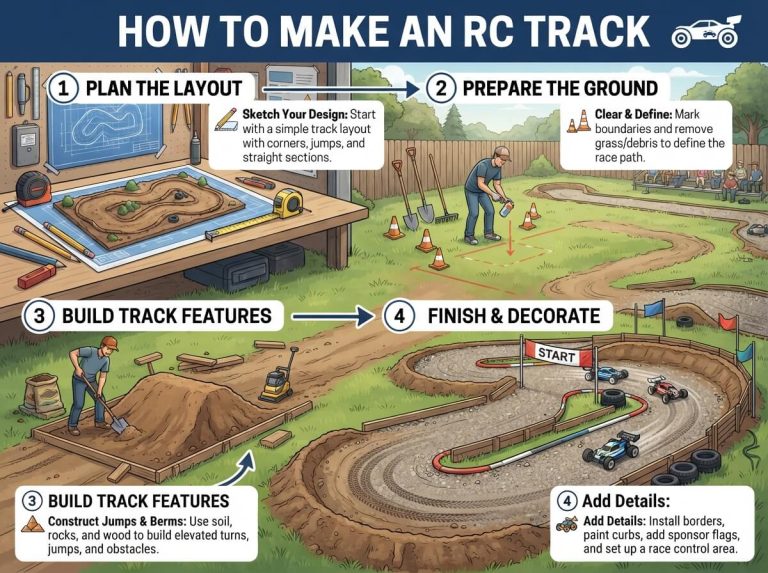
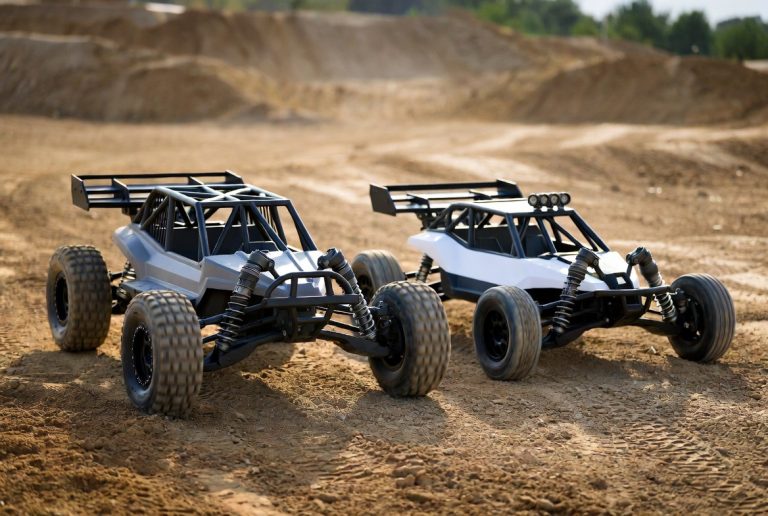
Off-Road Racing happens on dirt, mud, sand, and grass. These vehicles are tougher and built to handle rough terrain. The suspension is more aggressive, and the tires have deeper treads for traction. Off-road racing can happen on open fields, in deserts, or on purpose-built dirt tracks. It’s messier, more chaotic, and incredibly fun.
Truck Racing uses larger remote control trucks. These can do both on-road and off-road. Monster trucks, buggies, and stadium trucks all fall into this category. They’re heavier than standard cars, and the driving style is a bit different due to their size and weight.
Touring Car Racing uses 1/10 scale sedans and coupes that look like real cars. These are popular for competitions because the rules are very standardized. You’ll find touring car racing at almost every RC club.
What Makes RC Racing Competitive
Racing is all about competition. You’re constantly trying to improve your lap times, learn better lines through corners, and execute perfect passes. The racing community is tight-knit but fiercely competitive.
To succeed in RC racing, you need a few things. First, you need a quality remote control car built for speed. Second, you need track access and practice time. Third, you need mechanical knowledge—knowing how to tune your car for different conditions makes a huge difference. Fourth, you need patience. Getting better takes time, lots of crashes, and learning from mistakes.
Racing events vary in format. Some races are sprint races where you try to cover the most distance in a set time. Others are head-to-head matches where you race against one other driver. Still others are large competitions with many drivers on the track at once, trying to win through elimination rounds.
Discovering RC Drifting
RC drifting is the newcomer to the scene. It only became popular in the last few decades, inspired by full-size drift racing that originated in Japan. But RC drifting has developed its own culture and community.
In RC drifting, style matters more than raw speed. Judges look at several things: line control, angle of the drift, smoothness of transitions, and overall flow. You’re trying to navigate a course while maintaining controlled slides. It’s artistic and technical at the same time.
The Art of Drifting
Drifting isn’t about driving in a straight line. You approach a corner at speed, then intentionally lose traction on the rear wheels. Your front wheels point toward the next turn while the rear of the car slides sideways. You’re balancing on the edge between control and chaos. It’s harder than it sounds.
The physics of drifting involves countersteering. You turn the front wheels one way while the car slides the other way. You’re managing throttle control constantly, keeping the car moving forward while maintaining that sideways angle. Too much throttle, and you spin out. Too little, and the car straightens up. The sweet spot requires practice and feel.
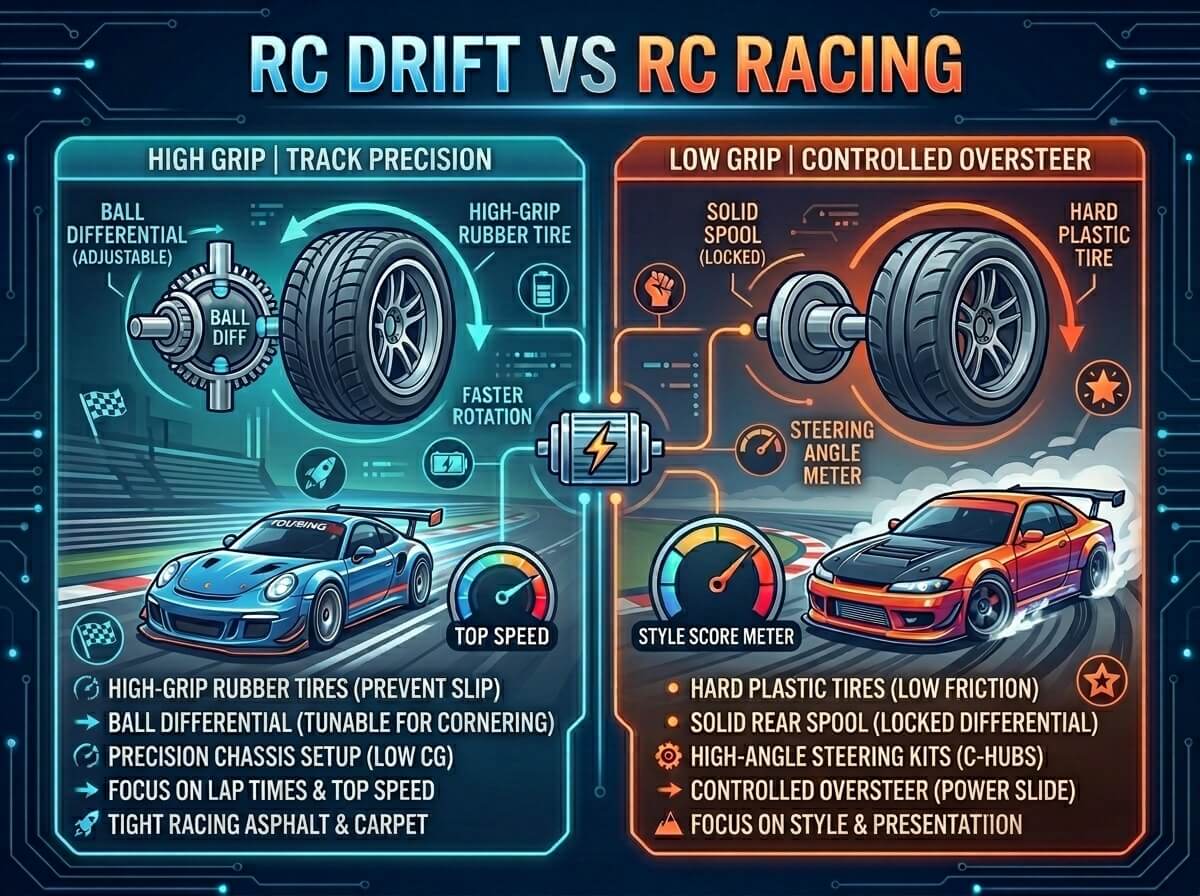
RC drift cars are special. They have weaker brakes and lower grip tires compared to racing cars. The suspension is set up to allow more movement and less grip. Everything about a drift car says “let’s slide around corners.” Some people spend as much time tuning their drift cars as racing drivers do—it’s an entire skill set.
Types of Drift Events
RC drifting has several competitive formats.
Tandem Drifting is head-to-head competition. Two drivers drift simultaneously, often one behind the other. Judges rate each driver individually. The one with better style, control, and angle wins the battle. It’s like a dance-off—you need to beat your opponent on skill and style.
Solo Competition has each driver taking a turn on the course alone. Judges score based on predetermined criteria. You’re competing against a standard, not another driver. This reduces the chaotic element and lets drivers focus on their technique.
Drift Events at RC clubs are often just for fun. Drivers show up, practice, and enjoy the community. Scoring may or may not be involved. The focus is on pushing your skills and having a good time with fellow enthusiasts.
King of the Hill competitions pit drivers against each other in bracket-style tournaments. The winners advance, and drivers keep competing until a champion emerges. It combines tandem drifting with tournament structure.
Key Differences Between RC Drift and RC Racing
Now let’s get to the heart of it. What actually separates these two hobbies?
Goal and Objective
In racing, the goal is simple: win. Get across that finish line first. Every decision you make serves that purpose. You want the fastest car, the best setup, and the perfect race line. Everything is measured in speed.
Drifting has a different goal. You want to look good doing it. Your car needs to flow through the course with style and control. Judges aren’t watching your lap times—they’re watching your technique. A drift car that wins is smooth, controlled, and impressive to watch. The driver who hits the biggest angles and maintains perfect control wins.
The Cars
Racing cars are built for grip and acceleration. Their suspension is tight and responsive. The tires are sticky. The whole setup maximizes traction and speed. Aerodynamics matter. Weight distribution matters. Everything is optimized for going fast in a straight line and through corners with grip.
Drift cars sacrifice some grip intentionally. They run harder suspension, looser setups, and lower grip tires. The cars are often lighter and have more aggressive proportions. They look cool, too—many people choose drift cars based on appearance as much as performance. The vehicle itself becomes part of the artistic expression.
The Driver’s Skill
Racing demands smooth steering inputs, good timing, and the ability to find the fastest line through each corner. You’re trying to minimize time. This requires precise, calculated driving. Professional racing drivers train extensively on technique and mental focus.
Drifting demands something different. You need to feel the car. You’re managing throttle, steering angle, and weight transfer constantly. It’s more about instinct and reading the car’s behavior. Many drifters say it’s like playing music—you’re responding and reacting rather than executing a predetermined plan.
The Track Layout
Racing tracks are built for speed and competition. The layout emphasizes straightaways for passing and technical corners for skill challenges. Tracks are usually closed circuits. The focus is on creating a fair competition where the best driver wins.
Drift courses are different. They include long sweeping turns, not tight technical sections. The layout lets drivers build speed and maintain long drifts. Courses often have obstacles or gates to navigate. It’s more about flowing through a course than racing around a tight circuit.
Competition Format
Racing competitions are standardized. Heats, semifinals, finals. The person with the best time or wins most often becomes the champion. It’s objective—the clock doesn’t lie.
Drift competitions rely on judges. Multiple people score each driver on technique, style, and execution. Different judges might weight things differently, which adds some subjectivity. It’s like gymnastics or figure skating rather than track and field.
What Each Hobby Demands from You
Both RC hobbies require commitment. But they demand different things from you as a person.
Physical Requirements
Racing is physically demanding in short bursts. During a race, you’re focused, your reflexes are firing, and you’re completely locked in. But races don’t last long—usually minutes. You need quick reactions and sustained concentration.
Drifting is different. You might spend 15 or 20 minutes at a time drifting a course. It’s less about raw reflexes and more about endurance and feel. Your arm muscles work harder because you’re constantly inputting steering adjustments.
Mental Approach
Racing rewards strategic thinking. You plan your approach to each race. You study the track. You think about tire wear and fuel consumption. You develop tactics for passing. It’s chess at high speed.
Drifting rewards intuition and feel. You’re reading your car’s feedback constantly. You’re adjusting based on what you feel rather than a predetermined plan. It’s more about trusting your instincts and practicing until your muscle memory takes over.
Time Commitment
Both require practice. But racing might demand more specific practice—track time, setup adjustments, test sessions. Drifting can happen anywhere with a large open area. You can practice in parking lots, closed courses, or any smooth surface big enough to slide around.
Money Investment
Racing can be expensive. You need a competitive car, which costs money. Track fees add up. Parts and maintenance accumulate. Competitive racing requires a serious budget.
Drifting is sometimes more affordable to start, though serious drifters also spend big money. But you can have fun drifting with a decent beginner car. Many people drift without spending thousands of dollars.
Getting Started with RC Racing
Want to start racing? Here’s what you need to do.
Buy a Competitive Car: You can start with a basic model, but you’ll eventually want something built for racing. Popular brands include Tamiya, HPI, and Associated. Look for cars designed for the racing class you want to join.
Join a Club: Find an RC racing club near you. They’ll have tracks, experienced people to learn from, and regular events. Clubs are invaluable for new racers.
Invest in Tools and Spares: You’ll need tools for maintenance and adjustment. Spare parts break during crashes—expect to break things while learning.
Practice: Spend lots of time on the track. Practice teaches you more than anything else. You’ll learn the track, understand your car, and develop smooth driving skills.
Study Your Car: Learn how to tune and maintain it. Changing camber angles, adjusting suspension stiffness, and modifying gearing all make a big difference. Understanding your vehicle is half the battle.
Race Smart: Don’t just go out and drive fast. Race strategically. Study other drivers. Learn when to make passes. Develop a racing style that works for your car.
Getting Started with RC Drifting
Ready to drift? Here’s your path forward.
Choose a Drift Car: Pick a car designed for drifting. Many come as kits that you build yourself. Popular drift cars include models from brands like Tamiya, Yokomo, and HPI.
Get to Know the Basics: Learn how drift cars work. Understand the setup, the tires, and how to adjust the car for your style. Drift cars are more customizable than racing cars.
Find a Drift Community: Look for local drift groups or clubs. Many cities have active drift communities. Online forums are great for learning too.
Practice Drifting: Start in a large parking lot if you can. Practice maintaining control while sliding. Work on consistent angles and smooth transitions.
Fine-Tune Your Setup: Adjust your car’s suspension, steering, and throttle response. Every driver’s style is a bit different, so you’ll customize your car to match your preferences.
Watch and Learn: Follow drift competitions online. Watch experienced drifters. Notice how they approach courses, how they handle transitions, and how they maintain control. Learning from others accelerates your progress.
Enter Events: Once you’re comfortable, try a local drift event. Even if you don’t win, you’ll get valuable feedback and experience.
The Communities Are Different
The RC racing community and the RC drifting community have different vibes. Both are welcoming, but they’re distinct cultures.
Racing communities tend to be competitive and technical. People talk about setup details, tire choices, and strategy. There’s respect for speed and efficiency. Events are structured and run like actual sports competitions.
Drifting communities tend to be more relaxed and social. There’s emphasis on style, creativity, and having fun. People modify their cars for looks as much as performance. Events feel more like social gatherings where everyone’s pushing their skills. The vibe is more about community and personal growth than pure competition.
That doesn’t mean racing is cutthroat and drifting is all fun—that’s an oversimplification. But the emphasis is different. If you love competition and pure speed, racing might be your thing. If you love style, creativity, and pushing boundaries, drifting might fit better.
Making Your Choice
So which one should you pick? That depends on you. Ask yourself some questions.
Do you love speed above all else? Racing probably suits you better. Do you want to look cool while driving? Drifting might be your jam. Do you like planned, strategic thinking? Racing might appeal more. Do you like instinct and feel? Drifting could be right for you.
Want to compete seriously? Both are competitive, but racing is more straightforward. Racing has clear winners based on time. Drifting involves judging, which introduces more variables.
Want to start affordably? Drifting might have a lower entry cost. Want something you can practice anywhere? Drifting is easier to do in unconventional places.
Want to join a big community? Both have active communities. But your local area might have more of one than the other. Check what’s available near you.
Why Not Both?
Here’s a secret: you don’t have to choose. Many RC enthusiasts do both. Some people race on weekends and drift on weeknights. Some drivers switch between styles depending on their mood.
Your car can even transition between styles with setup changes. A racing car can sometimes be set up for drifting, and vice versa. It’s not a permanent choice.
The skills overlap too. Good racers develop smooth inputs that help with drifting. Good drifters develop car control skills that transfer to racing. You’re building your overall driving ability no matter what.
The Costs Explained
Let’s talk money because it’s practical. Both hobbies cost something, but they’re different.
Initial RC Racing Investment: A decent racing car runs $200-500. Tools and maintenance supplies add $100-200. Track membership and fees might be $50-200 monthly depending on your club. Parts and replacements happen regularly. Total year one might be $1,000-3,000.
Initial RC Drifting Investment: A basic drift car costs $150-400. Tools and maintenance add $50-150. Events and courses might cost less because drift practices are less formal. Customization parts can add up if you go crazy. Year one might be $500-2,000.
These are estimates—you can spend less or more depending on your approach. Casual hobbyists spend less. Serious competitors spend more. But both give you incredible fun and satisfaction for the investment.
Beyond the Basics
As you get deeper into either hobby, options expand.
In racing, you can compete in different classes, on different track types, and at different levels of competition. Some people race locally for fun. Others travel to regional or national competitions. The ceiling is high if you want to go that far.
In drifting, you can pursue different styles. Some focus on line and smoothness. Others go for angle and style. Some get really creative with car modifications and appearance. The artistic side of drifting runs deep.
Both hobbies have social events, conventions, and gatherings beyond competition. It’s not just about racing or drifting—it’s about the community and culture.
Real Talk: What’s Actually Better?
Honestly? Neither is better. They’re just different. It’s like asking whether baseball or basketball is better. They’re both great sports, just different.
RC racing is better if you want pure competition and speed. It’s more straightforward, with clearer rules and measurements. You know exactly how you stack up against others.
RC drifting is better if you want to express yourself and push your driving style. It’s more creative and less rigid. You’re building something unique.
The best hobby is the one you’ll actually stick with. The one that gets you excited. The one you’ll practice regularly. Pick what appeals to you, try it, and adjust from there.
Common Misconceptions
Let’s clear up some myths.
Myth: Drifting is just goofing around, racing is the serious hobby.
Truth: Serious drifters are incredibly skilled and dedicated. The top-level drifting events are competitive and structured. Racing and drifting are equally serious for people who take them seriously.
Myth: You need a rich sponsor to race in RC.
Truth: Local racing is very accessible and affordable for regular people. National competition is expensive, but casual racing is not.
Myth: Drifting is easier than racing.
Truth: Both are difficult. They’re difficult in different ways. Mastering either takes time and dedication.
Myth: Drift cars are slower than racing cars.
Truth: Drift cars aren’t built for top speed, but they’re not slow either. Speed isn’t the point—control and style are. A drift car excels at what it’s designed for.
Conclusion: Find Your Fun
RC drift and RC racing are both fantastic hobbies. Both offer challenge, community, and incredible fun. Both will improve your driving skills, teach you about vehicles, and connect you with passionate people.
The choice between them isn’t about which is objectively better. It’s about which resonates with you. Which one makes you excited? Which appeals to your personality and interests?
The good news? You’re not locked in. Try one, then try the other. Some people stick with one. Some do both. Some people switch over time. There’s no wrong answer.
What matters is that you get out there and enjoy remote control vehicles. Whether you’re chasing the fastest time or the smoothest drift, you’re part of an amazing hobby with a welcoming community ready to help you succeed.
So pick up a remote control car, find a local club or community, and start your journey. Fast or smooth, competitive or creative—the world of RC is waiting for you. And trust us, once you get hooked on either racing or drifting, you’ll wonder why you didn’t start sooner.
Get out there and drive.