Metal Gear vs Plastic Gear Servo
If you’re getting into robotics, RC cars, or any hobby that uses servos, you’ve probably seen the terms “metal gear servo” and “plastic gear servo” thrown around. The choice between them might seem confusing at first. But don’t worry. This guide will break down everything you need to know in simple terms.
What Exactly Is a Servo?
Before we dive into the gear debate, let’s talk about what a servo actually does. A servo is a small motor that moves to a specific position and then holds there. Unlike regular motors that just spin forever, servos are smart. They know where they are and they stay put.
Think of it like a mechanical helper that can position things exactly how you want. Servos appear in RC planes, drones, robots, and countless other projects. They’re the joints and muscles of the mechanical world.
Inside every servo sits the same basic stuff:
- A small electric motor
- A circuit board that controls it
- A set of gears that reduce the motor speed
- A feedback system that knows where the servo is pointing
The gears are what we’re going to talk about today.
Why Do Servos Have Gears?
The motor inside a servo spins really fast but doesn’t have much strength. The gears slow it down and make it powerful. It’s like the difference between a person running fast but weak versus walking slow but strong.
The gear system is called a gear train. Each gear wheel meshes with the next one, stepping down the speed while stepping up the torque. Torque is the turning force. More torque means the servo can move heavier things and hold them in place better.
This is where metal and plastic enter the picture.
The Plastic Gear Servo Breakdown
Plastic gear servos are the budget-friendly option. Most cheap servos you find online have plastic gears. Let’s look at what that means.
Advantages of Plastic Gear Servos
Price is the biggest win. Plastic gear servos cost way less than metal ones. If you’re starting your first project or building something you might crash and break, plastic servos make sense. You can buy more of them without hurting your wallet.
Weight is lighter too. Plastic weighs less than metal. For flying drones or tiny robots, every gram matters. A plastic gear servo will save you weight compared to a metal one. This means your project can go higher, faster, or longer on a single charge.
They work fine for light jobs. If you’re controlling something that doesn’t need much force, plastic gears are totally fine. A simple servo-controlled camera pan, a robotic arm lifting light objects, or a door opener in a Rube Goldberg machine? Plastic gears can handle it.
Quiet operation. Plastic gears tend to run quieter than metal gears. The plastic absorbs more vibration and doesn’t ring out like metal does.
Widely available. You can find plastic gear servos everywhere. Every electronics store stocks them. Online shops have endless options. This makes finding replacements or upgrades easy.
Problems with Plastic Gear Servos
The downsides show up over time and under stress.
Durability is limited. Plastic gears wear out faster than metal gears. Every time the servo moves, the gears mesh together and tiny plastic flakes away. After a few thousand movements, you’ll notice the servo getting weaker. The gears might develop backlash, which means a tiny gap forms between the teeth. This makes the servo less precise.
Impact damage destroys them fast. Bump a plastic gear servo hard enough and the gears break. You might crack a tooth or shatter an entire gear. Metal gears laugh at impacts that would destroy plastic. If your project involves crashes or rough handling, plastic gears will cost you a fortune in replacements.
Gear slippage under load. When you push a plastic gear servo to its maximum torque, the gears might slip. The teeth can’t grip hard enough to transfer all that force. Metal gears have better grip because they’re harder and more rigid.
Limited lifespan. Plastic gears have a defined service life. You can expect somewhere between 5,000 to 20,000 cycles before problems show up. A cycle is one complete movement from end to end.
Precision degrades. Over time, as the gears wear, the servo becomes less accurate. Small movements become harder to control. The servo might jitter or shake. This matters a lot for precision work.
Not suitable for continuous motion. Plastic gear servos aren’t built for non-stop operation. They’re made for discrete movements with breaks in between. Run one constantly and it overheats and fails.
The Metal Gear Servo Explained
Metal gear servos are the heavy-duty choice. They cost more but deliver serious durability and power.
Advantages of Metal Gear Servos
Durability is incredible. Metal gears are hard and tough. They can take a beating. The teeth don’t wear down easily. A metal gear servo can handle hundreds of thousands of movements. Some of them run for millions of cycles without breaking a sweat.
Impact resistant. Drop a metal gear servo on concrete. It’ll survive. The hard metal can take forces that would shatter plastic gears. This makes metal servos perfect for RC cars that crash, or robots that work in rough environments.
Handles heavy loads. Metal gears can transfer much more torque to the output. They can move heavier objects and hold them with more strength. The rigid metal structure means no slipping or giving way under pressure.
Precision stays stable. Metal gear servos maintain their accuracy over time. Even after tens of thousands of movements, you get the same precise positioning. Backlash develops more slowly. This matters for projects that need consistency.
More power output. Metal gear servos often pack more torque into the same size as plastic ones. You get stronger servos without making them bigger.
Continuous operation capable. Metal gear servos can run non-stop for extended periods. They handle constant motion better than plastic ones. Industrial and professional applications almost always use metal gears.
Better for extreme conditions. Metal can handle temperature swings better than plastic. Heat and cold don’t make the gears brittle or loose. This matters outdoors or in harsh environments.
Disadvantages of Metal Gear Servos
Cost is higher. A decent metal gear servo costs two to five times more than a plastic one. If you need ten servos, that’s a big chunk of money. Budget projects become expensive fast.
Weight increases. Metal is denser than plastic. A metal gear servo weighs noticeably more. For weight-critical projects like drones or ultralight robots, this adds up quickly.
More mechanical noise. Metal gears clicking and grinding together sound louder than plastic gears. This doesn’t matter for most projects, but some applications need quiet operation. A robot butler moving around your house might seem creepy if all the servos are grinding away.
Overkill for simple jobs. Not every project needs metal gears. If you’re moving a light load once or twice, you’re paying for durability you won’t use. It’s like buying a bulldozer to move pebbles.
Slightly more complex maintenance. Metal gears can rust if exposed to moisture. You might need to use higher-quality lubricants. Plastic gears don’t rust, though they can degrade in sunlight.
Real-World Comparison: When to Pick Each
Let’s get specific. What kind of project should you use each type?
Use Plastic Gear Servos When:
You’re learning robotics for the first time. Spend your money on sensors and controllers, not servo durability.
You need lightweight construction. Drones, aerial robots, and ultralight builds benefit from saving grams.
You have a tight budget. Building ten robot arms? Plastic gears keep costs down so you can actually finish the project.
The servo handles light loads. Opening a small door, controlling a camera, positioning a sensor? Plastic works great.
You don’t need precision over time. Decorative mechanics or one-time movements don’t need perfect accuracy years later.
You can replace parts easily. Hobbyist projects often sit on desks where you can swap a broken servo in minutes.
Use Metal Gear Servos When:
You’re building something professional. Anything you’re selling or relying on daily needs metal gears.
The servo gets heavy use. If you’re moving it thousands of times per day, metal gear durability saves money long-term.
Crashes and impacts are likely. RC racing, outdoor robots, or anything that might hit things needs the impact resistance.
You need long-term precision. Machinery that must perform the same way after years of use requires metal gears.
Continuous operation is required. Servos that run non-stop need the heat tolerance and durability of metal.
You’re working in harsh environments. Salt spray, extreme temperatures, or dirty conditions favor metal.
Safety matters. If the servo failing could hurt someone, metal gears are the right choice.
The Gear Train Details
Let’s talk about what’s happening inside with those gears.
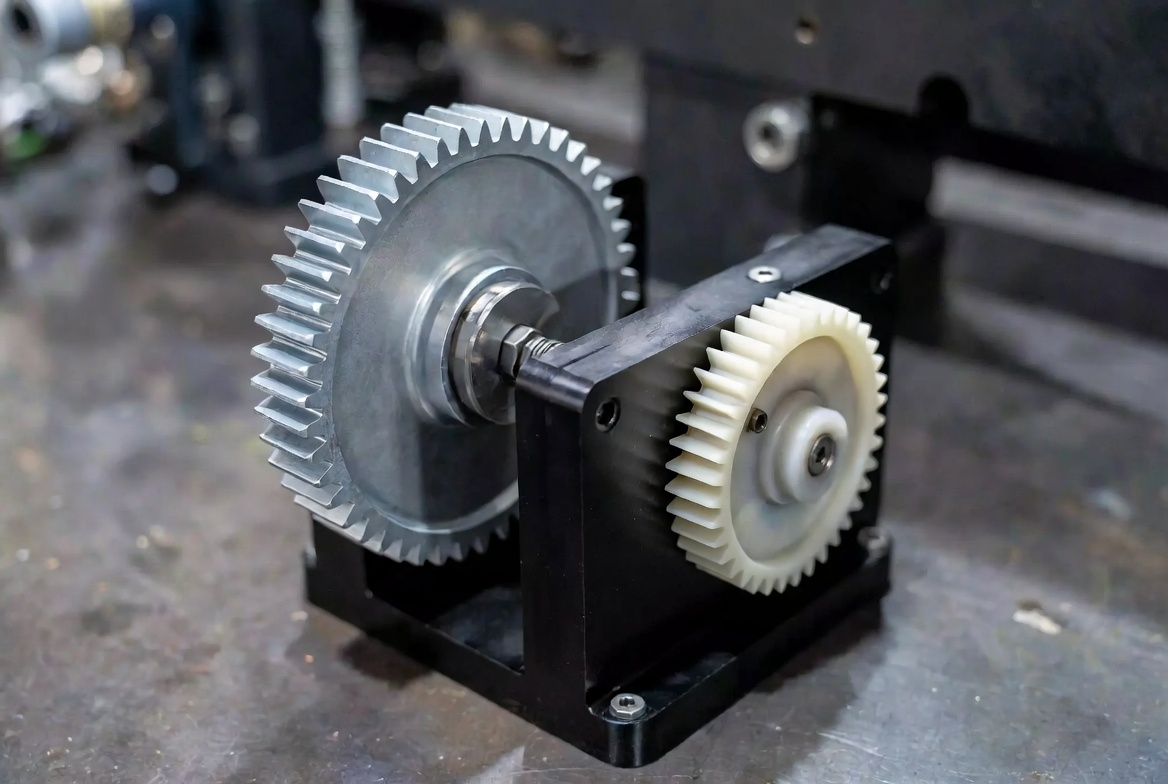
A typical servo has four to five gear stages. Each stage has a small gear meshing with a larger one. The small gear sits on the motor shaft. The large gear sits on the next stage’s shaft.
The ratio between the sizes determines how much the speed drops. A small gear with 12 teeth driving a large gear with 48 teeth creates a 4:1 reduction. The speed drops to one-quarter, but the torque increases four times.
With plastic gears, each stage experiences small losses due to friction and give. The plastic compresses slightly under load. The teeth mesh with tiny gaps. These small inefficiencies add up through all the stages.
Metal gears mesh more precisely. Less play means more efficient power transfer. Almost all the motor’s power makes it through to the output shaft.
Over time, plastic gears develop microgrooves and scratches. These increase friction. The servo becomes less efficient and generates more heat. Heat speeds up the plastic’s degradation. It’s a downward spiral.
Metal gears, by contrast, actually become slightly smoother as they wear in, then stabilize for hundreds of thousands of cycles.
Performance Metrics That Matter
When you’re comparing servos, a few numbers matter.
Torque is measured in kilogram-force centimeters (kgf·cm) or ounce-force inches (oz-in). This is the turning force. Higher torque means the servo can move heavier loads. Metal gear servos usually have 20% to 50% more torque than plastic for the same price tier.
Speed is how fast the servo moves, usually in degrees per second. A 60-degree rotation in 0.1 seconds is fast. Plastic and metal gears can be equally fast. The material doesn’t change speed much.
Accuracy is how precisely the servo reaches a position. Both plastic and metal can be built with similar accuracy when new. The difference shows over time. Metal gear servos maintain accuracy longer.
Lifespan is how many cycles the servo lasts. Plastic: 5,000 to 20,000 cycles typical. Metal: 100,000 to 1,000,000 cycles typical. That’s a huge difference.
Linearity means the servo responds the same way throughout its range. A linear servo moves smoothly everywhere. A non-linear one might move fast at the start of its range and slow at the end. Both types can be linear or non-linear depending on design.
Hybrid Gears: A Middle Ground
Some servo manufacturers have created hybrid solutions. These use metal gears in the critical stages and plastic in others. The idea is to get decent durability without full metal cost.
This approach works okay. You get better lifespan than full plastic but not as good as full metal. The price sits in the middle too. Hybrid servos are worth considering for mid-range projects.
The downside is that they’re less available. You’ll find fewer options. Fewer brands make them, so comparison shopping is harder.
How to Make Your Servos Last Longer
No matter which type you choose, good habits extend the lifespan.
Don’t overdrive them. Use servos rated for more torque than you actually need. Running a servo at 80% of its max continuous torque keeps it much cooler and lasts longer.
Lubricate properly. Most servos come with some lubricant, but it dries out. Use silicone-based lubricants designed for gears. Never use WD-40 or other light oils. They don’t stay on the gears. For plastic gears, be gentler with lubrication. Heavy grease can slow down plastic servos.
Keep them clean. Dust and dirt act like grinding paste. Regular cleanup extends life. Use compressed air to blow dust out of the servo case.
Protect from moisture. Even metal gears can rust if water gets inside. Seal your robot or RC car properly. If operating in wet conditions, apply a thin protective coat inside the servo.
Allow cool-down time. If a servo is getting hot to the touch, stop using it and let it cool. Heat is the enemy of both plastic and metal gears, though plastic suffers more.
Avoid sudden shocks. Don’t slam servos to their limits instantly. Smooth acceleration and deceleration reduce stress on gears. If possible, program acceleration curves into your control system.
Cost Analysis Over the Project Lifetime
Here’s what you need to think about for budgeting.
A plastic gear servo costs $8 to $20. A decent metal gear servo costs $25 to $60. Let’s say you’re building a hexapod robot with eighteen servos.
Plastic gears: 18 × $15 = $270 initial cost
Metal gears: 18 × $40 = $720 initial cost
Looks like plastic wins on budget. But let’s say your robot runs for five years with regular use.
If each plastic servo lasts 15,000 cycles and you use your robot twice a week, running each servo through 20 cycles per session, then each servo dies after about 750 sessions or 7.5 years. But in real-world heavy use, they might fail sooner. Let’s say you replace them twice over five years. That’s 36 servos × $15 = $540. Total: $270 + $540 = $810.
If metal gear servos last 200,000 cycles, you might never need to replace them in five years. Your total cost is just $720.
Suddenly the metal gears are cheaper over time. The analysis changes based on usage patterns, though.
Making Your Decision
Here’s the framework to use.
Ask yourself these questions:
- What’s the duty cycle? Light use? Heavy daily use? Continuous operation? Light use favors plastic. Heavy use favors metal.
- Can it fail? If a servo failing ruins your project or hurts someone, use metal. If it just means you swap in a replacement, plastic is okay.
- Do I have money for replacements? Money tight? Plastic now, upgrade later. Budget allows? Metal pays dividends over time.
- Does precision matter? Needs consistent accuracy? Metal. Decorative or approximate motion? Plastic works.
- Is weight critical? Every gram counts? Plastic saves weight. Weight not an issue? Metal is fine.
- What environment? Indoor, climate-controlled? Plastic is fine. Outdoor, salty, hot, cold, wet? Metal earns its price.
- What’s my skill level? Beginner? Start with plastic, learn the basics, upgrade later. Advanced? Maybe go metal from the start.
The Verdict
Neither choice is wrong. They’re solutions for different problems.
Plastic gear servos are perfect for learning, prototyping, light-duty work, and budget-constrained projects. Don’t feel bad choosing them. Most hobbyists start with plastic and never need anything else.
Metal gear servos shine when durability matters, when you’re using servos heavily, when your project is professional, or when failure isn’t an option. They cost more upfront but deliver peace of mind and lower long-term costs for demanding applications.
The smartest approach? Start with plastic gear servos if you’re new to servos. Learn how they work, understand your actual needs, and see how hard your projects push the equipment. Then upgrade to metal gear servos for the subsystems that demand it. Many professionals run a mix, using metal gears where it matters and plastic gears where it doesn’t.
Whatever you choose, take care of your servos. Clean them, lubricate them, don’t overstress them, and they’ll serve you well. Your project’s success depends more on your design and code than on the servo gear material anyway.
Now go build something cool. You’ve got this.