5 Best RC Receiver for Crawlers In 2026
If you run an RC crawler, you already know the receiver is the quiet hero of the whole setup. It sits in the body, out of sight, but it decides how smoothly your steering responds, whether your throttle feels crisp on a rock ledge, and whether your rig stops safely when the signal drops. Pick a weak one and the crawler feels twitchy or dull. Pick a good one and you can creep over obstacles with real control.
This guide looks at five popular options for crawler fans: the Radiolink R7FG, the MEUS RACING ME-8B, the INJORA T6M, the Radiolink RC4GS V3, and the Flysky FS-GT3B with FS-GR3E. Each one suits a different kind of builder, and the differences matter more than the marketing photos suggest. Let’s go through them one by one, then compare them side by side, and finish with a buying guide so you can match a receiver to your rig.
How These Reviews Were Put Together
These reviews are based on published specifications, product listings, manufacturer information, and the kinds of feedback crawler builders usually share in forums and comment sections. Where a listing seems to conflict with another source, we point that out. Specs can change between production batches, so always check the packaging and the included manual before you buy or wire anything up.
We also focus on real-world use cases. A receiver that looks great on paper can still frustrate you if it does not match your transmitter, your servo, or the size of your crawler. Keep that in mind as you read.
Quick Basics Before You Start
Before we get into the products, a few basics will help you read the reviews with confidence.
A receiver picks up the signal from your transmitter (the handheld radio you hold) and sends commands to your servo (for steering) and ESC (electronic speed controller, for throttle and braking). Most modern crawler radios use 2.4GHz signals, which hop between frequencies to avoid interference. That is why you rarely need to set frequency channels by hand the way older radios required.
The channel count tells you how many separate functions the system can control. Basic steering and throttle need two channels. A third channel often handles a light bar, a winch, or a two-speed transmission. A fourth or fifth channel might control a winch, lights, or a gear selector. More channels give you room to grow, but you do not need them if your build is simple.
Binding is the process of pairing a receiver to a transmitter so they recognize each other. Most systems bind with a button press and a light sequence. If you skip this step or bind to the wrong transmitter, nothing responds.
Failsafe settings tell the receiver what to do if the signal drops. Good failsafe settings bring the throttle to neutral or brake the crawler so it does not run off on its own. Check this setting before every first run.
A gyro is a sensor that helps the receiver counter-steer when the crawler slides or rotates. Many crawler builders like gyros because they make the rig feel more planted, especially on slippery surfaces. Some builders prefer a non-gyro setup for a more direct, mechanical feel, so a gyro is a matter of taste as much as function.
Finally, water resistance matters more than many people expect. Crawlers often drive through puddles, mud, and wet grass. A receiver with splash protection gives you more peace of mind, though it is not the same as being fully waterproof.
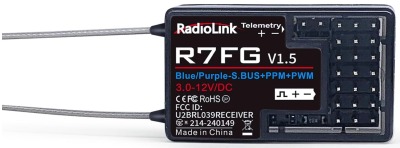
1.Radiolink R7FG 7-Channel Water-Splash Proof RC Gyro Receiver
Product Description
The Radiolink R7FG is a 7-channel receiver with a built-in gyro and splash-proof housing. It is a receiver only, so you need a compatible transmitter to use it. Radiolink builds several transmitters that work well with this type of receiver, and that pairing is where most builders find the best experience.
Best Use Cases
This receiver suits builders who run a gyro-equipped crawler and want extra channels for lights, winches, or a transmission switch. It also fits people who drive in damp or muddy conditions and want a bit more protection than a basic receiver offers.
Key Features Explained Simply
The seven channels give you plenty of room to add accessories without buying a second receiver later. The built-in gyro helps the rig hold its line, which is useful on off-camber trails where the back end likes to wander. The splash-proof housing handles a light spray and wet grass without worry. It is not built for full submersion, so keep it out of deep water.
Real-Life Usage Insight
Most people who use this receiver with a gyro notice that the steering feels more stable at low speeds. That helps when you are trying to hold a slow, precise line over rocks. The extra channels are where many builders get the most value, since adding a winch or lights no longer means rewiring the whole system. Expect a short learning curve around gyro settings. The first few runs often need tuning until the steering feels natural.
Pros
- Seven channels leave room for accessories
- Built-in gyro improves stability on tricky terrain
- Splash-proof housing handles wet conditions
- Pairs well with Radiolink transmitters
Cons
- Receiver only, so you need a compatible transmitter
- Gyro tuning takes some patience for beginners
- Not suitable for full water immersion
Performance Discussion
On a well-built crawler, the R7FG delivers smooth, consistent response. Signal stability is strong when the transmitter and receiver are properly bound and the antennas are placed away from metal parts. The gyro adds a sense of control that many drivers appreciate, especially on uneven ground. Performance depends heavily on how well you set up the gyro and servo, so expect to spend time getting it dialed in.
Ease of Use
The setup is not hard for someone who has bound a receiver before. Beginners may find the gyro menu a bit intimidating at first. Read the manual carefully and make small adjustments rather than big jumps. Once it is set, the system is easy to live with.
Value for Money
For builders who want a gyro and extra channels, the R7FG offers solid value. You get features that often cost more in other lines. If you only need basic steering and throttle, you may find a simpler receiver is enough, so the value depends on what you plan to add later.
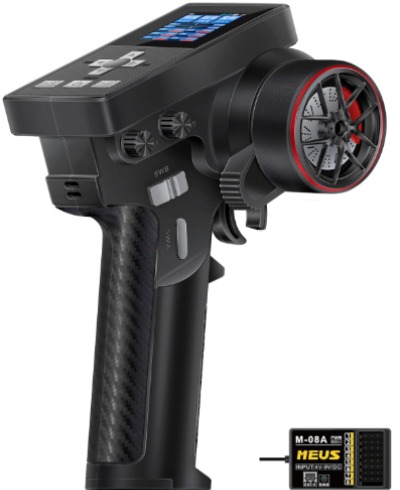
2. MEUS RACING ME-8B RC Transmitter 8 Channels 2.4GHz and Receiver
Product Description
The MEUS RACING ME-8B is a complete kit with an 8-channel transmitter and a matching receiver. The listing says it works with a range of crawler scales, including 1/8, 1/10, 1/18, and 1/24, and it names popular platforms like the TRX4, TRX4M, SCX10, and SCX24. Check the box for the exact receiver channel count, since listings sometimes differ from what ships.
Best Use Cases
This kit suits builders who want a full transmitter and receiver package in one purchase. It works well for people with multiple crawlers who want room to add accessories later. It also suits anyone who wants more channels than a basic radio offers.
Key Features Explained Simply
The eight-channel transmitter gives you plenty of control options. You can map functions like lights, winches, or transmission modes to different switches. The package includes a receiver, so you do not need to hunt down a separate one. The 2.4GHz system helps reduce interference from other radios in the area.
Real-Life Usage Insight
Many crawler owners like having extra channels on a transmitter, because it makes the radio feel like a complete control center. You can add a light bar, a winch, or a second gear selection without buying new gear. Expect a bit of time spent on channel mapping and endpoint adjustment. Once you set those, the radio becomes easy to use every session.
Pros
- Complete transmitter and receiver package
- Eight channels for accessories and future upgrades
- Works with a range of crawler scales
- 2.4GHz system reduces interference
Cons
- Menu setup takes time for new users
- Compatibility claims should be double-checked against your specific model
- Build quality may feel less premium than higher-end radios
Performance Discussion
Signal performance is solid for typical crawler use. Range is more than enough for the kind of driving most crawler fans do in backyards, parks, and trails. Steering and throttle response are dependable when the system is bound correctly. Some users find the stick feel a little firmer or looser than they expect, so take a few minutes to adjust your settings before a long session.
Ease of Use
The radio has more buttons and menus than a basic transmitter, which is great once you learn it but can feel crowded at first. Setting up channel mapping and failsafe takes some reading. After that, daily use is simple. The layout is familiar to anyone who has used a mid-range radio.
Value for Money
The ME-8B offers a lot of channels for the price, especially for builders who want room to grow. The main trade-off is that the feel and finish do not match the most expensive radios on the market. For most crawler fans, the value is strong.
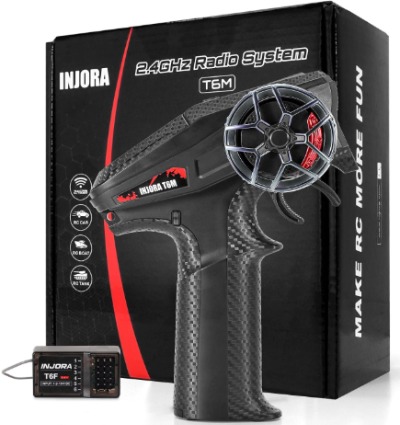
3. INJORA T6M 2.4GHz Transmitter with 6CH Receiver
Product Description
The INJORA T6M is a 6-channel 2.4GHz transmitter paired with a receiver. It is marketed for 1/24 and 1/18 crawlers, which are popular with beginners and builders who like smaller rigs. It is a compact, budget-friendly option.
Best Use Cases
This system fits small crawlers and first-time builders who want a reliable, affordable radio. It is also a good pick for a second rig or a backup transmitter. If you run a mini crawler and want room for lights or a winch, this kit gives you enough channels without a big price jump.
Key Features Explained Simply
Six channels cover the basics plus a few extras. The compact transmitter is comfortable for small hands and fits well with light, portable crawlers. The 2.4GHz link keeps the signal steady and reduces the chance of interference from other nearby radios.
Real-Life Usage Insight
Small crawlers are fun, but they are also sensitive to bad radio gear. Builders often find that the T6M gives predictable steering and throttle, which matters more on small chassis. The compact size makes it easy to carry to a local trail or a backyard course. Expect the throttle and steering trim to need a little tuning at first.
Pros
- Affordable and easy to get started with
- Compact design suits small crawlers
- Six channels give room for a few extras
- Simple to bind and use
Cons
- Build quality is simpler than premium radios
- Less suited to large or heavy crawlers
- Fewer advanced features than higher-end systems
Performance Discussion
The T6M performs well for light, small-scale crawling. Signal stability is good at typical distances, and the steering response is smooth enough for slow, technical trails. Heavier builds may push the limits of the setup, especially if the servo is powerful and the chassis is large. Matching the radio to the rig is the key to good performance here.
Ease of Use
This is one of the easier systems on the list. The menu is simple, binding is quick, and the controls are straightforward. Beginners will likely feel comfortable after a short session. More advanced users may wish for deeper setup options.
Value for Money
The T6M is one of the better budget choices for small crawlers. You get a complete, working system without spending much. If you plan to move up to a large, heavy crawler later, you may want to upgrade. For a small rig, the value is excellent.
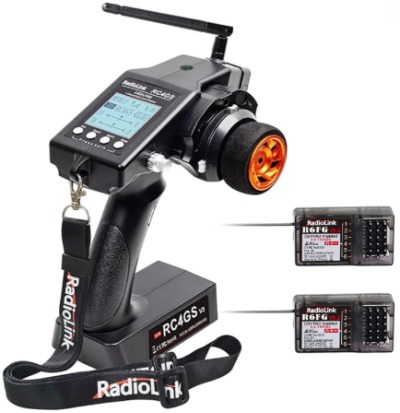
4. Radiolink RC4GS V3 5 Channel RC Radio Transmitter with 2Pcs R6FG Receiver
Product Description
The Radiolink RC4GS V3 is a transmitter kit that includes two R6FG receivers. The listing describes a 5-channel transmitter, though the RC4GS line is commonly associated with four channels in other sources, so check the manual for your exact unit. The R6FG receiver is a 6-channel unit with gyro support, based on the product line’s typical description.
Best Use Cases
This kit works well for builders who run two crawlers and want a receiver for each. It also suits people who want gyro support and multiple channels without buying separate parts. The two-receiver setup makes it handy for swapping between rigs or keeping a spare on hand.
Key Features Explained Simply
Two receivers mean you can use the same transmitter with two different crawlers or keep a backup ready. The R6FG receivers add gyro support and multiple channels. The transmitter is built to be comfortable for longer sessions.
Real-Life Usage Insight
Having a spare receiver is useful. Crawlers take a beating, and it is nice to know you can swap quickly if one goes down. The gyro feature can make a big difference on uneven terrain. Expect to spend some time on gyro tuning, just like with the R7FG.
Pros
- Two receivers included for multiple rigs or a spare
- Gyro support for stability on tricky ground
- Multiple channels for accessories
- Good value for builders with more than one crawler
Cons
- Channel count listing may vary, so verify the manual
- Gyro tuning requires patience
- Some builders may want more premium build quality
Performance Discussion
The system delivers responsive steering and throttle when bound and tuned correctly. Gyro-assisted driving feels smoother on off-camber sections. Signal stability is consistent for typical crawler distances. The biggest performance gains come from careful setup, especially around gyro gain and endpoint adjustment.
Ease of Use
The transmitter is manageable, but the gyro menu takes some reading to master. Binding two receivers is simple once you know the sequence. The learning curve is moderate, so take your time during your first sessions.
Value for Money
Two receivers with a transmitter and gyro support is a strong package. For builders with multiple rigs, the value is especially good. If you only run one crawler and do not need the spare, the savings are smaller, but the gyro option still makes it a solid choice.
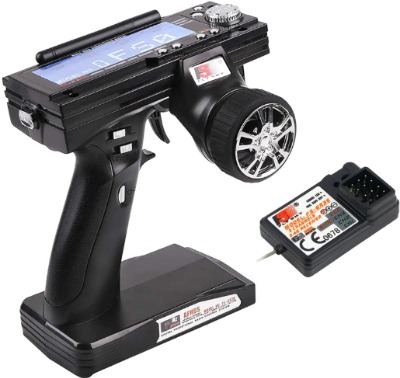
5. Flysky FS-GT3B Rc Transmitter & FS-GR3E Receiver
Product Description
The Flysky FS-GT3B is a 3-channel 2.4GHz transmitter, and the FS-GR3E is its matching receiver. This pair is designed for compact RC cars and simple crawlers. It keeps the controls focused on the basics: steering, throttle, and one extra function.
Best Use Cases
This system suits beginners, kids, and simple crawler builds that do not need many extras. It is also a good fit for a light rig that only needs steering, throttle, and a basic auxiliary function. If you want a straightforward, no-fuss radio, this pair makes sense.
Key Features Explained Simply
Three channels cover the essentials. The steering and throttle controls are easy to reach and easy to learn. The 2.4GHz link keeps the signal steady and avoids most interference problems. The system is light and compact, which suits small builds.
Real-Life Usage Insight
Simple radios are often underrated. With fewer buttons and menus, you spend less time fiddling and more time driving. This pair is well suited to someone who wants to get out on the trail quickly. The trade-off is that you will not have room for many accessories or advanced gyro features.
Pros
- Simple, beginner-friendly controls
- Compact and lightweight
- Reliable 2.4GHz link
- Good choice for basic steering and throttle
Cons
- Only three channels, limiting future upgrades
- No built-in gyro support
- Less suited to large, feature-heavy crawlers
Performance Discussion
Performance is solid for basic crawling. Steering and throttle respond well on light builds, and the signal is stable at typical distances. The limits show up when you want advanced features or a heavier rig. For a simple setup, the performance is more than adequate.
Ease of Use
This is among the easiest systems on the list. Binding is quick, the controls are simple, and there is little to configure. It is a good first radio for anyone new to the hobby.
Value for Money
For basic use, this pair offers good value. It costs less than the multi-channel options and does the basics well. If you expect to add lights, a winch, or a gyro later, you will likely outgrow it and need to upgrade, so factor that into your decision.
Comparison Insights
Looking at the five side by side makes the differences clearer. The Radiolink R7FG and Radiolink RC4GS V3 both focus on gyro-assisted driving, which suits builders who want stability on uneven ground. The R7FG adds splash protection and seven channels, while the RC4GS V3 offers two receivers in one kit, which helps if you run more than one rig.
The MEUS RACING ME-8B stands out for channel count and its complete transmitter and receiver package. It suits builders who want room to grow without buying new gear. The INJORA T6M and Flysky FS-GT3B are the budget-friendly picks. The T6M handles small crawlers with six channels, while the FS-GT3B keeps things basic with three channels and very simple controls.
Here is a quick look at the main differences:
| Product | Channels | Gyro Support | Included Parts | Best For |
|---|---|---|---|---|
| Radiolink R7FG | 7 | Yes (built-in) | Receiver only | Gyro builds with room for accessories |
| MEUS RACING ME-8B | 8 (verify) | Check model | Transmitter and receiver | All-in-one kit with room to grow |
| INJORA T6M | 6 | Not highlighted | Transmitter and receiver | Small crawlers on a budget |
| Radiolink RC4GS V3 | 5 (verify) | Yes (R6FG) | Transmitter and two receivers | Multiple rigs or a spare receiver |
| Flysky FS-GT3B | 3 | No | Transmitter and receiver | Beginners and simple builds |
The biggest takeaway is that channel count and gyro support drive most of the decision. If you want to add accessories later, lean toward more channels. If you want stability on steep or slippery trails, a gyro-capable receiver is worth the extra setup time.
Buying Guide: How to Match a Receiver to Your Crawler
Start with your crawler’s scale and weight. Small 1/24 and 1/18 crawlers do well with simpler radios, while larger 1/10 and 1/8 rigs often benefit from more channels and stronger, more responsive gear. A heavy chassis with a powerful servo needs a receiver that can handle the load without hiccups.
Next, think about your plans. If you only drive for fun on a single rig, three or four channels may be enough. If you want lights, a winch, or a two-speed transmission, aim for at least five or six channels. Buying a receiver with extra channels now saves you from upgrading later.
Gyro support is the next question. A gyro helps with stability, especially on off-camber terrain and slippery surfaces. It also adds tuning work, so think about how much time you want to spend in setup. Some builders prefer a direct, non-gyro feel, and that is a perfectly valid choice.
Consider your transmitter as well. Some receivers work best with their own brand’s transmitter, and mixing brands can cause compatibility issues. Read the compatibility notes carefully and check the manual before you buy.
Water resistance deserves a look if you drive in wet areas. Splash-proof is good for puddles and damp grass. It is not the same as full waterproofing, so avoid submerging the receiver.
Finally, check the battery and power requirements. Make sure your receiver’s voltage range matches your ESC and battery. Mismatched power is one of the most common causes of problems in crawler builds.
Who Should Buy These Products
The Radiolink R7FG suits intermediate builders who want gyro stability and room for accessories, especially those who drive in damp conditions. It is a strong pick for anyone who plans to build out a feature-rich crawler over time.
The MEUS RACING ME-8B fits builders who want a complete kit with plenty of channels. It works well for people who own more than one crawler or plan to add lights, winches, and other extras.
The INJORA T6M is a smart choice for small-scale crawler fans and beginners on a budget. It works best for compact rigs where you want a reliable, affordable radio without advanced features.
The Radiolink RC4GS V3 suits builders with two rigs or anyone who wants a spare receiver on hand. It also works well for those who want gyro support and multiple channels in a single package.
The Flysky FS-GT3B is ideal for beginners, younger drivers, and simple crawler builds that only need steering and throttle. It is a great first radio for someone who wants to get out on the trail quickly without fuss.
Common Mistakes to Avoid
One of the most common mistakes is buying a receiver without checking transmitter compatibility. Some combinations work fine, while others need extra setup or do not work at all. Always confirm before you buy.
Another frequent error is skipping the failsafe setup. If the signal drops and the throttle stays open, your crawler can run off on its own. Set failsafe to neutral or brake every time you change your radio setup, and test it before driving.
Many builders also forget to check endpoint and trim settings. If the steering does not center or the throttle has a dead zone, you lose control and precision. Take a few minutes to adjust these before your first run.
Overloading a small crawler with a powerful servo or heavy accessories is another trap. Extra weight and force can cause stress on the chassis and the receiver. Match the gear to the rig’s size and purpose.
Installing the receiver in a spot surrounded by metal or wrapped in tight wiring can weaken the signal. Keep the antenna clear of metal parts and route wires neatly. A little planning here prevents signal dropouts later.
Finally, do not rush gyro tuning. Many people set a high gain and wonder why the steering feels twitchy. Start with a low setting, drive a few runs, and adjust in small steps.
Final Verdict
There is no single best receiver for every crawler. The right choice depends on your rig’s size, your budget, and how you plan to drive. Still, some clear winners emerge.
For gyro-equipped builds with room for accessories, the Radiolink R7FG is a strong pick. Its seven channels, built-in gyro, and splash-proof housing make it a solid long-term choice for builders who want stability and expandability.
For an all-in-one kit with plenty of channels, the MEUS RACING ME-8B delivers good value. It suits builders who want a complete system and room to grow, though you should verify the exact specs on the box.
For small crawlers on a budget, the INJORA T6M is hard to beat. It is simple, affordable, and works well for compact rigs.
For builders with more than one crawler, the Radiolink RC4GS V3 offers useful flexibility with two receivers and gyro support. Just double-check the channel count in the manual.
For beginners and simple builds, the Flysky FS-GT3B keeps things easy. It handles the basics well and gets you driving quickly.
Match the receiver to your crawler, double-check compatibility, set your failsafe, and take your time with tuning. A good receiver setup makes every trail run more enjoyable, and the right choice from this list will serve you well for many sessions to come.
Frequently Asked Questions
Do I need a gyro for my crawler?
A gyro is not required, but it can improve stability on uneven or slippery terrain. If you like a direct, mechanical feel, you may prefer a non-gyro setup.
How many channels do I need?
Two channels handle basic steering and throttle. Add more channels if you plan to use lights, a winch, or a two-speed transmission.
Can I use any transmitter with any receiver?
Not always. Check the compatibility notes for each product. Some receivers work best with their own brand’s transmitter.
Is a splash-proof receiver fully waterproof?
No. Splash-proof means it handles light moisture, puddles, and wet grass. Do not submerge it.
What is failsafe and why does it matter?
Failsafe tells the receiver what to do when the signal drops, such as cutting throttle or braking. It helps prevent your crawler from running off on its own.