Why RC Boats Flip in Water?
You just got your brand new remote control boat. You take it to the lake, river, or pool. You hit the throttle, and within seconds, it flips over and sinks. Sound familiar?
This happens to beginners all the time. The good news? It’s totally fixable once you know what causes it.
RC boat flipping isn’t random. There’s a real reason behind it. Your boat isn’t broken. You’re just missing some key information about how these tiny speedboats actually work in water.
Let me walk you through everything. By the end of this guide, you’ll understand exactly why your remote control boat keeps flipping and what you can do about it.
The Main Culprit: Poor Weight Distribution
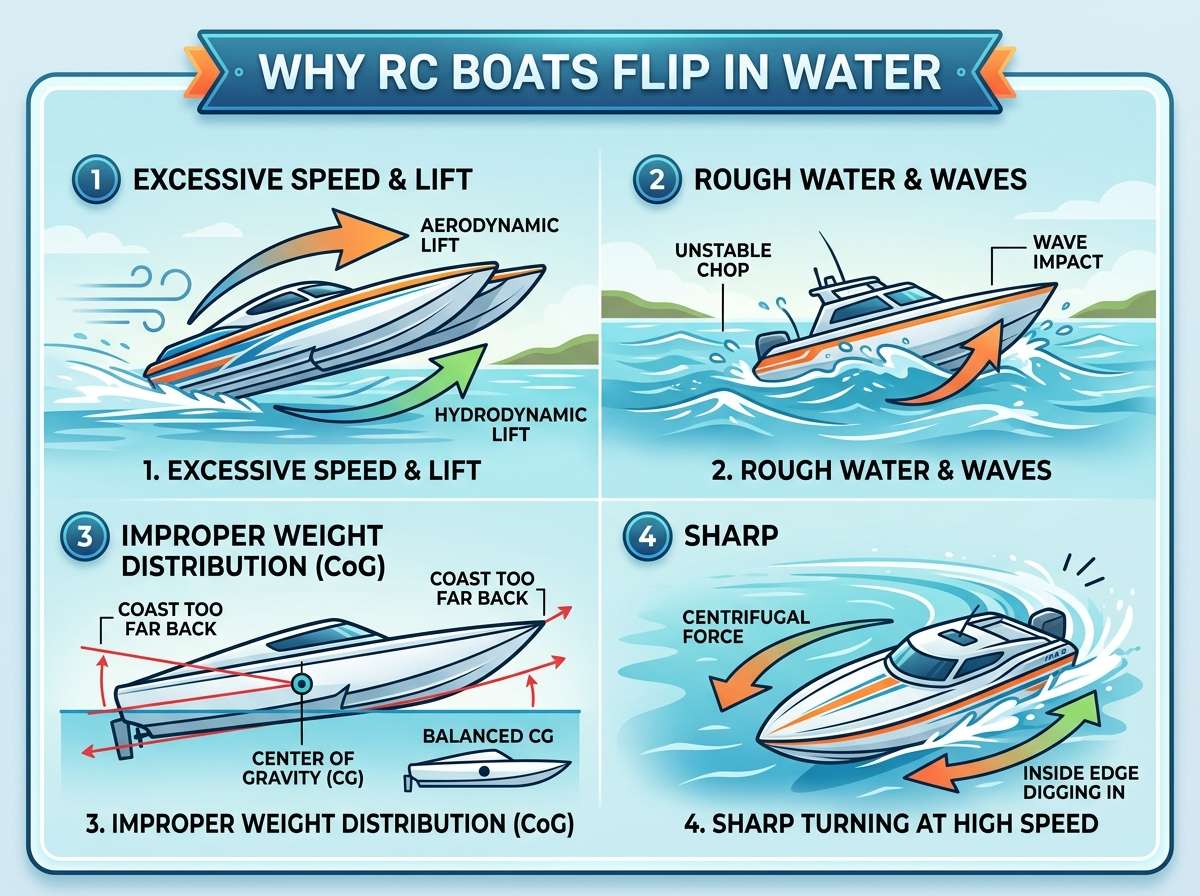
The number one reason RC boats flip is bad weight distribution. This is the foundation of almost every flipping problem you’ll face.
Think about a real boat. The captain doesn’t put all the cargo on one side. They balance it out. The same rule applies to your RC boat, except much more strict.
When your RC boat’s weight sits too far forward or too far back, the boat becomes unbalanced. An unbalanced boat doesn’t sit right in the water. It tilts to one side. Once it tilts, it catches water. And once water gets into the hull, flipping happens fast.
Most RC boats come with a battery and a motor. The battery is heavy. The motor is heavy. If these two parts aren’t positioned correctly, your boat will instantly become unstable. You need them near the center of the boat, not pushed to the front or back.
Many people don’t realize this. They just shove the battery wherever it fits. That’s a big mistake.
The center of gravity matters more than anything else in RC boating. Get this right, and your boat stops flipping. Get this wrong, and you’ll keep facing the same problem over and over.
Hydroplaning and Speed Issues
Your RC boat flips because of something called hydroplaning. This sounds technical, but it’s actually simple.
When your RC speedboat goes too fast, the front of the hull lifts up out of the water. The boat literally tries to climb onto the water’s surface. This is hydroplaning.
Hydroplaning feels cool at first. Your boat’s nose goes up. But then something bad happens. The back of the boat dips down. This creates an unstable angle. The boat wobbles. One small bump or wave hits it, and over it goes.
The faster you go, the worse this gets. Speed alone can cause your RC boat to flip, no matter how perfectly balanced it is.
Most beginners push the throttle all the way. They want to see how fast their boat can go. That’s the worst thing you can do when learning. Your remote control boat needs to go slower when you’re starting out.
Controlling your speed is one of the easiest fixes. Don’t go full throttle. Keep the boat at a moderate speed. Let your vessel sit flat on the water instead of trying to climb up.
The Hull Design and Its Role in Flipping
Not all RC boat hulls are the same. The shape of the hull matters a lot.
Some hulls are designed for racing. They’re thin and pointy. They go super fast, but they’re less stable. These hulls flip easier because they don’t have much surface area touching the water.
Other hulls are wide and flat. They’re slower, but they’re much harder to flip. The bigger surface area keeps the boat stable.
If you own a racing-style RC boat, you should expect it to flip more often. That’s just how these boats are. You trade stability for speed.
Beginners should start with a boat that has a wider, flatter hull. It’s more forgiving. You can practice without constantly fishing your boat out of the water.
The bottom of the hull matters too. Some hulls have a V-shape. Others are flat. A V-shaped hull cuts through water more easily, but a flat hull provides more stability. This is another reason why RC boat design affects how easy it is to flip.
If your hull has damage, that changes everything. A cracked or dented hull doesn’t sit right in the water. Water leaks in. The boat becomes heavier and tilts to one side. Boom. Flipping happens.
Check your hull before every session. Look for cracks, dents, or warping. Fix any damage right away.
Water Conditions and Environmental Factors
The water you’re using matters more than most people think.
Calm water is best for learning. Flat, smooth water lets you focus on controlling your boat without fighting waves and currents.
Waves are the enemy of RC boat stability. Every time a wave hits your boat, it pushes the hull up on one side. This shifts the balance. If your boat is already barely stable, even a small wave can tip it over.
Wind also causes problems. Strong wind can push a light RC boat sideways. A sideways boat is an unstable boat. The wind does the flipping work for you.
Rivers and moving water are even trickier. Current pulls your boat in a direction you can’t always control. The current might push your boat sideways or into a wave. Either way, flipping becomes more likely.
Water temperature doesn’t directly cause flipping, but it does affect the boat’s electronics. Cold water can drain battery power faster. A weak battery means less control. Less control means more flipping.
Salt water is especially harsh. It corrodes metal parts and damages electronics. Your boat might work fine at first, but it gets slower and less responsive over time. That reduced response time causes control problems, which leads to flipping.
When you’re starting out, find the calmest water you can. A small pond or pool is perfect. Avoid windy days. Avoid rivers. Avoid salt water. Once you get good at controlling your boat, then you can try harder water conditions.
Battery Placement and Weight Balance
Let’s get specific about the battery because it’s so important.
The battery is the heaviest thing in your RC boat. Where you put it decides whether your boat flips or not.
The ideal position is right in the middle of the boat. Not forward. Not back. Right in the center. This keeps the weight balanced.
If your battery sits too far forward, the front of the boat gets heavier. The front dips into the water. This creates drag and instability. The boat wants to flip backward.
If the battery sits too far back, the back gets heavy. The front lifts up too much. This is when hydroplaning happens. The boat becomes unstable and flips forward.
Some people use weights or ballast to adjust the balance. You can add small lead weights or fishing weights to fine-tune the weight distribution. Put them where they’re needed to balance out your boat.
The battery also affects how much the boat weighs overall. A heavier boat is more stable in rough water. A lighter boat flips easier. This is another reason why proper battery placement helps. It adds weight in the right spot, making your boat more stable.
Don’t just assume the battery goes where the manual says. Test it. Move the battery forward and backward. Find the sweet spot where the boat sits flat and stable in the water.
Motor Power and Thrust Issues
The motor is another heavy component that affects balance.
Most RC boats have a motor mounted on the back. This puts a lot of weight at the rear of the boat. If your battery is also at the back, you’ve got too much weight in one place.
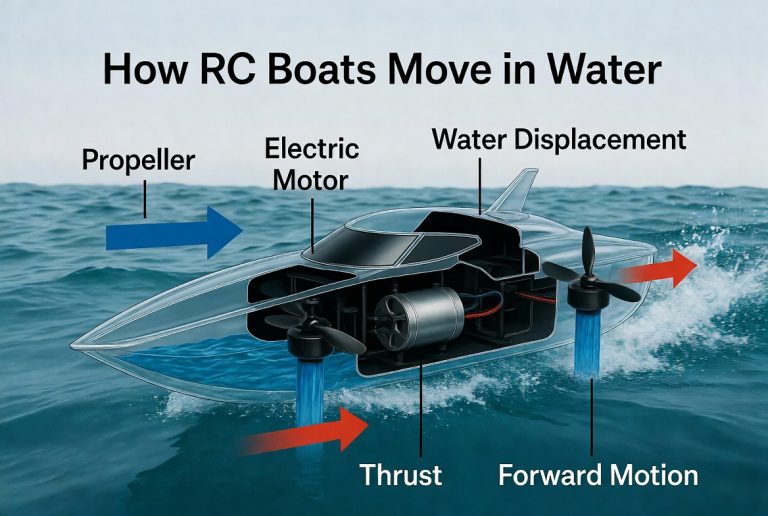
The thrust from the motor also matters. Thrust is the power pushing your boat forward.
If your motor is too powerful for your boat’s design, it can cause problems. A powerful motor makes your boat go fast. Fast equals hydroplaning equals flipping.
Some RC boats come with weak motors on purpose. These boats are meant to be stable. They won’t go super fast, but they’re beginner-friendly.
If you want to upgrade your motor, be careful. A bigger motor might flip your boat more often. You’re trading stability for speed.
The motor’s thrust should match your hull design. A fast, thin hull can handle a powerful motor. A wide, stable hull doesn’t need one.
Also, check that your motor is working correctly. A motor that’s broken or not firing properly will make your boat stall or slow down randomly. Sudden loss of power is a recipe for flipping.
The Rudder and Steering System
The rudder is the fin at the back of the boat that controls steering. It’s more important than most people realize.
A bent or broken rudder causes all kinds of control problems. If the rudder isn’t straight, your boat won’t steer right. It’ll pull to one side constantly. A boat that’s constantly trying to turn is a boat that’s constantly on the edge of flipping.
The rudder also affects how the boat sits in the water. If it’s not positioned correctly, it changes the water flow under the boat. This changes balance.
Make sure your rudder is perfectly straight. Look at it from behind. It should line up with the centerline of the boat.
Also, check your steering linkage. This is the little rod or cable that connects the rudder to your remote control. If it’s loose or bent, your steering will be sluggish or unpredictable. You won’t be able to control your boat properly. That leads to flipping.
Test your steering by moving it side to side on land. The rudder should respond immediately. It should move left and right the same amount. If it doesn’t, fix it before you hit the water.
Water Intake and Waterlogging
Every RC boat has a small hole or vent somewhere. This is to let water drain out and air flow in.
If these vents get blocked, water stays inside the boat. The boat gets heavier. Heavier boats sit lower in the water. Lower in the water means less stability.
Check all your vents before you use your boat. Keep them clear.
The hull’s design includes a small drain hole at the lowest point. When your boat tips or flips, water rushes in. When you flip it back over, that water should drain out quickly.
If the drain is blocked, water stays inside. Your boat becomes waterlogged. A waterlogged boat is much harder to control. It sits low in the water. It’s sluggish. It flips easier because it’s top-heavy with water inside.
After every session, let your boat drain completely. Flip it upside down if you need to. Get all the water out.
If you flip your boat constantly and water keeps getting inside, you might have a hull leak. A crack in the hull lets water in. No amount of draining will help. You need to patch the crack or replace the hull.
Radio Control Interference and Lag
Here’s something most beginners don’t think about: interference.
If there’s radio interference, your remote control might not respond as fast as it should. You tell the boat to turn left, but there’s a delay. By the time the boat responds, it’s already drifted right. Now you’re overcorrecting.
This lag and overcorrecting makes your boat unstable. It weaves back and forth. A boat that weaves is a boat that will flip.
Radio interference comes from cell towers, WiFi routers, power lines, and other wireless devices. Some locations are worse than others.
If you’re having trouble controlling your boat and you’ve ruled out everything else, interference might be the problem.
You can test this by going to a different location. If your boat behaves better elsewhere, interference is the culprit.
You can also upgrade to a more advanced remote control system. Older systems are more susceptible to interference. Newer systems use spread-spectrum technology. This makes them much more resistant to interference.
Propeller Problems
The propeller pushes your boat through the water. If something’s wrong with it, your boat won’t handle right.
A bent or damaged propeller creates unbalanced thrust. One side of the propeller is damaged, so it pushes harder than the other side. This pulls your boat to one direction. It’s like trying to steer with one hand. Your boat wants to turn even when you’re going straight.
This constant pulling causes the boat to lean. A leaning boat is on the verge of flipping.
Check your propeller after every use. Look for bent blades or cracks. If you hit a rock or something underwater, your propeller will get damaged.
Make sure the propeller is the right size for your motor and boat. A propeller that’s too big won’t spin fast enough. One that’s too small will let your boat go too fast and hydroplane.
The propeller should also be balanced. This is harder to check at home, but if you ever have it serviced, ask them to balance it.
A spinning propeller that’s not balanced is like a tire that’s not balanced in a car. It vibrates. That vibration makes everything unstable.
The Importance of Trimming and Adjustments
Trimming is the fine-tuning of your boat’s angle in the water.
Most RC boats have a trim adjustment on the remote control. This adjusts the angle of the motor or rudder slightly.
If your boat keeps doing one thing wrong, trim might fix it. For example, if your boat constantly dives nose-first into the water, you can trim up. This raises the front slightly.
Learning to use trim is a beginner skill that most people skip. Don’t skip it. Proper trimming makes a huge difference.
Start with trim in the middle. Then test your boat. If it dives, trim up a little bit. If it keeps diving after that, trim up a little more. Keep adjusting until the boat sits right.
The same goes for rudder trim. If your boat pulls to the left, trim the rudder slightly right. Keep making small adjustments until it goes straight.
Trim adjustments are small. We’re talking tiny movements. But they add up. A tiny lift on the front makes the difference between flipping and staying upright.
Common Mistakes Beginners Make
Let me spell out the most common mistakes that cause flipping.
Going full throttle immediately. Don’t do this. Start slow. Your boat needs time to plane on the water. Going full throttle immediately causes hydroplaning and flipping.
Using the boat in rough water. Beginners should stick to calm water. Waves and current create chaos. Your boat will flip constantly.
Not checking the boat before use. A quick inspection takes two minutes. It can save you from a flipping disaster. Check the hull, propeller, rudder, and vents.
Ignoring battery placement. This is the number one reason for flipping. Get your battery in the center of the boat.
Overloading the boat. Don’t put extra weight or cargo in your boat. It’s designed for specific weight. Extra stuff makes it flip.
Not trimming the boat. Trim is your friend. Learn how to use it.
Using old or damaged electronics. Old batteries lose power. Old motors lose control. Damaged electronics mean poor steering. All of these cause flipping.
Simple Fixes You Can Try Right Now
If your boat is flipping, try these fixes in this order.
Step 1: Check the battery. Make sure it’s centered in the boat and secure. Move it forward and back to find the perfect spot.
Step 2: Inspect the hull. Look for cracks or damage. Fix anything you find.
Step 3: Examine the propeller. Make sure it’s not bent or broken.
Step 4: Straighten the rudder. It should be perfectly vertical and aligned with the boat’s centerline.
Step 5: Test in calm water. Go to the calmest water you can find. No waves, no wind, no current.
Step 6: Start slow. Don’t go full throttle. Build speed gradually.
Step 7: Use trim. Adjust the trim until the boat sits flat.
Step 8: Practice control. Learn smooth movements. Avoid sharp turns at high speed.
If you do all these things and your boat still flips, the problem might be with your specific boat design. Some boats are just less stable than others. If that’s the case, consider getting a different RC boat that’s designed for beginners.
Different Types of RC Boats and Flipping
Racing boats flip more often. They’re designed for speed, not stability. If you own one, accept that flipping is part of the deal.
Scale model boats that look like real boats tend to be more stable. They’re wider and have realistic proportions.
Jet boats have special issues. The water intake for the jet can cause balance problems if it’s not right. These boats need careful setup.
Sailboats are in a completely different category. Wind and sail angle matter more than anything else. They flip for completely different reasons.
Know what type of boat you have. Do some research. Find out what problems that type commonly has.
Maintenance and Long-Term Stability
Your boat needs regular maintenance to stay stable and not flip.
After every use, dry out your boat completely. Water inside the hull makes it heavier and less stable.
Check all moving parts regularly. Bearings wear out. Motors lose power. Batteries get weaker. All of these cause control problems that lead to flipping.
Store your battery separately from the boat. Batteries left in a boat for weeks can leak or swell. They cause damage and create balance problems.
Replace the propeller if it shows any wear. A slightly worn propeller still works, but it’s not as efficient. Inefficiency means unpredictable performance.
Keep the radio control system clean and dry. Moisture inside the remote damages the electronics. Damaged electronics mean delayed response. Delayed response causes flipping.
Learning from Other Boaters
Join an RC boat club or online community. Talk to experienced boaters about flipping problems.
Most people are happy to help. They’ve dealt with the same problems. They know solutions that actually work.
Watch videos of other people using their boats. Pay attention to how they start, how they control speed, and how they handle turns.
Every boater has different boats and different water conditions. Their techniques might give you ideas for your own setup.
The Bottom Line
RC boats flip because of poor balance, too much speed, water conditions, or control problems. In most cases, it’s a combination of these factors.
The good news is that almost every flipping problem is fixable. Most of the time, the fix is simple. You need to adjust weight, slow down, or fix a bent part.
Start with the basics. Get your weight distribution right. Use calm water. Go slow. Learn to control your boat properly.
Once you master these fundamentals, you’ll stop flipping so much. Your RC boat will become fun instead of frustrating.
Remember, every expert boater started out flipping their boat constantly. It’s not a sign that you’re doing something wrong. It’s just part of learning.
Be patient with yourself. Take your time. Make small adjustments. Test each fix. Eventually, you’ll find the right setup for your boat.
Your RC boat wants to stay upright. Help it do that by understanding why it flips. Once you get that, everything else falls into place.
Get out on the water with the right knowledge. Your boat will reward you with stable, smooth performance. No more constant flipping. Just fun on the water.
Happy boating!
Peterson is an RC hobby enthusiast and product reviewer with a passion for remote-controlled cars, trucks, boats, drones, and accessories. He enjoys testing the latest RC products, comparing features, and sharing practical buying guides to help beginners and experienced hobbyists make informed decisions. Through RCThing.com, Peterson provides honest reviews, maintenance tips, and expert advice to help readers get the most from their RC adventures.